Key Takeaways
- GeoGen is 10x cheaper at entry level: €20/mo vs $199/mo makes GeoGen the obvious pick for small brands and startups testing AI visibility for the first time
- Brandlight targets enterprise buyers: Built for Fortune 500 teams with multi-brand tracking, custom deployments, and a $30M Series A backing -- overkill if you're not a large organization
- Both cover the same core AI engines: ChatGPT, Perplexity, Gemini, Claude, Copilot -- the main difference is depth of analytics, not breadth of coverage
- Free tier only on Brandlight: Brandlight offers a free version for basic monitoring; GeoGen has no free plan but starts very cheap
- GeoGen caps at €399/mo: Their Pro plan is half the cost of Brandlight's $750/mo Activation plan, making GeoGen the budget-conscious choice even at the high end
- Neither platform helps you fix gaps: Both are monitoring-only dashboards -- they show you where you're invisible but don't help you create content or optimize pages to improve rankings
Overview: Two AI visibility trackers at very different price points
GeoGen: Budget-friendly tracking for small brands
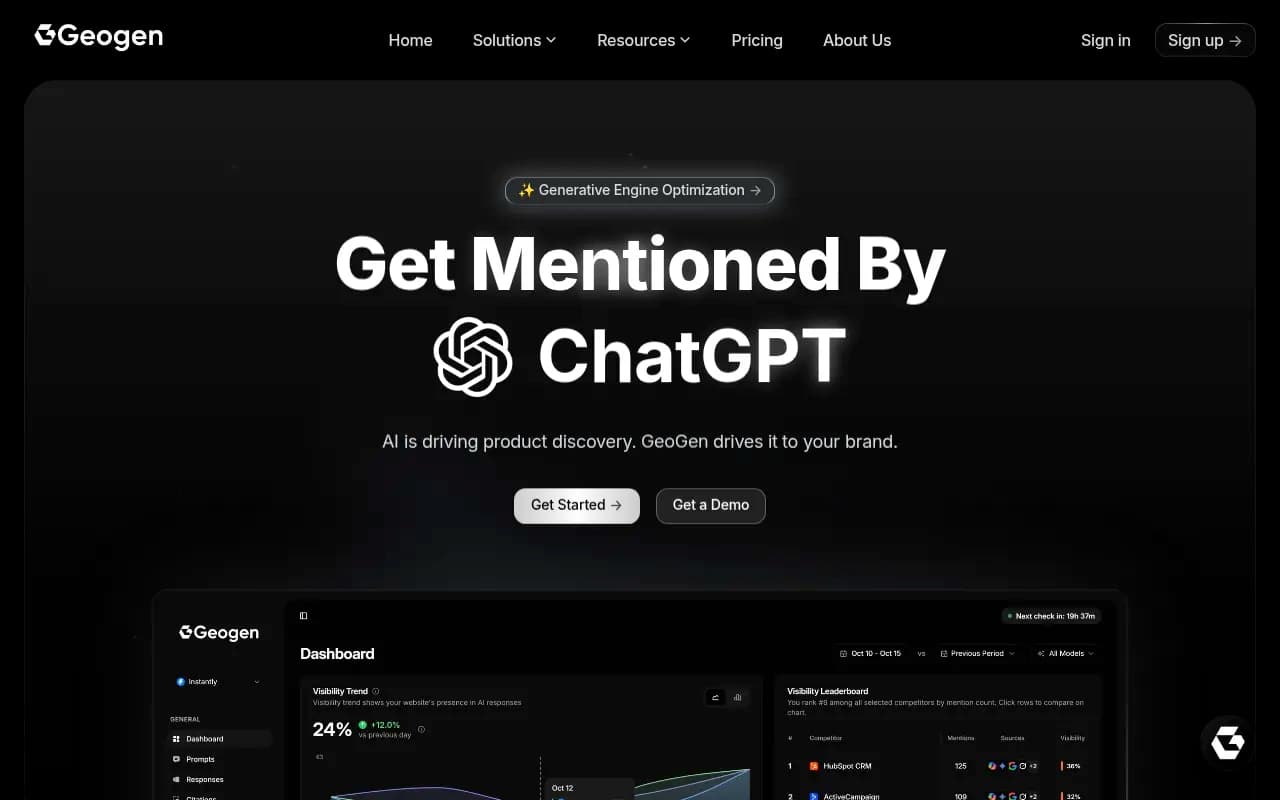
GeoGen is a straightforward AI visibility tracker aimed at small to mid-sized brands. You pick your prompts, GeoGen runs them across ChatGPT, Perplexity, Gemini, Grok, and Copilot, then shows you where your brand gets mentioned. The interface is clean, the pricing is accessible (starting at €20/mo), and the feature set is focused: track mentions, compare against competitors, get basic recommendations. It's not trying to be an enterprise platform -- it's trying to make AI visibility monitoring affordable for teams that can't justify $200+/mo tools.
The company is based in Europe (pricing in euros, 20% discount on annual billing) and positions itself as the entry point for brands exploring Generative Engine Optimization. You won't get advanced sentiment analysis or multi-brand deployments, but you will get the core data: which AI engines mention you, for which prompts, and how you stack up against competitors.
Brandlight.ai: Enterprise analytics for Fortune 500 teams
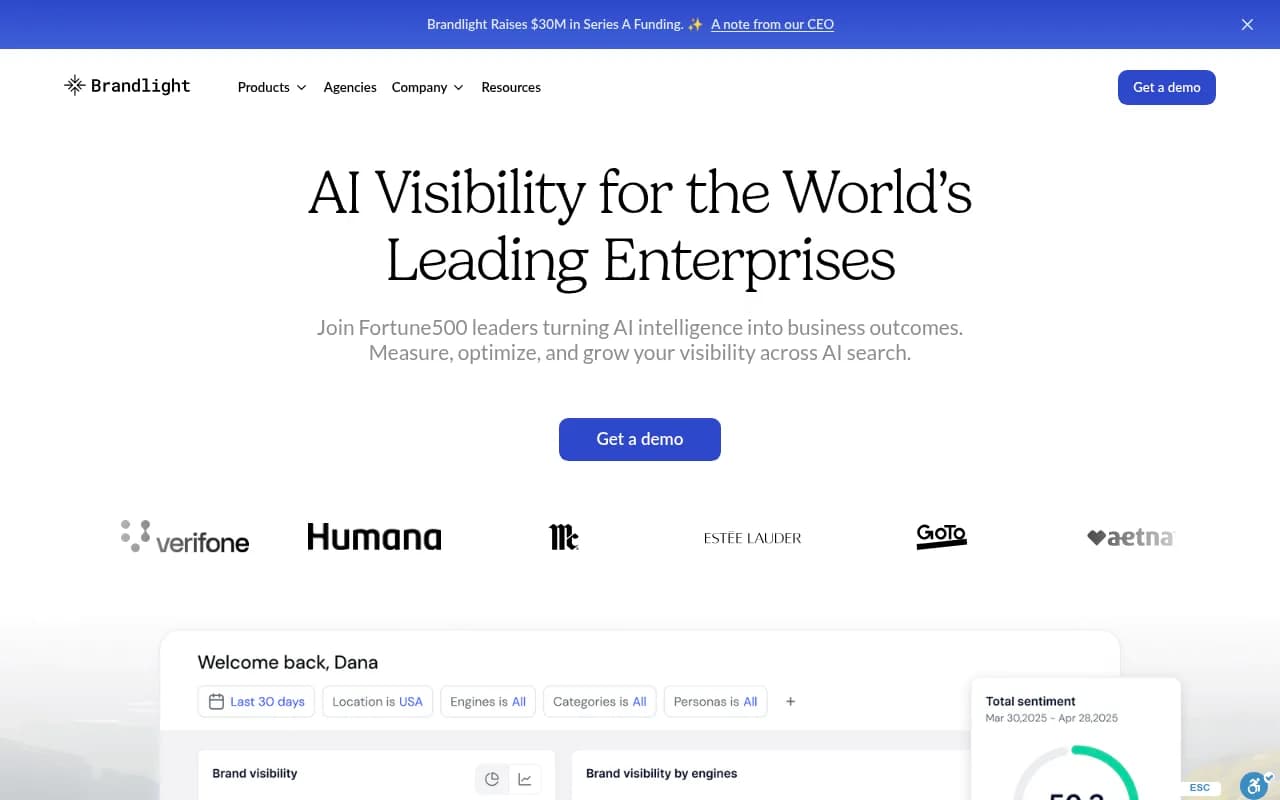
Brandlight raised $30M in Series A funding and explicitly targets Fortune 500 marketing teams. The platform monitors the same AI engines as GeoGen (ChatGPT, Perplexity, Claude, Gemini, Copilot) but layers on enterprise-grade features: sentiment tracking, citation analysis, multi-brand deployments, custom integrations. Pricing starts at $199/mo for basic monitoring and goes up to $750/mo for the Activation plan, with custom enterprise pricing for large deployments.
The pitch is that AI visibility is too important for Fortune 500 brands to track with basic tools. Brandlight's customers include Mastercard, Estée Lauder, Humana, and Aetna -- companies that need detailed analytics, compliance-ready reporting, and white-glove support. If you're a three-person startup, this is massive overkill. If you're a global brand with multiple product lines, Brandlight's infrastructure starts to make sense.
Side-by-side comparison
| Feature | GeoGen | Brandlight.ai |
|---|---|---|
| Starting price | €20/mo (Micro) | $199/mo (basic monitoring) |
| Top-tier plan | €399/mo (Pro) | $750/mo (Activation) |
| Free tier | No | Yes (basic monitoring) |
| AI engines covered | ChatGPT, Perplexity, Gemini, Grok, Copilot | ChatGPT, Perplexity, Claude, Gemini, Copilot |
| Competitor tracking | Yes | Yes |
| Sentiment analysis | Basic | Advanced (enterprise-grade) |
| Citation tracking | No | Yes |
| Multi-brand support | Limited | Yes (enterprise plans) |
| Custom integrations | No | Yes (enterprise) |
| Target audience | Small to mid-sized brands | Fortune 500 marketing teams |
| Annual discount | 20% | Not specified |
| Enterprise pricing | Custom | Custom |
Pricing: GeoGen wins on affordability, Brandlight offers a free tier
This is where the two platforms diverge most sharply.
GeoGen pricing
| Plan | Price | What you get |
|---|---|---|
| Micro | €20/mo | Entry-level tracking for small brands |
| Mid-tier | Not specified | Likely €100-200/mo range |
| Pro | €399/mo | Full feature set for mid-sized brands |
| Enterprise | Custom | Multi-site, custom integrations |
GeoGen's €20/mo entry point is the cheapest AI visibility tracking you'll find. Even their top Pro plan at €399/mo undercuts Brandlight's $750/mo Activation plan by nearly half. The 20% annual discount brings the Micro plan down to €16/mo if you pay yearly -- absurdly cheap for this category.
The trade-off: you're not getting enterprise features. No multi-brand dashboards, no advanced sentiment scoring, no custom API integrations. But if you're a small brand that just wants to know "do AI engines mention us?", GeoGen delivers that for the price of a couple coffees per month.
Brandlight.ai pricing
| Plan | Price | What you get |
|---|---|---|
| Free | $0 | Basic monitoring (limited prompts/engines) |
| Basic Monitoring | $199/mo | Core tracking across all engines |
| Activation | $750/mo | Advanced analytics, sentiment, citations |
| Enterprise | Custom | Multi-brand, white-glove support, custom integrations |
Brandlight's free tier is the only free option between these two platforms, which matters if you're just exploring AI visibility. But the paid plans are 10x more expensive than GeoGen at the entry level ($199 vs €20). The $750/mo Activation plan is aimed at brands with serious budgets -- you're paying for deeper analytics, not just mention tracking.
For Fortune 500 teams managing multiple brands across regions, the custom enterprise pricing makes sense. For everyone else, it's hard to justify unless you need features GeoGen doesn't offer.
Verdict: GeoGen for budget, Brandlight if you need enterprise features
If cost matters, GeoGen wins by a mile. If you need a free tier to test the waters, Brandlight has you covered. If you're a large organization that needs multi-brand tracking and compliance-ready reporting, Brandlight's pricing is table stakes.
AI engine coverage: Essentially identical
Both platforms monitor the major AI search engines:
- ChatGPT (OpenAI)
- Perplexity
- Google Gemini
- Microsoft Copilot
- Claude (Anthropic) -- Brandlight explicitly lists this; GeoGen likely covers it but doesn't highlight it
- Grok (xAI) -- GeoGen explicitly lists this; Brandlight may cover it in enterprise plans
The practical difference is negligible. Both platforms hit the AI engines that matter for brand visibility. Brandlight's enterprise focus means they might add niche engines faster (e.g. DeepSeek, Mistral) if Fortune 500 clients request them, but for 95% of use cases, the coverage is the same.
Neither platform monitors Google AI Overviews or Meta AI as comprehensively as dedicated tools like Promptwatch, which tracks 10+ AI models including those two. Worth noting if you need truly exhaustive coverage.

Verdict: Tie -- both cover the essentials
You're not choosing between these platforms based on AI engine coverage. The difference is in what they do with the data, not which engines they query.
Feature depth: Monitoring vs enterprise analytics
GeoGen: Core tracking, basic recommendations
GeoGen's feature set is straightforward:
- Brand mention tracking: See which prompts trigger mentions of your brand across AI engines
- Competitor comparison: Track how often competitors get mentioned vs you
- Basic recommendations: Suggestions for improving visibility (though not actionable content creation)
- Dashboard reporting: Clean interface showing mention frequency, trends over time
What's missing: citation analysis (which specific URLs AI engines pull from), advanced sentiment scoring, multi-brand dashboards, API access. GeoGen is a monitoring tool, not an optimization platform. It tells you where you stand but doesn't help you improve beyond surface-level suggestions.
Brandlight.ai: Enterprise-grade analytics
Brandlight layers on features that matter to large organizations:
- Citation tracking: See exactly which pages, articles, or sources AI engines cite when mentioning your brand
- Sentiment analysis: Detailed scoring of whether mentions are positive, neutral, or negative
- Multi-brand support: Track multiple brands or product lines in one dashboard
- Custom integrations: API access, white-label reporting, integration with existing martech stacks
- Competitive positioning: Not just "how often are we mentioned" but "how are we positioned vs competitors in AI responses"
The $30M Series A funding shows in the product. Brandlight is built for teams that need to report AI visibility metrics to C-suite executives, track sentiment across product launches, and justify marketing spend with detailed attribution.
Verdict: Brandlight for depth, GeoGen for simplicity
If you need enterprise analytics, Brandlight is the only choice here. If you just want to track mentions without drowning in data, GeoGen's simplicity is a feature, not a bug.
User experience: Clean dashboards vs enterprise complexity
GeoGen's interface is clean and focused. You set up your prompts, pick your competitors, and get a dashboard showing mention frequency and trends. The learning curve is minimal -- most users can start tracking within 15 minutes of signing up.
Brandlight's interface is more complex because it does more. Citation tracking, sentiment analysis, and multi-brand dashboards mean more tabs, more filters, more configuration. Enterprise users appreciate the depth; small teams find it overwhelming.
Neither platform has a reputation for bad UX, but they're optimized for different users. GeoGen feels like a SaaS tool you can figure out on your own. Brandlight feels like an enterprise platform where you'll want onboarding and training.
Verdict: GeoGen for ease of use, Brandlight for power users
If you want to start tracking today without reading documentation, pick GeoGen. If you need advanced features and have time to learn the platform, Brandlight's complexity pays off.
What both platforms are missing: Content optimization
Here's the frustrating part: both GeoGen and Brandlight are monitoring-only tools. They show you where you're invisible in AI search, but they don't help you fix it.
You'll see reports like "Your brand is mentioned in 12% of prompts about [topic], while Competitor X is mentioned in 34%." Great -- now what? Neither platform tells you which content to create, which pages to optimize, or how to structure information so AI engines cite you more often.
This is where platforms like Promptwatch differentiate themselves. Promptwatch's Answer Gap Analysis shows exactly which prompts competitors rank for but you don't, then its AI writing agent generates content grounded in citation data to close those gaps. You're not just monitoring -- you're optimizing.
If you're serious about improving AI visibility (not just tracking it), you'll need a content strategy on top of whichever monitoring tool you pick. Or you'll need a platform that does both.
Who should pick GeoGen
GeoGen makes sense if:
- You're a small brand or startup: The €20/mo Micro plan is accessible for teams with tight budgets
- You want simple mention tracking: No need for citation analysis, sentiment scoring, or multi-brand dashboards
- You're testing AI visibility for the first time: Low cost, low complexity -- easy to try without committing big budget
- You're in Europe: Pricing in euros, likely better support for EU timezones and languages
- You don't need enterprise features: If your use case is "track our brand mentions and compare to 2-3 competitors," GeoGen does that well
GeoGen is the budget-conscious choice. It won't impress your CFO with advanced analytics, but it will answer the basic question: "Are AI engines talking about us?"
Who should pick Brandlight.ai
Brandlight makes sense if:
- You're a Fortune 500 brand: The platform is explicitly built for enterprise marketing teams
- You need multi-brand tracking: Managing multiple product lines or regional brands in one dashboard
- Citation analysis matters: You want to know not just "are we mentioned" but "which sources are AI engines citing"
- You need detailed reporting: Sentiment analysis, competitive positioning, white-label reports for executives
- Budget isn't a constraint: If $750/mo (or custom enterprise pricing) is a rounding error, Brandlight's depth is worth it
- You want a free tier to start: The free plan lets you test before committing to paid plans
Brandlight is overkill for small teams, but it's the right tool for organizations that treat AI visibility as a strategic priority.
Final verdict: Pick based on budget and complexity needs
GeoGen and Brandlight.ai are both solid AI visibility trackers, but they target completely different buyers.
Pick GeoGen if: You're a small to mid-sized brand that wants affordable mention tracking without enterprise complexity. The €20/mo entry point and €399/mo top-tier plan make it the budget winner by a landslide.
Pick Brandlight.ai if: You're a Fortune 500 marketing team that needs enterprise-grade analytics, multi-brand support, and detailed citation/sentiment tracking. The $30M Series A funding and customer roster (Mastercard, Estée Lauder, Humana) signal this is built for large organizations.
Pick neither if: You want a platform that not only monitors AI visibility but helps you optimize it. Both tools are dashboards that show you problems without solving them. If you need content gap analysis, AI-powered content generation, and page-level optimization recommendations, look at platforms like Promptwatch that close the loop between tracking and action.
The bottom line: GeoGen is the affordable monitoring tool for small brands. Brandlight is the enterprise analytics platform for large organizations. Choose based on your budget and whether you need basic tracking or advanced features.