Key takeaways
- Qwairy has a free tier (100 credits, no credit card) and public pricing from €49/month. Meridian has no public pricing and requires a demo call before you see any numbers.
- Meridian is positioned as a managed growth service -- you get human experts plus AI agents executing on your behalf. Qwairy is a self-serve SaaS platform where your team does the work.
- Qwairy's five-module structure (Visibility, Insights, Strategy, Technical, Analytics) is more transparent about what you're getting. Meridian's feature set is harder to evaluate without a sales conversation.
- Both cover the major AI engines (ChatGPT, Claude, Perplexity, Gemini, Grok, Copilot, DeepSeek, Google AI Overviews). Qwairy explicitly adds Mistral and Google AI Mode to its list.
- Qwairy has a built-in Content Studio for creating and optimizing AI-search-ready content. Meridian's content execution is delivered through its managed service model.
- If you want to move fast without a sales cycle, Qwairy wins on accessibility. If you want a team to run the whole program for you, Meridian's model is worth exploring.
Overview
Meridian
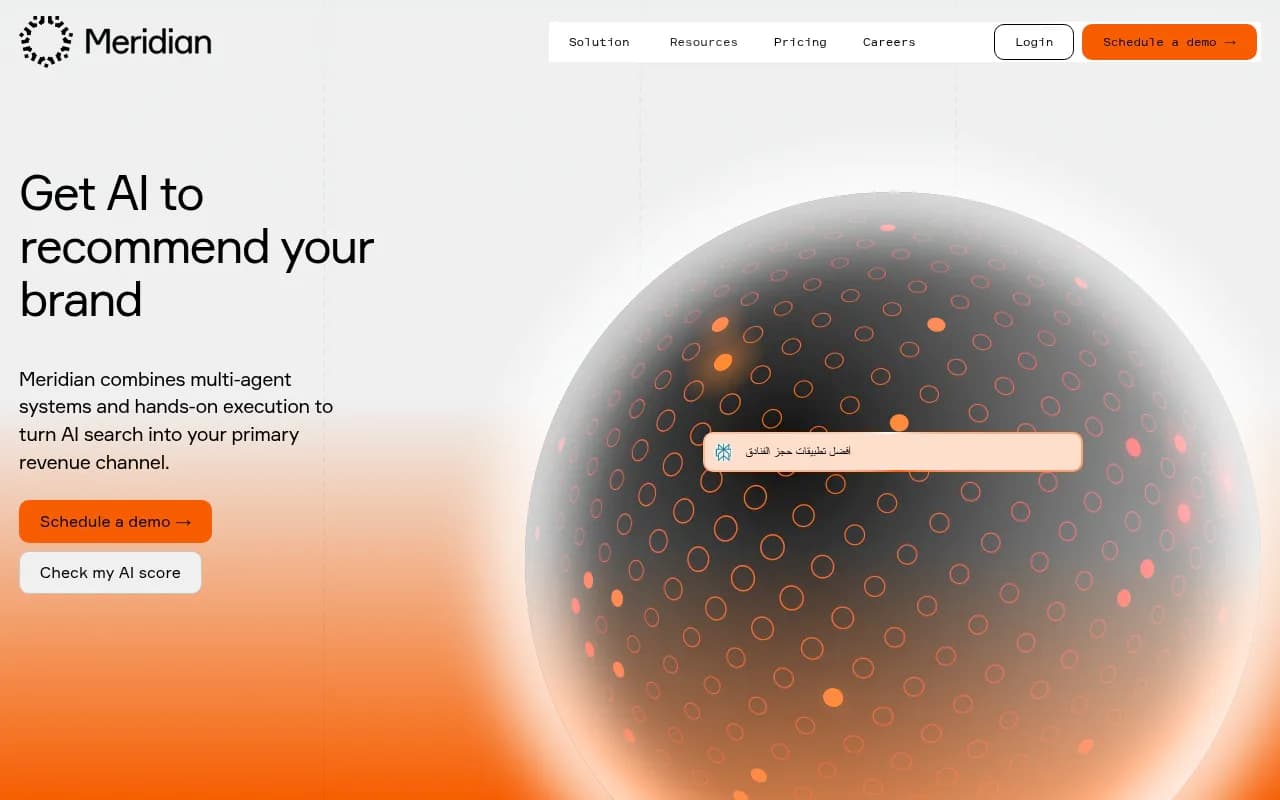
Meridian describes itself as an "agentic AI platform" that combines multi-agent systems with hands-on human execution. The pitch is that AI search optimization shouldn't just be a dashboard you stare at -- it should be a revenue channel someone actively manages. Meridian tracks brand visibility, sentiment, citation sources, and competitive positioning across ChatGPT, Perplexity, Gemini, Google AI, Copilot, Grok, DeepSeek, and more. But the distinguishing angle is the "expert-led" layer: you're not just buying software, you're buying a team that runs the playbook.
That's a compelling idea, but it comes with a real trade-off: no public pricing, no self-serve trial, and no way to evaluate the product without booking a demo. For teams that want to move quickly or test before committing, that's a friction point.
Qwairy

Qwairy is a GEO (Generative Engine Optimization) platform used by 2,000+ brands including TotalEnergies, Match Group, and Air Transat. It monitors brand mentions across 10 AI engines and organizes everything into five modules: Visibility, Insights, Strategy, Technical, and Analytics. The free tier (100 credits, no credit card) means you can actually try it before spending anything, and the paid plans start at €49/month -- making it accessible to teams that aren't ready to commit to an enterprise contract.
The platform is self-serve by design. You set up your brand, configure your prompts, and work through the modules yourself. There's an AI Agent built into the dashboard, but the execution is on your team, not Qwairy's.
Side-by-side comparison
| Feature | Meridian | Qwairy |
|---|---|---|
| Pricing model | Custom (demo required) | Freemium + public tiers from €49/mo |
| Free tier | No | Yes (100 credits, no credit card) |
| Self-serve signup | No | Yes (2-min setup) |
| AI engines covered | ChatGPT, Perplexity, Gemini, Google AI, Copilot, Grok, DeepSeek, Claude, Meta AI | ChatGPT, Claude, Perplexity, Gemini, Copilot, Grok, Google AI Overview, Google AI Mode, Mistral, DeepSeek |
| Sentiment tracking | Yes | Yes |
| Citation source tracking | Yes | Yes |
| Competitor benchmarking | Yes | Yes |
| Content creation tools | Managed service (human + AI agents) | Content Studio (self-serve) |
| Technical site analysis | Not documented | Yes (Site Diagnostics module) |
| Crawler analytics | Not documented | Yes |
| Social signals (Reddit, YouTube) | Not documented | Yes (Insights module) |
| GSC / Bing Webmaster integration | Not documented | Yes |
| Multi-language / multi-region | Yes (shown in demo) | Not explicitly documented |
| Managed execution | Yes (core differentiator) | No |
| Target audience | Mid-market to enterprise brands | SMBs, agencies, mid-market brands |
Head-to-head feature deep-dive
Pricing and accessibility
This is where the two tools diverge most sharply. Qwairy publishes its pricing: a free tier with 100 credits, a Starter plan at €49/month, a Growth plan in the €300-500/month range, and Enterprise on custom terms. You can sign up, connect your brand, and start seeing data in about two minutes.
Meridian gives you nothing until you book a demo. No pricing page, no trial, no free tier. That's a deliberate choice -- the managed service model doesn't lend itself to self-serve -- but it means you're committing time to a sales process before you know if the product fits your budget.
Verdict: Qwairy wins on accessibility. Meridian's pricing opacity is a real barrier for teams that want to evaluate before engaging.
AI engine coverage
| Engine | Meridian | Qwairy |
|---|---|---|
| ChatGPT | Yes | Yes |
| Claude | Yes | Yes |
| Perplexity | Yes | Yes |
| Gemini | Yes | Yes |
| Google AI Overviews | Yes | Yes |
| Google AI Mode | Not documented | Yes |
| Copilot | Yes | Yes |
| Grok | Yes | Yes |
| DeepSeek | Yes | Yes |
| Meta AI | Yes | Not documented |
| Mistral | Not documented | Yes |
Both platforms cover the engines that matter most. The differences at the edges (Mistral vs. Meta AI) are unlikely to be decisive for most buyers. What matters more is how each platform handles the data from those engines -- and that's where the feature set diverges.
Verdict: Roughly equivalent. Qwairy is more transparent about its coverage list.
Monitoring and visibility tracking
Qwairy's Visibility module tracks prompt performance, response analysis, competitor mentions, and citation sources. You can see every mention across all 10 engines, drill into which sources AI models are citing, and compare your visibility against competitors. The dashboard is self-serve and updated regularly.
Meridian tracks category-level AI visibility, sentiment scores, position rankings, and competitive benchmarking. The demo screenshots show visibility scores, sentiment percentages, and position rankings per prompt -- which looks clean and useful. But because it's a managed service, how much of this you can explore independently vs. through a client success manager isn't clear from the outside.
Verdict: Qwairy gives you more direct access to the data. Meridian's monitoring is solid but filtered through a managed service layer.
Content and optimization tools
Qwairy has a dedicated Strategy module with a Content Studio, Content Opportunities tracker, Content Optimization tools, and an Action Center. It also integrates with Google Search Console and Bing Webmaster Tools, so you can connect your existing SEO data to your GEO strategy. The idea is that you identify gaps in AI visibility, then use the Content Studio to create content that addresses them.
Meridian's approach is different: the "agent-powered execution" means Meridian's team (human experts plus AI agents) handles content and optimization work on your behalf. That's potentially more powerful if you don't have internal bandwidth, but it's also less transparent -- you're trusting the managed service to make the right calls.
Verdict: Depends on what you need. Qwairy gives you the tools; Meridian gives you the execution. If you have a capable in-house team, Qwairy's self-serve approach is more flexible.
Technical analysis
Qwairy's Technical module includes Site Diagnostics that audits pages across technical, content, AEO (AI Engine Optimization), and speed dimensions. The dashboard shows per-page scores and flags issues -- the kind of thing that helps you understand why AI models might not be citing specific pages.
Meridian doesn't document a technical analysis feature publicly. It may exist within the managed service, but there's no way to evaluate it without a demo.
Verdict: Qwairy has a clear edge here on documented capabilities.
Insights and social signals
Qwairy's Insights module surfaces Reddit discussions, YouTube content, Hacker News threads, and other social signals that influence AI recommendations. It also includes Query Fan-Out analysis (how one prompt branches into sub-queries), Shopping Results tracking, and Local Business data. This is genuinely useful for understanding why AI models recommend certain sources.
Meridian doesn't document equivalent social signal tracking publicly.
Verdict: Qwairy wins on documented insight capabilities.
Managed service vs. self-serve
This is the fundamental philosophical difference between the two tools. Meridian is built around the idea that most brands don't have the internal expertise or time to run a GEO program themselves. So they sell you a team. That's a legitimate value proposition, especially for brands that want results without building internal capability.
Qwairy assumes you have (or want to build) that capability in-house. The platform gives you the data and tools; your team executes.
Neither approach is wrong. But they suit different buyers.
Verdict: Meridian for teams that want a done-for-you service. Qwairy for teams that want control and transparency.
Pricing comparison
| Plan | Meridian | Qwairy |
|---|---|---|
| Free tier | None | 100 credits, no credit card |
| Entry-level paid | Custom (demo required) | €49/month (Starter) |
| Mid-tier | Custom | ~€300-500/month (Growth) |
| Enterprise | Custom | Custom |
Qwairy's pricing structure is straightforward. Meridian's is opaque by design -- the managed service model means pricing depends on scope, which makes sense, but it also means you can't budget without a sales conversation.
Pros and cons
Meridian
Pros:
- Managed execution means you're not doing the work yourself
- Human experts plus AI agents -- more than just a dashboard
- Clean visibility, sentiment, and position tracking
- Multi-language and multi-region support shown in demos
- Good fit for brands that want a growth partner, not just a tool
Cons:
- No public pricing -- requires a demo before you see any numbers
- No free trial or self-serve access
- Feature set is hard to evaluate independently
- Managed service model means less direct control over the data
- Smaller company with less documented customer base than Qwairy
Qwairy
Pros:
- Free tier with no credit card required
- Public pricing from €49/month
- Five well-documented modules covering the full GEO workflow
- 2,000+ brands using it, including recognizable names
- Technical site diagnostics built in
- Reddit, YouTube, and social signal tracking
- GSC and Bing Webmaster Tools integration
- Crawler analytics for understanding AI bot behavior
Cons:
- Self-serve means your team has to do the work
- No managed execution option
- Growth plan pricing (~€300-500/month) is a meaningful jump from Starter
- Multi-language support not explicitly documented
Who should pick which tool
Pick Meridian if:
- You want a team to run your AI search optimization program, not just a dashboard to manage yourself
- You're a mid-market or enterprise brand with budget for a managed service
- You don't have internal GEO expertise and don't want to build it
- You're comfortable with a sales process before seeing pricing
Pick Qwairy if:
- You want to start immediately without a sales call
- Budget transparency matters -- you need to know the cost before committing
- You have an in-house marketing or SEO team that can work with the platform
- You want technical site diagnostics alongside visibility tracking
- You're an agency managing multiple brands (the 2,000+ customer base suggests it scales well for agencies)
- You want Reddit and social signal data to inform your content strategy
If you're also thinking about how your brand shows up in AI search results more broadly, Promptwatch is worth a look -- it covers similar GEO ground with a strong emphasis on content gap analysis and AI-driven content generation, and it's used by 6,700+ brands including Booking.com.

Final verdict
Qwairy is the more accessible, more transparent option. You can start free, see the pricing, and evaluate the platform without talking to anyone. The five-module structure is well thought out, and the technical diagnostics plus social signal tracking give it depth that Meridian doesn't document publicly.
Meridian's managed service model is genuinely differentiated -- if you want experts running your GEO program rather than a tool your team has to learn -- but the lack of public pricing and self-serve access makes it hard to recommend without a caveat: you're buying blind until you get on a call.
For most teams in 2026, Qwairy is the practical starting point. Meridian is worth exploring if you have the budget and want a done-for-you approach.