Key takeaways
- Peec AI is a functioning AI search analytics tool used by 2,000+ marketing teams. Bear AI has pivoted -- its current website describes an enterprise workflow dataset product for building AI agents, not a marketing visibility platform.
- Peec AI covers three AI platforms (ChatGPT, Perplexity, Gemini). That's narrower than most competitors in 2026, where 6-10 model coverage is becoming standard.
- Peec AI starts at $95/mo with a free trial. Bear AI's previously listed marketing pricing started at $199/mo, but that product appears to no longer exist in its original form.
- Both tools are monitoring-only in their original conception -- neither offers content generation, crawler logs, or traffic attribution. If you need to act on the data you collect, you'll need something more.
- For teams that just want clean, simple AI visibility dashboards without complexity, Peec AI is the clearer choice between these two right now.
- If you need a full optimization loop (track gaps, generate content, measure results), neither tool covers that -- look at platforms built around the complete workflow.
Overview
Peec AI

Peec AI is a straightforward AI search analytics platform aimed squarely at marketing teams. The pitch is simple: track how often your brand appears in AI-generated answers, where you rank relative to competitors, and whether the sentiment is positive or negative. It covers ChatGPT, Perplexity, and Gemini, lets you add custom prompts, organize them with tags, and track across countries. The interface is clean and the setup is fast -- you don't need an engineer to get started.
It's trusted by 2,000+ marketing teams and agencies, which is a real signal that the product works for its intended audience. The limitation is equally clear: Peec AI stops at the data. There's no content generation, no crawler logs, no traffic attribution. You see the numbers; figuring out what to do about them is your problem.
Bear AI
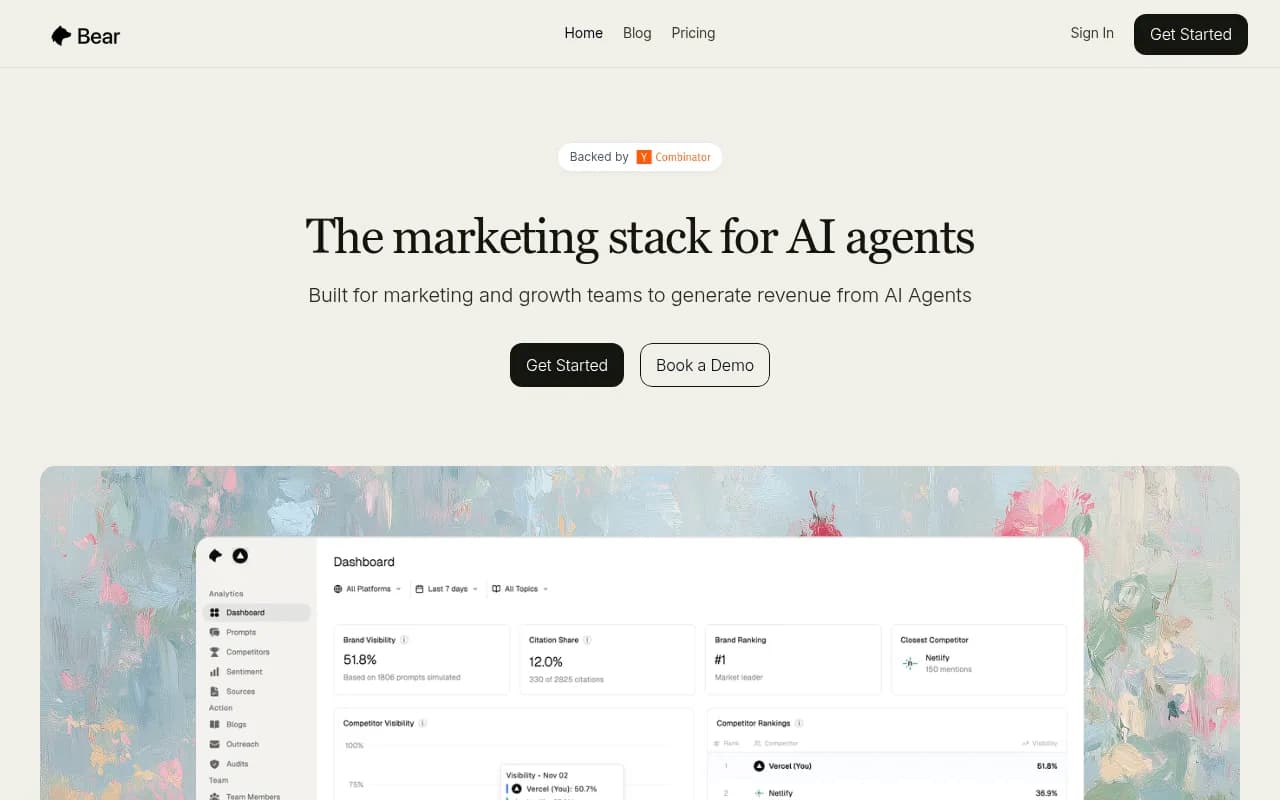
This is where things get complicated. Bear AI was originally positioned as a platform to help businesses generate revenue from AI agent traffic -- tracking how AI models discover and recommend your brand, identifying high-intent visitors from AI sources, and converting that traffic into leads. The pricing listed in its original form started at $199/mo.
However, Bear AI's current website tells a completely different story. As of mid-2026, the site describes a product focused on "datasets of real work" to help enterprises build reliable AI agents -- decisions, exceptions, handoffs, and workflow data. It's backed by Y Combinator and is now reaching out to frontier labs and enterprises building agents, not marketing teams tracking brand visibility.
In short: Bear AI appears to have pivoted away from the GEO/AI visibility market. The product that was being compared to Peec AI may no longer exist in its original form. This makes a direct feature-for-feature comparison difficult, and it's a real risk for anyone who was considering Bear AI for marketing use cases.
Side-by-side comparison
| Feature | Peec AI | Bear AI |
|---|---|---|
| Primary use case | AI search visibility tracking | Enterprise AI agent datasets (pivoted) |
| AI models covered | ChatGPT, Perplexity, Gemini (3) | Unclear post-pivot |
| Visibility tracking | Yes | Unknown |
| Competitor benchmarking | Yes | Unknown |
| Sentiment analysis | Yes | Unknown |
| Custom prompts | Yes | Unknown |
| Content generation | No | No |
| Crawler logs | No | No |
| Traffic attribution | No | No |
| Free tier / trial | Free trial available | No |
| Starting price | $95/mo | $199/mo (original; product changed) |
| Target audience | Marketing teams, agencies | Now: enterprises building AI agents |
| Product stability | Active, 2,000+ users | Pivoted -- original product uncertain |
| Country/region tracking | Yes | Unknown |
Head-to-head feature deep-dive
AI model coverage
Peec AI tracks three platforms: ChatGPT, Perplexity, and Gemini. For many marketing teams, that's enough to get started -- these three handle the majority of consumer AI search volume right now. But the gap is growing. Competitors in 2026 routinely cover Claude, Grok, DeepSeek, Copilot, and Meta AI alongside the big three. If your audience uses a broader mix of AI tools, three models starts to feel thin.
Bear AI's original product claimed coverage of 6+ AI engines natively, which would have been a genuine advantage. That advantage is now moot given the product pivot.
Verdict: Peec AI wins by default -- it's the only one of these two still operating in the AI visibility space.
Prompt tracking and discovery
Peec AI lets you add custom prompts manually and organize them with tags. It's a deliberate, researcher-driven approach: you decide which questions matter, you add them, you track them. That works well if you already know what your customers are asking AI tools. It's less useful if you're trying to discover new prompt opportunities you haven't thought of yet.
Bear AI's original positioning included auto-discovery of frequently asked prompts, which would have been a meaningful differentiator. Manual prompt research is genuinely time-consuming, and automation here saves real hours. Again, this feature's current status is unclear.
Verdict: Peec AI's manual approach is functional but requires upfront research investment.
Visibility, position, and sentiment metrics
This is Peec AI's core strength. The three-metric framework -- visibility (share of chats where your brand appears), position (where you rank in AI responses), and sentiment (how AI describes your brand) -- is well-designed and genuinely useful. The dashboard is information-dense without being overwhelming. You can see trends over time, compare against competitors, and filter by model or prompt tag.
The sentiment metric is particularly valuable and something many competitors handle poorly. Knowing that you appear in 47% of relevant AI responses is useful; knowing that the AI describes your brand negatively in 30% of those appearances is actionable.
Verdict: Peec AI's core metrics are solid and well-implemented.
Content optimization and action tools
Neither tool was built to help you act on the data. Peec AI shows you where you're invisible or underperforming -- what you do next is up to you. There's no content brief generation, no gap analysis tied to specific pages, no crawler logs showing which pages AI models are actually reading.
This is the fundamental ceiling of monitoring-only platforms. The data tells you there's a problem; it doesn't help you fix it. If you're running a serious GEO program, you'll eventually hit this wall and need to either build your own workflow around the data or move to a platform that closes the loop. Tools like Promptwatch are built specifically around that full cycle -- find gaps, generate content, track results -- which is worth knowing if you're planning ahead.

Verdict: Neither tool wins here. Both are monitoring-only.
Pricing and accessibility
| Plan | Peec AI | Bear AI (original) |
|---|---|---|
| Free tier | Free trial | None |
| Entry-level | $95/mo | $199/mo |
| Mid-tier | Not publicly listed | Not listed |
| Enterprise | Not publicly listed | Custom (unlimited prompts, 6+ models) |
Peec AI is meaningfully cheaper at entry level and offers a free trial, which lowers the risk of trying it. Bear AI's original pricing was more than double the entry cost, which made sense only if the additional features (auto-discovery, more models, lead gen tools) justified the premium. With Bear AI's pivot, that pricing structure is no longer relevant to the AI visibility use case.
Verdict: Peec AI wins on pricing and accessibility.
Product stability and roadmap
Peec AI is actively developed, has 2,000+ users, and is hiring. The product is clearly in growth mode and the core use case is stable.
Bear AI's pivot is a real concern. A product that changes its fundamental value proposition mid-stream is a risk for any buyer. Teams that built workflows around Bear AI's original marketing platform may find themselves without support or feature development going forward. This isn't a criticism of the pivot as a business decision -- pivots happen, especially at early-stage YC companies -- but it's a practical problem for anyone evaluating it as a marketing tool.
Verdict: Peec AI wins clearly on stability.
Pricing comparison
| Plan | Peec AI | Bear AI |
|---|---|---|
| Free / trial | Free trial available | No |
| Basic / entry | $95/mo | $199/mo (original product) |
| Enterprise | Custom | Custom |
Peec AI's $95/mo entry point is competitive for a monitoring-only tool. The free trial means you can validate whether the data is useful before committing. Bear AI's original $199/mo entry was harder to justify for teams that just wanted basic visibility tracking.
Pros and cons
Peec AI
Pros:
- Clean, fast setup with no technical expertise required
- Solid three-metric framework (visibility, position, sentiment)
- Free trial lowers the barrier to entry
- Actively developed with a growing user base
- Custom prompts with tag organization and country tracking
- Competitive benchmarking built in
Cons:
- Only covers three AI platforms -- no Claude, Grok, DeepSeek, Copilot, or Meta AI
- No content generation or optimization tools
- No crawler logs or traffic attribution
- Manual prompt research required -- no auto-discovery
- Monitoring-only means you still need to figure out what to do with the data
Bear AI
Pros:
- Original product had broader model coverage (6+) and auto-discovery
- YC-backed with strong technical credibility
- Lead generation tools in original product were a differentiator
Cons:
- Product has pivoted away from AI visibility/marketing use case
- Original pricing was expensive relative to Peec AI
- No free trial in original product
- Current product direction (enterprise workflow datasets) is unrelated to GEO/AI search marketing
- Significant uncertainty about whether original features still exist or are supported
Who should pick which tool
Choose Peec AI if:
- You're a marketing team that wants a clean, simple AI visibility dashboard
- You're tracking brand performance on ChatGPT, Perplexity, and Gemini specifically
- You want to start with a free trial before committing
- You need competitor benchmarking and sentiment analysis without complexity
- You're okay building your own content strategy around the data
Don't choose Bear AI (for AI visibility) if:
- You need a stable, actively developed AI search marketing platform
- You want to track brand visibility and benchmark competitors in AI search
- You're looking for the features Bear AI originally advertised -- the product has moved on
Consider a more complete platform if:
- You need coverage beyond three AI models
- You want content gap analysis and content generation built in
- You need crawler logs, traffic attribution, or page-level citation tracking
- You're running an agency or managing multiple brands
Final verdict
This comparison is lopsided in a way that has nothing to do with features. Peec AI is a functioning, actively developed AI search analytics tool that does what it says. Bear AI has pivoted to a completely different product category. For anyone evaluating these two tools for AI visibility and GEO purposes in 2026, Peec AI is the only real option between them.
That said, Peec AI's three-model coverage and monitoring-only approach mean it's a starting point, not a complete solution. It's good for teams that want to understand their AI search presence without complexity. Teams that need to act on that data -- generating content, fixing gaps, tracking which pages AI models actually read -- will outgrow it quickly and need to look at platforms built around the full optimization workflow.