Key takeaways
- Most AI search visibility tools are monitoring dashboards — they show you data but don't help you act on it
- The tools that deliver real ROI combine tracking with content gap analysis, AI-powered content generation, and traffic attribution
- AI-referred traffic converts at roughly 14.2% vs 2.8% for traditional search (per RankScience), which makes AI visibility worth optimizing seriously
- The market splits into two camps: traditional SEO platforms adding AI features, and purpose-built GEO/AEO platforms built from scratch for AI search
- For most teams, the right choice depends on whether you need monitoring only, content optimization, or a full action loop from gap to fix to result
There's a version of this guide that just lists ten tools with feature bullets and pricing tables. You've seen that guide. It doesn't help you pick anything.
What actually matters in 2026 is a different question: which of these platforms will help you do something? Because the dirty secret of the AI visibility tool market is that most of them are glorified dashboards. They'll tell you your brand appears in 12% of ChatGPT responses for your category. Great. Now what?
The tools worth paying for are the ones that close the loop -- find the gap, help you create content to fill it, then show you whether it worked. That's a much shorter list.
Here's how the market actually breaks down, and which platforms belong in each tier.
Why "monitoring only" isn't enough anymore
AI search is eating traditional search traffic. Google's market share dropped below 90% for the first time in years. ChatGPT, Perplexity, and Google's own AI Overviews are answering questions directly -- and the brands that get cited in those answers are capturing traffic that never hits a search results page.
The conversion math is brutal for anyone not paying attention: AI-referred visitors convert at around 14.2% compared to 2.8% for traditional organic search. That's not a marginal difference. That's a different category of visitor.
So yes, you need to know where you stand. But knowing you're invisible in Perplexity for "best project management software for agencies" doesn't help unless you can figure out why and what to publish to fix it. Most tools stop at the first part.
The 10 best AI search optimization platforms in 2026
1. Promptwatch — best for the full optimization loop
Promptwatch is the platform that most clearly separates itself from the monitoring-only crowd. It tracks your visibility across 10 AI models (ChatGPT, Perplexity, Claude, Gemini, Grok, DeepSeek, Copilot, Meta AI, Google AI Overviews, Google AI Mode), but the tracking is really just the entry point.
The part that matters: Answer Gap Analysis shows you exactly which prompts your competitors rank for that you don't. Not vague topic clusters -- specific prompts, with volume estimates and difficulty scores. Then the built-in AI writing agent generates content designed to get cited, grounded in 880M+ citations analyzed across those models. After you publish, page-level tracking shows which pages are being cited, by which models, and how often. Traffic attribution (via code snippet, GSC integration, or server log analysis) connects that visibility to actual revenue.
It also has AI crawler logs -- real-time records of GPTBot, ClaudeBot, and other AI crawlers hitting your site. Most competitors don't have this at all. You can see which pages they're reading, what errors they hit, and how often they return. That's genuinely useful for diagnosing why a page isn't getting cited.
Reddit and YouTube tracking rounds it out: Promptwatch surfaces discussions on those platforms that directly influence AI recommendations, which is a channel most tools completely ignore.
Pricing starts at $99/month for one site and 50 prompts. Professional ($249/month) adds crawler logs, city/state tracking, and 150 prompts. Business ($579/month) covers 5 sites and 350 prompts.

2. Surfer SEO — best for content optimization against AI search signals
Surfer has been the content optimization standard for traditional SEO for years, and it's adapted reasonably well to the AI search era. Its content editor gives you real-time scoring against top-ranking pages, NLP term suggestions, and structure guidance that happens to align with what AI models want: clear answers, well-organized sections, direct responses to specific questions.
It's not a GEO-native platform -- it won't tell you whether ChatGPT is citing your page. But if your problem is "my content isn't structured well enough to get cited," Surfer's optimization layer is still one of the best tools for fixing that.
3. Semrush — best for teams that want traditional SEO and AI visibility in one place
Semrush has been adding AI search features to its already-massive platform. The AI Toolkit tracks brand mentions across AI models, and the ContentShake AI tool helps generate SEO-optimized content. The advantage is obvious: if you're already using Semrush for keyword research, backlink analysis, and rank tracking, having AI visibility data in the same dashboard reduces tool sprawl.
The limitation is that Semrush's AI features use fixed prompts rather than custom ones you define, and there's no AI traffic attribution. It's a solid addition to an existing Semrush workflow, not a replacement for a dedicated GEO platform.
4. Ahrefs — best for connecting traditional SEO authority to AI citation potential
Ahrefs launched Brand Radar to track brand mentions in AI search engines, and it integrates naturally with the platform's existing backlink and content data. The logic makes sense: AI models tend to cite pages with strong backlink profiles and topical authority, so understanding your traditional SEO standing helps you predict and improve AI visibility.
Like Semrush, the AI features use fixed prompts and lack AI traffic attribution. But Ahrefs' underlying data quality is exceptional, and for teams already deep in the platform, Brand Radar is worth using alongside your existing workflow.
5. Profound — best enterprise AI visibility platform (monitoring-focused)
Profound tracks brand mentions across 9+ AI search engines with solid reporting depth. It's positioned at enterprise teams and agencies that need detailed visibility data across multiple brands and markets. The reporting is genuinely good -- you can slice by model, by prompt category, by competitor.
The gap is on the action side. Profound doesn't have content generation, answer gap analysis, or traffic attribution built in. It's a strong monitoring platform that you'd need to pair with other tools to actually act on the data.
Profound

6. Otterly.AI — best entry-level AI visibility tracker
Otterly.AI is frequently recommended as the most accessible starting point for AI search monitoring. It's affordable, easy to set up, and covers the major models. For small teams or individuals who just want to know whether their brand is showing up in ChatGPT and Perplexity, it does the job.
The ceiling is low, though. No crawler logs, no content generation, no traffic attribution, no Reddit/YouTube tracking. It's a monitoring tool, and a basic one. Fine for getting started; not fine if you need to actually move the needle.
Otterly.AI

7. AthenaHQ — best for structured AI visibility reporting
AthenaHQ takes a more structured approach to AI visibility tracking, with clean dashboards and good competitor comparison features. It's monitoring-focused like Otterly.AI but with more depth in the reporting layer -- better for teams that need to present AI visibility data to stakeholders.
It still lacks content optimization and generation capabilities, so the same caveat applies: you'll know where you stand, but you'll need other tools to improve.

8. Search Atlas — best for AI-assisted SEO automation
Search Atlas combines traditional SEO tools (rank tracking, site audits, keyword research) with AI content generation and some GEO features. It's one of the more complete platforms for teams that want to automate SEO workflows -- the AI writing tools are genuinely capable, and the platform covers a lot of ground.
The GEO features are less mature than dedicated platforms like Promptwatch, but Search Atlas is worth considering if you want a single platform that handles both traditional SEO and AI search optimization without being a pure monitoring play.
9. Rankability — best for agencies doing Google and AI search optimization together
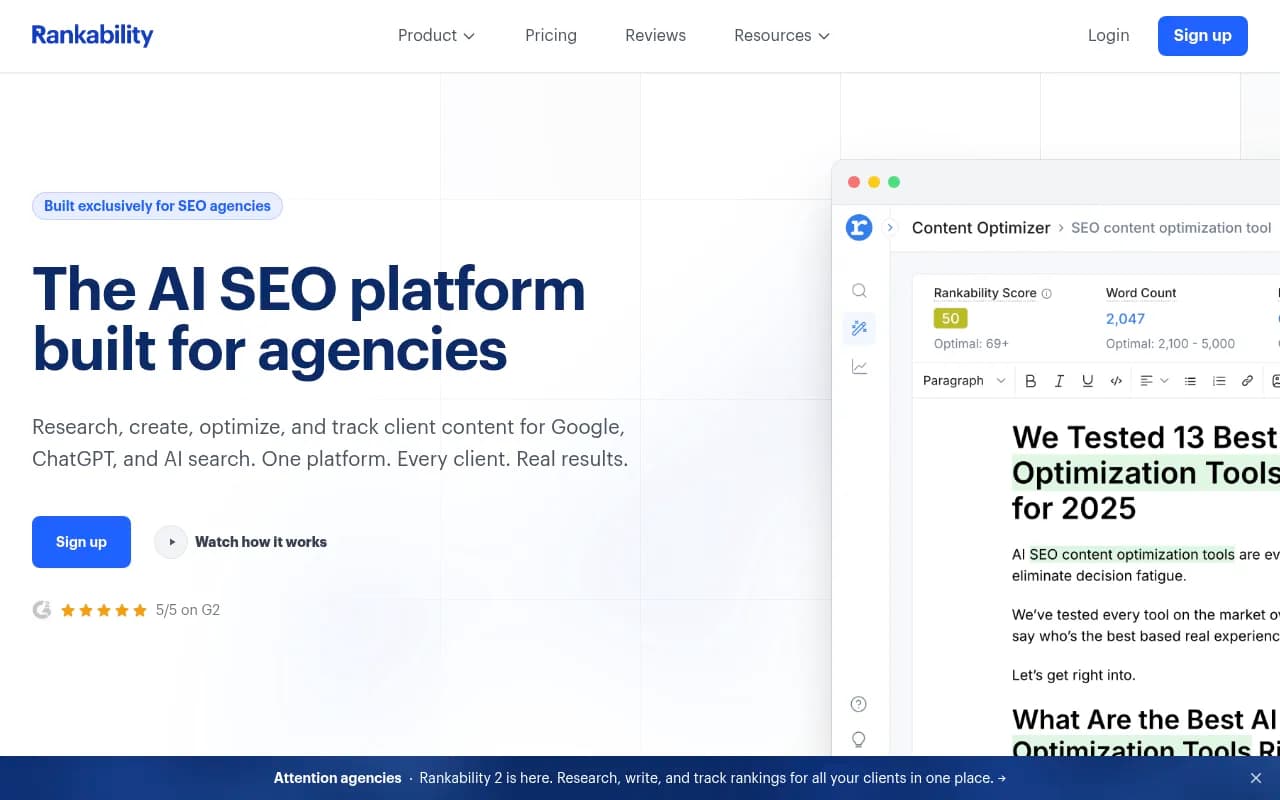
Rankability is built for agencies and focuses on the overlap between traditional Google optimization and AI search. Its content briefs are strong, and it's one of the few platforms that explicitly tries to optimize for both Google and AI models simultaneously rather than treating them as separate problems.
The AI visibility tracking is less comprehensive than dedicated GEO platforms, but the content optimization layer is solid. Good choice for agencies that primarily serve clients who still care about Google rankings but want to start building AI visibility.
10. Scrunch AI — best for mid-market teams wanting AI visibility with some optimization features
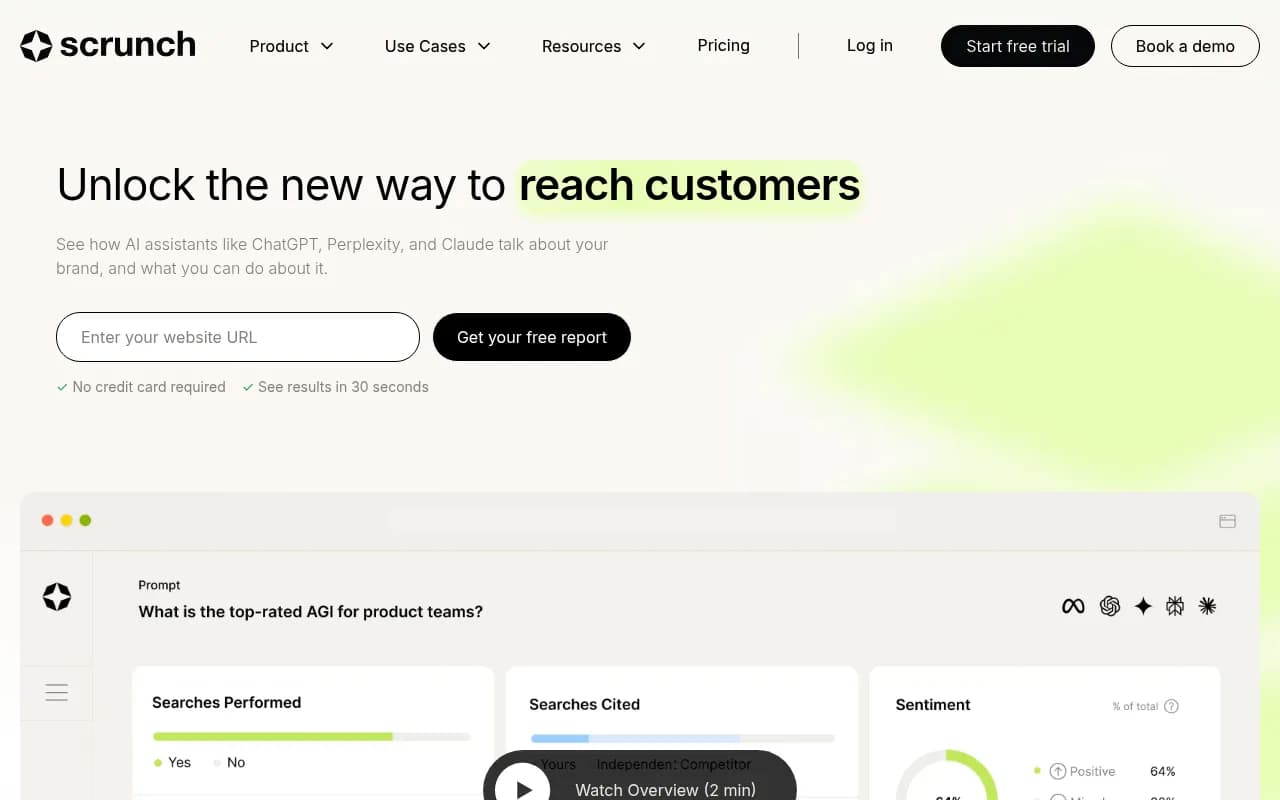
Scrunch AI sits between pure monitoring tools and full-stack platforms like Promptwatch. It tracks brand mentions across AI models with reasonable depth and has started adding optimization features. It's a reasonable choice for mid-market teams that find Profound too expensive and Otterly.AI too limited.
How these platforms compare
| Platform | AI models tracked | Content generation | Answer gap analysis | Crawler logs | Traffic attribution | Starting price |
|---|---|---|---|---|---|---|
| Promptwatch | 10 | Yes (built-in AI writer) | Yes | Yes | Yes | $99/mo |
| Surfer SEO | 0 (content optimization only) | Yes | No | No | No | ~$89/mo |
| Semrush | Multiple (fixed prompts) | Yes (ContentShake) | No | No | No | $139/mo |
| Ahrefs | Multiple (fixed prompts) | No | No | No | No | $129/mo |
| Profound | 9+ | No | No | No | No | Custom |
| Otterly.AI | Multiple | No | No | No | No | ~$49/mo |
| AthenaHQ | Multiple | No | No | No | No | Custom |
| Search Atlas | Multiple | Yes | Limited | No | No | $99/mo |
| Rankability | Limited | Yes | No | No | No | $99/mo |
| Scrunch AI | Multiple | Limited | No | No | No | Custom |
How to choose the right platform for your situation
The honest answer is that it depends on where you are in the AI visibility journey.
If you're just starting out and want to understand whether your brand is showing up in AI search at all, Otterly.AI or Promptwatch's Essential plan are both reasonable entry points. Otterly.AI is cheaper; Promptwatch gives you a path to actually improving what you find.
If you're already doing traditional SEO and want to add AI visibility without switching platforms, Semrush or Ahrefs make sense. The AI features aren't best-in-class, but they're good enough for a first pass, and you're not adding tool sprawl.
If you need to actually move the needle -- not just measure it -- Promptwatch is the clearest choice. The combination of answer gap analysis, AI content generation grounded in citation data, crawler logs, and traffic attribution is genuinely different from what any other platform offers. Most competitors stop at step one of the process; Promptwatch is built around completing all three steps.
If you're enterprise and need deep reporting for multiple brands across multiple markets, Profound or Evertune are worth evaluating alongside Promptwatch's Business/Agency tiers.
What to watch for in the second half of 2026
A few things are worth tracking as this market matures:
The line between "traditional SEO tool" and "GEO platform" is blurring fast. Semrush and Ahrefs are both investing heavily in AI visibility features. Whether they catch up to purpose-built platforms or stay a step behind is genuinely unclear.
ChatGPT Shopping is becoming a real channel. Promptwatch already tracks when brands appear in ChatGPT's product recommendations and shopping carousels. Most other platforms don't. If you're in e-commerce, that's a gap worth paying attention to.
Traffic attribution is still the unsolved problem for most platforms. Knowing you're cited in AI responses is useful; knowing that those citations drove $40,000 in revenue last month is transformative. The platforms that crack attribution will have a significant advantage.
The prompt volume data is getting better. Early GEO tools had no way to estimate how often a given prompt was being asked. Platforms like Promptwatch now provide volume estimates and difficulty scores, which means you can prioritize high-value, winnable prompts instead of guessing. That changes the ROI math considerably.
The bottom line
The AI search optimization market in 2026 is full of tools that will happily charge you $200/month to show you a dashboard of bad news. The ones worth investing in are the ones that help you turn that bad news into a content strategy, execute on it, and measure whether it worked.
That's a shorter list than the vendors would have you believe.