Key takeaways
- Most AI SEO advice is a list of tactics, not a strategy. A real strategy starts with a business problem and works backward to content decisions.
- AI models cite sources based on topical authority, prompt-level relevance, and third-party corroboration -- not just keyword density.
- You need to track which prompts your competitors are visible for but you're not. That gap is your content roadmap.
- Technical crawlability for AI bots is a separate problem from Google crawlability -- and most sites haven't addressed it.
- Visibility in AI search is measurable. If you're not tracking citations and traffic attribution, you're flying blind.
There's a specific kind of frustration that comes from reading "AI SEO strategy" content in 2026. You click in hoping for a framework. You leave with a checklist: add FAQ schema, target long-tail queries, write conversational content. These are tactics. Useful ones, maybe. But they're not a strategy, and they won't hold up the first time ChatGPT changes how it surfaces sources or Perplexity shifts its citation logic.
A strategy has to start somewhere upstream of tactics. It starts with what your business actually needs, what your brand is uniquely positioned to say, and where the specific gaps are between what AI models want to cite and what currently exists on your site. Everything else flows from there.
Here's the six-step framework I'd use if I were building an AI SEO strategy from scratch today.
Step 1: Define the actual business problem (not the channel problem)
The most common mistake is treating AI visibility as its own goal. It isn't. It's a means to something else -- leads, revenue, brand awareness, customer acquisition.
Before you touch a single piece of content, answer these questions:
- What decisions are your target customers making that AI search is influencing?
- At what stage of the funnel does AI search touch them? (Research phase? Comparison? Ready to buy?)
- What does it cost you when a competitor gets cited and you don't?
This matters because it shapes everything downstream. A SaaS company losing top-of-funnel awareness to AI Overviews has a different problem than a retailer losing product recommendations in ChatGPT Shopping. The tactics look similar on the surface. The strategy is completely different.
Write a one-paragraph problem statement before you do anything else. Something like: "Our target buyers are using Perplexity to research [category] before booking a demo. We currently appear in fewer than 10% of relevant responses. Our goal is to be cited in 40% of those responses within six months, which we estimate would add X qualified leads per month."
That's a business problem. Now you can build a strategy around it.
Step 2: Map prompt intent, not just keywords
Traditional keyword research asks: what are people searching for? AI SEO asks a harder question: what are people asking AI, and what kind of answer does the AI want to give?
These are different. A Google search for "best CRM software" is a navigational/commercial query. The same question asked to ChatGPT becomes a conversation that might span five sub-questions: what features matter, what's the price range, what do reviews say, what integrations exist, which is best for a specific use case. AI models fan out from a single prompt into a web of related queries.
Understanding this fan-out logic is one of the most underrated parts of AI SEO. If you only create content for the top-level prompt, you'll miss most of the citation opportunities.
Practical steps here:
- Identify 20-30 prompts your target audience is likely asking AI models about your category
- For each prompt, manually run it in ChatGPT, Perplexity, and Gemini and note what sub-questions appear in the response
- Map these into a content cluster where each sub-question has a dedicated page or section
Tools like Promptwatch surface prompt volumes and query fan-outs automatically, which saves a lot of manual work at this stage.

For keyword research that feeds into this process, tools like Ahrefs and Semrush still matter -- they tell you what the underlying search demand looks like, which correlates with what people are asking AI.
Step 3: Audit your current AI visibility (honestly)
You can't fix what you haven't measured. Before creating anything new, you need to know where you stand.
Run your core prompts through the major AI models and document:
- Does your brand appear at all?
- Are you mentioned by name, or just implied?
- Which competitors are being cited instead of you?
- What sources (pages, Reddit threads, third-party sites) are being cited in those responses?
This audit tells you two things. First, it shows you the gap between where you are and where you need to be. Second, it shows you the citation ecosystem -- the types of sources AI models trust in your category. That's your roadmap for both content creation and off-site authority building.

The audit also reveals something most people miss: AI models often cite the same handful of sources repeatedly for a given topic. If those sources are review sites, Reddit threads, or industry publications -- not your own site -- that tells you something important about where you need to build presence, not just what you need to write.
For ongoing tracking rather than a one-time audit, platforms like Promptwatch, Otterly.AI, and Profound all monitor brand mentions across AI engines.
Otterly.AI

Profound

Step 4: Close content gaps with intent-matched pages
This is where most strategies actually begin -- and why they fail. Creating content without doing steps 1-3 first means you're guessing at what AI models want to cite.
With your prompt map and audit complete, you now know:
- Which prompts your competitors rank for but you don't
- What sub-questions those prompts fan out into
- What format and depth the AI models seem to prefer for your category
Now you can create content that's actually engineered to fill those gaps.
A few principles that matter here:
Write for the question, not the keyword. AI models are trying to answer a specific question. Your page needs to answer that question directly, completely, and early. Don't bury the answer in paragraph six.
Go deeper than the competition. AI models tend to cite sources that provide the most complete, accurate answer. If every competitor has a 600-word overview of a topic, write the 2,000-word version with original data, examples, and structured subsections.
Use clear structure. Headers, numbered lists, and defined terms help AI models extract and cite specific passages. This isn't about gaming the system -- it's about making your content easy to parse.
Cover the full topic cluster. A single page won't win broad visibility. You need a cluster of pages that collectively cover the topic from multiple angles -- overview, comparison, how-to, FAQ, use cases.
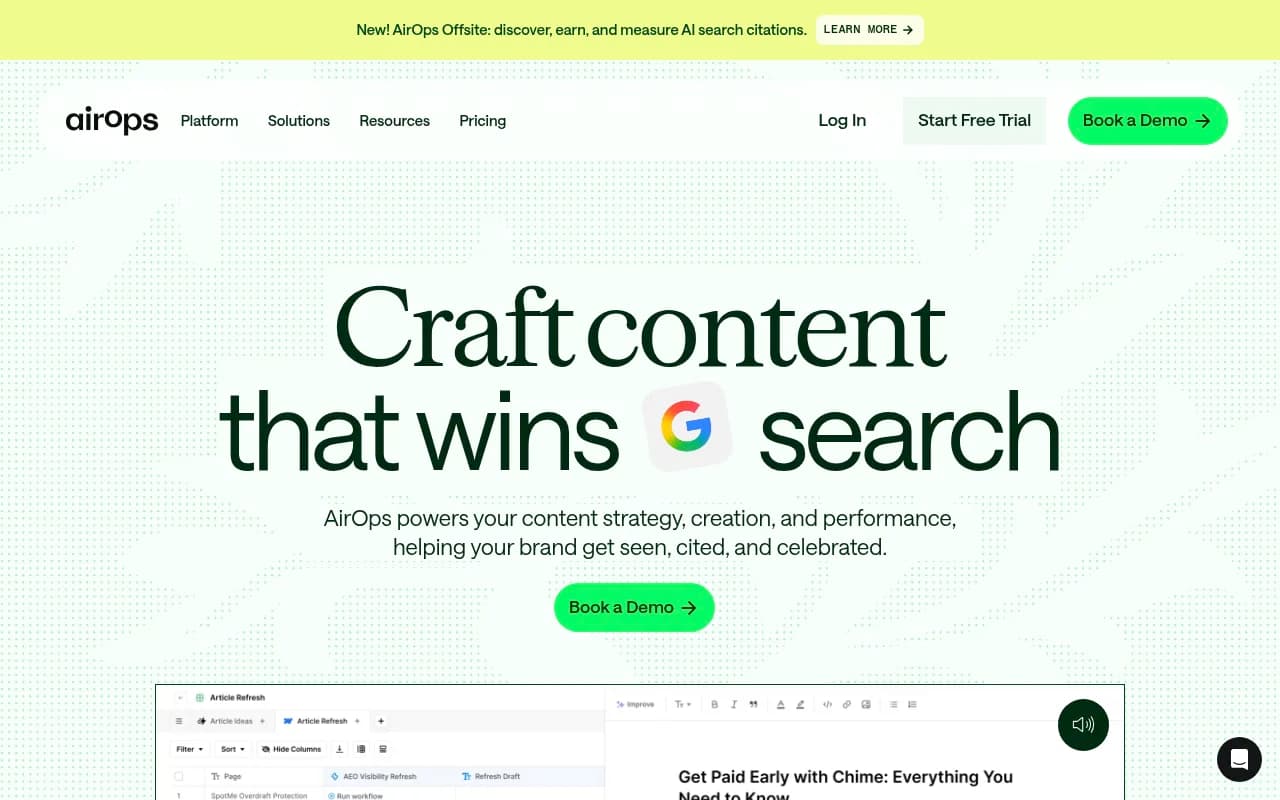
For content creation at scale, tools like SEO.ai and Surfer SEO help with optimization, while Jasper and AirOps are worth looking at for content generation workflows.
Step 5: Fix your technical AI crawlability
This step gets skipped constantly, and it's a real problem. Google crawlability and AI crawlability are not the same thing.
AI models like ChatGPT (GPTBot), Perplexity (PerplexityBot), and Claude (ClaudeBot) have their own crawlers. They visit your site independently of Googlebot, on their own schedules, and they can encounter their own errors. A page that Google indexes fine might be blocked to GPTBot by your robots.txt, or might fail to render correctly because of JavaScript dependencies.
Things to check:
- Are AI crawlers explicitly allowed in your robots.txt? (Check for GPTBot, PerplexityBot, ClaudeBot, and others)
- Are your most important pages rendering correctly for bots that don't execute JavaScript?
- Are AI crawlers actually visiting your site? How often? Which pages?
- Are there crawl errors specific to AI bots that you're not catching?
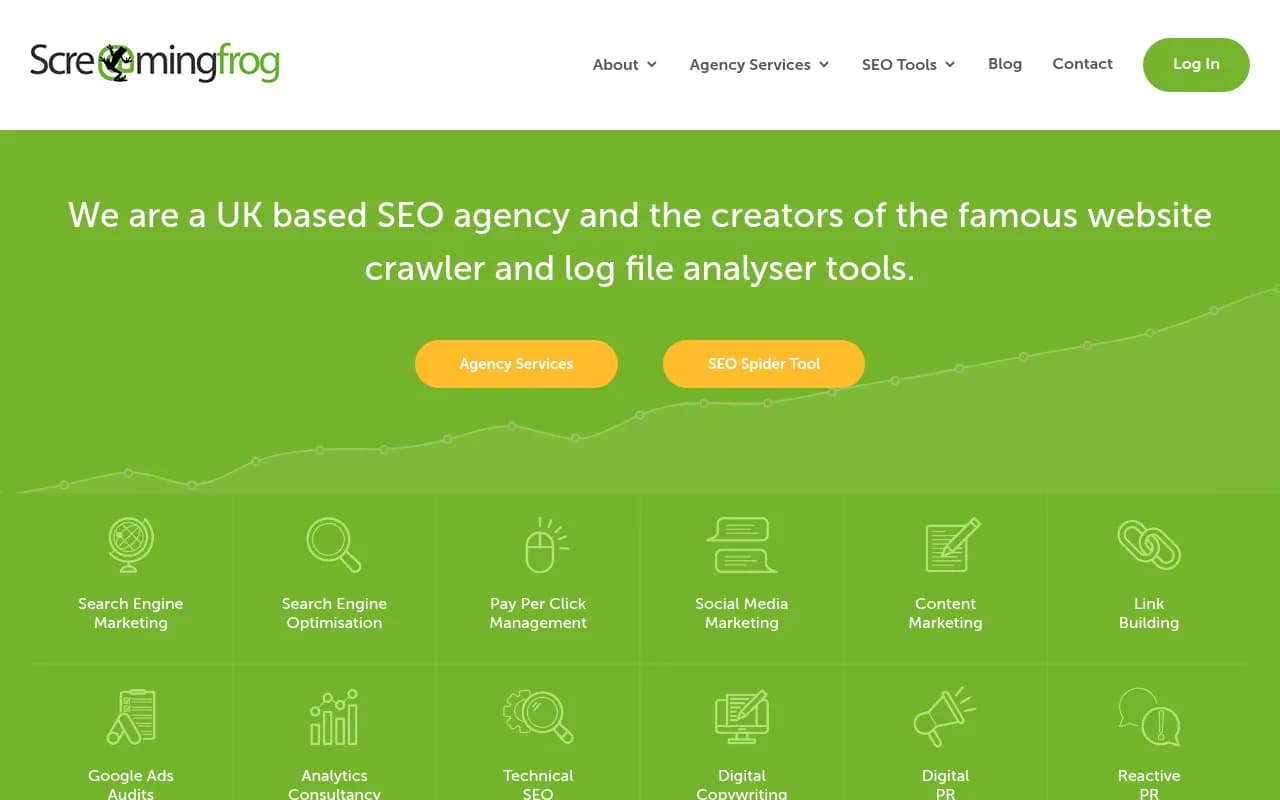
Screaming Frog is still the best tool for general crawl audits.
For AI-specific crawler monitoring, Promptwatch's crawler logs show you in real time which AI bots are hitting your site, which pages they're reading, and what errors they're encountering. Most other platforms don't have this at all.
Step 6: Track, attribute, and iterate
The last step is the one that turns a one-time project into a compounding strategy. You need to close the loop between what you publish and what actually gets cited -- and then between citations and actual traffic or revenue.
Here's what to track:
Citation tracking: Which of your pages are being cited by which AI models? How often? Is that number going up after you publish new content?
Prompt-level visibility: For each of your target prompts, are you appearing more or less often over time? Are you moving from "not mentioned" to "mentioned" to "cited as primary source"?
Traffic attribution: This is the hardest part. AI search traffic often shows up as direct traffic in Google Analytics because the referrer gets stripped. To properly attribute it, you need either a tracking snippet, a GSC integration, or server log analysis. Without this, you can't connect your AI visibility work to actual business outcomes.
Competitor movement: Are competitors gaining visibility on prompts you care about? Are you taking share from them?
The iteration loop looks like this: you publish a new page targeting a specific prompt cluster, you check whether AI models start citing it within 4-6 weeks, you look at whether that citation drives traffic, and you use that data to decide what to create next.
For the full loop -- gap analysis, content creation, citation tracking, and traffic attribution -- Promptwatch is the most complete platform available right now. Most competitors handle one or two of these steps; Promptwatch connects all of them.
Putting it all together: the strategy vs. tactics distinction
Here's a comparison of what a tactic-first approach looks like versus a strategy-first one:
| Dimension | Tactic-first approach | Strategy-first approach |
|---|---|---|
| Starting point | "What should I optimize?" | "What business problem am I solving?" |
| Content decisions | Based on keyword volume | Based on prompt gaps and competitor citations |
| Technical work | Standard SEO audit | AI crawler-specific audit |
| Measurement | Traffic and rankings | Citation rate, prompt visibility, revenue attribution |
| Iteration | Ad hoc | Systematic loop tied to business goals |
| Durability | Breaks when platforms change | Survives platform changes because it's grounded in intent |
The tactics -- FAQ schema, structured data, conversational content -- aren't wrong. They're just not sufficient on their own. They need to sit inside a strategy that knows why you're doing them and how you'll know if they're working.
Recommended tools by step
| Step | What you need | Tools to consider |
|---|---|---|
| 1. Define the problem | Business framing, funnel analysis | Internal data, Google Analytics |
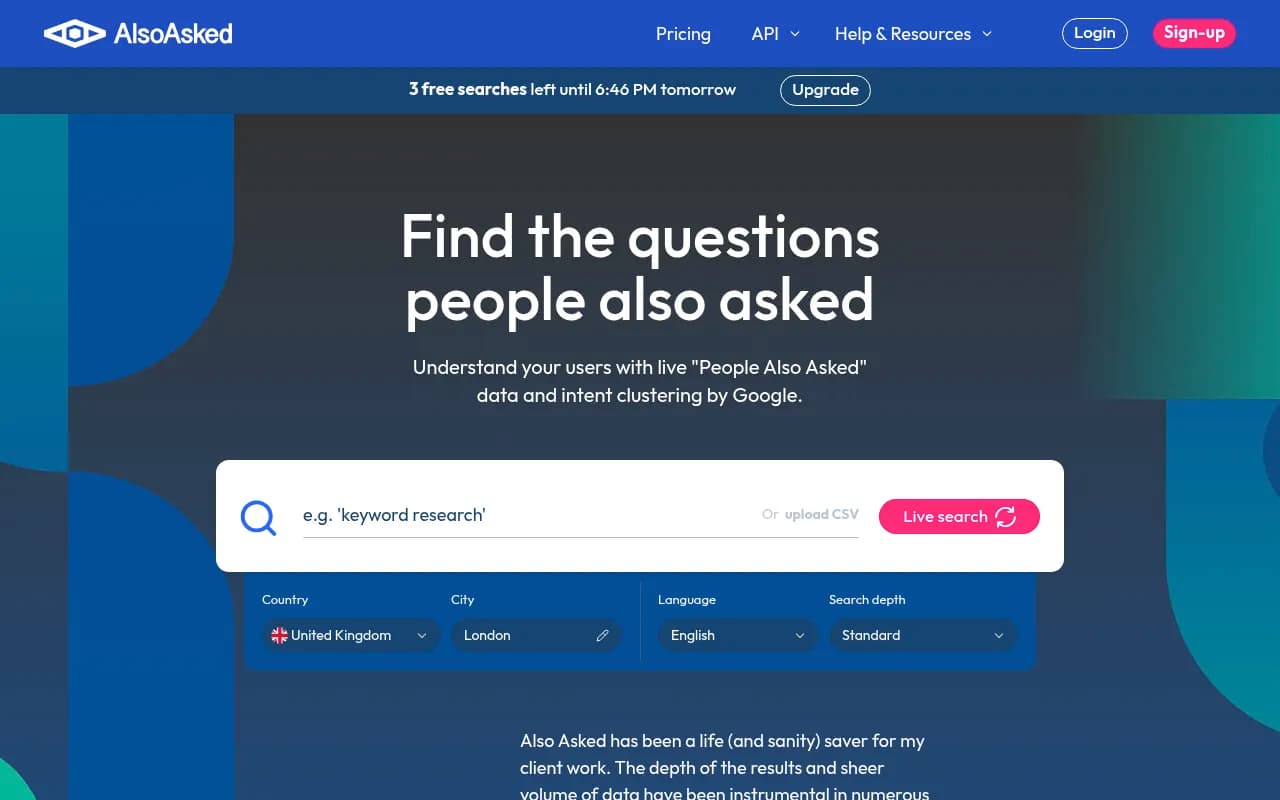
| 2. Map prompt intent | Prompt research, fan-out analysis | Promptwatch, AlsoAsked, AnswerThePublic |
| 3. Audit AI visibility | Brand monitoring across LLMs | Promptwatch, Otterly.AI, Profound |
| 4. Close content gaps | Content creation and optimization | SEO.ai, Surfer SEO, Jasper, AirOps |
| 5. Fix crawlability | Technical audit, bot monitoring | Screaming Frog, Promptwatch crawler logs |
| 6. Track and attribute | Citation tracking, traffic attribution | Promptwatch, Google Analytics, GSC |
One last thing
The reason most AI SEO strategies fail isn't bad tactics. It's that they're built to impress a platform rather than serve a customer. AI models cite sources that genuinely answer questions well. If your content does that -- if it's specific, accurate, well-structured, and covers the full topic -- you're already ahead of most of the competition.
The framework above is just a way to make sure you're doing the right work in the right order, and that you can actually tell whether it's working.