Key takeaways
- Otterly.AI is a solid monitoring tool, but it stops at showing you data — it doesn't help you act on it
- The most common complaint: you can see you're missing from AI responses, but the tool gives no guidance on what to change
- The best alternatives in 2026 combine monitoring with content gap analysis, AI writing, and traffic attribution
- Promptwatch is the only platform rated "Leader" across all GEO categories in a 2026 comparison of 12 platforms — and the only one that closes the full loop from gap discovery to content creation to revenue tracking
- Budget-focused options like Peec AI and LLM Pulse work fine for basic brand tracking; enterprise teams need something with more depth
Here's the honest version of the Otterly.AI story: it does what it says. You set up prompts, it checks whether your brand appears in ChatGPT, Perplexity, and Google AI Overviews, and you get a dashboard showing your visibility over time. For a lot of people, that's genuinely useful.
But then what?
You see you appeared in 4 out of 10 responses. Competitor X appeared in 8. You know there's a gap. You just have no idea what's causing it, which pages are being cited, or what content you'd need to create to close it. As one Reddit user put it: "It tracks the source, but gives zero actionable strategy on how to restructure content to get cited."
That's the implementation gap — and it's why so many teams that started with Otterly are now looking for something more. This guide covers 9 alternatives worth considering in 2026, with honest assessments of what each one actually does well.
The core problem with monitoring-only tools
Before getting into the alternatives, it's worth naming the pattern clearly. Most AI visibility tools — Otterly included — were built around a simple idea: query AI models, check if your brand appears, report the results. That was genuinely novel in 2023. In 2026, it's table stakes.
The tools that are pulling ahead are the ones that answer the follow-up question: now what? That means:
- Showing which specific prompts competitors rank for that you don't
- Identifying what content is missing from your site that AI models want to cite
- Actually helping you create that content (not just flagging the gap)
- Tracking whether new content improves your visibility scores
- Connecting visibility to actual website traffic and revenue
Very few tools do all of this. Most do one or two. Knowing which category a tool falls into before you pay for it saves a lot of frustration.
Quick comparison: Otterly.AI vs the alternatives
| Tool | Monitoring | Content gap analysis | AI content generation | Crawler logs | Traffic attribution | Starting price |
|---|---|---|---|---|---|---|
| Otterly.AI | Yes | No | No | No | No | $29/mo |
| Promptwatch | Yes | Yes | Yes | Yes | Yes | $99/mo |
| Peec AI | Yes | Limited | No | No | No | €89/mo |
| AthenaHQ | Yes | Yes | No | No | No | Custom |
| Scrunch AI | Yes | Yes | Limited | No | No | Custom |
| SE Ranking AI Visibility | Yes | Limited | No | No | No | $189/mo |
| LLM Pulse | Yes | No | No | No | No | €49/mo |
| Rankshift | Yes | No | No | No | No | Varies |
| ZipTie | Yes | Limited | No | No | No | Varies |
| Profound | Yes | Yes | No | No | Limited | $99/mo |
1. Promptwatch — best overall for teams that want to actually improve their rankings
Promptwatch is the most complete platform in this space right now, and the gap between it and the field is meaningful. Where most tools stop at "here's your visibility score," Promptwatch is built around a full optimization loop.

The core workflow: Answer Gap Analysis shows you the exact prompts where competitors are being cited but you're not. You see the specific topics and questions AI models want answers to but can't find on your site. From there, the built-in AI writing agent generates articles, listicles, and comparisons grounded in real citation data — not generic SEO filler, but content engineered to get cited by ChatGPT, Claude, Perplexity, and others. Then page-level tracking shows whether your new content is actually getting picked up.
A few things that stand out compared to the rest of the field:
The AI Crawler Logs feature is rare. You get real-time logs of AI crawlers hitting your site — which pages they read, errors they encounter, how often they return. Most competitors don't have this at all. It's the difference between guessing why you're not being cited and actually seeing the crawl behavior.
Traffic attribution is also genuinely useful. You can connect AI visibility to actual website visits via a code snippet, GSC integration, or server log analysis. Most monitoring tools can't tell you whether being cited in Perplexity actually drives any traffic. Promptwatch can.
It monitors 10 AI models (ChatGPT, Perplexity, Claude, Gemini, Google AI Overviews, Google AI Mode, Meta/Llama, DeepSeek, Grok, Mistral, Copilot), tracks Reddit and YouTube discussions that influence AI recommendations, and includes ChatGPT Shopping tracking for product-focused brands.
Pricing starts at $99/mo for the Essential plan (1 site, 50 prompts, 5 articles/month). Professional is $249/mo and adds crawler logs, state/city tracking, and 15 articles. Business is $579/mo for 5 sites and 30 articles. A free trial is available.
The main caveat: it's not the cheapest option. If you genuinely only need basic brand monitoring and have no interest in content optimization, there are cheaper tools. But if you want to actually move your visibility numbers, this is where the ROI is.
2. Peec AI — best for clean cross-engine reporting
Peec AI is a solid monitoring platform with a cleaner interface than most. It tracks brand visibility across ChatGPT, Perplexity, Claude, and Gemini, and its reporting is genuinely easy to read — which matters when you're presenting to stakeholders who don't want to dig through raw data.

The cross-engine comparison view is one of the better implementations in this price range. You can see at a glance which models are citing you vs competitors, and the export options are decent for building custom reports.
Where it falls short: it's still fundamentally a monitoring tool. There's no content gap analysis, no writing features, and no crawler logs. You'll know you have a visibility problem; you won't know how to fix it. At €89/mo, it's reasonably priced for what it does — but "what it does" has a ceiling.
Good fit for: SaaS and B2B teams that want clean visibility dashboards and don't need optimization features yet.
3. AthenaHQ — best for mid-market analytics depth
AthenaHQ sits in an interesting middle ground. It goes further than basic monitoring — there's genuine competitor benchmarking and some content gap analysis — but it stops short of actually helping you create content. Think of it as a strong analytics layer without the execution tools.

The platform is well-designed for teams that want to understand why their visibility looks the way it does. The competitor analysis is more detailed than most tools at this level, and the prompt tracking gives you a reasonable view of which queries matter most in your category.
The pricing is custom (enterprise-oriented), which makes it harder to evaluate for smaller teams. And the lack of content generation means you're still on your own when it comes to actually fixing the gaps it identifies.
Good fit for: Mid-market brands and agencies that want deeper analytics and are comfortable using separate tools for content creation.
4. Scrunch AI — best for enterprise GEO stacks
Scrunch AI is one of the more capable platforms in the enterprise tier. It has solid monitoring across major AI models, some content optimization guidance, and reporting that works at scale. Several large brands use it as their primary GEO platform.
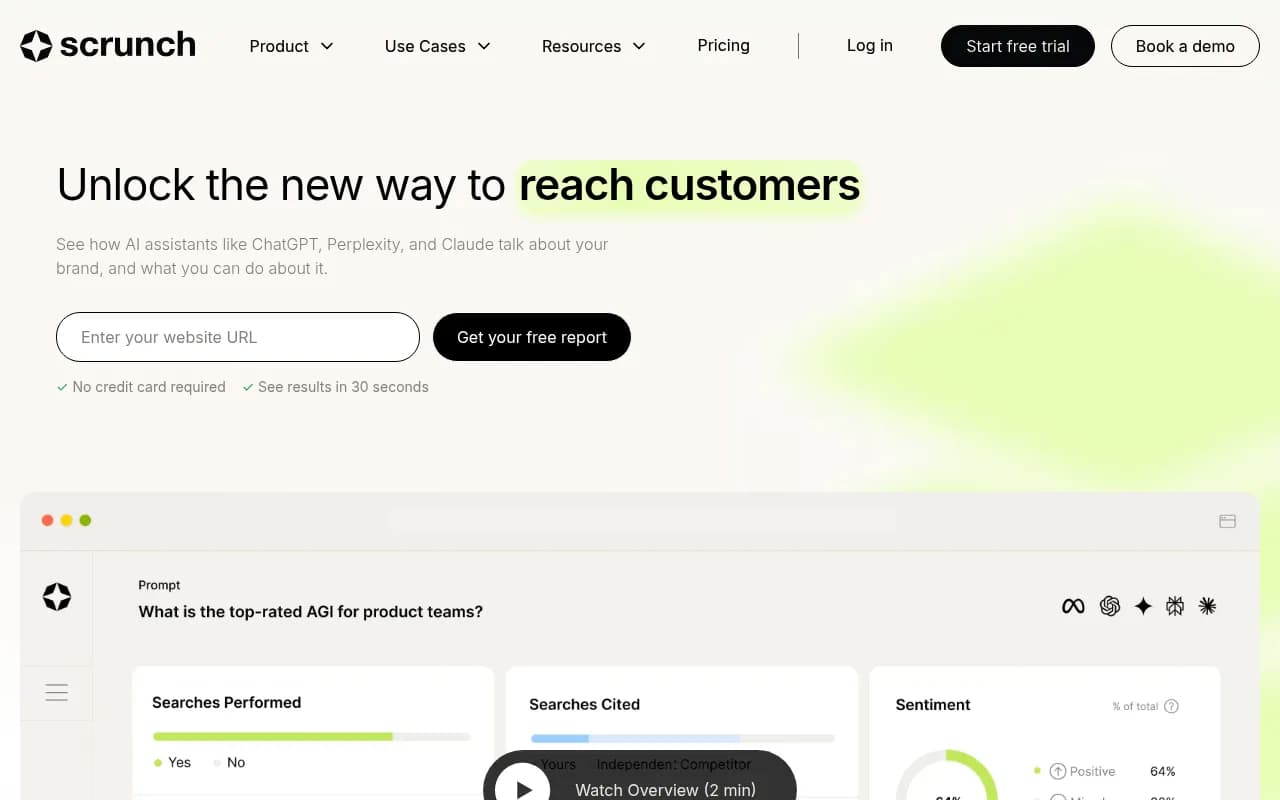
The feature set is genuinely strong — better than most monitoring-only tools — but the pricing reflects that. It's custom/enterprise pricing, which typically means you're looking at a significant investment. There's also no Reddit or YouTube tracking, and no ChatGPT Shopping monitoring, which are gaps that matter depending on your category.
For enterprise teams with budget and a need for robust multi-brand tracking, Scrunch is worth evaluating. For everyone else, the price-to-feature ratio probably doesn't work.
Good fit for: Enterprise brands with complex multi-brand GEO needs and existing budget for premium tooling.
5. SE Ranking AI Visibility — best for teams already in the SE Ranking ecosystem
If your team already uses SE Ranking for traditional SEO, the AI Visibility add-on is a natural extension. It layers AI search monitoring on top of the existing rank tracking and site audit infrastructure you're already paying for.
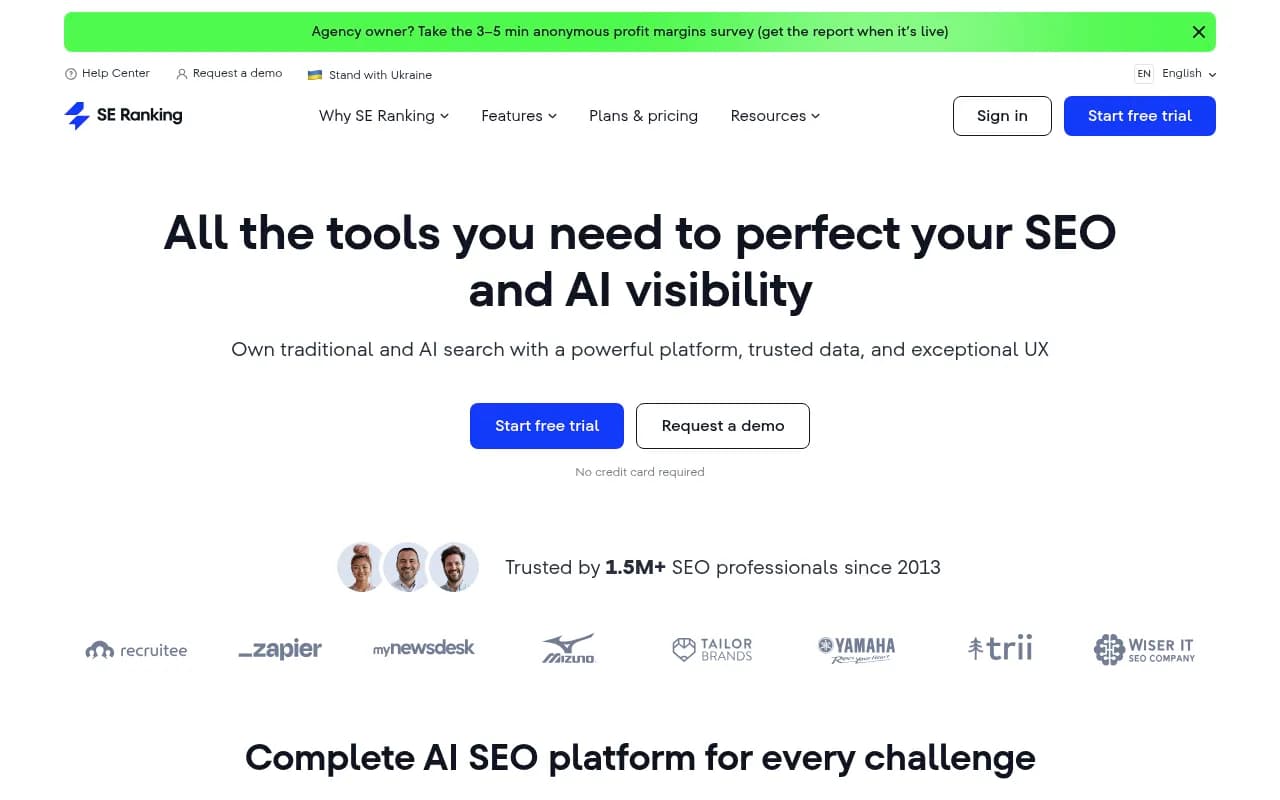
The integration is the main selling point. Having your traditional SEO data and AI visibility data in one place reduces context-switching and makes it easier to see how the two relate. The AI monitoring itself is competent — it covers the major models and gives you decent competitor benchmarking.
The limitation is that it's an add-on, not a purpose-built GEO platform. The depth of AI-specific features (prompt intelligence, content gap analysis, crawler logs) doesn't match what dedicated GEO tools offer. It's a reasonable choice if you want to dip into AI visibility without adding another tool to your stack.
Starting price for AI Visibility is around $189/mo.
Good fit for: SE Ranking users who want AI monitoring without switching platforms.
6. LLM Pulse — best budget option for brand tracking
LLM Pulse does one thing well: it tracks brand mentions and sentiment across major AI models at a price point that's hard to argue with. At €49/mo, it's one of the most affordable options in the space.
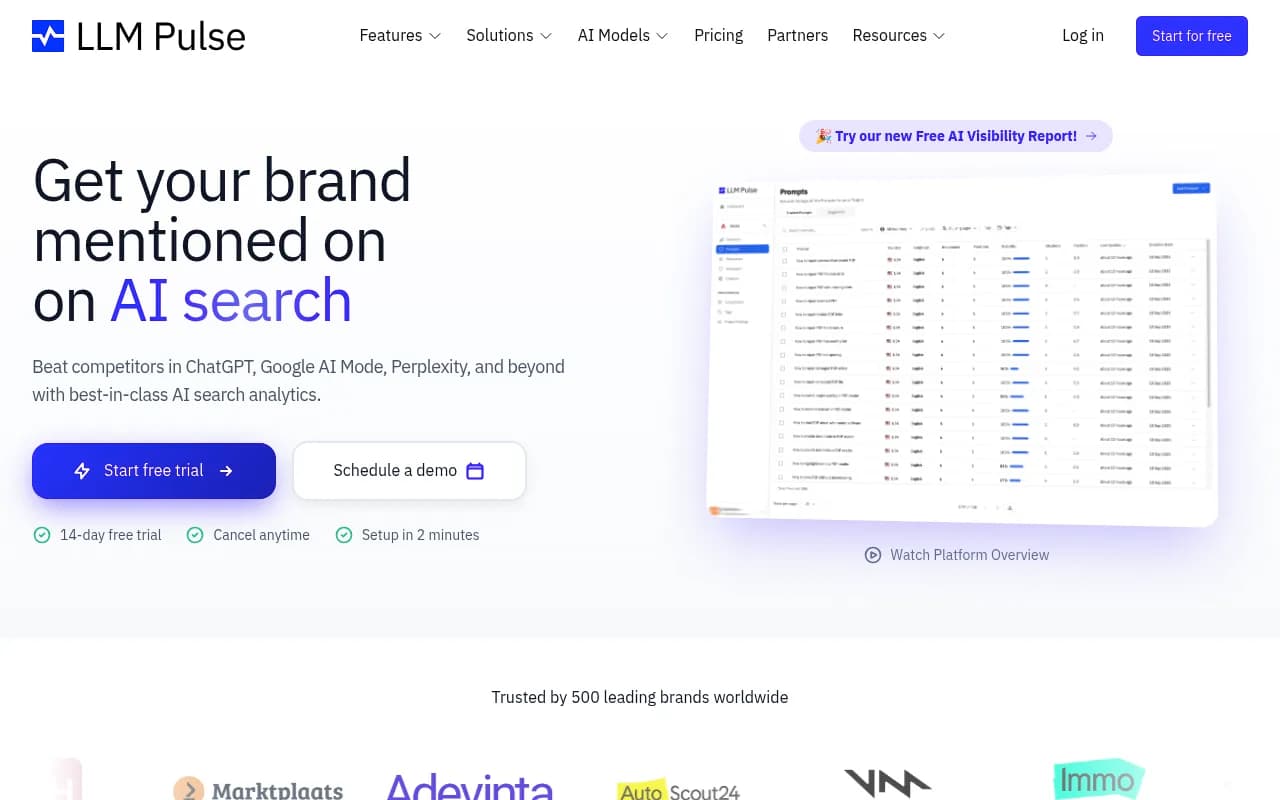
The share-of-recommendations metric is genuinely useful for CMOs who want a simple answer to "how often does AI recommend us vs competitors?" The sentiment tracking adds some color beyond raw mention counts.
But it's firmly in the monitoring-only category. No content tools, no crawler logs, no traffic attribution. It's a dashboard that tells you where you stand. For teams that just need to report on AI visibility without needing to optimize it, that might be enough.
Good fit for: Small teams, agencies running basic brand health checks, or anyone who needs a low-cost entry point into AI visibility tracking.
7. Rankshift — best for straightforward brand visibility tracking
Rankshift focuses on tracking brand visibility across ChatGPT, Perplexity, and other AI search engines with a clean, no-frills interface. It's built for marketers who want to get up and running quickly without a steep learning curve.

The setup is fast and the tracking is reliable. For teams that have been burned by overly complex platforms, the simplicity is a genuine feature. The reporting is clear enough to share with non-technical stakeholders.
The trade-off is depth. Rankshift doesn't offer content optimization, gap analysis, or crawler monitoring. It's a visibility tracker, not an optimization platform. Whether that's a problem depends entirely on what you need.
Good fit for: Marketing teams that want quick, reliable brand monitoring without the complexity of a full GEO platform.
8. ZipTie — best for deep AI visibility analysis
ZipTie positions itself as a deep analysis platform for AI visibility tracking, going beyond surface-level mention counts to give you more context about how and why you're appearing (or not appearing) in AI responses.
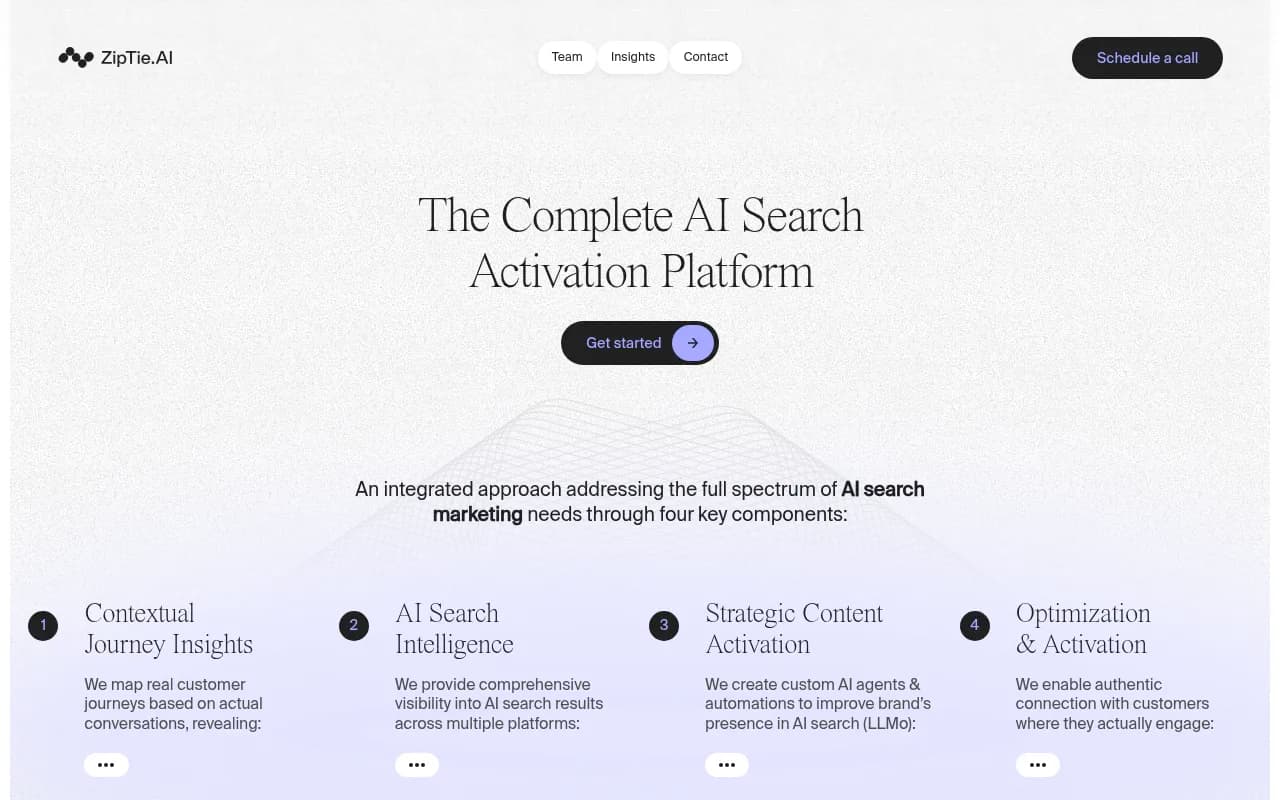
The analysis depth is a genuine differentiator compared to basic monitoring tools. You get more context around citation patterns, competitor positioning, and prompt-level data. It's a good choice for teams that want to understand the mechanics of AI visibility, not just track a number.
The gap is on the execution side — there's limited content generation capability, and the workflow for turning insights into action still requires external tools. It's strong on the "understand" part of the loop, weaker on the "fix it" part.
Good fit for: SEO teams and analysts who want deeper visibility data and are comfortable acting on insights independently.
9. Profound — best for enterprise AI visibility with some optimization features
Profound is one of the more established names in the enterprise GEO space. It monitors brand mentions across 9+ AI search engines, has solid competitor benchmarking, and includes some content optimization guidance that goes beyond pure monitoring.
Profound

The "read/write AI model" feature is interesting — it can both analyze your AI visibility and suggest content changes. The automation capabilities are more developed than most competitors. For large brands running complex GEO operations, it's a credible option.
The pricing starts at $99/mo but scales up quickly for enterprise features. And while it has more optimization capability than pure monitoring tools, it doesn't have the full content generation workflow that Promptwatch offers. You'll get guidance on what to change, but the writing still happens elsewhere.
Good fit for: Large brands and enterprises that need robust monitoring with some optimization guidance and have budget for premium tooling.
How to choose the right tool
The honest answer is that the right tool depends on where you are in your GEO journey.
If you're just starting out and need to understand your current AI visibility before doing anything else, a cheaper monitoring tool (LLM Pulse, Peec AI, or even Otterly itself) gets you there without overcommitting budget.
If you're past the "what's my visibility score?" stage and want to actually move the needle, you need a platform with content gap analysis and ideally content generation. That's a much shorter list. Promptwatch is the most complete option here, with the full loop from gap identification to content creation to traffic attribution. Profound and AthenaHQ offer partial versions of this.
If you're in an enterprise context with multiple brands, complex reporting needs, and a dedicated GEO team, Scrunch AI and Profound are worth evaluating alongside Promptwatch.
One thing worth saying directly: the monitoring-only tools aren't bad products. They do what they say. The issue is that in 2026, knowing your visibility score without knowing how to improve it is a bit like having a fitness tracker that tells you your heart rate but can't tell you what workout to do. The data is real; the utility is limited.
The platforms that are pulling ahead are the ones that close the loop — find the gap, create the content, track the result. That's the workflow that actually moves visibility numbers, and it's worth paying for.