Key takeaways
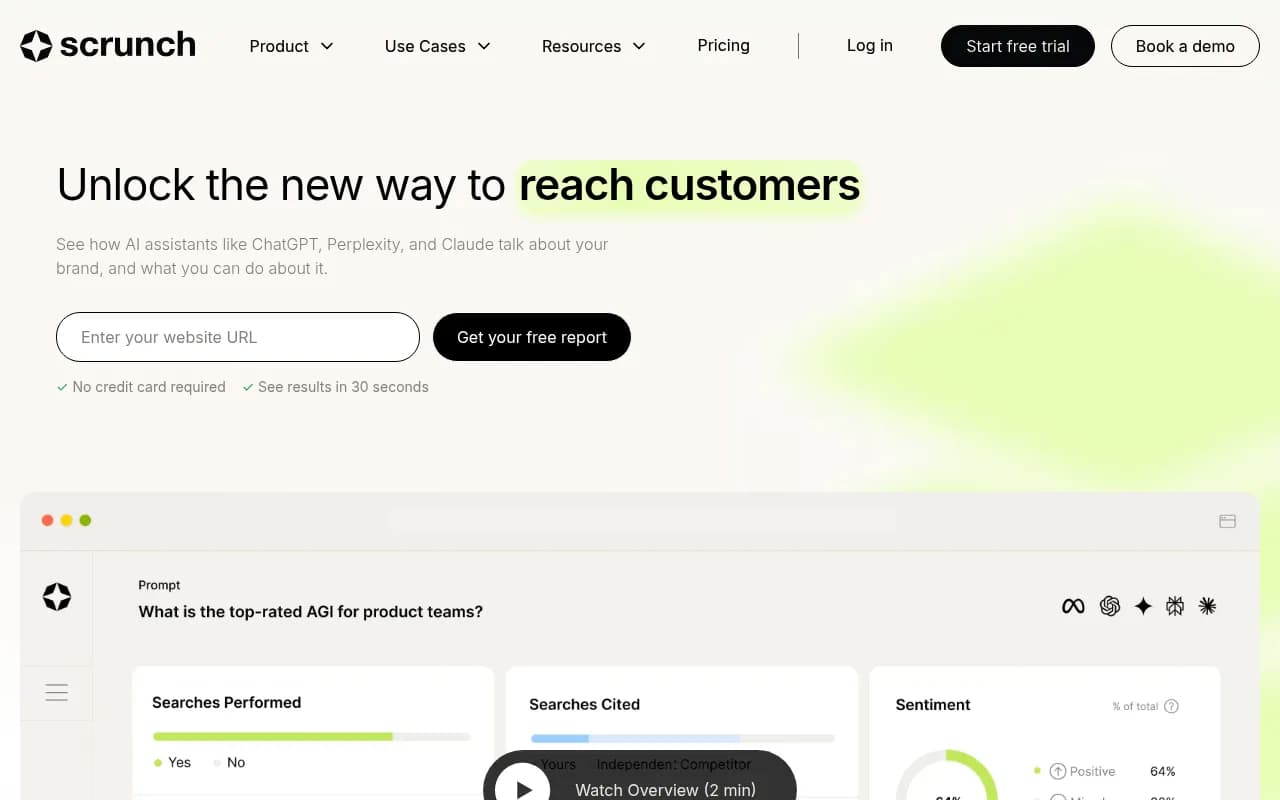
- Scrunch AI's Core plan starts at $250/mo and only covers 4 LLMs -- Claude, Gemini, Meta AI, and Grok require an Enterprise contract
- Most small business teams need tools that help them act on visibility data, not just report it
- The best alternatives combine monitoring with content gap analysis, AI writing, and traffic attribution
- Promptwatch covers 10 AI models, costs less than Scrunch's Core plan, and includes content generation -- making it the strongest all-around pick for teams that want to close the loop
- Budget-conscious teams can start with Otterly.AI or Peec AI, but expect to hit walls quickly when you need to actually improve your rankings
Scrunch AI raised serious money, landed big-name customers, and built something genuinely interesting with its AXP (Agent Experience Platform). The idea of serving AI-optimized content directly to AI crawlers -- reducing page size by up to 98% -- is clever. There's nothing else quite like it in the GEO space.
But here's the problem if you're a small business: that feature is Enterprise-only. And the Core plan at $250/mo locks you to just 4 LLMs (ChatGPT, Perplexity, Google AI Overviews, and Copilot). Want Claude? Gemini? Meta AI? Grok? Enterprise contract. Reviewers on G2 also flag that prompt credits deplete fast when you're tracking multiple engines, there's no report export, and optimization suggestions are thin on actual implementation guidance.
So you're paying $250/mo for monitoring data with limited coverage and no clear path to acting on it. For a small business, that's a tough sell.
These five alternatives give you more coverage, more actionable features, and in most cases, a lower price tag.
How to pick the right alternative
Before jumping into the list, it's worth being honest about what you actually need. Most small business marketing teams fall into one of two camps:
Camp 1: "We just need to know where we stand." You want to see whether ChatGPT mentions your brand, which competitors show up, and how your visibility trends over time. Basic monitoring is enough for now.
Camp 2: "We need to actually improve our AI visibility." You want to know what content to create, which prompts to target, and whether your efforts are working. Monitoring alone won't cut it -- you need a platform that helps you take action.
The tools below are ranked with Camp 2 in mind, because that's where real business value lives. But I've noted which tools work for Camp 1 if you're just getting started.
Comparison table
| Tool | Starting price | LLMs covered | Content generation | Crawler logs | Best for |
|---|---|---|---|---|---|
| Promptwatch | $99/mo | 10 | Yes (built-in AI writer) | Yes (Professional+) | Teams that want the full loop: track, fix, measure |
| Otterly.AI | ~$49/mo | 4-5 | No | No | Budget monitoring, getting started |
| Peec AI | ~$49/mo | 3-4 | No | No | Lightweight tracking for small teams |
| AthenaHQ | Custom | 6+ | Limited (credit-based) | No | Mid-market teams with optimization budget |
| GetMint | Contact | 5+ | Yes | No | Content-forward teams needing execution help |
1. Promptwatch -- best overall for small businesses that want to act, not just watch
Promptwatch is the tool I'd point most small business teams to first, and not just because it's cheaper than Scrunch. The real difference is what it does after it shows you the data.

Most GEO tools -- including Scrunch at the Core tier -- are monitoring dashboards. They show you where you're visible, where you're not, and maybe which competitors are winning. Then they stop. You're left figuring out what to do about it.
Promptwatch is built around a different idea: find the gap, fix the gap, measure the result. The Answer Gap Analysis shows you exactly which prompts your competitors are getting cited for that you're not. Not vague categories -- specific questions and topics that AI models are answering with competitor content because your site doesn't have a good answer. From there, the built-in AI writing agent generates articles, listicles, and comparisons grounded in real citation data (880M+ citations analyzed). Then page-level tracking shows whether those new pages actually start getting cited.
For a small business with limited time and budget, that loop matters. You're not just paying for a dashboard -- you're paying for a system that tells you what to write next.
Coverage-wise, Promptwatch monitors 10 AI models: ChatGPT, Perplexity, Google AI Overviews, Google AI Mode, Claude, Gemini, Meta/Llama, DeepSeek, Grok, Mistral, and Copilot. Scrunch's Core plan covers 4 of those. The Professional plan ($249/mo) adds AI crawler logs -- real-time logs of which pages ChatGPT, Claude, and Perplexity are actually crawling on your site, and what errors they're hitting. That's genuinely rare. Most competitors don't have this at all.
Pricing: Essential at $99/mo (1 site, 50 prompts, 5 articles/mo), Professional at $249/mo (2 sites, 150 prompts, 15 articles, crawler logs), Business at $579/mo. Free trial available.
The one honest caveat: if you're a solo founder who just wants to check in on brand mentions once a week, this might be more platform than you need. But for any team actively trying to improve AI visibility, it's the strongest option at this price point.
2. Otterly.AI -- best for budget monitoring when you're just starting out
Otterly.AI comes up constantly in SEO circles as the go-to entry point for AI visibility tracking. It's affordable, reasonably well-designed, and gets you basic monitoring across ChatGPT, Perplexity, and Google AI Overviews without a lot of setup friction.
Otterly.AI

For a small business that's never tracked AI visibility before, Otterly.AI is a decent first step. You can see whether your brand shows up, track a handful of prompts, and get a feel for how AI search is affecting your category.
The limitation is that it stops there. No content generation, no crawler logs, no gap analysis that tells you what to create. Reviewers consistently note that it's a monitoring tool, not an optimization tool. Once you've seen the data and want to do something about it, you'll need to take that work elsewhere.
That's fine if you're in Camp 1 (just need to know where you stand). It becomes frustrating quickly if you're in Camp 2.
3. Peec AI -- lightweight tracking for very small teams
Peec AI is similar to Otterly.AI in positioning: affordable, focused on monitoring, and good for teams that want basic visibility data without a complex setup.
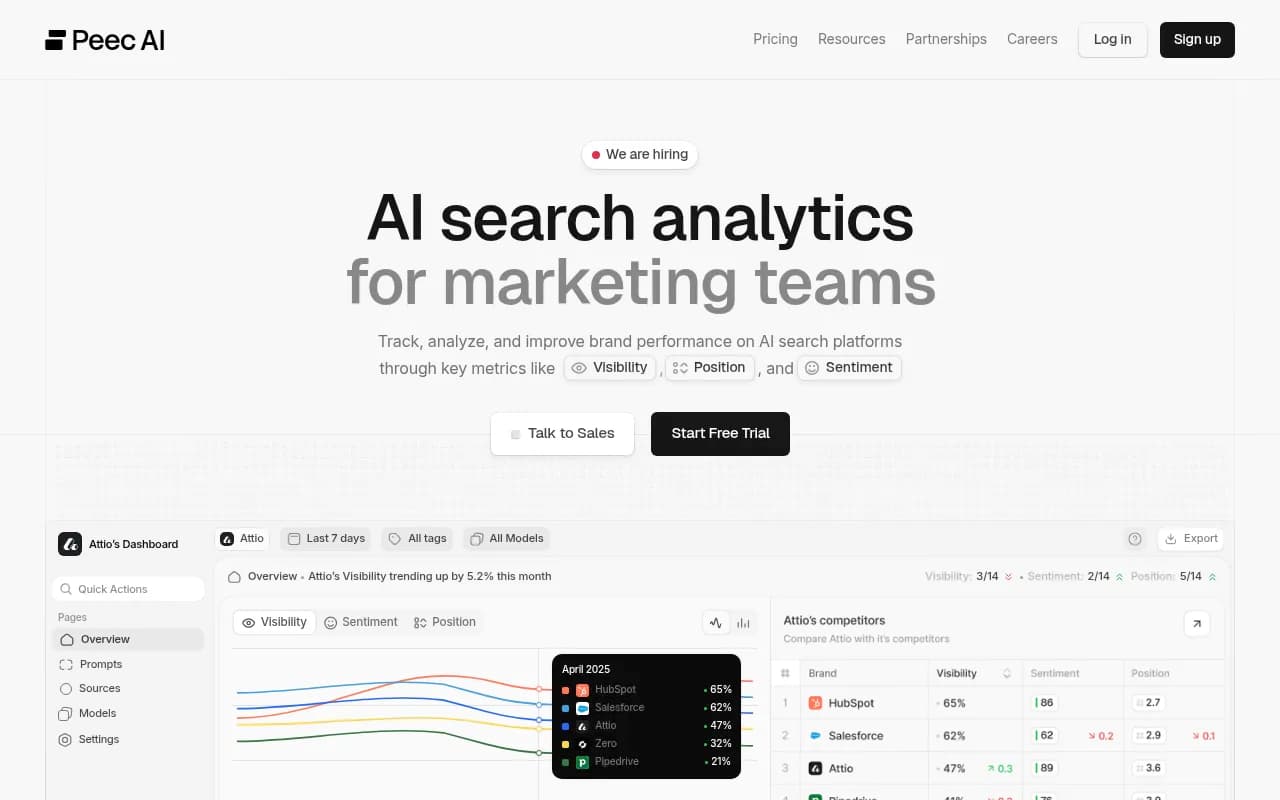
Where Peec AI differentiates slightly is in its interface simplicity. It's genuinely easy to get up and running, which matters if you don't have a dedicated SEO person and just need something that works. Coverage is limited to a few major LLMs, and like Otterly.AI, there's no content generation or optimization workflow built in.
For a small business owner who wants to check whether ChatGPT is recommending competitors over them -- and get a rough sense of the gap -- Peec AI does the job. For anything beyond that, you'll hit its ceiling fast.
4. AthenaHQ -- solid mid-market option with more depth
AthenaHQ sits in an interesting middle ground. It covers more LLMs than Otterly.AI or Peec AI, has more structured monitoring, and offers some optimization workflows -- though these are credit-based, which means costs can add up if you're running a lot of queries.

The platform is genuinely useful for teams that have moved past "do we have an AI visibility problem?" and into "which specific prompts should we be targeting?" It surfaces competitor data reasonably well and gives you a clearer picture of share-of-voice across models.
The gap is on the content side. AthenaHQ is primarily a monitoring and analysis platform. It can tell you what's missing, but it doesn't help you create the content to fill those gaps. For small business teams without a dedicated content operation, that means you're still doing the hard work manually after you leave the dashboard.
Pricing is custom/contact-based, which is a bit of a friction point if you're trying to evaluate quickly.
5. GetMint -- best for content-forward teams that need execution help
GetMint takes a different angle from most tools on this list. Rather than leading with monitoring dashboards, it's built around helping teams actually create the content that wins AI citations. If your main bottleneck is execution -- you know you need more AI-optimized content but don't have the bandwidth to produce it -- GetMint is worth a look.
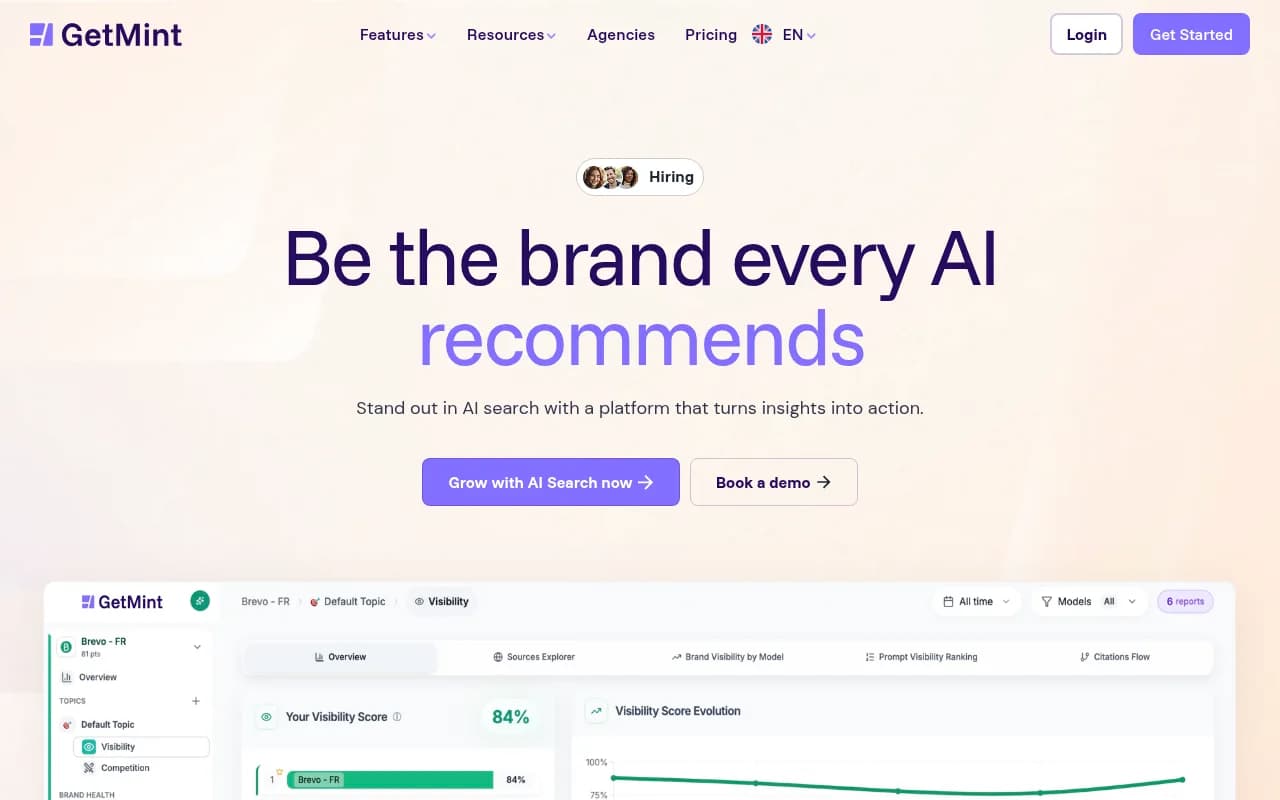
The platform covers 5+ AI engines and includes content creation workflows that are more tightly integrated with the visibility data than most competitors. The framing is "move from diagnosis to execution," which is a real problem in this space -- plenty of tools diagnose, few help you execute.
The trade-off is that GetMint's monitoring depth is lighter than Promptwatch's. You get fewer LLMs covered, no crawler logs, and less granular prompt intelligence. If you need both strong monitoring and strong content creation in one place, Promptwatch is still the more complete option. But if content production is your primary need and you're willing to accept lighter monitoring, GetMint is a legitimate alternative.
What Scrunch AI does well (and why you might still consider it)
To be fair: Scrunch AI isn't a bad product. Its G2 rating of 4.6/5 across 50+ reviews is real, and the AXP technology -- serving AI-optimized content directly to AI crawlers -- is genuinely innovative. If you're an enterprise team with a developer who can implement AXP and you need that specific technical capability, Scrunch might be worth the Enterprise contract conversation.
But for small businesses? The Core plan's limitations (4 LLMs, no report export, thin optimization guidance, quick credit depletion) make it hard to justify at $250/mo when alternatives like Promptwatch cover more ground for less money and actually help you improve your rankings.
The question most small businesses should ask first
Before picking a tool, it's worth asking: what's the actual outcome I'm trying to drive?
If the answer is "I want to know whether AI search is sending traffic to my site and whether that traffic converts," you need traffic attribution, not just citation tracking. Promptwatch handles this through a code snippet, Google Search Console integration, or server log analysis -- connecting AI visibility to actual revenue. Most tools on this list don't go that far.
If the answer is "I want to show up when someone asks ChatGPT for a recommendation in my category," you need both monitoring (to see where you're missing) and content creation (to fill the gaps). Again, that points toward Promptwatch or GetMint over pure monitoring tools.
If the answer is "I just want to see what's happening before I commit to anything," start with Otterly.AI or Peec AI. They're low-cost ways to get oriented before you invest in a more complete platform.
Bottom line
The GEO tool market in 2026 is crowded, and most tools are still monitoring-only dashboards. That's fine as a starting point, but it's not a strategy.
For small businesses that want to actually move the needle on AI search visibility -- not just watch the numbers -- the combination of gap analysis, content generation, and traffic attribution in one platform is what separates useful tools from expensive dashboards. Promptwatch is the clearest example of that in the market right now, and it costs less than Scrunch's Core plan while covering more than twice as many AI models.
Start with a free trial, run your first Answer Gap Analysis, and see what content your site is actually missing. That's a more productive use of an afternoon than comparing dashboard screenshots.