Key takeaways
- Most AI visibility tools are monitoring dashboards — they show you where you're invisible but don't help you fix it
- The tools worth paying for in 2026 close a full loop: find gaps, generate content, track results
- Promptwatch is the only platform rated a leader across all categories in a 2026 comparison of 12 GEO platforms, largely because it combines tracking with content generation and crawler log analysis
- Frase and Search Atlas are strong alternatives if your team wants content creation tightly integrated with visibility data
- Profound and Peec AI are solid choices if enterprise-grade monitoring is your primary need and you're handling content separately
- If you're already in Semrush, the AI Toolkit is a reasonable starting point — but it has real limits
About 68% of Google searches ended without a click in early 2026, according to SparkToro's analysis of Similarweb clickstream data. ChatGPT hit roughly 900 million weekly active users in February 2026. Google AI Overviews now reach an estimated 2 billion people per month.
That's the new reality: the answer is the destination. If you're not cited inside it, you don't exist for that query.
The problem is that most tools built to address this stop at the diagnosis. They tell you your brand appeared in 12% of relevant AI responses last month, that a competitor appeared in 47%, and that you're missing from ChatGPT entirely for your most important product category. Then they leave you there, staring at a chart.
That's useful information. It's not a solution.
This guide covers the platforms that actually help you close the gap — not just measure it.
Why "monitoring only" isn't enough anymore
The first wave of AI visibility tools was essentially alert systems. You'd set up a list of prompts, the tool would run them against ChatGPT or Perplexity, and you'd get a report showing your brand's mention rate. That was genuinely novel in 2024.
In 2026, that's table stakes. The harder problem is figuring out why you're not being cited and what to do about it.
AI models cite content that directly answers the questions users are asking. If your website doesn't have a page that clearly answers "what's the best [category] tool for [use case]," an AI model will find someone else's page that does. The fix isn't technical — it's content. You need to know which questions are being asked, which ones your site currently answers, and which ones it doesn't. Then you need to create the missing content.
That three-step loop — find gaps, create content, track results — is what separates the useful platforms from the expensive dashboards.
The 6 platforms worth considering
1. Promptwatch — the full loop, end to end
Promptwatch is the most complete platform in this category right now. It's used by 1,480+ brands and agencies including Booking.com and Center Parcs, and in a 2026 comparison of 12 GEO platforms it was the only one rated a "leader" across all evaluation categories.
What makes it different from most competitors isn't the monitoring — it's what comes after. The Answer Gap Analysis shows you exactly which prompts competitors are visible for that you're not. Not just "you're missing from this topic area" but the specific questions, with prompt volume data and difficulty scores, so you can prioritize which gaps are actually worth closing.
From there, Content Agents generate articles, listicles, comparisons, and briefs grounded in that prompt data — combined with citation data, competitor analysis, and brand guidance you upload. The output is content designed to answer the specific questions AI models are already asking, not generic SEO filler.
Then you track results at the page level: which pages are being cited, by which models, how often, and when. The AI Crawler Logs show you in real time when GPTBot, ClaudeBot, or Perplexity's crawler hits your site, which pages they read, and whether those visits convert to citations. Most competitors don't have this at all.
It monitors 10 AI models: ChatGPT, Perplexity, Google AI Overviews, Google AI Mode, Claude, Gemini, Meta/Llama, DeepSeek, Grok, and Mistral. Pricing starts at $99/month for the Essential plan (1 site, 50 prompts, 5 articles), with Professional at $249/month and Business at $579/month.

2. Frase — content creation with visibility data baked in
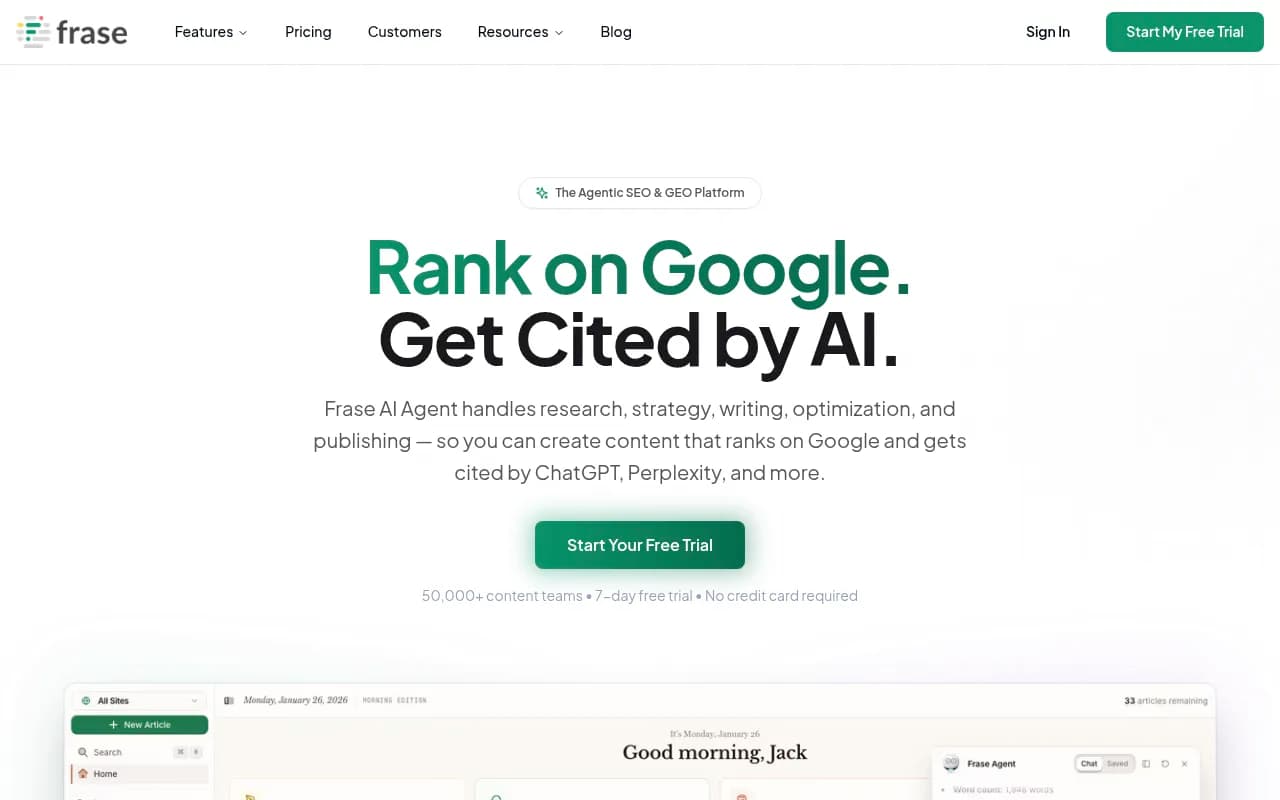
Frase has been an SEO content tool for years, and in 2026 it's made a serious push into AI visibility. The pitch is similar to Promptwatch's: track where you're missing from AI responses, then use the platform to write content that closes those gaps.
Where Frase is strongest is the content creation workflow itself. The research and writing interface is mature and well-designed, and teams that are already using Frase for traditional SEO content will find the AI visibility features slot in naturally. The monitoring side covers ChatGPT, Perplexity, Claude, and Gemini.
The gap compared to Promptwatch is on the data infrastructure side. Frase doesn't have crawler log analysis, doesn't track ChatGPT Shopping or entity mentions, and the prompt intelligence (volume estimates, difficulty scores, query fan-outs) is less developed. For a team that primarily wants to write better content and see if it gets cited, Frase is a strong option. For a team that wants to understand the full picture of how AI engines discover and cite their site, it falls short.
3. Search Atlas — automation-heavy, good for agencies
Search Atlas takes a different approach: it leans heavily on automation. The platform can fix, optimize, and publish content with minimal manual intervention, which makes it appealing for agencies managing multiple clients or brands with large content backlogs.
On the AI visibility side, it tracks brand mentions across the major models and has content generation built in. The automation layer is genuinely useful — you can set up workflows that monitor for visibility gaps and trigger content creation without someone manually reviewing every data point.
The tradeoff is depth. The prompt intelligence isn't as granular as Promptwatch's, and the crawler log analysis is limited. For an agency that needs to run AI visibility programs across 10+ clients efficiently, Search Atlas is worth a look. For a single brand that wants to really understand what's happening at the citation level, you'll want more.
4. Profound — enterprise monitoring, serious depth
Profound is the strongest dedicated monitoring platform in this space. It tracks brand mentions across 9+ AI search engines with enterprise-grade reporting, and the data quality is genuinely good. Large brands that need to report AI visibility metrics to executives will find Profound's dashboards and export capabilities well-suited to that.
The honest limitation: Profound is a monitoring tool. It shows you the problem clearly and in detail. It doesn't help you fix it. There's no content generation, no answer gap analysis that surfaces specific content to create, no crawler logs. You'll need a separate workflow — and separate tools — to act on what you find.
For a large organization with a dedicated content team that just needs reliable visibility data, that's fine. For most marketing teams that are already stretched thin, paying for monitoring and then figuring out the fix separately is a harder sell.
Profound

5. Peec AI — deep research, agency-friendly
Peec AI is frequently mentioned in the same breath as Profound for teams that want serious monitoring depth. It's particularly popular with agencies that need to run detailed AI visibility audits for clients — the research capabilities are strong and the reporting is clean.
Like Profound, it's primarily a monitoring and research tool. Content creation and optimization happen outside the platform. The prompt coverage is solid and the competitive benchmarking is useful, but if you're looking for a tool that closes the loop from data to content to results, Peec AI isn't it.
Where it earns its place: if your agency already has a content production workflow and just needs reliable AI visibility data to inform it, Peec AI is a reasonable choice. The price point is also more accessible than some enterprise-focused competitors.

6. Semrush AI Toolkit — good starting point if you're already in Semrush
Semrush added AI search tracking to its platform, and for teams already standardized on Semrush it's the path of least resistance. You get brand mention tracking across the major AI models, some basic prompt monitoring, and it integrates with the rest of Semrush's SEO data.
The limitations are real though. Semrush uses fixed prompts rather than letting you define your own, which means you're tracking what Semrush thinks matters rather than what your actual customers are asking. There's no AI traffic attribution, no crawler logs, and the content generation side is handled by ContentShake AI as a separate product rather than being integrated into the visibility workflow.
For a team that wants to dip a toe into AI visibility tracking without adding a new platform, the Semrush AI Toolkit works. For a team that wants to actually improve their AI visibility, it's a starting point, not a destination.
How these platforms compare
| Platform | Monitoring | Content generation | Crawler logs | Prompt intelligence | Best for |
|---|---|---|---|---|---|
| Promptwatch | 10 AI models | Yes, AI-powered | Yes | Volume, difficulty, fan-outs | Full-loop optimization |
| Frase | 4 AI models | Yes, mature workflow | No | Limited | Content-first teams |
| Search Atlas | Major models | Yes, automated | Limited | Moderate | Agencies, scale |
| Profound | 9+ AI models | No | No | Good | Enterprise monitoring |
| Peec AI | Major models | No | No | Strong | Agency research |
| Semrush AI Toolkit | Major models | Separate product | No | Fixed prompts only | Existing Semrush users |
What to actually look for when evaluating these tools
A few things that matter more than the feature list suggests:
Prompt flexibility. Can you define the exact prompts your customers use, or are you stuck with the platform's preset list? Fixed prompts are a significant limitation — your customers don't ask generic questions.
Content integration. Is the content creation workflow inside the same platform as the visibility data, or are you copying insights from one tool into another? The tighter the integration, the faster you can act on what you find.
Crawler visibility. Do you know when AI crawlers are hitting your site? This matters because a page can be crawled without being cited, and understanding that gap tells you whether you have a content quality problem or a crawlability problem.
Attribution. Can you connect AI visibility to actual traffic and revenue? A visibility score is interesting. Knowing that your Perplexity citations drove 340 qualified visits last month is useful.
Prompt volume data. Not all prompts are worth optimizing for. A tool that shows you which prompts have high search volume and which are winnable given your current authority is much more useful than one that just lists gaps.
The honest bottom line
If you're serious about AI search visibility in 2026, the monitoring-only tools are a starting point, not a strategy. Knowing you're invisible to ChatGPT for your most important queries is only useful if you do something about it.
The platforms that help you close the loop — find the specific content gaps, create content engineered to fill them, then track whether it actually gets cited — are where the real value is. Promptwatch is the most complete version of that today. Frase and Search Atlas are solid alternatives depending on your workflow. Profound and Peec AI are worth considering if your content production is already handled and you just need reliable data to feed it.
The worst outcome is paying for a dashboard that tells you what's wrong every month while you stay invisible.