Key takeaways
- ChatGPT ads went from zero to roughly 20-32% of web-search responses between May and August 2026, and the rate keeps climbing (Promptwatch's ChatGPT ads data).
- Only ChatGPT and Google (AI Overviews and AI Mode) have live ad inventory right now. Perplexity retired sponsored answers in February 2026, and Claude, Gemini, and Copilot have no ad units at all.
- Dedicated "ad radar" features exist at Trendos (ChatGPT only), Finseo, LLM Pulse, and Searchable (in early access). Ahrefs Brand Radar and Semrush's AI toolkit have no ad-tracking feature whatsoever.
- Vendors disagree wildly on penetration rates because they define "ad-eligible response" differently, and several still list Perplexity as an ad surface months after it stopped running them. Check methodology before trusting any single number.
- Ads sit above organic answers rather than replacing them, so a brand can be the top organic citation and still lose the first thing a user reads to a paid competitor.
Why sponsored AI placements suddenly matter
For most of 2025, AI visibility tools were built around one question: does the model mention my brand? That was a fair question when nothing in ChatGPT or Google AI Overviews was for sale. It stopped being the whole question the moment OpenAI started testing ads.
The rollout moved fast. OpenAI announced plans to test ads on Free and Go tiers in mid-January 2026, went live with a pilot in early February, and by late March had confirmed the ad business had already topped $100 million in annualized revenue, in under two months. By May, the self-serve platform opened to the public and the minimum spend requirement dropped from $200,000 to $50,000, shifting from a flat CPM to a proper CPC auction. Within roughly 200 days of launch, OpenAI says the ad business hit a $1 billion annualized run rate. Google, for its part, made existing Search, Shopping, and Performance Max campaigns eligible to show inside AI Overviews and AI Mode, and by March 2026 had rolled out a distinct "sponsored stores" unit inside AI Mode's product panel.
So the question an AI visibility tool answers now needs a second half: not just "am I mentioned," but "who's paying to sit above the mention." Most of the market hasn't caught up.
How big is the ad problem, really
This is where I'd slow down and ask any vendor for their methodology before believing a headline number, because the spread between sources is large enough to be almost useless on its own.
Promptwatch's ChatGPT ads over time report, which tracks the trailing 90 days from real UI monitoring (not the API), shows ads appeared in zero ChatGPT responses until May 27, 2026. The rate then climbed in bursts, cracked 30% on July 1, and has stayed there since, averaging 20.1% over the full 90-day window but 32.4% over just the last 7 days, with a recorded peak of 43.9% on individual days. That same data breaks down which prompts get ads: 73.3% land on plain organic prompts, 18% on brand-specific prompts, and only 8.6% on direct competitor comparisons. That surprised me a little. I'd have guessed competitor-comparison prompts would be the prime ad real estate, since that's exactly where a rival wants to interrupt your pitch. It turns out generic, non-branded searches carry most of the ad load.
Compare that to the figures reported by independent tracker Cloro and picked up by Tech Insider: over 49-53% ad penetration in the US, Canada, and Australia by early July 2026. That's more than double Promptwatch's 90-day average for roughly the same window. Neither number is necessarily wrong; they're probably measuring different things, different geographies, different account tiers, or a different definition of "eligible response." The lesson for anyone shopping for a tracking tool: ask exactly how a vendor defines an ad-bearing response, over what date range, and in what market, before you compare their number to anyone else's.
Which AI surfaces actually carry ads today
It's worth being blunt about this because a lot of marketing copy hasn't kept up.
- ChatGPT: live, expanding fast, now in 40+ countries as of August 2026.
- Google AI Overviews and AI Mode: live, fragmenting into at least three distinct ad formats: standard AI Overview ads pulled from existing Search/Shopping campaigns, the "sponsored stores" unit inside AI Mode's product detail panel, and a "Quick results from the web" block introduced in early 2026.
- Perplexity: dead. Perplexity stopped accepting new advertisers by October 2025 and confirmed a full pivot to a subscription-first model by February 2026.
- Claude, Gemini (as a chat surface), Copilot: no ad inventory at all right now.
That Perplexity detail matters because several vendor pages, including Searchable's, still advertise Perplexity ad tracking. It's a dead feature they haven't bothered to remove from the marketing site, and it's a decent litmus test for how current a tool's documentation actually is.
Who's tracking this, and how well
Here's where the actual platform comparison gets useful. I'll go through the tools that claim some form of sponsored-placement tracking, plus a couple of notable non-answers.
Trendos: ChatGPT-only, first mover
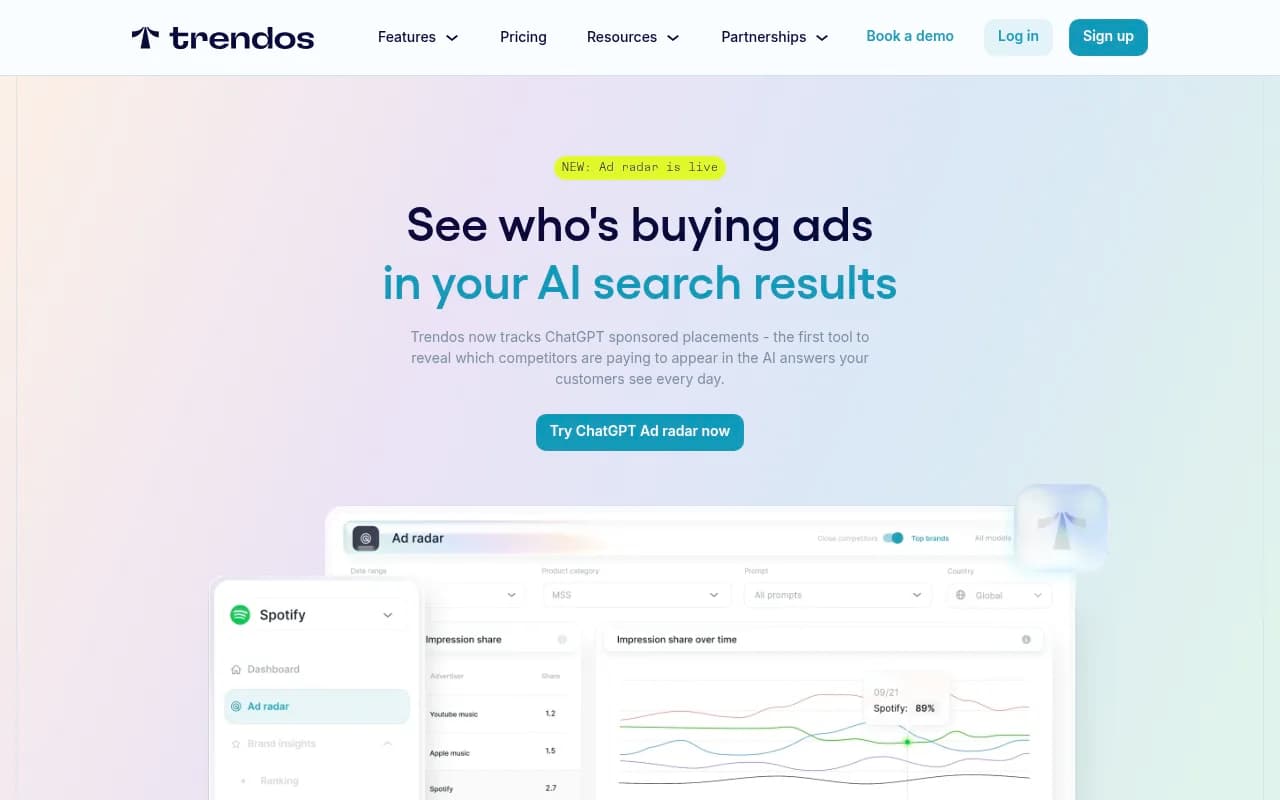
Trendos launched "Ad Radar" as, by its own claim, the first tool built specifically to surface who's paying for placement inside ChatGPT answers. It continuously monitors your tracked prompts and pulls four data points per detected ad: impression share, ad title, ad description, and the final landing URL. That's a genuinely useful set for competitive intelligence, since it tells you not just that a competitor is advertising but exactly what they're saying and where the click goes.
The catch is scope. Trendos states plainly in its own FAQ that Ad Radar covers ChatGPT only, no AI Overviews, no AI Mode, no Perplexity. Pricing starts free, with paid tiers at $30, $140, and $320 per month based on prompt volume, all with unlimited countries and brands.
Finseo: covers both live ad surfaces
Finseo's ad tracking explicitly targets what it calls "the two engines with live ad inventory," ChatGPT and Google AI Overviews. For each detected ad it logs the advertiser, landing URL, UTM parameters, first-seen date, and a running count of appearances, rolled up into an exportable ad intelligence report with category-level bidding data. It also makes a point worth repeating in your own reporting: ads don't replace organic citations, they sit above them, so being the top organic source doesn't protect the top-of-answer slot from a paying competitor.
LLM Pulse: builds an advertiser leaderboard
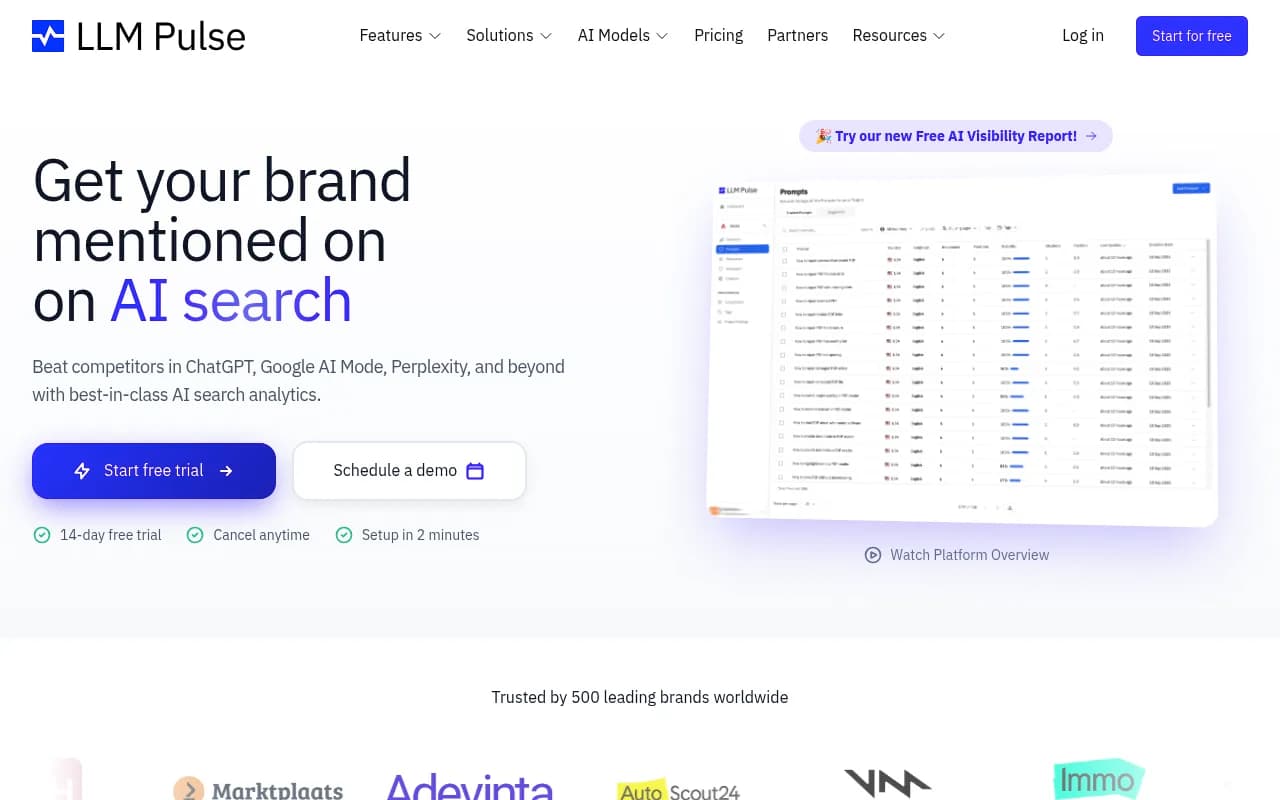
LLM Pulse's ad tracking covers ChatGPT and both Google AI surfaces, and keeps a dormant watch on Perplexity in case ads return there. For every ad it detects, it records headline, description, advertiser domain, and position within the answer, then rolls that into an advertiser leaderboard showing ad count, prompt coverage, and average position, benchmarked against your own brand. It runs on the same prompts you're already tracking for organic visibility, so there's no separate setup. Pricing starts at €49/month for 50 prompts across 5 models, scaling up through several tiers to €1,199/month for high-volume accounts.
Searchable: early access, watch for stale copy
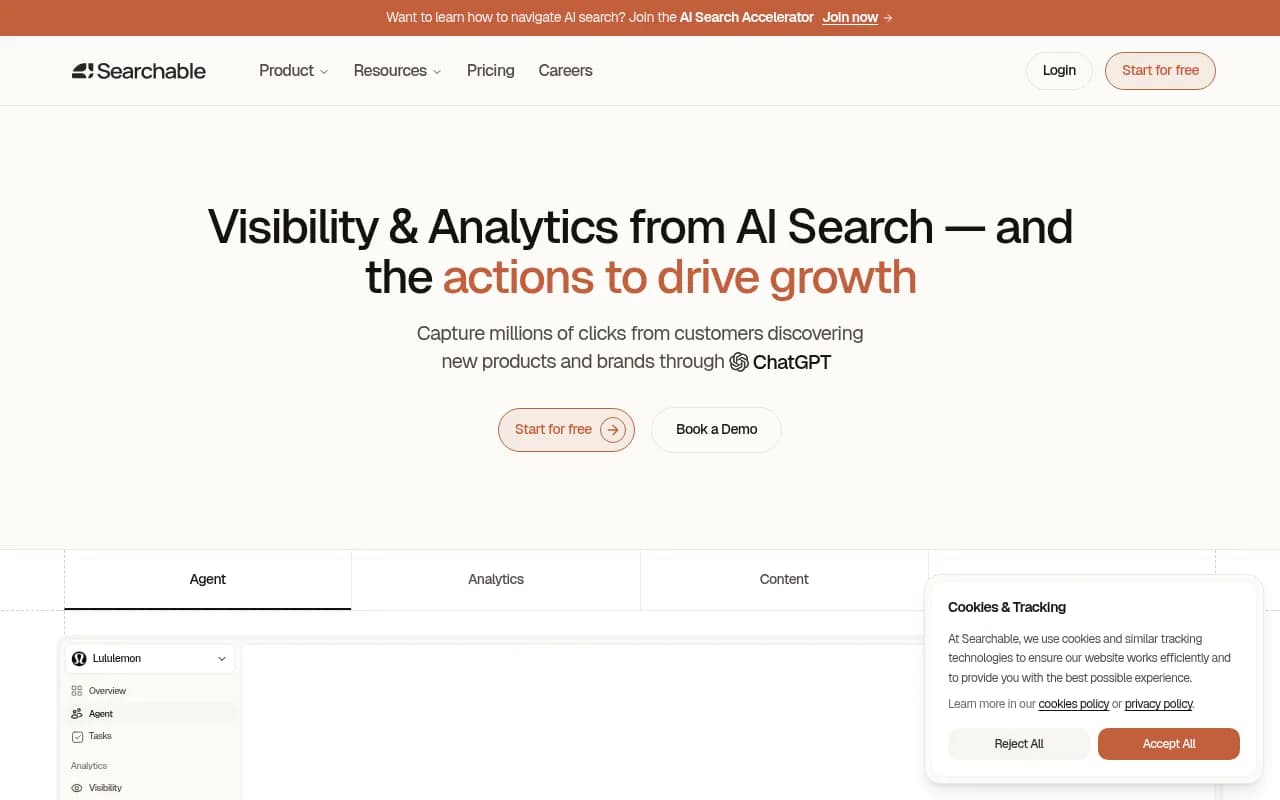
Searchable's AI Ads Intelligence still lists Perplexity as a tracked surface, which is a red flag given Perplexity killed its ad program in February 2026. Both the ChatGPT and Google Ads sub-pages are labeled "Early Access," meaning the feature is still in beta. Its framing is around "organic displacement": the idea that when a competitor buys a placement, your organic mention can effectively disappear from the visible answer even if the model still considers you relevant. Pricing runs from $125/month (Pro) to $400/month (Scale), with custom enterprise tiers adding Claude, Copilot, Grok, and DeepSeek as add-ons.
Profound: measurement framework, not a named ad radar
Profound doesn't market a dedicated ad-tracking product the way Trendos or LLM Pulse do, but coverage from eMarketer describes the platform building an early measurement framework around AI search advertising, and its "Aim" agent reportedly accounts for clearly labeled sponsored placements as part of general visibility tracking. If you're evaluating Profound specifically for ad monitoring, ask for a live demo of that feature rather than assuming it matches the depth of a purpose-built ad radar.
Profound

The notable non-answers: Ahrefs Brand Radar and Semrush
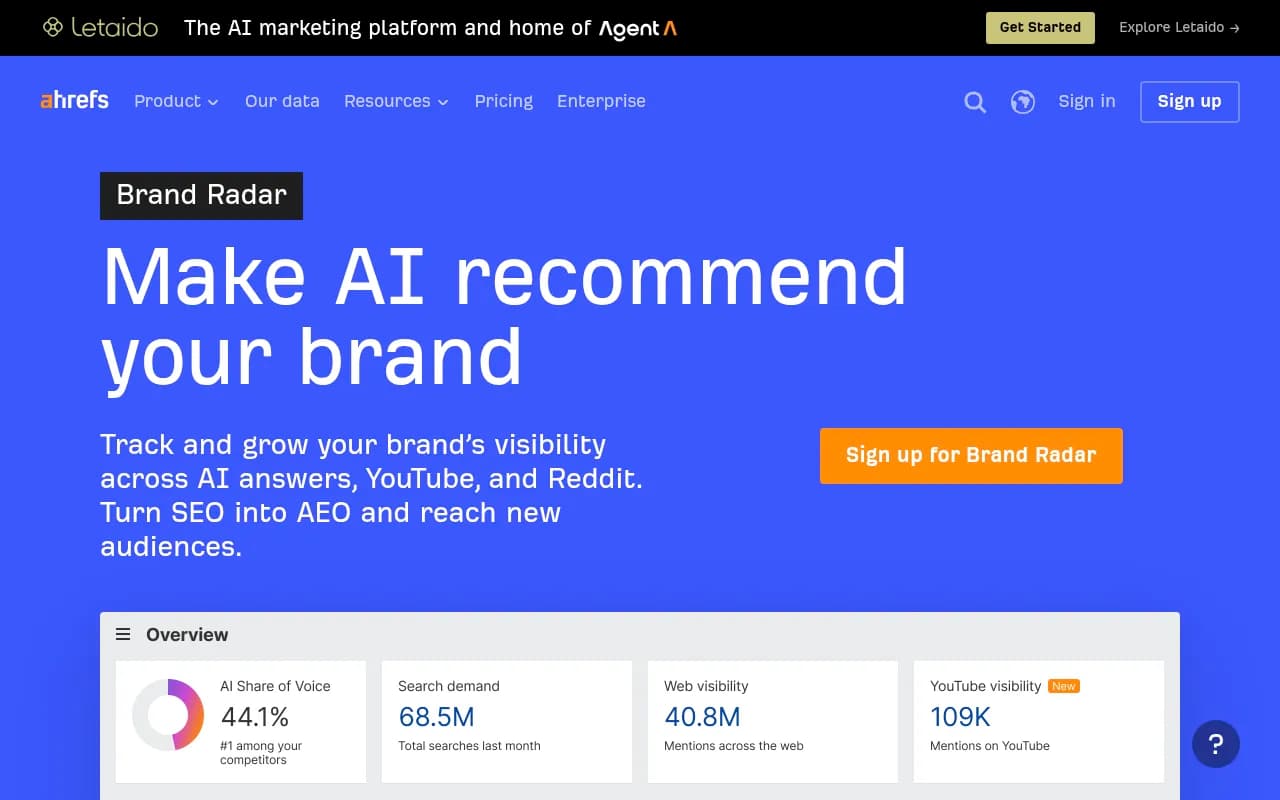
Both are worth naming because they're popular AI visibility products with a real gap. Ahrefs Brand Radar's differentiator is monitoring YouTube and TikTok visibility, which is genuinely useful for a leading indicator of future AI training data, but it has no dedicated sponsored-placement detection. Semrush's AI Visibility Toolkit draws its data from ChatGPT search-mode responses for organic citation tracking, again with no ad-detection layer. If ad monitoring is a priority for you, neither of these covers it out of the box.
Comparison table
| Platform | Ad surfaces tracked | What it captures | Entry pricing |
|---|---|---|---|
| Trendos (Ad Radar) | ChatGPT only | Impression share, ad title, description, landing URL | Free / $30/mo |
| Finseo | ChatGPT + Google AI Overviews | Advertiser, landing URL, UTMs, first-seen date, appearance count | ~€99/mo (gated) |
| LLM Pulse | ChatGPT + AI Overviews/AI Mode (Perplexity dormant) | Headline, description, domain, in-answer position, advertiser leaderboard | €49/mo |
| Searchable | ChatGPT, Google AI (early access), Perplexity (stale) | Organic displacement framing, ad detection | $125/mo |
| Profound | Unnamed measurement framework | General visibility metrics, sponsored-placement awareness | $99/mo (ChatGPT only tier) |
| Ahrefs Brand Radar | None | No ad-tracking feature | $699+/mo add-on |
| Semrush AI Toolkit | None | No ad-tracking feature | $99/mo |
Where does an AI visibility platform like Promptwatch fit into this
Worth being straightforward here: as of this research, Promptwatch doesn't (yet) offer a named, competitor-level "ad radar" that tells you which specific brand bought which specific ad slot the way Trendos or LLM Pulse do. What it does have is the aggregate, category-level data behind the ad rollout itself, the ChatGPT ads-over-time tracking and the shopping feature usage numbers cited throughout this piece, both pulled from real UI monitoring across its 26 billion-plus analyzed citations, prompts, and responses.

That distinction matters if you're deciding what to buy. If your immediate need is "tell me exactly which competitor is buying ads against my brand name and what their ad copy says," a dedicated ad radar tool is the right call today. If your need is broader, understanding why you show up or don't in AI answers, tracking the AI crawlers actually reading your site, measuring real traffic AI sends you, and then having something write and publish the content that closes the gaps, Promptwatch's stack goes further than any of the pure ad trackers, none of which do content generation, crawler log analysis, or CMS publishing. Most of what's covered above answers "was there an ad." Promptwatch's broader platform is built to answer "how do I grow visibility and revenue from AI search," with Unified Actions, content gap analysis, and automated Content Agents doing the follow-through work.
If sponsored-placement tracking specifically is the one feature you need right now, it's worth pairing a dedicated tool like Trendos or LLM Pulse with a broader visibility platform rather than expecting one tool to do both jobs well. You can browse more options in the GEO software directory at bestgeosoftware.com if you want to compare a wider set before committing.
Practical checklist before you buy
A few questions worth asking any vendor demo, based on everything above:
- Which specific AI surfaces does the ad-tracking feature cover, and does that list still include Perplexity? If yes, that's a sign the marketing hasn't been updated since February 2026.
- How does the tool define an "ad-eligible response"? Get the exact methodology, not just a headline percentage, given how far Promptwatch's 20-32% range sits from the 49-53% figures reported elsewhere.
- Does it separate Google's different ad formats, standard AI Overview ads, AI Mode sponsored stores, and Quick Results blocks, or lump them together as one "Google AI ads" line item?
- Does the feature run on the same prompts you already track for organic visibility, or does it require separate setup and a separate bill?
- Beyond detection, does the platform help you do anything about a competitor's paid placement, through content, positioning, or bidding on your own prompts, or does it stop at reporting?
Ad tracking in AI search is still a young category, barely six months old as a standalone feature at most of these vendors. Expect the numbers, the coverage claims, and the pricing to keep shifting through 2026 as OpenAI and Google keep tuning how often and where these placements show up.