Key takeaways
- AI search engines don't give the same answers in every city or country -- your brand might be well-cited in one region and completely invisible in another
- Multi-location businesses need region-specific prompt monitoring, not just global share-of-voice numbers
- The biggest gap most brands have is between monitoring (seeing the problem) and fixing it (creating the right content for each market)
- Tools like Promptwatch let you run location-specific prompt checks across 10+ AI models and generate content to close regional visibility gaps
- Local-focused platforms like Yext, SOCi, and Uberall handle the listings and reputation layer, but need to be paired with LLM-specific tracking for full coverage
Why regional AI visibility is a different problem than local SEO
If you run a hotel chain, a dental group, a retail franchise, or any business with locations in multiple cities or countries, you've probably spent years optimizing Google Business Profiles, managing local citations, and tracking rank positions by city. That work still matters. But it doesn't tell you what ChatGPT says when someone in Munich asks "what's the best hotel near the trade fair?" or what Perplexity recommends when a user in Toronto searches for "top dental clinics near me."
AI search engines synthesize answers from training data, web crawls, and real-time retrieval. The sources they pull from -- and the answers they generate -- vary by geography. A prompt run from a US IP address with English language settings will often return different brand mentions than the same prompt run from a German IP in German. The models have different training data distributions, different web crawl coverage by region, and different retrieval sources depending on where the query originates.
For multi-location brands, this creates a visibility problem that's genuinely harder than traditional local SEO. You're not just tracking one set of rankings -- you're tracking how 10+ AI models represent your brand across dozens of cities, languages, and regional contexts. And unlike a Google ranking, you can't just "optimize" a page and watch it move up. You need to understand which content sources the AI is actually pulling from in each market, what's missing, and what to create.
This guide walks through how to approach that problem systematically.
How AI models handle geographic context
Before diving into tools and tactics, it's worth understanding how LLMs actually handle location.
Most AI models don't have a fixed "local" mode the way Google Maps does. Instead, they respond to geographic signals in the prompt itself ("best accountants in Austin"), the user's language and locale settings, and -- for models with real-time retrieval like Perplexity and ChatGPT with browsing -- the sources they pull at query time.
This means a few things for multi-location brands:
- Prompt language matters. A prompt in Spanish asking about "mejores hoteles en Madrid" will pull different sources than the same question in English. If your Spanish-language content is thin, you'll be invisible to Spanish-speaking users even if your English content is strong.
- Regional retrieval sources matter. Perplexity and ChatGPT with browsing pull from live web results. If local review sites, regional news, or country-specific directories don't mention your brand, you won't appear in those answers.
- Training data distribution matters. Models trained on English-heavy data will have better coverage of US and UK brands than brands primarily mentioned in other languages.
- Persona and intent matter. Someone asking "best family hotel in Barcelona" is prompting differently than "luxury hotel Barcelona business travel." Your visibility can differ significantly across these intent clusters even within the same city.
SOCi's 2026 Local Visibility Index introduced a framework specifically for measuring this -- tracking AI visibility for multi-location brands across ChatGPT, Gemini, and other models at the city level. The core finding: most multi-location brands have wildly inconsistent AI visibility across their own locations. A flagship location in a major city might be well-cited; a location in a mid-size market might not appear at all.
The three-layer monitoring stack for multi-location brands
Getting a complete picture of your regional AI visibility requires thinking in three layers.
Layer 1: LLM brand mention tracking by region
This is the core of AI visibility monitoring. You need to run prompts that simulate how real customers search, across multiple AI models, with location context built into the prompts. The output tells you: for each city/region, which AI models mention your brand, how often, and in what context.
Promptwatch handles this well for multi-location teams. Its Professional and Business plans include state/city-level tracking, so you can set up location-specific prompt sets and see how your visibility varies across markets. The platform monitors 10 AI models simultaneously -- ChatGPT, Perplexity, Claude, Gemini, Google AI Overviews, Google AI Mode, Grok, DeepSeek, Copilot, and Mistral -- and supports multi-language, multi-region prompt configurations.

For brands that need enterprise-scale regional tracking, Profound is another option with strong multi-model coverage.
Profound

Layer 2: Local listings and reputation signals
AI models don't operate in a vacuum. When they retrieve real-time information (as Perplexity and ChatGPT with browsing do), they pull from review platforms, local directories, and regional web sources. Your Google Business Profile, Yelp listing, TripAdvisor page, and local review scores all feed into what AI engines say about you.
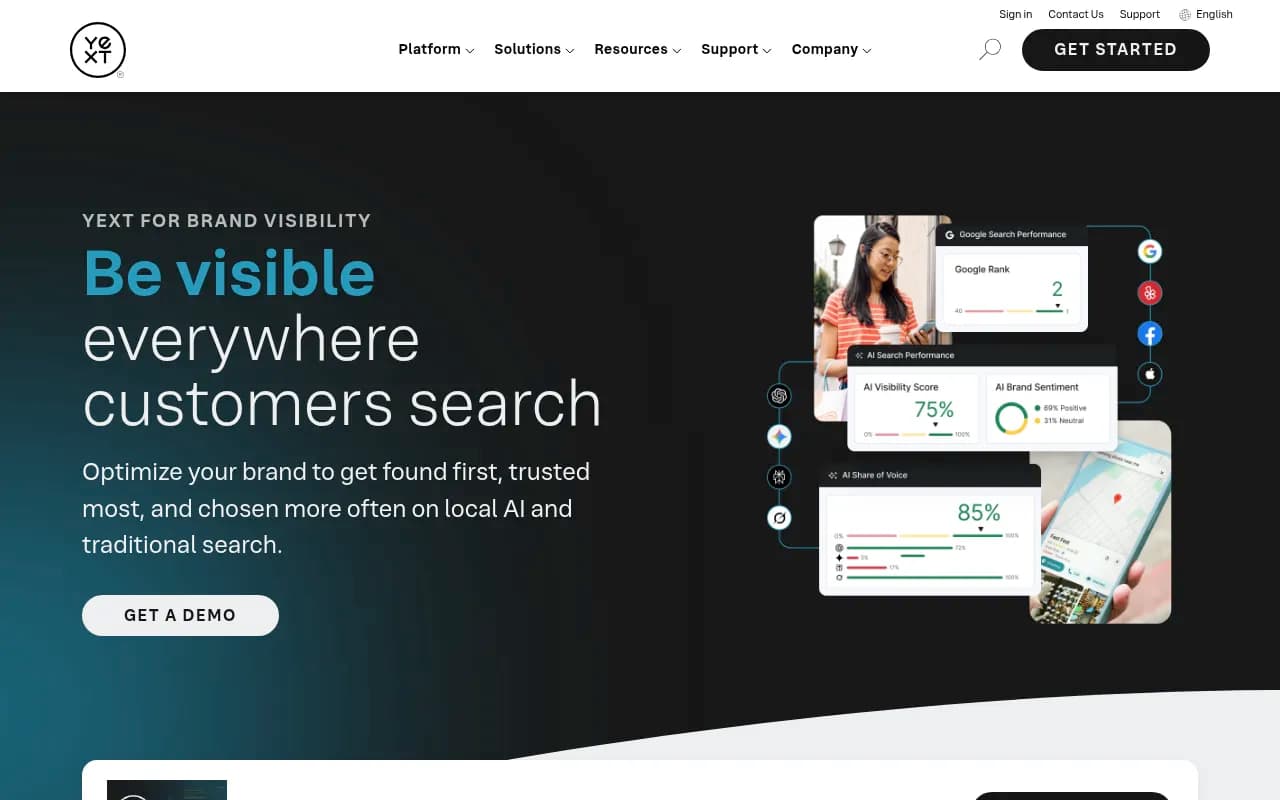
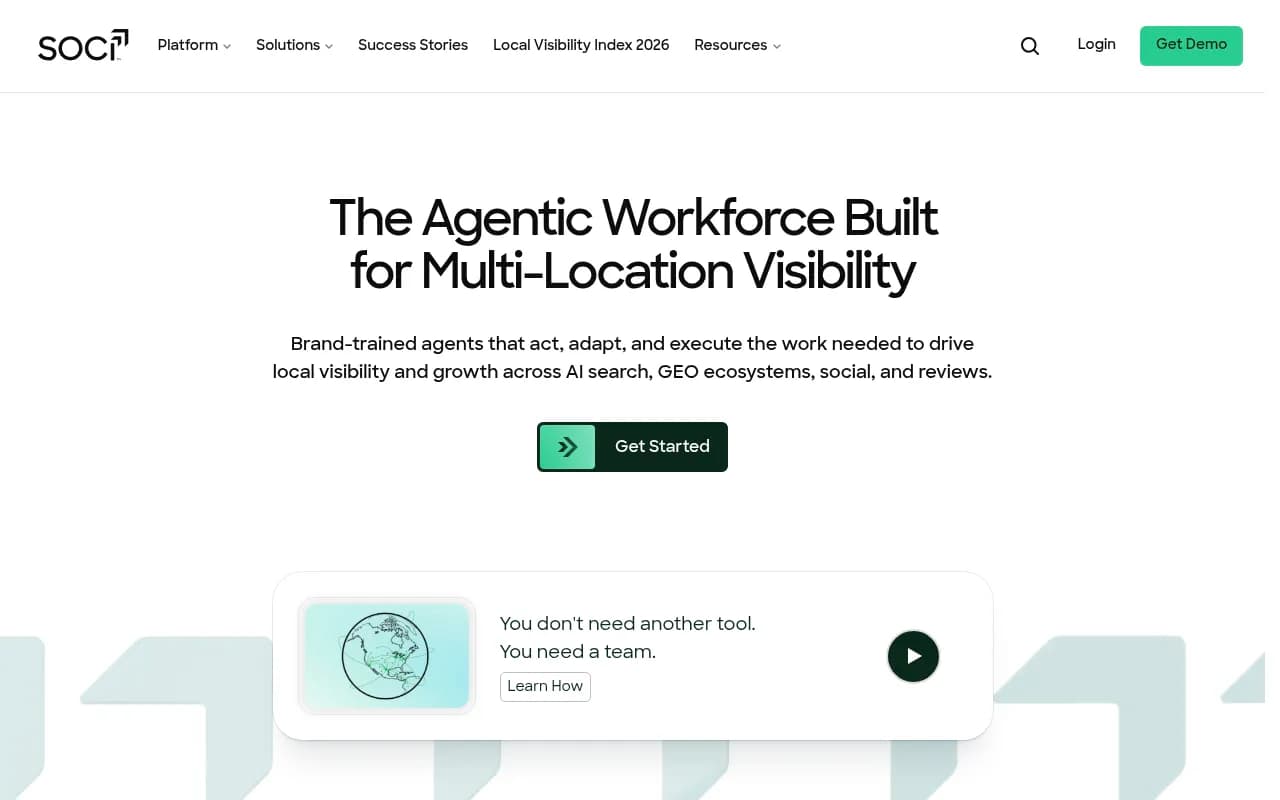
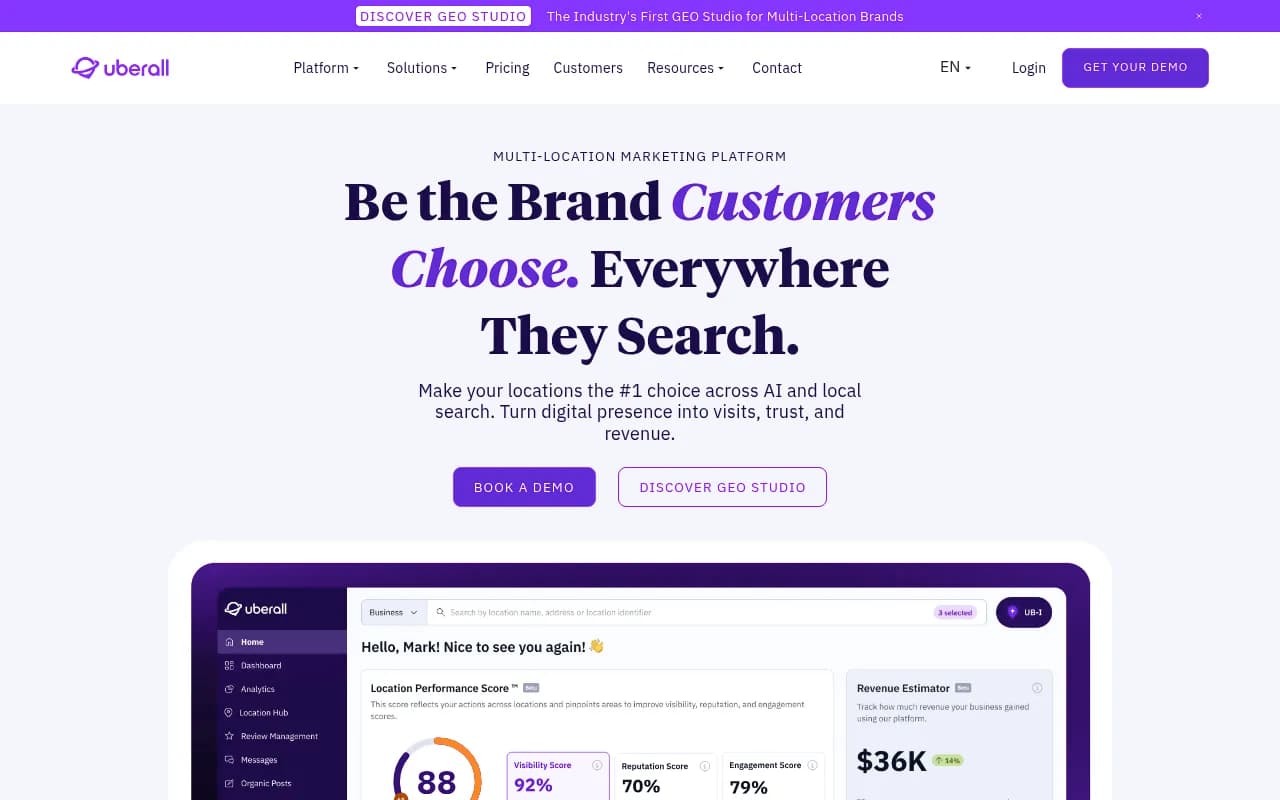
This is where platforms like Yext, SOCi, and Uberall come in. They're not AI visibility trackers in the LLM sense, but they manage the underlying signals that influence what AI models retrieve.
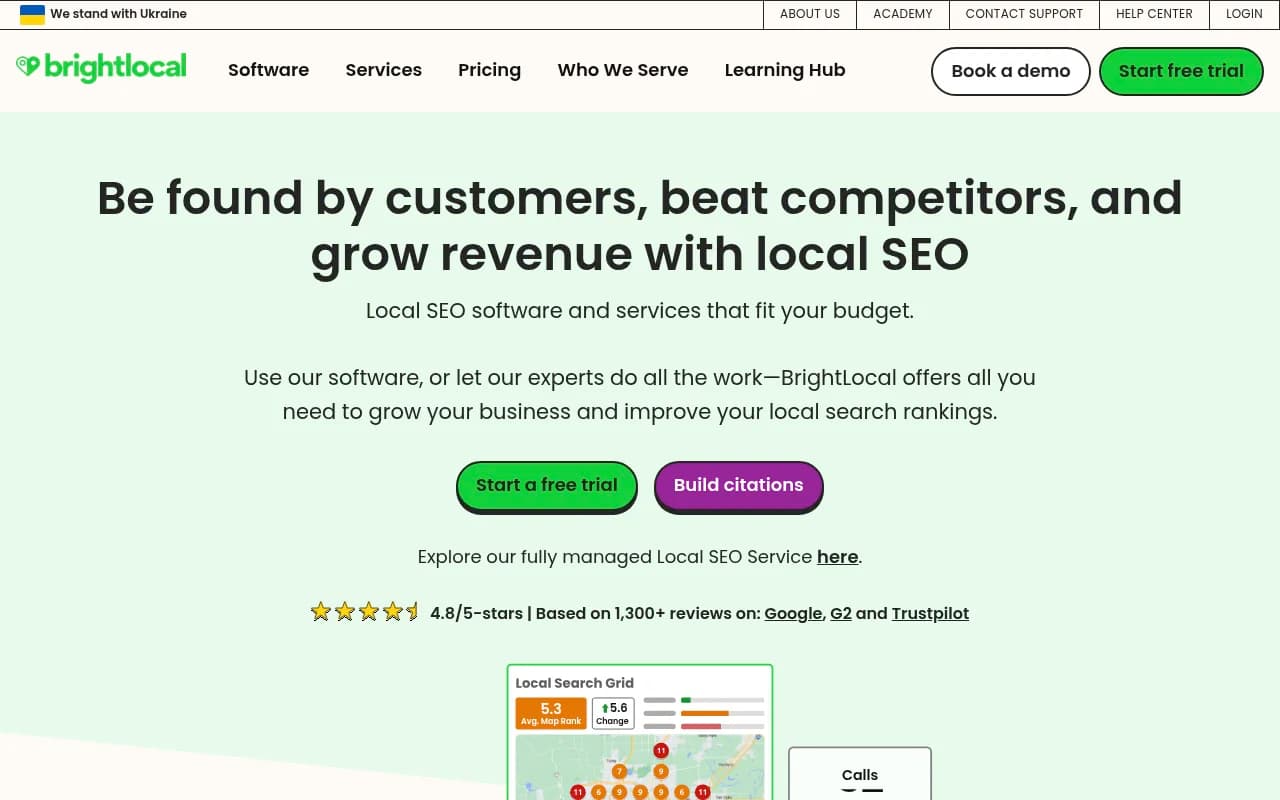
BrightLocal is another solid option for agencies managing local SEO for multi-location clients, with strong review management and citation tracking.
Layer 3: Content gap analysis and creation
Monitoring tells you where you're invisible. But visibility doesn't improve until you create the content that AI models want to cite. For multi-location brands, this means location-specific content: city pages, regional guides, local FAQs, and location-specific comparison content.
This is where most monitoring-only tools fall short. They show you the gap but leave you to figure out how to fill it. Promptwatch's built-in AI writing agent generates content grounded in citation data -- it knows which sources AI models are currently citing in your category and region, and creates content designed to compete with them.
Setting up regional prompt monitoring: a practical approach
Here's how to structure your monitoring setup if you're running a multi-location business.
Step 1: Map your locations to prompt clusters
Start by listing your key locations and the types of queries customers use in each market. For a dental group with locations in Chicago, Dallas, and Miami, your prompt clusters might look like:
- "best dentist in [city]"
- "dental implants [city]"
- "emergency dentist near [neighborhood]"
- "cosmetic dentistry [city] reviews"
- "affordable dental care [city]"
Do this for each location. You'll end up with a matrix of locations x prompt types. This becomes your monitoring framework.
Step 2: Configure language and locale settings
For international businesses, this step is critical. Run prompts in the local language, not just English. A French user asking "meilleur dentiste à Lyon" is not the same as an English-speaking tourist asking "best dentist in Lyon" -- the AI will pull different sources and potentially recommend different providers.
Promptwatch supports multi-language and multi-region configurations, letting you simulate prompts from specific countries with specific language settings. This is the only way to get accurate visibility data for non-English markets.
Step 3: Track at the right frequency
AI model responses change over time as models are updated, as new content gets indexed, and as retrieval sources shift. For active markets, weekly tracking is a reasonable baseline. For your most competitive locations, daily tracking lets you catch changes faster.
Step 4: Set up competitor benchmarks by region
Your competitors aren't the same in every market. The national chain you compete with in Chicago might not operate in your smaller markets, where local independents are the real competition. Set up competitor tracking per region, not just globally.
Key metrics to track for multi-location AI visibility
| Metric | What it tells you | Why it matters for multi-location |
|---|---|---|
| Brand mention rate | % of relevant prompts where your brand appears | Baseline visibility per location |
| Share of voice | Your mentions vs. competitors' mentions | Shows competitive position by market |
| Citation sources | Which URLs AI models cite for your brand | Reveals which content is working |
| Sentiment framing | How AI describes your brand | Can vary significantly by location |
| Model coverage | Which AI models mention you | Some models may favor you in one region but not another |
| Prompt-level win/loss | Which specific prompts you win vs. lose | Identifies exact content gaps to fill |
The prompt-level win/loss view is particularly useful for multi-location brands. If you're winning "best dentist in Chicago" on ChatGPT but losing "dental implants Chicago" on Perplexity, that's a specific content gap you can address. Promptwatch's Answer Gap Analysis surfaces exactly this -- showing which prompts competitors are visible for that you're not, broken down by location.
Tools comparison: multi-location AI visibility
Here's how the main options stack up for multi-location use cases specifically:
| Tool | Multi-region support | Language support | Content generation | Local signals | Best for |
|---|---|---|---|---|---|
| Promptwatch | Yes (city/state/country) | Yes (any language) | Yes (built-in AI writer) | No | LLM tracking + content optimization |
| Yext | Yes | Yes | No | Yes (listings) | Listings management + AI search integration |
| SOCi | Yes | Yes | Limited | Yes | Multi-location local marketing |
| Uberall | Yes | Yes | No | Yes | Listings + reputation |
| Profound | Yes | Limited | No | No | Enterprise LLM monitoring |
| BrightLocal | Yes | Limited | No | Yes | Agency local SEO |
| Otterly.AI | Limited | Limited | No | No | Basic LLM monitoring |
| Chatmeter | Yes | Yes | No | Yes | Multi-location reputation + AI |
Otterly.AI

The content problem: why monitoring alone isn't enough
Here's the uncomfortable reality for multi-location brands: you can have perfect visibility data across every city and every AI model, and still be stuck if you don't have a process for acting on it.
The typical gap looks like this. You run your monitoring setup and discover that your locations in secondary markets -- say, your Denver and Phoenix offices -- have near-zero AI visibility, while your New York and LA locations are reasonably well-cited. You know the problem. But creating location-specific content for 20+ markets is a significant content production challenge.
This is where the monitoring-to-content pipeline matters. Promptwatch's approach is to connect the gap analysis directly to content generation -- it identifies which prompts you're losing in Denver, analyzes what content is being cited in those answers, and generates articles or location pages designed to compete. The content is grounded in 880M+ real citations, so it's not generic filler -- it's built around what AI models in that category actually want to cite.
For multi-location brands managing this at scale, that pipeline is the difference between knowing you have a problem and actually fixing it.
International considerations: language, culture, and AI model preferences
If your business operates across countries, the complexity multiplies. A few things to keep in mind:
Different AI models dominate in different markets. ChatGPT has strong global coverage, but Perplexity's market share varies significantly by country. In some European markets, Google AI Overviews and Gemini are more commonly used than in the US. Your monitoring should weight models by their actual usage in each market.
AI models have different training data coverage by language. A model trained primarily on English data will have weaker coverage of brands that are primarily discussed in German, French, or Japanese. This means international brands often need to invest in creating content in local languages specifically to improve AI visibility -- not just for human readers, but to give AI models something to cite.
Review platforms vary by country. In the US, Google Reviews and Yelp are dominant. In Germany, Trustpilot and Kununu matter more. In France, Pages Jaunes still has significant weight. Since AI models with retrieval pull from these sources, your presence on country-specific review platforms directly affects your regional AI visibility.
Regulatory and compliance considerations. In some markets, particularly in the EU, there are emerging discussions about AI transparency and how AI models should handle commercial recommendations. This is still evolving, but multi-national brands should be aware that the regulatory context for AI search may differ by country.
Practical workflow for a multi-location marketing team
If you're a marketing manager or SEO lead responsible for multiple locations, here's a realistic workflow:
-
Monthly visibility audit. Run your full prompt set across all locations and models. Export the data and identify the locations with the lowest brand mention rates. These are your priority markets.
-
Quarterly content sprint. For your lowest-visibility markets, use the gap analysis to identify the 3-5 prompts where competitors are visible but you're not. Create location-specific content targeting those prompts. Publish it, then track whether visibility improves over the following 4-6 weeks.
-
Ongoing competitor monitoring. Set up alerts for when competitors gain significant visibility in markets where you're currently winning. This is your early warning system.
-
Local signals maintenance. Make sure your listings, reviews, and local citations are current in every market. This is the foundation that AI retrieval systems build on.
-
Annual framework review. The AI search landscape is changing fast. The models that matter, the prompts that drive traffic, and the content formats that get cited are all shifting. Build in a quarterly review of your monitoring framework to make sure you're tracking the right things.
Getting started
For most multi-location businesses, the right starting point is a visibility audit: run a structured set of location-specific prompts across the AI models your customers actually use, and see where you stand. That baseline tells you where to focus.
Promptwatch offers a free trial that lets you set up location-specific prompt monitoring and see your visibility data before committing. For businesses with 5+ locations or international operations, the Business plan ($579/mo) supports up to 5 sites with city/state tracking, multi-language configurations, and the content generation tools you need to actually close the gaps you find.
The brands that will win in AI search over the next few years aren't necessarily the ones with the biggest budgets or the most locations. They're the ones that understand how AI models represent them in each market, and have a systematic process for improving it. That starts with knowing where you stand.