Key takeaways
- Most AI writing tools optimize for Google rankings, not for getting cited by ChatGPT, Perplexity, or other AI search engines -- these are different targets with different requirements.
- Content that gets cited by AI models tends to be specific, factual, well-structured, and authoritative. Generic filler content almost never appears in AI-generated answers.
- The tools that produce the most citation-worthy content share a common trait: they ground their output in real data, competitor analysis, and topic authority -- not just keyword density.
- Tracking which of your pages actually get cited requires a separate layer of tooling beyond what content writers provide.
- The full workflow -- write, publish, track, iterate -- is what separates brands that grow their AI visibility from those that guess.
There's a gap most marketers haven't noticed yet. They're using AI writing tools to produce content, watching it rank reasonably well in Google, and assuming that's enough. It isn't.
AI search engines like ChatGPT, Perplexity, and Google AI Overviews pull from a different set of signals than traditional search. A page that ranks #3 on Google might never appear in a ChatGPT response. A Reddit thread with 47 upvotes might get cited constantly. The rules are different, and most content tools were built before anyone cared about this distinction.
This guide looks at the AI writing tools that actually produce content with a higher chance of being cited -- and explains why the gap between "AI-generated" and "AI-cited" is wider than most people expect.
Why citation rate is a different metric than search ranking
When Perplexity answers a question, it doesn't crawl the web in real time and pick the highest-ranking page. It draws on training data, live search results, and its own retrieval logic to surface sources it considers authoritative and specific enough to cite. ChatGPT's web browsing mode does something similar.
What this means in practice: a page needs to be genuinely informative, clearly structured, and specific enough that an AI model can extract a discrete, citable claim from it. Thin content, vague overviews, and keyword-stuffed articles fail this test even if they rank fine on Google.
A Reddit thread from r/AI_Agents noted something that many SEOs are starting to confirm: the pages getting cited by ChatGPT and Perplexity are rarely the ones that rank highest in Google. They tend to be pages with clear answers to specific questions, original data, or well-organized comparisons.
So the question becomes: which writing tools help you produce that kind of content?
What makes content citation-worthy
Before comparing tools, it's worth being concrete about what AI models actually want to cite. Based on citation pattern analysis across AI search engines, a few characteristics show up consistently:
- Specific claims with numbers, dates, or named sources (not "experts say" but "according to X study")
- Clear question-and-answer structure, especially for informational queries
- Original data, research, or proprietary insights that can't be found elsewhere
- Authoritative entity signals -- the page is clearly about a specific topic, not a catch-all
- Proper structured markup that helps AI crawlers parse the content
- Reasonable page authority and backlink profile
Most AI writing tools help with prose quality and SEO structure. Fewer help with the specificity and originality that drive citations.
AI writing tools compared by citation-worthiness
Here's how the major AI content writing tools stack up when evaluated not just on output quality, but on whether the content they help produce is likely to get cited by AI search engines.
| Tool | Grounded in real data | Competitor analysis | Structured for AI parsing | Citation-focused features | Best for |
|---|---|---|---|---|---|
| Jasper | Partial | No | Basic | No | Marketing copy at scale |
| Surfer SEO | Yes (SERP data) | Yes | Yes | No | Google-first SEO content |
| Frase | Yes (SERP data) | Yes | Yes | No | Content briefs and optimization |
| MarketMuse | Yes (topic modeling) | Yes | Yes | No | Content strategy and depth |
| AirOps | Yes (citation data) | Yes | Yes | Yes | AI search-optimized content |
| Writesonic | Partial | No | Basic | No | Fast content drafts |
| Copy.ai | No | No | Basic | No | Short-form marketing copy |
| Promptwatch (content agent) | Yes (880M+ citations) | Yes | Yes | Yes | GEO-optimized content |
| Clearscope | Yes (SERP data) | Yes | Yes | No | Content grading and optimization |
| SEO.ai | Yes (SERP data) | Yes | Yes | No | SEO article writing |
Tools that produce content most likely to get cited
Jasper
Jasper is one of the most widely used AI writing platforms for marketing teams. It's fast, produces readable prose, and integrates with brand voice guidelines. For producing volume -- blog posts, social copy, email sequences -- it's genuinely useful.
The limitation for citation purposes: Jasper doesn't ground its output in real citation data or AI search patterns. It's trained to write well, not to write in a way that AI models will want to reference. Content produced purely through Jasper tends to be competent but generic, which is exactly what AI search engines skip over.
Surfer SEO
Surfer takes a different approach. It analyzes the top-ranking pages for a given keyword and tells you what topics to cover, how long to write, and what terms to include. This produces more comprehensive content than most tools, and comprehensiveness does correlate with citation rate -- AI models prefer pages that cover a topic thoroughly.
The gap: Surfer optimizes for Google's ranking signals, not AI citation signals. These overlap but aren't identical. A Surfer-optimized article will likely perform better in AI search than a pure Jasper draft, but it's still not built with AI citation in mind.
Frase
Frase is strong for content briefs and research. It surfaces what questions people are asking, what competitors cover, and what your content is missing. This kind of gap analysis is genuinely useful for producing citation-worthy content -- if you know what specific questions to answer, you can write content that AI models will pull from.
Like Surfer, though, Frase is built around Google signals. It doesn't tell you which prompts are being asked in ChatGPT or Perplexity, or which pages are currently getting cited for those prompts.
MarketMuse
MarketMuse goes deeper than most tools on topic authority. Its content modeling identifies which subtopics you need to cover to be considered authoritative on a subject, and it scores your existing content against that model. This matters for AI citation because AI models tend to cite pages that demonstrate genuine depth on a topic, not just surface-level coverage.
If you're building a content strategy with AI visibility in mind, MarketMuse's topic authority approach is one of the more defensible frameworks available.
AirOps
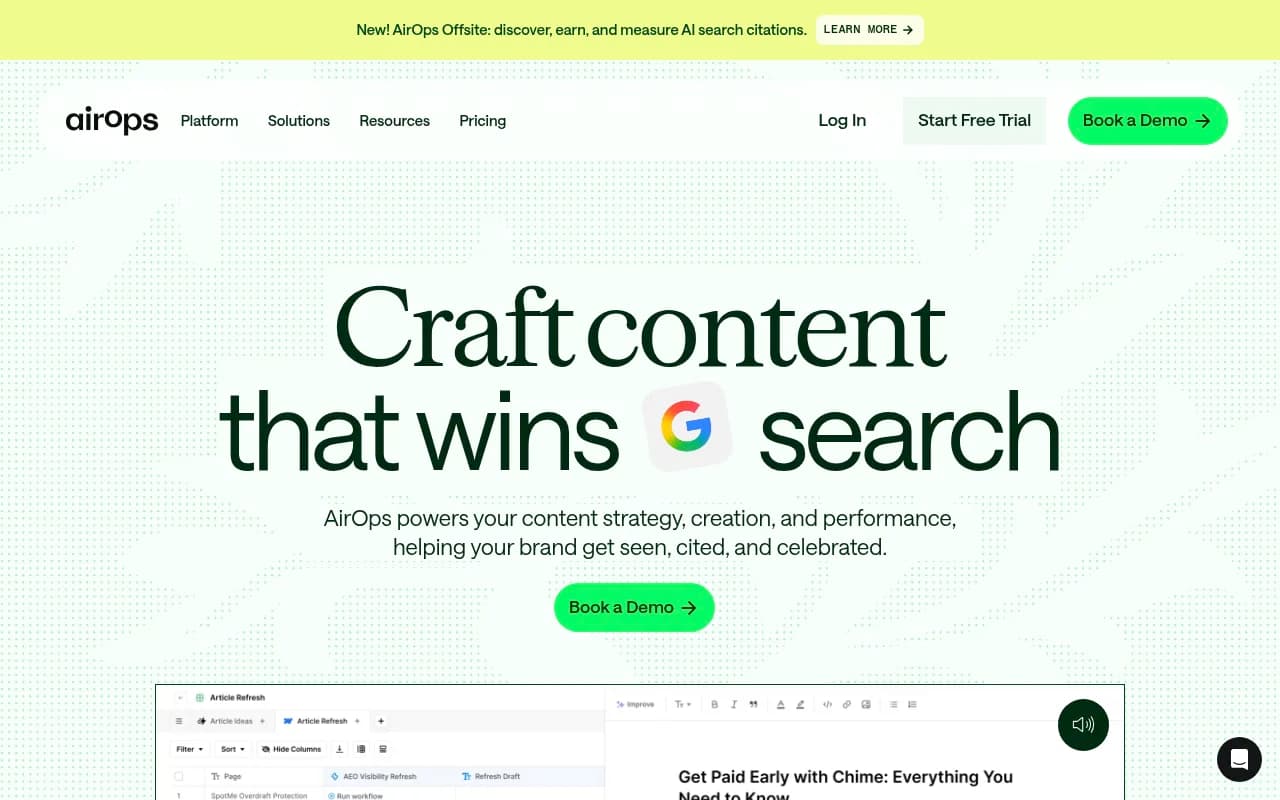
AirOps is worth calling out specifically because it's one of the few writing tools built with AI search visibility as an explicit goal. It helps teams build content workflows grounded in real search data and structured for AI parsing. The emphasis on content engineering -- not just content writing -- makes it more aligned with citation-rate outcomes than most alternatives.
Clearscope
Clearscope is a content grading tool that tells you how well your draft covers a topic relative to top-ranking competitors. It's not an AI writer per se, but it's a strong optimization layer on top of whatever you write. Content that scores well in Clearscope tends to be more comprehensive and better structured, both of which help with AI citation.

Copy.ai and Writesonic
Both are fast, affordable, and useful for drafting. Neither is particularly well-suited for producing citation-worthy content. Copy.ai is strongest for short-form marketing copy; Writesonic for blog drafts that need significant editing. If you're using either as your primary content tool and hoping to appear in AI search results, you'll need to add a serious optimization layer on top.


The missing piece: knowing what to write
Here's the problem with evaluating writing tools in isolation. Even the best writing tool can't help you if you don't know:
- Which prompts people are actually asking ChatGPT and Perplexity
- Which of those prompts your competitors are currently visible for
- Which specific topics and angles are missing from your site
This is the answer gap problem, and it's where most content strategies fall apart. You can produce technically excellent content and still miss the mark entirely because you're writing about the wrong things.
Tools like Promptwatch address this at the source. Its Answer Gap Analysis shows you exactly which prompts competitors are appearing for that you're not -- giving you a concrete list of content to create rather than a guess. The built-in content agent then generates articles grounded in real citation data (over 880 million citations analyzed), prompt volumes, and competitor patterns. This is a different starting point than "write me a blog post about X."

The distinction matters. A writing tool that starts from keyword research produces content optimized for search. A writing tool that starts from citation data and prompt patterns produces content optimized for AI visibility. These are related but not the same thing.
What the citation data actually shows
Across the AI search engines, a few content patterns get cited disproportionately often:
- Comparison articles with clear structure (X vs Y, best tools for Z)
- Original research or data with specific numbers
- Definitional content that clearly explains what something is
- Step-by-step guides with numbered structure
- FAQ-style content that directly answers specific questions
Notice that most of these are formats, not just topics. The same information presented as a wall of prose versus a structured comparison table will have very different citation rates. AI models need to be able to extract a discrete answer -- they're not reading for pleasure.
This is why tools that produce well-structured, specific, data-grounded content outperform tools that produce fluent but vague prose. Fluency is table stakes. Structure and specificity are what drive citations.
Tracking whether your content actually gets cited
Writing better content is only half the equation. You also need to know whether it's working.
Most content teams have no visibility into this. They publish, check Google rankings, and call it done. But if your goal is AI search visibility, you need to know:
- Which of your pages are being cited by ChatGPT, Perplexity, Claude, and other models
- How often, and for which prompts
- Whether new content you publish is getting picked up
- How your citation rate compares to competitors
A few tools in the catalog address this monitoring layer:
Otterly.AI


Profound

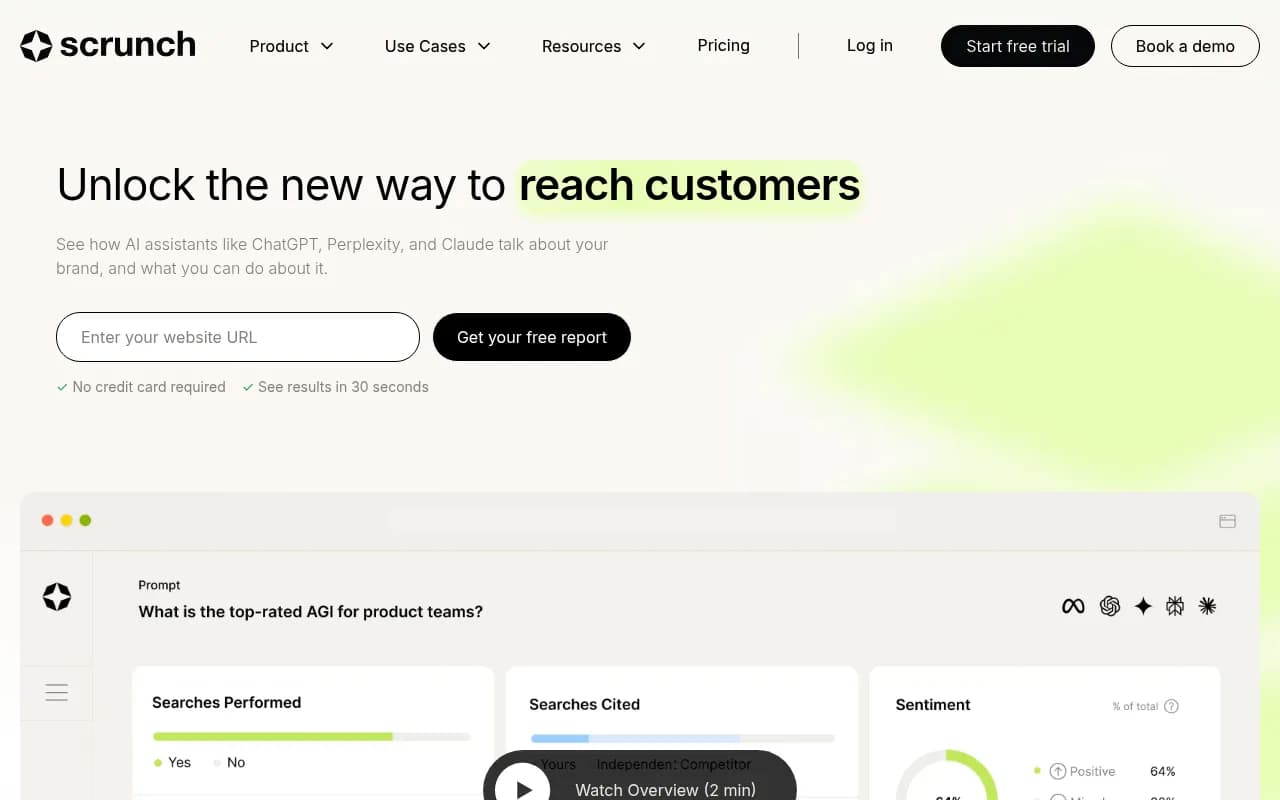
These tools vary significantly in depth. Some show you citation counts; others show you the actual AI responses, the specific prompts, and how your competitors are performing. If you're serious about improving your citation rate, monitoring-only tools are a starting point, not a destination.
The more complete approach is a platform that connects content creation to citation tracking -- so you can see whether what you wrote is actually getting cited, and iterate from there. That closed loop is what separates brands that are systematically improving their AI visibility from those that are publishing and hoping.
Practical recommendations
If you're trying to produce content that gets cited by AI search engines, here's a realistic framework:
Start with prompt research, not keyword research. Find out what people are actually asking ChatGPT and Perplexity in your category. These prompts are often different from Google search queries -- more conversational, more specific, more comparison-oriented.
Write for extractability. Structure your content so that an AI model can pull a specific answer from it. Use headers, numbered lists, and comparison tables. Answer the question directly before elaborating.
Add original data wherever possible. AI models strongly prefer to cite sources with proprietary information. If you have survey data, customer data, or any kind of original research, lead with it.
Use a content optimization tool to check comprehensiveness. Surfer SEO, Frase, Clearscope, or MarketMuse will tell you if you're missing important subtopics. Comprehensive coverage correlates with citation rate.
Track your citations, not just your rankings. Set up monitoring so you know which pages are being cited and for which prompts. This feedback loop is how you improve over time.
Iterate based on what's working. When you see a page getting cited frequently, analyze why -- what's the structure, the specificity, the angle? Replicate it.
The bottom line
Most AI writing tools were built for a world where Google rankings were the primary goal. That world still exists, but it's no longer the only game in town. AI search engines have their own citation logic, and content that wins in Google doesn't automatically win there.
The tools that produce the most citation-worthy content share a few traits: they ground output in real data, they help you cover topics comprehensively, and they produce well-structured content that AI models can parse and extract from. Tools like MarketMuse, Surfer SEO, Frase, and AirOps are stronger on these dimensions than pure generation tools like Jasper or Copy.ai.
But the real competitive advantage comes from closing the loop -- knowing which prompts to target, creating content specifically for those prompts, and tracking whether that content is actually getting cited. That's a workflow, not just a tool choice.