Key takeaways
- Organic rank still predicts citations. In a September 2026 study of 400 US SERPs, position 1 was cited 56% of the time and position 8 under 10%. Metrix Digital saw 73% at position 1 and about 3% beyond position 20.
- The overlap is shrinking. Ahrefs found 76.1% of cited URLs in the top ten in July 2025, then only 37.9% in March 2026. Nobody agrees on one number, so report a range and name your method.
- Citations do not equal clicks. Seer Interactive found organic CTR fell 61% on queries with an AI Overview, while cited brands earned 35% more organic clicks than uncited ones. Search Engine Land found citation clicks land around position 6 levels.
- Your boss needs four numbers: citation rate by rank band, share of AI voice versus competitors, AI-referred traffic and conversions, and the actions you are taking next.
- Citation position inside an overview is a weak metric on its own. Rank band, citation presence and source type tell you more.
The question your boss is really asking
Nobody in the leadership meeting cares about AI Overview citation position as a concept. They want to know two things. Are we visible where people now get answers, and is it making us money?
The trouble is that your existing rank report cannot answer either. A position-one ranking used to be a decent proxy for traffic. Now a page can rank first and sit underneath an AI answer that nobody scrolls past. Ahrefs measured the position-one click-through rate on AI Overview keywords falling by 58% between December 2023 and December 2025. So you need a report that separates three things: where you rank, whether you get cited, and whether either produces a visit.
This guide walks through what the data says, where the studies conflict, and how to turn it into something a non-SEO executive will read.
What the data says about rank and citations
The core question is simple. If I rank at position X, how likely is an AI Overview to cite me? Three data sets give three different answers, and the differences matter.
| Source | Sample | Key finding |
|---|---|---|
| Metrix Digital (Jul to Sep 2026) | 2,350 keyword snapshots, 314 keywords, client sites | 73% cited at position 1, 49% at positions 2-3, 42% at 4-10, 9% at 11-20, 3% beyond 20 |
| Ahrefs SERP study (Sep 2026) | 400 US SERPs, 1,561 outside links | 51.0% of citations pointed to a URL already in the top ten; position 1 cited in 56.0% of SERPs, position 8 in 9.9% |
| Ahrefs (Jul 2025 vs Mar 2026) | Millions of cited URLs | 76.1% of citations from the top ten in 2025, 37.9% in March 2026 |
| seoClarity (Oct 2025) | Overlap study | 32% overlap with the top results; position-one page cited 43% of the time |
| Moz (2026) | Nearly 40,000 AI Mode queries | 88% of citations did not match the organic top ten for the exact query |
These do not contradict each other as much as they look like they do. They measure different things.
Metrix Digital measures "given that I rank here, how often am I cited?" That is a per-site view. The Ahrefs 400-SERP study measures both directions: where citations point, and how often each position is cited. The Moz figure is about AI Mode, a different surface, and about exact-term matching, which is stricter than domain-level matching. The Ahrefs trend (76.1% down to 37.9%) is the one I would flag to a boss, because it says the overlap is moving, and the direction is down.
The Ahrefs 400-SERP author gives a reason: query fan-out. Google does not only look at the top ten for your exact query. It runs related sub-queries and cites pages that rank for those. A page that ranks for a hundred related queries is more likely to be cited than a page that ranks first for one.
The rank bands worth reporting
The Metrix table suggests a useful reporting shape. Page one behaves like one zone: 49% at positions 2-3 and 42% at 4-10. The big drops sit at position 1 (a league of its own at 73%) and at the page-one/page-two boundary, where citation rates fall from 42% to 9%.
So do not report "average position". Report four bands: position 1, positions 2-10, positions 11-20, and beyond. For each band, show how many tracked keywords sit there and what share of those keywords' AI Overviews cite you. Your boss will immediately see where moving a keyword up a band changes the odds.
Where the data disagrees with the "rank #1 or nothing" story
Several sources, including SEOcrawl and a Moz study, say citations regularly come from positions 4 to 20 and beyond. The Ahrefs 400-SERP data agrees in part: 20.1% of citations went to pages outside the top ten, another 16.1% to YouTube videos not in the top ten, and 12.7% to a different page on a domain that already ranked on page one.
My read: rank is the main road in, but it is not the only one. If your boss asks "do we need to be number one?", the honest answer is that it helps a lot, being on page one matters more, and a page with the clearest answer and strong backlinks can beat a higher-ranked page at the same position. The Ahrefs author found that at the same organic position, the cited page and uncited page had nearly identical median domain rating. What separated them was referring domains to the URL itself.
Why citation position inside the overview is a weak metric
It is tempting to report "we were cited first in the overview". I would not lead with it.
Search Console data as of August 31, 2026 includes a Generative AI performance report showing impressions from AI Overviews and AI Mode by page, country and device. But clicks from AI Overviews are still blended into the Web search type, and an AI Overview click inherits the block's single position. That means Google itself does not give you a clean per-citation position to report.
Third-party trackers can record which prompts cite you and in what order. But the order inside the block is a thin signal. Search Engine Land found the strongest AI Overview citation slot produces click levels near position 6, and that by citation position 4 or 5 the link barely exists from a click perspective. Treat position within the overview as a secondary detail. Citation presence is the primary one.
The click numbers, and how to present them honestly
These figures come up in every board conversation, so know what they mean.
- Seer Interactive found organic CTR on queries with an AI Overview dropped 61%, from 1.76% to 0.61%.
- In the same data, brands cited in AI Overviews earned 35% more organic clicks and 91% more paid clicks than uncited brands on those queries.
- Ahrefs reported that AI search visitors converted far better than traditional organic visitors: 0.5% of traffic from AI platforms produced 12.1% of signups in a 30-day window.
A warning. Cited versus uncited is not a controlled experiment. Brands that get cited are often the ones that already rank well and have strong pages, so some of that click advantage is the same strength showing up twice. Present it as "cited brands do better" rather than "citations cause a 35% lift". Your boss will trust you more for the caveat.
Also note that the third-party stats here (Seer, Moz) were quoted from secondary write-ups and not re-verified for this guide. Link to the original source in your own report before you put a number on a slide.
Not all citations are web pages
Here is a gap that plain rank-versus-citation comparisons miss. Many AI Overview citations are not ranking web pages at all.
Promptwatch Data's October 2026 social media report (Sep 28 to Oct 4, 2026) found that social platforms made up 12.2% of Google AI Overviews citations, against 0.46% for ChatGPT. Within AI Overviews, YouTube was 4.28%, Facebook 2.38%, Reddit 2.15%, Instagram 1.61%, LinkedIn 1.55% and TikTok 0.22%. You can read the full breakdown in Promptwatch's social media citations by AI model data. The Ahrefs 400-SERP study agrees from a different angle: 16.1% of citations went to YouTube videos outside the top ten.
So segment your report by source type. At minimum, split citations into your own pages, your YouTube or social content, and third-party pages that mention you. A citation from a Reddit thread or a review site is not something your rank tracker will ever explain, and the fix is different (earn mentions, not rewrite a page). For the longer view on which domains show up, the Promptwatch Data hub has the live source and citation reports.
What to put in the report
Here is a template I would actually send. One page, four sections.
| Section | Metric | Why leadership cares |
|---|---|---|
| Visibility | Share of tracked keywords with an AI Overview where we are cited, by rank band | Shows where rank gains would add citations |
| Competitive position | Share of AI voice versus two or three named competitors | Gives context; a raw percentage means little alone |
| Business impact | AI-referred sessions, conversions, revenue, plus Search Console AI impressions | Connects the work to money |
| Actions | Pages updated, links earned, issues fixed, next quarter priorities | Shows the plan, not just the scoreboard |
The structure borrows from the AI search KPI guidance at Artificial AI SEO, which makes the same point: classic rank-and-sessions reports do not capture AI search, and leadership wants to know whether the investment is working.
A short sample line for the executive summary
Something like: "We rank in the top ten for 62% of tracked keywords with an AI Overview. On those, we are cited 41% of the time, versus 9% when we rank on page two. Moving 15 priority keywords from page two to page one is our main lever this quarter." Numbers are placeholders, but the shape works. It ties rank to citation to an action.
What to leave out
- Average citation position inside the overview as a headline number.
- A single blended "AI visibility score" with no definition.
- Claims that AI search will hit 70 to 80% of queries by end of 2026. That is a projection from one report, and Conductor measured 25.11% of searches triggering an AI Overview in Q1 2026.
Tools to collect the data
You need three data sources: rank tracking, AI citation tracking, and traffic attribution.
Rank and search data
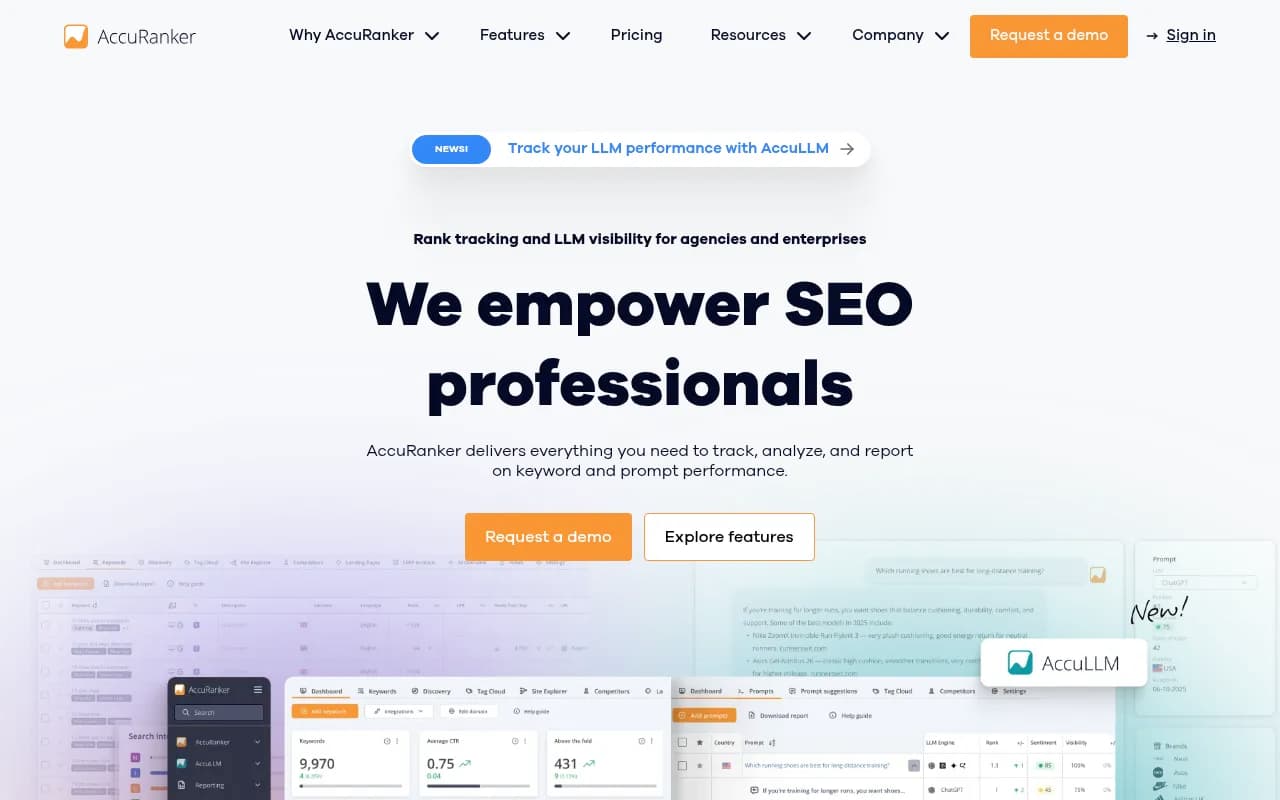
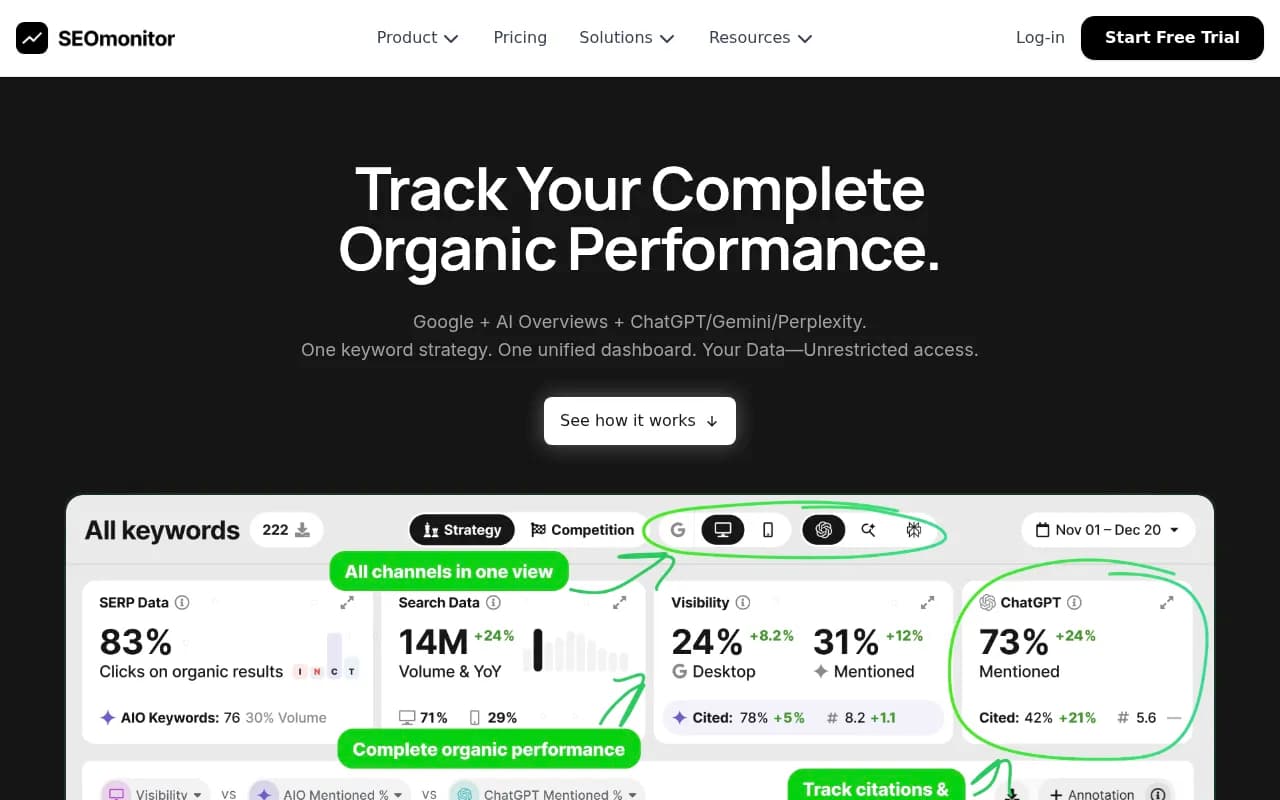
Google Search Console is free and now includes the Generative AI performance report. Pair it with a rank tracker that records AI Overview presence per keyword, such as AccuRanker or SEOmonitor.
The larger suites also track AI Overviews alongside classic rankings.
AI citation tracking
For tracking which prompts cite you across AI surfaces, Promptwatch is the one I would start with. It monitors real AI interfaces including Google AI Overviews and AI Mode, records citations and source types, and ties them to AI-referred traffic through visitor analytics and crawler logs. That last part is what turns a citation count into a business number. It also has a Content Agent for fixing gaps, which matters when your report ends with "here is what we are doing about it".

Lighter options exist if you only need monitoring.
Otterly.AI


Profound

For a broader comparison, the directories at bestgeosoftware.com and ai-rank-tools.com list the field.
| Need | Option | Notes |
|---|---|---|
| AI Overview impressions by page | Google Search Console | Free; clicks still blended into Web search |
| Rank band per keyword | AccuRanker, SEOmonitor | Check that AI Overview presence is tracked |
| Citations plus traffic and fixes | Promptwatch | Tracks citations, crawler logs, AI traffic, content actions |
| Basic prompt monitoring | Otterly.AI, Peec AI | Mentions and citations; less on traffic attribution |
How to improve the numbers you just reported
A report without a plan is a status update. The research points to a few levers.
- Move priority keywords up a band. The page-one/page-two cliff is the biggest swing in the Metrix data.
- Build links to the specific URL. At the same rank, referring domains to the page separated cited from uncited pages in the Ahrefs study.
- Make pages rank for the sub-questions. Fan-out means a page that covers related queries has more routes into the overview.
- Write specific answers. A page that states emergency response times and service areas beats one with a generic tagline, as the QBiz Leads example puts it.
- Do not bet on freshness or length tricks. Ahrefs found cited pages averaged 1,432 days old, the same as organic results, and a 0.04 correlation between length and citation position.
- Be present where corroboration happens: YouTube, forums, review sites.
One budget point from Metrix Digital: money spent on AI-visibility tactics that do not improve organic rank is mostly wasted, in their view. That is one agency's reading of its own client data, so treat it as an input, not a rule. But it is a useful counter to the idea that AI search needs a fully separate budget.
Common mistakes in this report
- Mixing AI Overviews, AI Mode and ChatGPT into one number. Moz's AI Mode data differs from Ahrefs' AI Overview data, and ChatGPT cites almost no social content while AI Overviews cite plenty. Report each surface separately.
- Quoting a single overlap figure. The 76.1% and 37.9% numbers are eight months apart from the same publisher. Show a range.
- Treating a rank as a traffic forecast. Position 1 no longer guarantees clicks on AI Overview queries.
- Ignoring query type. The Ahrefs sample leans informational, and finance, for instance, cites what ranks, while some verticals give a quarter to a third of slots to video.
The short version for your boss
Rank still opens the door. Top-ten pages are cited far more often than anything on page two, and position 1 is cited most. But the overlap is falling, a lot of citations go to video, forums and other pages, and being cited does not produce the clicks a blue link used to. So report rank bands, citation rate within each, competitor share, and AI-referred revenue, and end with the three pages or keywords you will move next. Check each external number against its original source before it goes on a slide.