Key takeaways
- A solid starter set is 20-40 prompts for a small brand and 100-150 for a team that wants topic-level data you can act on. Beyond roughly 350-400, returns drop fast.
- A single prompt is noise. Group 15-20 prompts into a topic and measure the topic, not the individual question.
- Cost scales with prompts x models x run frequency, so adding engines multiplies your bill faster than adding prompts.
- Run daily if you can and track for at least 30 days before drawing conclusions.
- Spend on prompt coverage that maps to buyer intent, personas and products, then put the leftover budget into fixing content gaps.
Why the question has no clean answer
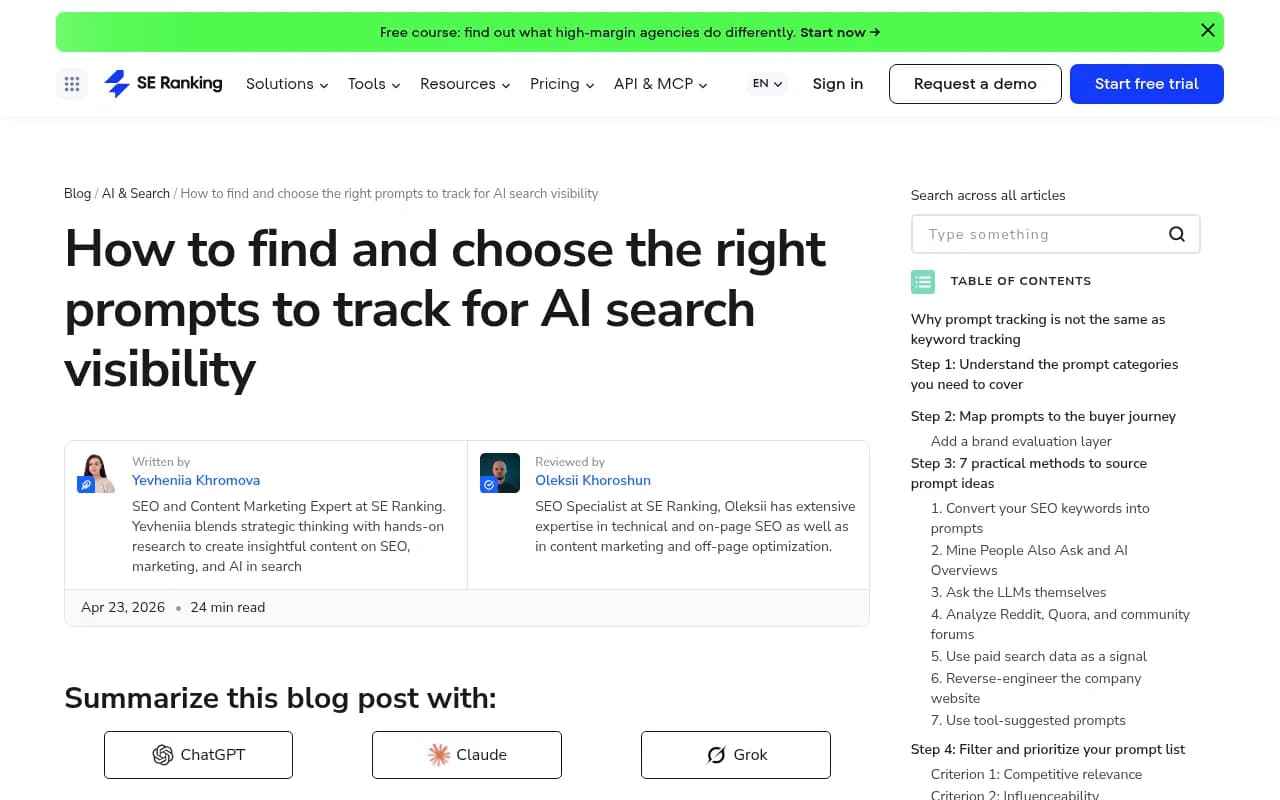
In classic SEO you had volume data, rank positions and a fixed set of results. Prompt tracking gives you none of that. The same question can return different brands depending on session, location and a bit of randomness. SE Ranking's guide on choosing prompts to track puts it well: choosing the right prompts matters more than tracking more of them.
So the honest answer to "how many?" is a range, and the range depends on three things: how precise you need the numbers to be, how many topics you sell into, and what you can afford to run daily across several models.
What the recommendations say
A few sources converge on similar numbers, with different reasoning.
| Source | Recommended size | Logic |
|---|---|---|
| SE Ranking | 20-40 prompts, 2-3 models, 30+ days | Split across awareness, consideration and brand evaluation |
| Rank Prompt | 30-100 prompts per market | Roughly 60% buying intent, 40% informational |
| Kevin Indig (via SE Ranking) | ~15 prompts per persona, ~5 runs a week | Personas as the organizing unit |
| Obsero | 15-20 prompts per topic, ~100 total across 5 topics | Statistical margin of error |
Notice the pattern. Nobody says "track 1,000." Nobody says "track 5." The sweet spot sits between 20 and 150, and the real variable is how you organize them.
Track topics, not individual prompts
This is the idea that changed how I think about sizing. Obsero's Mike Logue (published May 2026) walks through the statistics. Take one prompt like "best trainers for a first marathon." Tracked daily across three models, that is about 21 readings a week, and at a realistic visibility rate the margin of error is roughly plus or minus 16 percentage points. A metric that can swing 16 points either way is not a metric.
Group that prompt with 15 or 20 others about running trainers and you have a topic score. His worked example: 100 prompts across three models, grouped into five topics of 20, refreshed daily. Each topic produces about 420 readings a week, which gives a weekly margin of error around plus or minus 3.7 points. Over a month that tightens to roughly plus or minus 1.8.
Helen Pollitt, Director of SEO at Getty Images, makes the same point in programmatic terms: treat the topic as a variable that plugs into any prompt structure, and measure how often it gets queried and how often you appear.
The sample-size math in one table
Obsero's formula uses a visibility rate of 0.3 (more realistic than the textbook 0.5) and 90% confidence (plenty for a marketing dashboard):
| Margin of error | Prompts needed (single snapshot) | Practical read |
|---|---|---|
| plus or minus 10pp | 57 | Broadly directional |
| plus or minus 5pp | 228 | Commercial standard |
| plus or minus 1pp | 5,682 | Academic precision |
That 228 figure is for one measurement. Because every prompt runs every day, you are taking hundreds of measurements over time, which is why 100 well-grouped prompts already work. Treat these numbers as one author's modeling, not a law. They are useful mostly for the shape: precision improves with the square root of sample size, so chasing the last few points gets expensive.
Why single prompts tell you so little
Promptwatch Data backs this up from the citation side. In Promptwatch's report on unique domains per ChatGPT response (Sep 28 to Oct 4, 2026), 47.6% of responses cited 10 or more domains. For organic prompts with no brand named, that rose to 52.5%. With that many sources in a single answer, one prompt is a thin slice of reality.
Brand-specific prompts behave differently. For things like "is Asana good for small teams," 5 domains was the most common count and 40.7% of responses cited 5 or fewer. That is one reason to track brand prompts as their own bucket rather than mixing them into category metrics.
There is another wrinkle. The prompt a user types is not the query the engine searches. Promptwatch's query fanout data (Dec 2025 to Apr 2026) shows average fanout length fell from about 117 characters in early December to roughly 53 in April. So track prompts that represent sub-questions and topics, not one exact wording.
Engines matter as much as prompts
Prompts x models x frequency is the cost formula, so engine choice changes your sizing as much as prompt count does. SE Ranking suggests starting with 2-3: ChatGPT for user base, Perplexity for citation-heavy behavior, and Google AI Overviews or AI Mode for search-linked intent.
Engines also differ in stability. According to Promptwatch's average sources per response data (a September 2025 report, so treat the numbers as dated), Perplexity cited almost exactly 10 sources per answer, day after day, which makes it a steady test bench. Copilot's average swung from under 2 to nearly 17 sources within weeks. If you track Copilot, use bigger samples and judge it on monthly trends.
A sizing table by team type
Here is how I would size it. These are my recommendations built on the sources above, not a standard.
| Team | Prompts | Models | Run cadence | Why |
|---|---|---|---|---|
| Solo founder, one product | 20-40 | 2-3 | Daily or 3x weekly | Enough to see direction in a single topic or two |
| Small marketing team | 50-100 | 3+ | Daily | 3-5 topics of 15-20 prompts each |
| Mid-size brand, several personas | 100-200 | 3-5 | Daily | About 15 per persona, plus brand prompts tracked separately |
| Multi-market or multi-product | 350-400+ | 5+ | Daily | 30-100 per market, per Rank Prompt |
| Agency | Per client, 50-150 | 3+ | Daily | Budget per client, not pooled |
How to split the list
SE Ranking's journey-stage split for 20-40 prompts is a good default: 10-20 awareness, 20-30 consideration (the ranges overlap because they scale with the total), and 5-10 brand evaluation prompts kept separate. Rank Prompt's version is simpler: about 60% buying intent and 40% informational. Pick one and stick with it. Also pick one tracker and stay with it for the whole reporting period, as Supermetrics advises in its guide to measuring AI search visibility. Switching mid-quarter breaks your trend line.
Where the prompts come from
Sizing is pointless if the prompts are guesses. The most grounded sources:
- Existing SEO keywords converted into conversational questions
- People Also Ask and AI Overview follow-ups
- Reddit and community threads where your buyers describe problems
- Competitor sites and their comparison pages
- Your own sales calls and support tickets
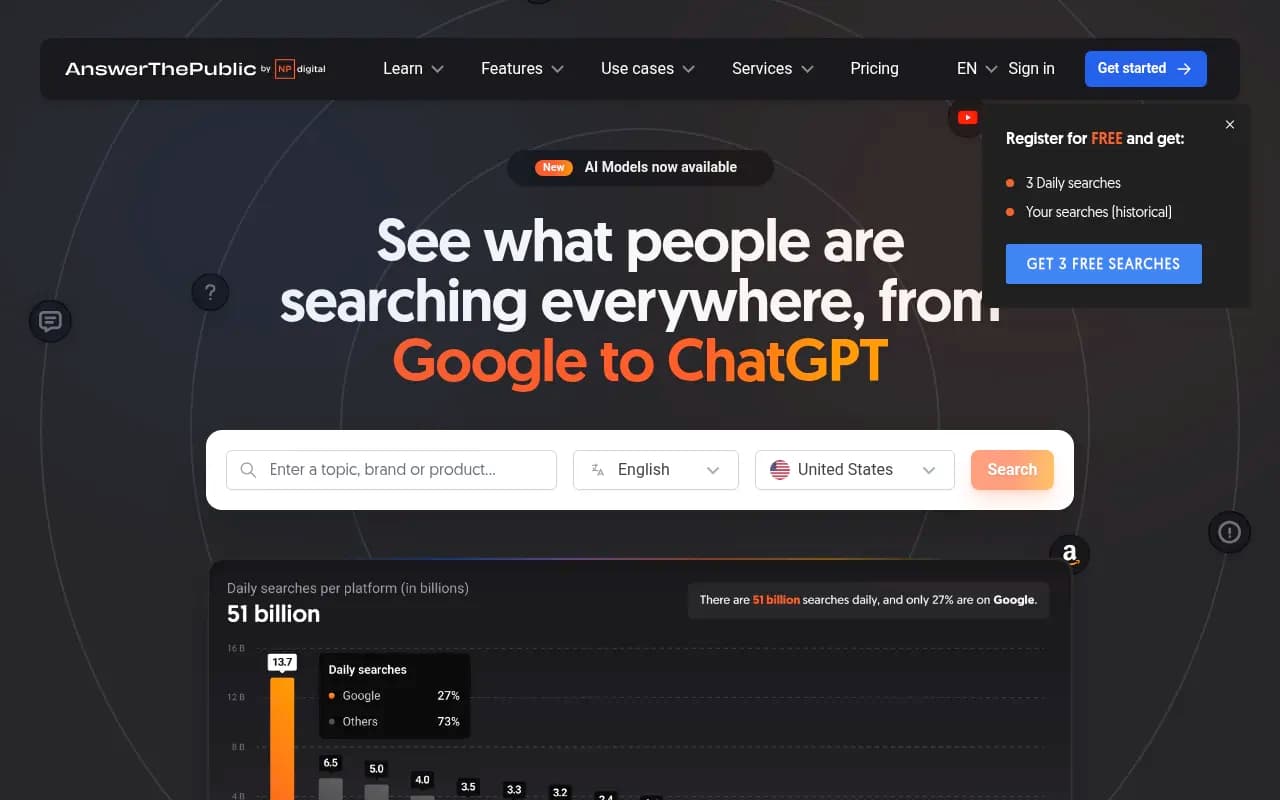
For question mining, tools like AlsoAsked and AnswerThePublic work well, and Google Search Console shows which queries already bring you impressions.
What prompt limits cost in 2026
Plan sizes cluster around 50, 100-150 and 350-400 prompts, which is a handy anchor. The figures below come from vendor pricing pages and roundups (Semrush, Agenzy and Industry Lens, checked September and October 2026). Vendor numbers go stale, so confirm before buying.
| Tool | Entry plan | Mid plan | Top self-serve plan | Engines |
|---|---|---|---|---|
| Promptwatch | $95/mo, 50 prompts | $245/mo, 150 prompts | $579/mo, 350 prompts | All models on every paid plan |
| Peec AI | $95/mo, 50 prompts, 3 engines | $245/mo, 150 prompts | $495/mo, 350 prompts | 3 picked from 6, 4th is an add-on |
| Profound | $99/mo, 50 prompts, ChatGPT only | $399/mo, 100 prompts | Custom | 3 engines on Growth |
| Otterly.AI | $29/mo, 15 prompts | $189/mo, 100 prompts | $489/mo, 400 prompts | ChatGPT, AI Overviews, Perplexity, Copilot |
| Trendos | $30/mo, 100 prompts | $140/mo, 450 prompts | $320/mo, 1,050 prompts | Varies |
| LLMrefs | $79/mo, 500 prompts | n/a | n/a | Varies |
Two things stand out. First, prompt counts are not comparable across vendors unless you also count engines. A 50-prompt plan on one engine is a different product from 50 prompts on every model. Second, cost per reading varies a lot: Agenzy's comparison, which comes from a Peec partner so treat it as partial, put Profound Starter at about $0.066 per prompt per engine per day against roughly $0.01 to $0.02 for Otterly and Peec.
Matching plans to the sizing table
The 50-prompt tier fits the solo founder. The 150-prompt tier covers most small teams running three to five topics with some persona prompts. The 350-prompt tier is for multi-market brands. Promptwatch is worth a look here because every paid plan includes all tracked models, so you are not choosing which engines to drop to stay in budget. Its responses allowance also appears to be about 120 per prompt on the Essential plan (6,000 responses for 50 prompts), which is my inference rather than a published formula.

Tools worth comparing at the same size:

Profound

Otterly.AI

For a wider view of the category, the rank tracker directory at ai-rank-tools.com and the GEO software list at bestgeosoftware.com are good places to scan alternatives.
A practical rollout plan
- Week 1. Pick 2-3 topics tied to revenue. Write 15-20 prompts for each. Add 5-10 brand prompts in a separate group.
- Weeks 1-4. Run daily on 2-3 engines. Do not react to single days. Rank Prompt and Kevin Indig both suggest repeating runs (3-5 per prompt) because answers vary.
- Day 30. Look at topic-level trends, not individual prompts. Which topics have low share of voice? Which have mentions but no citations of your own pages?
- Month 2. Prune prompts that never change and never matter. Add prompts for the gaps you found, not for completeness.
- Quarterly. Review the list against your sales conversations. Prompts drift as buyers' language does.
One caution. A bloated prompt set is hard to analyze and expensive to maintain, as SE Ranking points out. Money spent on prompt number 300 is money not spent on fixing the content gap you found at prompt number 30.
Common mistakes
- Tracking only "best X tool" prompts. Buyers also ask instructional, comparative and use-case questions.
- Mixing brand prompts with category prompts, which inflates your visibility score.
- Judging a prompt after one run. Ranges of plus or minus 16 points are normal on a single prompt.
- Counting prompts without counting engines. Ten prompts on five engines is 50 daily readings.
- Ignoring cadence. Daily runs are the cheapest accuracy you can buy, per the Obsero analysis.
Bottom line
Start with 20-40 prompts if you are small, or 100 organized into five topics if you can afford it. Track 2-3 engines daily for at least 30 days, read the trend rather than the dot, and only expand when a gap in the data justifies it. Past 350-400 prompts you are mostly buying precision no commercial decision needs.