Key takeaways
- 2026 brought a run of AI visibility deals: Adobe closed its Semrush purchase on April 28, HubSpot folded XFunnel into HubSpot AEO, and Sitecore announced it was acquiring Scrunch in June.
- The research I found shows no verified case of an AI visibility tool being shut down after an acquisition. The risk is quieter: roadmap absorption, bundling, repricing and priorities that shift toward the parent company.
- Sort vendors by ownership model (independent, acquired, suite-embedded, platform-native) and apply different scrutiny to each.
- Your own data, prompt sets and exports are the real asset. Keep them portable and you can switch vendors without losing your history.
- Review AI visibility vendor dependence quarterly and after any ownership, pricing or data-collection change.
Why this matters now
AI visibility tracking was a niche category two years ago. Now it feeds board reports, content roadmaps and budget decisions. That makes the tool underneath a dependency, and dependencies carry vendor risk.
The category is also consolidating. Deepak Gupta's September 2026 acquisition map (who is buying and building AI visibility) argues that buying beats building because the hard part is measurement infrastructure that turns nondeterministic model outputs into stable signals. He puts that at roughly 18 months of work. HubSpot reportedly cut its time to market from about 18 months to about 6 by buying. That logic will keep pushing deals.
I want to be careful here. Most of what follows is analysis from a third party plus general third-party risk management (TPRM) practice. I found no source on specific contract clauses, so the contract advice below is standard procurement hygiene, not a research finding.
What actually happened in 2026
Deals worth knowing
| Deal | Announced / closed | What it means for customers |
|---|---|---|
| Adobe and Semrush | Announced Nov 19, 2025, closed Apr 28, 2026; all cash at $12.00 per share, about $1.9B | Semrush and its AI Visibility Toolkit now sit inside Adobe's enterprise stack, with about 28M users folded into Adobe CX Enterprise |
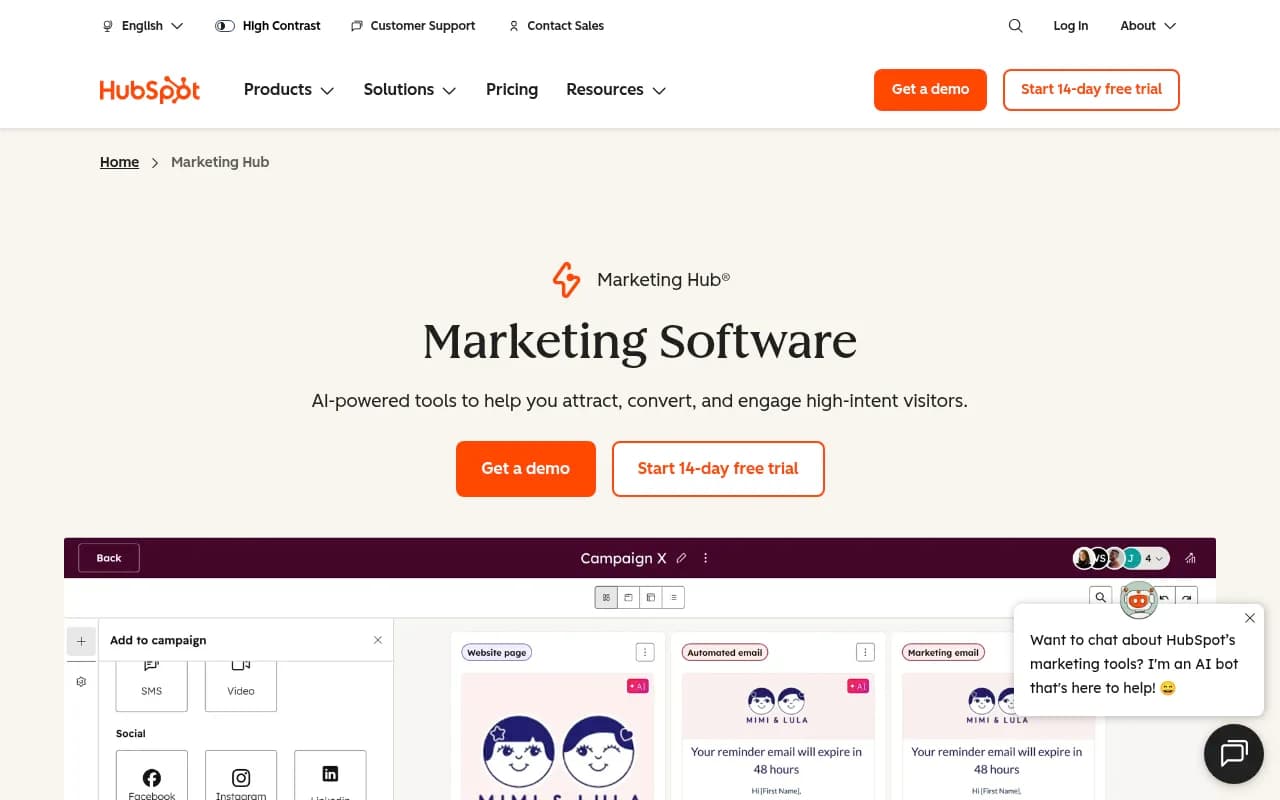
| HubSpot and XFunnel | Announced Oct 31, 2025, closed Dec 1, 2025 | HubSpot AEO became generally available Apr 14, 2026 inside Marketing Hub. Reviewers describe it as essentially XFunnel rebuilt in HubSpot's interface |
| Sitecore and Scrunch | Announced June 2026 | Scrunch (about $26M raised, an Agent Experience Platform) becomes part of a DXP vendor |
| Searchable and Meridian | Announced 2026, seven-figure deal | A pure-play buying another startup, so consolidation is happening inside the category too |
See Sitecore's press release for its own account of the Scrunch deal.
The Adobe deal carried a 77.5% premium over Semrush's last close before the announcement, and founders and major shareholders with more than 75% of voting power had committed their votes. Semrush's enterprise ARR was growing 33% year over year, with customers including Amazon, JPMorganChase and TikTok. One reviewer at generatemore.ai reads the deal as an SEO suite "moving upmarket inside Adobe" and notes Adobe announced no change for smaller customers. That is opinion, but it is the right kind of question to ask: what happens to mid-market customers when a tool moves upmarket?
Who built instead of bought
Several platforms shipped their own tracking: Wix (AI Visibility Overview, July 2025), Squarespace, Cloudflare (AEO Visibility Dashboard) and Optimizely, which pairs its GEO-ready CMS and Agent Visibility Analytics with a Conductor partnership. Contentful, Sanity, Drupal and Salesforce had shipped nothing native in Gupta's analysis, and Webflow had AEO for Enterprise in private beta. Gupta predicts the next wave of M&A comes from that group.
Funding adds pressure on the independent side. Pure-play AI visibility startups have raised more than $255M by one count (another source says $300M+), with Sequoia, Lightspeed, Kleiner Perkins and Salesforce Ventures on cap tables. Investors expect exits.
A vendor-risk taxonomy for AI visibility tools
Gupta's buckets (acquired, built, partnered, shipped nothing) work well as a TPRM lens. Here is how I would translate them into risk profiles.
| Ownership model | Examples from 2026 | Main risk | What to check |
|---|---|---|---|
| Independent pure-play | Promptwatch, Profound, Peec AI, Otterly.AI, AthenaHQ | Funding runway and acquisition risk | Financial backing, customer base, change-of-control terms |
| Recently acquired standalone | Scrunch (Sitecore), XFunnel (HubSpot) | Roadmap absorption, product merging into a suite | Stated roadmap for existing customers, pricing and data migration plans |
| Suite-embedded | Semrush (Adobe), HubSpot AEO, Ahrefs Brand Radar | Bundling, shallow depth, priorities set by the suite | Whether AI tracking is a core product or a bolt-on, export options |
| Platform-native | Wix, Squarespace, Cloudflare, Optimizely | Tied to one platform, may be less deep | Cross-platform coverage, whether data survives leaving the platform |
None of these is automatically safe or unsafe. An independent vendor can be well funded and stable. A suite can be a strong home. The point is to know which failure mode you are exposed to.
The XFunnel lesson
The XFunnel case shows the pattern most likely to hit you. Nothing was shut down in a dramatic way. The standalone product was absorbed into a suite, and customers who bought a specialist tool ended up with a feature inside Marketing Hub. If you valued the specialist roadmap, that is a real change even though no one sent a sunset notice.
Risk beyond ownership: the ground moves under every tool
Ownership is only one source of instability. The platforms these tools measure change without notice, and that can break your metrics with no vendor action at all.
Promptwatch Data tracked average citations per search-enabled ChatGPT response falling from about 6.4 to roughly 4.7 to 4.9 around the GPT-5.3 rollout on March 4, 2026, about 27% fewer, across GPT-5.3, GPT-5.4 and GPT-5-Mini at once (ChatGPT citation drop report, covering Feb 26 to Mar 11, 2026). Its advice: check dates against model releases before blaming your content.
A second example: reddit.com's share of ChatGPT citations held about 3.83% from Jul 18 to Aug 7, 2026, then fell below 1% on Aug 14, averaging 0.52% from Aug 14 to 17 (Reddit citations report). Promptwatch notes a data-collection issue can't be ruled out, so the size of the drop is provisional.
For vendor risk, this means two things. Single-snapshot audits are unreliable, and you should ask every vendor how it handles data-collection integrity and whether it annotates anomalies. A tool that quietly changes its collection method after an acquisition could shift your trend lines without telling you.
The general TPRM playbook, applied here
The research on third-party risk converges on a few points that map neatly onto AI visibility tools.
Bitsight's 2026 guide argues for replacing annual vendor reviews with continuous monitoring, tiering vendors by exposure, and validating self-reported claims with outside evidence. Compyl's 2026 guide adds that vendor AI features can route your data through fourth-party model providers you never assessed. Ncontracts' August 2026 roundup makes the point that AI risk often arrives without a procurement decision, because vendors add AI features to products already under contract.
Applied to this category:
- Inventory every tool that touches AI visibility data, including seats bought by individual teams and suite features nobody formally approved.
- Tier them. A tool feeding board-level reporting or automated publishing is critical. A free checker used by one analyst is not.
- Ask where your data goes and which model providers sit behind any AI features in the product.
- Re-review on events, not just on a calendar: acquisition announcements, price changes, new data subprocessors, a big shift in your numbers.
What to put in the contract
I found no research source on specific clauses, so treat this as general procurement practice and run it past your legal team.
- Change-of-control notice, with a right to terminate without penalty if the vendor is acquired.
- Price protection for the term, and a cap on renewal increases.
- Data export in open formats (CSV, API) covering prompts, responses, citations and historical scores, available for a set period after termination.
- Notice of material changes to data collection, supported models or scoring methodology.
- Subprocessor and model-provider disclosure, with notice of changes.
- Security evidence such as ISO/IEC 27001 certification and GDPR compliance, which matter more if the vendor moves under a larger parent with different data practices.
One caution from the AvePoint piece on AI vendor lock-in: vendor messaging is not a contractual commitment. A reassuring blog post after an acquisition does not replace a clause.
Keep your data portable and your fallback warm
AvePoint's multimodel advice is aimed at AI models, but the logic transfers to visibility tooling. A fallback you have never used is a plan, not a capability.
Practical steps:
- Keep your master prompt list and persona definitions in your own repository, not only inside a vendor's UI.
- Export results on a schedule (monthly is enough for most teams) and store them in your warehouse, so history survives a vendor switch.
- Run a small parallel pilot with a second tool on a subset of prompts. Compare it against your primary for a few weeks. If the numbers diverge a lot, you learn something about both.
- Document a switching plan: who owns it, how long migration takes, and what gets lost.
- Test the exit. Export everything once and confirm another tool or your warehouse can read it.
There is a trade-off. Running two tools costs money and creates reconciliation work. For a critical reporting workflow it is usually worth it. For a small team's side experiment it probably isn't.
Choosing a vendor with ownership risk in mind
Below are options in each bucket. This is not an endorsement list, just a way to see the spread. Check current pricing and roadmaps yourself, since I did not find pricing data for these tools.
Independent platforms
Promptwatch is an independent AI visibility platform, not a suite add-on. It tracks ChatGPT, Gemini, Claude, Perplexity, Google AI Overviews and others, and covers the full loop: monitoring, tracing citations and AI crawler logs, acting through content tooling, and measuring traffic. It is ISO/IEC 27001 certified, GDPR compliant, and offers a hosted MCP server and REST API, which helps with the portability point above. Its case studies include Crisp. Confirm plans at promptwatch.com/pricing; there is a 7-day free trial and a free AI visibility report.

Profound targets enterprises and is a major independent in the category.
Profound

Peec AI and Otterly.AI are lighter-weight trackers.

Otterly.AI

AthenaHQ is another independent in the monitoring and optimization space.

Recently acquired or suite-embedded
Scrunch now sits under Sitecore.
XFunnel was the HubSpot acquisition, and HubSpot's own marketing suite is where that capability now lives.
Semrush is part of Adobe after the April 2026 close, and Ahrefs Brand Radar is an add-on inside an SEO suite.

If your team already lives in one of these suites, the embedded option may be good enough. Just price in the bundling risk and ask for export guarantees.
Browse more
For wider comparison, the GEO software directory at bestgeosoftware.com lists many alternatives, and Promptwatch's 2026 GEO platform comparison covers feature differences head to head.
A quarterly review checklist
Run this every quarter and after any trigger event:
- Has the vendor been acquired, announced a deal, or raised a new round?
- Have pricing, packaging or supported AI models changed?
- Did the data-collection method or scoring change? Does the vendor annotate anomalies?
- Can you still export full history in a usable format? Test it.
- Does your fallback tool still return comparable numbers on your top prompts?
- Has your team's dependence grown, for example automated publishing now tied to the tool?
If you want outside help running a vendor assessment or building a GEO program that doesn't hinge on one tool, an agency can take it on. 1001 SEO Media does this kind of work and uses Promptwatch as its own AI visibility platform, which is worth knowing when weighing its advice.
Bottom line
The 2026 deals did not kill any tools I could verify. They changed who owns the roadmap. Treat that as a normal vendor-risk event: classify the vendor, keep your data in your own hands, write exit terms into the contract, and test a fallback before you need one. Then check again next quarter, because the next deal from the group that has shipped nothing native is already being predicted.