Key takeaways
- There's no single published "citation rate per article" leaderboard for AirOps and its competitors. What exists is citation-share-of-total data (which domains and formats win citations) plus separate third-party studies on citation rate by content format.
- How-to guides and original research consistently out-cite generic blog posts and listicles across ChatGPT, Perplexity, and Google AI Overviews, according to multiple 2026 studies.
- AirOps is a workflow-automation platform, not a citation-optimization engine on its own. Its alternatives split into three camps: brief-and-optimize tools (Frase, Surfer, Clearscope), full-stack AEO/GEO platforms (Search Atlas, AirOps itself, Promptwatch), and budget content generators (NeuronWriter, ContentMonk, GrowthBar).
- ChatGPT cites roughly 5 sources per response versus about 10 for AI Overviews and Perplexity, meaning the same article has roughly half the shot at a ChatGPT citation slot as it does at Google AI Overviews or Perplexity.
- If your goal is tracking how often your published articles actually get cited (not just producing them faster), pair a content-ops tool with a dedicated AI visibility platform like Promptwatch that reports citation rate per page.
The metric everyone wants but nobody quite publishes
I went looking for a clean "citation rate per published article" ranking of AirOps alternatives and ran into the same wall every researcher runs into: it doesn't exist as a single standardized number. Vendors report citation share (what percentage of all citations a domain or content type captures across thousands of prompts), not a per-article conversion rate you can compare tool to tool. That's an important distinction and worth sitting with for a second, because a lot of marketing copy blurs the two.
Citation share tells you AirOps-published product pages might make up, say, 15% of all citations in a category. Citation rate tells you what percentage of the articles AirOps actually published got cited at all. The first is useful for understanding the competitive field. The second is what you actually care about when you're deciding whether to pay $1,999/month for AirOps Pro or $39/month for Frase Starter.
So this guide does the next best thing: it combines Promptwatch's citation-share-of-total data (the closest thing to ground truth on what gets cited and how often, updated monthly) with third-party citation-rate-by-format studies, then ranks AirOps alternatives by how well their actual output, the format and structure of what they help you produce, aligns with what's getting cited right now.
What actually drives citation rate, format by format
Before ranking tools, it helps to know what AI engines are citing in 2026, because that's the variable every tool in this list is trying to influence.
In August 2026, product pages made up 28.7% of ChatGPT Search citations, more than any other format, though that share slipped from roughly 30% to 25% after August 22. How-to content more than doubled its share in the same window, climbing from 4.3% to 9.1%, while landing pages and social posts both collapsed (Promptwatch's ChatGPT citation type data). On Google AI Overviews, the picture is different: listicles led most of July at around 18%, but product pages overtook them late in the month for the first time, and video citations nearly doubled from January's 2.7% to 6.3% by late July (AI Overviews citation types, July 2026).
Third-party studies fill in the per-article rate gap Promptwatch's share data doesn't cover. Presenc AI's 2026 study on AI citation rate by page format found how-to and step guides carry a median citation rate of 24% (top quartile hits 38%), compared to listicles at 19% median. A synthesis by AuthorityTech pulling from four separate 2026 studies found original research with proprietary data gets cited 38-65% of the time, roughly 20x a thin blog post and 4-10x a standard article. That's the single biggest lever in this whole conversation: if your content pipeline can't produce anything with original data, you're capping your own citation ceiling no matter which tool you buy.
One more number worth knowing before you pick a tool: ChatGPT cites about 5 sources per web-search response, while both AI Overviews and Perplexity cite roughly 10 (average sources per response). That means every article you publish is fighting for half as many open slots on ChatGPT as it is on the other two engines. If a tool's roadmap is heavily weighted toward ChatGPT optimization specifically, temper your expectations accordingly.
AirOps, briefly
AirOps is a no-code content-ops platform built around a "Brand Kit" plus "Knowledge Base" architecture that feeds AI-driven publishing workflows. It positions itself against pure trackers like Profound or AthenaHQ as a tool that turns AI visibility insight into actual published content, not just a dashboard.
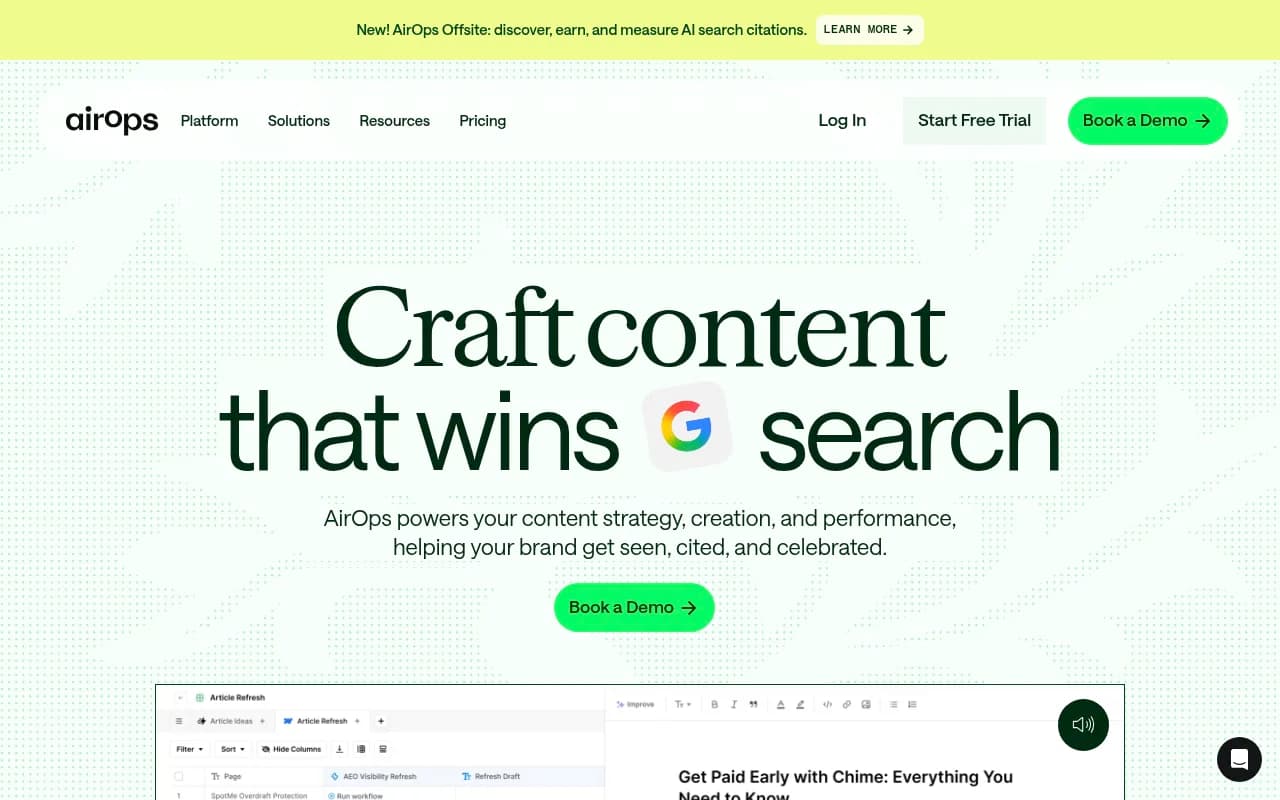
The honest complaint I keep seeing, in a Reddit thread from r/SEO_LLM and in a June 2026 YouTube teardown, is pricing structure rather than output quality. There's no middle tier between Solo (~$199/month, 20,000 tasks) and Pro ($1,999/month, 75,000 tasks). Each article eats 500-800 tasks across research, drafting, review, and publish steps, so 30 articles a month pushes a Solo user into overage fees fast. That $200-to-$2,000 cliff is the number one reason people start searching for alternatives, not dissatisfaction with citation performance itself.
Ranked: AirOps alternatives by citation-rate potential
Here's the ranking, weighted toward which tools help you produce the content formats actually earning citations right now (how-tos, comparisons, and original-data pieces) rather than raw feature count.
| Rank | Tool | Content format strength | Entry price | Best fit |
|---|---|---|---|---|
| 1 | Search Atlas | End-to-end execution across product pages, comparisons, how-tos | $99/mo | Teams wanting AI visibility tracking and publishing in one system |
| 2 | Frase | Intent-matched briefs that mirror how-to and comparison structure | $39/mo | Cost-sensitive teams wanting research-to-draft speed |
| 3 | Clearscope | Editorial governance for long-form, trustworthy how-to content | ~$129/mo | Teams prioritizing content quality over volume |
| 4 | Surfer SEO | On-page optimization matched to live SERP structure | $99/mo | Teams optimizing existing pages for citation-friendly structure |
| 5 | NeuronWriter | Budget optimization with GSC-linked citation tracking | $19/mo | Solo operators and small teams |
| 6 | AirOps | Bulk, brand-aware workflow automation across formats | $199/mo (Solo) | Teams already committed to no-code pipelines at scale |
1. Search Atlas
Search Atlas earns the top spot because it tracks LLM visibility (ChatGPT, Gemini, Google AI Mode on the Growth tier and up) alongside execution, so you can see which of your published articles are actually getting cited and adjust the next batch accordingly. Pricing starts at $99/month for the Starter tier without AI tracking, $199/month once you add LLM visibility, scaling to $999/month for the Agency tier with five-engine coverage.

What makes it rank ahead of AirOps for this specific question isn't raw content quality, it's the feedback loop. You can't improve citation rate per article if you can't measure citation rate per article, and Search Atlas is one of the few tools in this list that closes that loop natively rather than requiring a separate tracking subscription.
2. Frase
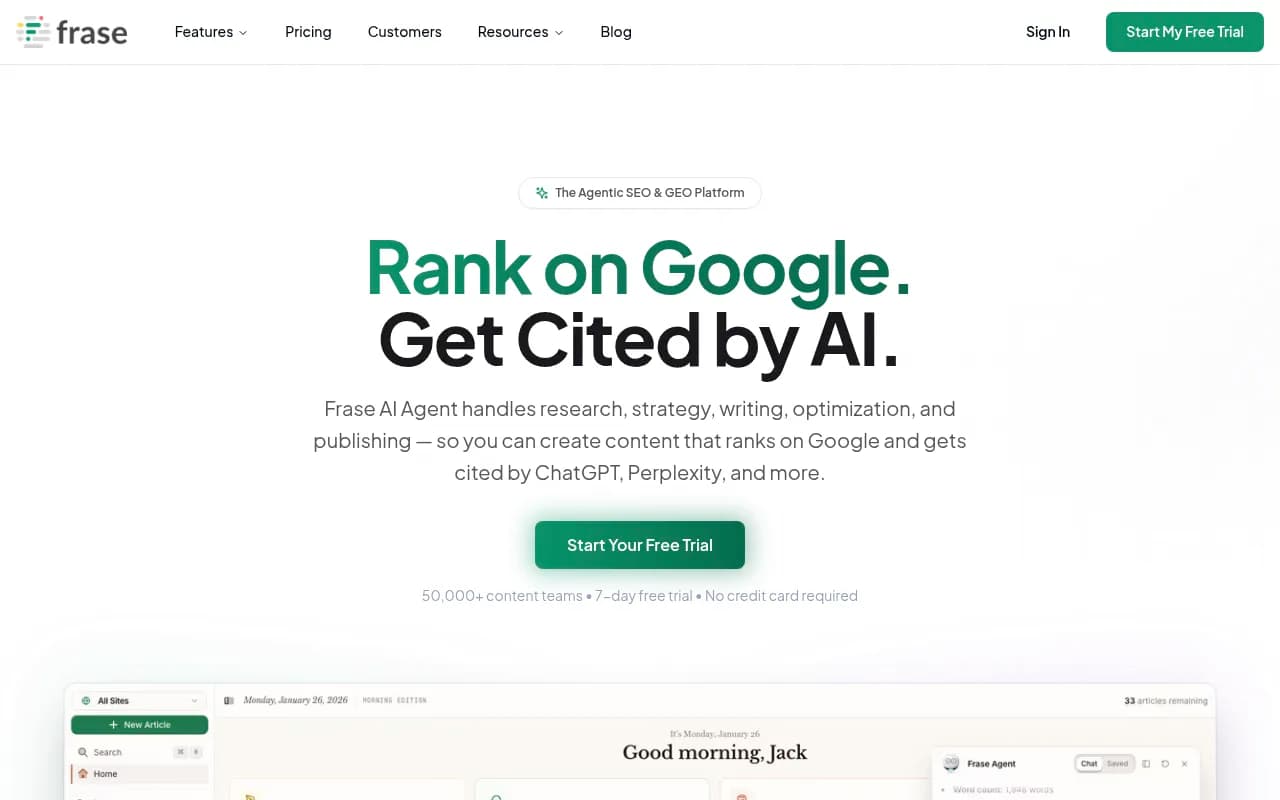
Frase is the budget pick that punches above its price. At $39/month for the Starter tier (10 articles, 2 AI platforms tracked, 50 visibility prompts), it undercuts Surfer, Clearscope, and MarketMuse on entry price while still bundling AI search tracking that used to be a $35/month add-on. Its research-to-brief flow naturally nudges writers toward the question-and-answer structure that how-to content needs to earn citations.
3. Clearscope
Clearscope costs more (roughly $129-189/month depending on the source) but it's positioned deliberately as "the discoverability platform," covering Google, ChatGPT, and AI search rather than classic on-page optimization alone. If your team already produces solid long-form how-to content and just needs editorial guardrails to keep it consistent, this is the safer bet over a raw content-generation tool.

4. Surfer SEO
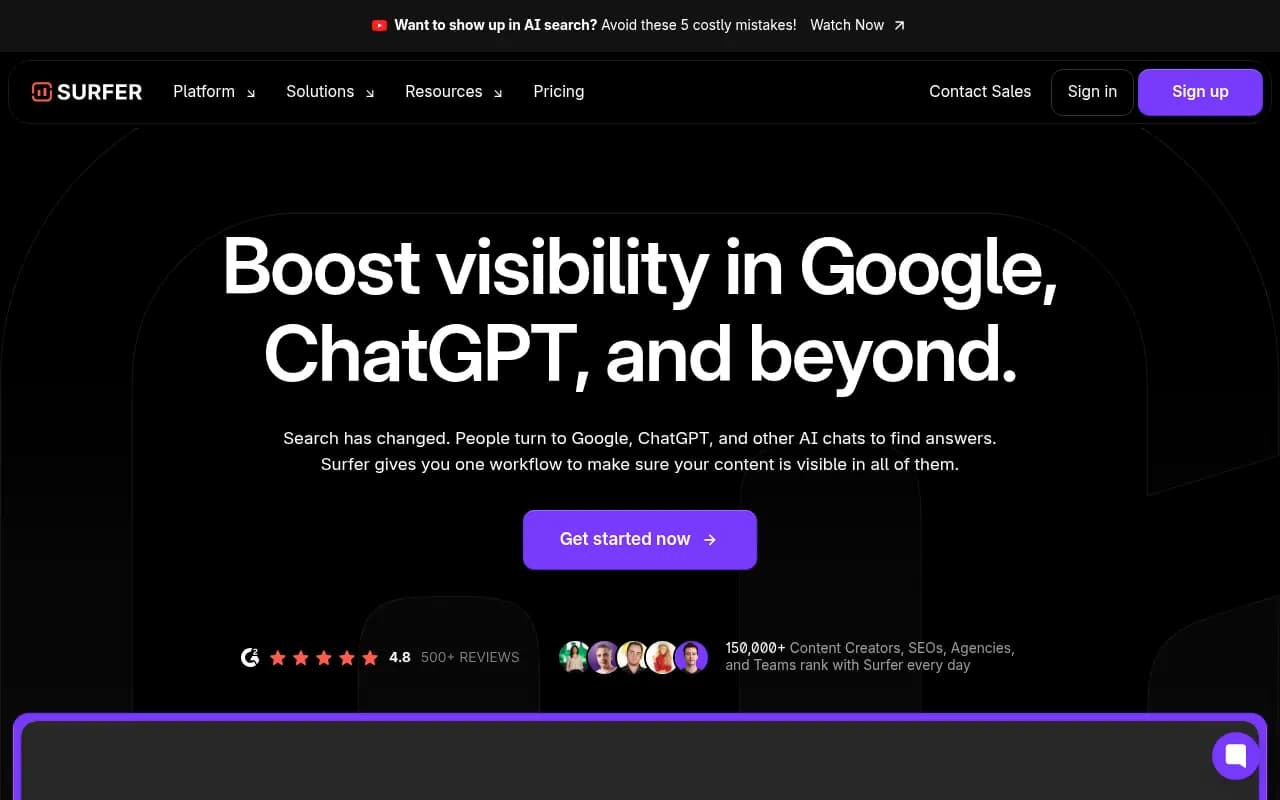
Surfer's Standard tier is $99/month for 360 documents and ChatGPT-only AI visibility tracking; Pro at $182/month adds Perplexity, Google AI Mode, AI Overviews, and Gemini tracking. It's strongest at matching your draft's structure to what's already ranking, which matters because Google AI Overviews still leans heavily on listicle and how-to formats.
5. NeuronWriter
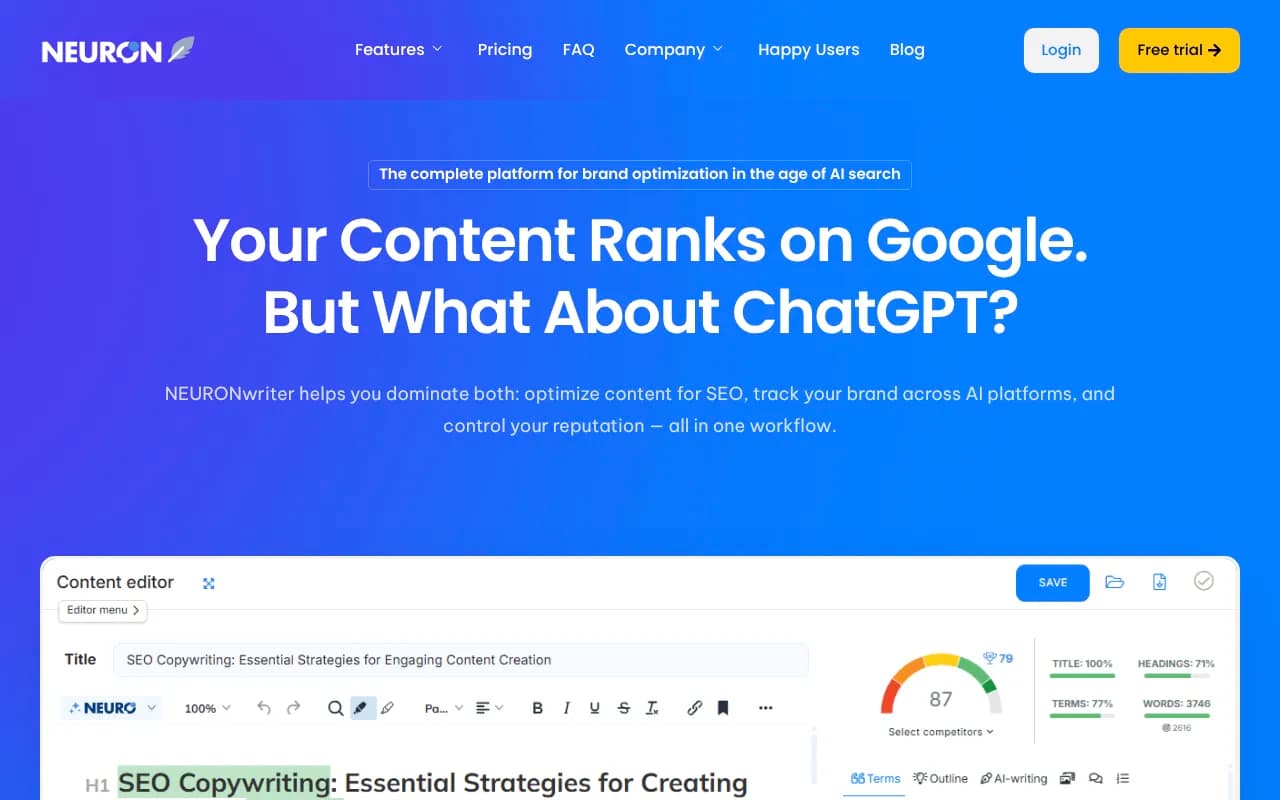
At $19/month, NeuronWriter is the cheapest entry point on this list with Google Search Console linking built in, letting you connect published articles to actual click and impression data rather than guessing at citation performance.
6. AirOps (as its own alternative to itself, worth keeping)
AirOps still belongs on this list, just not at the top, because its bulk-production capability is genuinely differentiated once you clear the pricing cliff. If you're publishing 50+ articles a month across multiple brand voices, the workflow automation pays for itself. The Pro tier's multi-engine insights (ChatGPT, Google, Perplexity, Google AI Studio) are also broader than most alternatives at a comparable price once you're past the $1,999/month threshold.
Where a dedicated AI visibility tool fits in
Every tool above is fundamentally a production tool: it helps you write and structure content faster. None of them natively answers the question this whole guide is built around, how often does what you publish actually get cited, at the individual article level, across every AI engine your audience uses.
That's the gap Promptwatch is built to close. It reports citation rate per page, tracks which of your specific published articles get pulled into ChatGPT, Claude, Gemini, Perplexity, Google AI Overviews and AI Mode, and pairs that with AI crawler logs showing whether bots are even reading the page correctly before it gets a chance to be cited. It goes further than the tools above in one specific way: its Content Agents and Content Gap Analysis close the loop from "this page isn't getting cited" to a rewritten, published fix, using the git-diff-style suggestions and coverage scoring most trackers stop short of.

Worth flagging while we're on the topic: Reddit's share of ChatGPT citations collapsed from around 3.8% to 0.5% in a single week in mid-August 2026, the same day ChatGPT changed its query fanout behavior (Promptwatch's Reddit citation data). ChatGPT's fanout queries also dropped from roughly 2 searches per response down to exactly 1.0 by April 2026, and average query length shrank from over 100 characters to around 53 (ChatGPT query fanout data). Both trends point the same direction: ChatGPT is running leaner, keyword-style searches and relying less on social proof, which raises the value of well-structured, entity-clear headings over broad social-style content.
A practical way to test citation rate yourself
If you want to actually measure citation rate per article rather than trust a vendor's aggregate number, here's a workable approach:
- Tag every article you publish with a unique identifier in your CMS or a simple spreadsheet.
- Run the same 10-20 prompts against ChatGPT, Perplexity, and Google AI Overviews weekly, noting which of your URLs show up.
- Divide citations by articles published in a rolling 90-day window to get your own rate, rather than relying on industry averages that mix in every content type.
- Cross-reference against domain authority. ChatGPT's mid-authority domains (DR 46-75) captured nearly half of all citations in August 2026, while top-tier DR 91-100 domains shrank to about 3% of citations after mid-August (ChatGPT citation share by domain rank, August 2026). If you're a smaller site, this is actually good news: you don't need Forbes-level authority to get cited anymore.
Manually tracking this across three or four engines every week gets tedious fast, which is the practical reason most teams graduate to a dedicated tracker once they've validated the approach by hand for a month or two.
Final take
There's no shortcut around the fact that citation rate is mostly a function of content format and depth, not the tool you used to produce it. How-to structure and original data beat generic listicles on every engine the data covers. Pick your AirOps alternative based on whether it nudges your writers toward that structure and whether it can actually measure the outcome, not just the production speed. For the production side, Frase and Search Atlas offer the best value right now; for measuring whether any of it worked, pair whichever production tool you choose with a visibility platform built for the job. You can browse more options in the GEO software directory at bestgeosoftware.com if you want to compare additional platforms side by side.