Key takeaways
- AirOps is built for teams that publish at volume. Workflows and Grids let one person run research, drafting and CMS publishing across hundreds of pages.
- Solo and Pro prices are not on the pricing page. Third parties report roughly $200 and $2,000 per month, but treat those as unconfirmed.
- Review sites disagree on plan limits. The live page lists 35,000 tasks on Solo and 100,000 on Pro, while older reviews cite 20,000 and 75,000.
- AirOps will not fix weak SEO fundamentals. It speeds up what a team already does well.
- ChatGPT cites product and landing pages more than blog posts, so bulk article output is only part of the AI visibility picture.
What AirOps is
AirOps started as a general AI workflow builder and now sells itself as a content engineering platform for AI search visibility. You get two halves. One is an intelligence layer that tracks how your brand shows up in answer engines. The other is an action layer, with Brand Kits, Knowledge Bases, Workflows, Grids and CMS publishing, that produces and ships content.
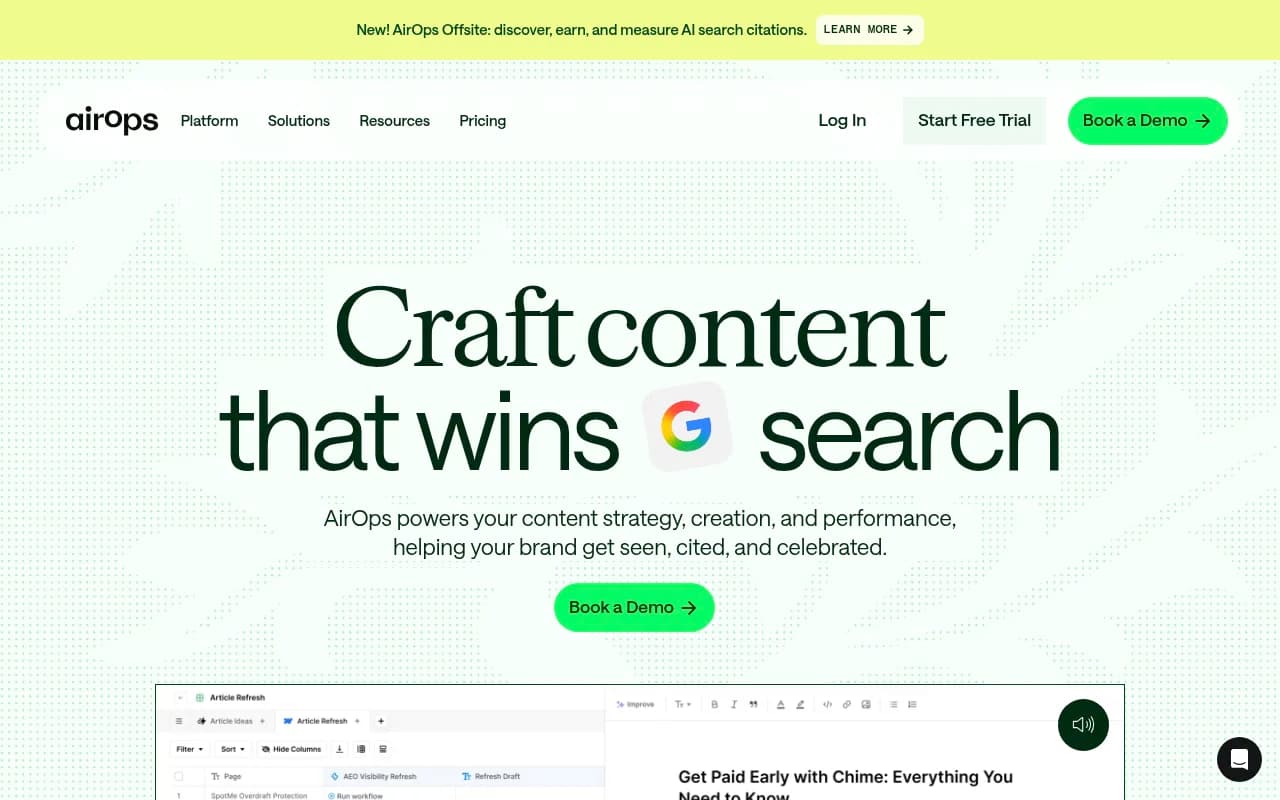
The Grids idea is the part people remember. It is a spreadsheet-style view where each row is a page or a prompt and each column is a step: research, outline, draft, review, publish. If you have ever managed a content calendar in Google Sheets and wished the sheet could write the articles, that is the pitch.
Pricing: what's published and what isn't
Here is the awkward part of this review. AirOps shows no dollar prices for Solo or Pro on its pricing page. There is a free Insights tier, a Solo plan, a Pro plan, and a sales-led Enterprise plan. Billing runs on tasks, the unit of work the platform meters.
The dollar figures you see elsewhere are third-party reports. Sources like ContentMonk and SyncGTM put Solo around $200 per month (SyncGTM estimates a realistic bill of $200 to $300) and Pro around $2,000. Rankability describes a different, older structure with plans from $99 per month and Scale and Team tiers. That does not match the current Solo, Pro and Enterprise layout, so I would treat it as stale.
Plan limits are a moving target
The official page I checked lists the following. Earlier reviews give lower numbers, so check the page the day you buy.
| Plan | Reported price | Tasks (live page) | Answer engines (live page) | Seats |
|---|---|---|---|---|
| Insights | $0 | 1,000 or 10,000 tasks via slider | Limited | 1 |
| Solo | Not published (about $200 reported) | 35,000 | ChatGPT only | 1 |
| Pro | Not published (about $2,000 reported) | 100,000 | 10+ engines | Unlimited |
| Enterprise | Custom | Custom | Custom | Unlimited |
The ContentMonk and RankUp reviews say Solo has 20,000 tasks and Pro has 75,000 with four engines. AirOps' live page now says 35,000, 100,000 and 10+. Either the plans were upgraded or those reviews are dated. Note too that ContentMonk sells a competing product, so its framing leans toward its own published pricing.
Where the gating hurts
The practical complaint is about tiers, not sticker price. Multi-engine visibility, Ahrefs and Semrush integrations and weekly opportunity reports sit on Pro. Multi-region tracking, multi-brand support and SSO sit above that, and you need a sales call to learn what they cost. If you manage one brand in one market, that is tolerable. If you are an agency with ten clients, the math gets uncomfortable fast.
What users say
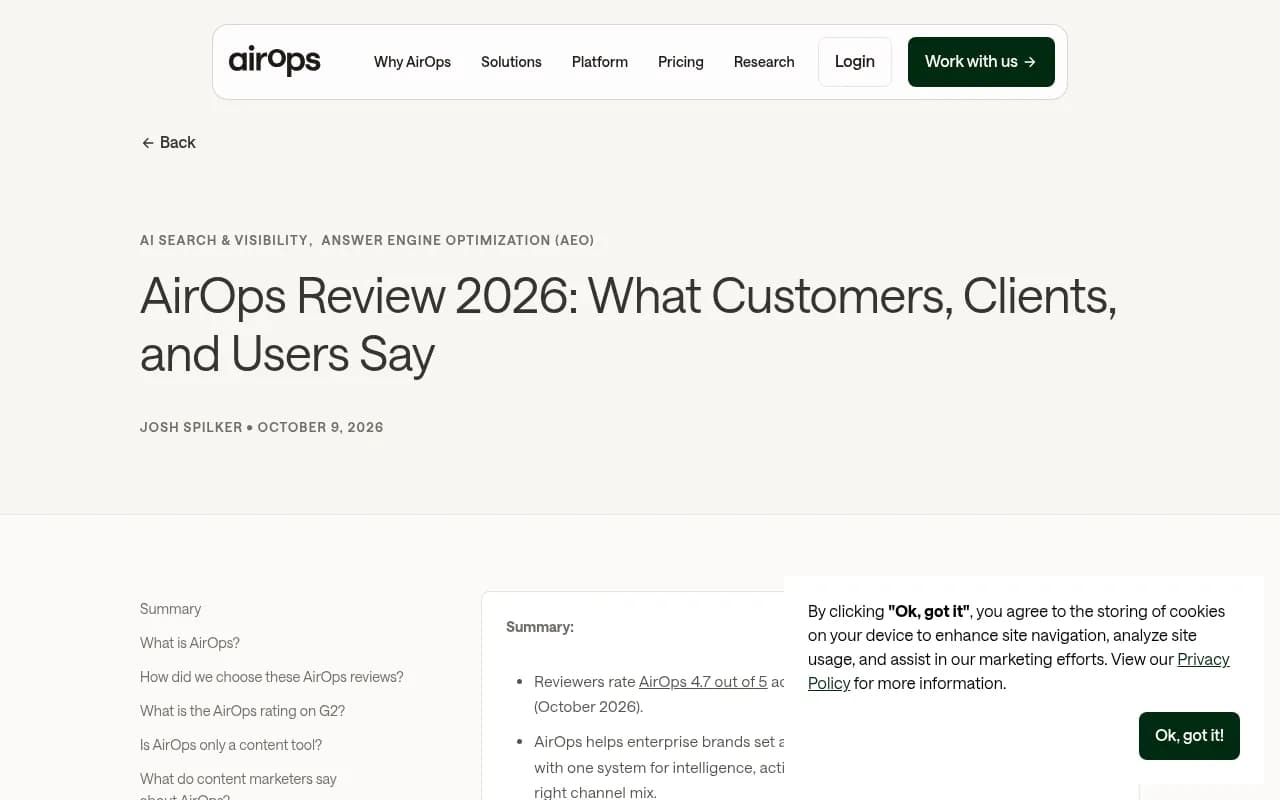
G2 shows AirOps at 4.7 out of 5. The count varies by source, from 129 reviews in one report to 134 in AirOps' own October 2026 roundup, which says 110 of those are five-star. Octave's February 2026 review cites 4.6 from 81 reviews, so the score has been stable while the review count grew.
Two caveats. AirOps' own review roundup is obviously not neutral. And Octave sells a competing GTM platform and discloses it, though its scorecard is more useful than most: ease of use 4.5, content quality 3.8, workflow flexibility 4.0, integrations 3.8, value for price 3.2, overall 3.8 out of 5.
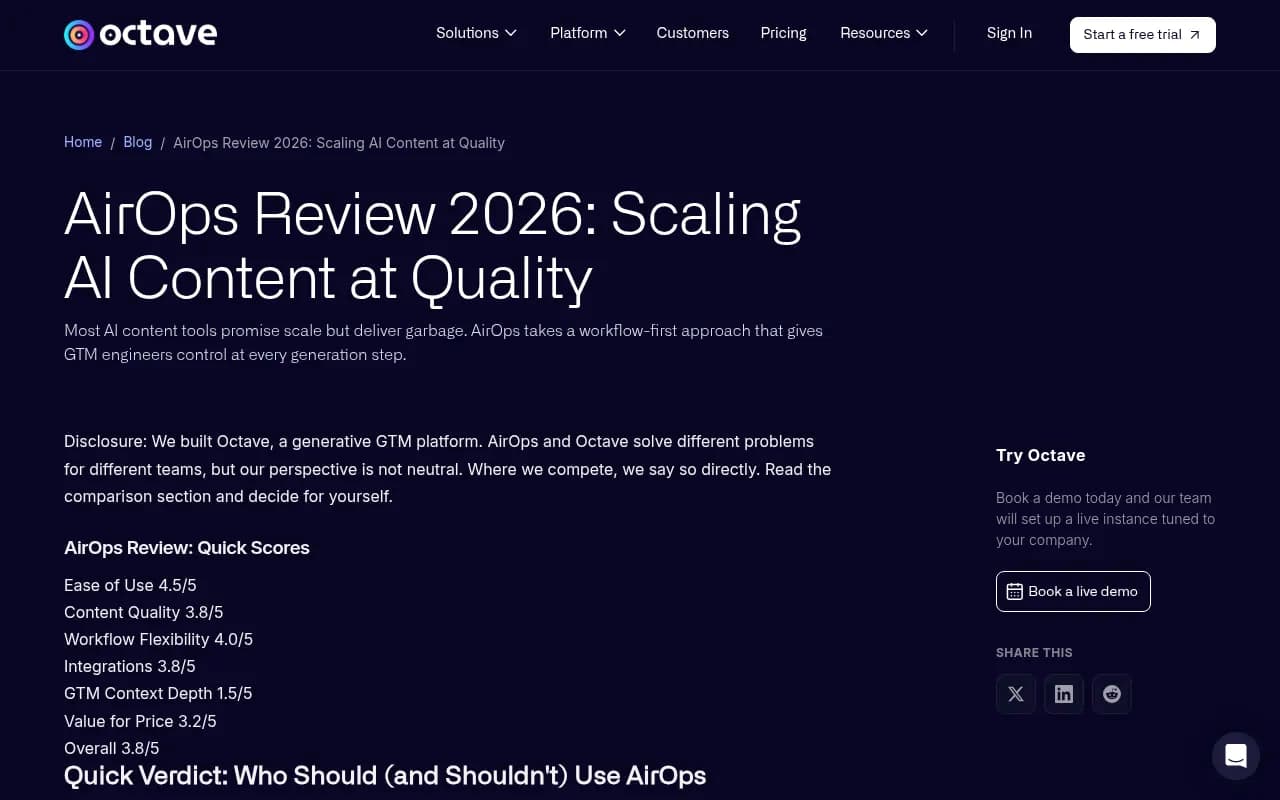
The pattern in that scorecard matches what the research suggests. People like the workflow builder. They are lukewarm on value for money. Content quality lands in the middle, which brings us to the next section.
Content quality: what to expect
I could not find independent hands-on evidence of ranking lifts, and I would be wary of anyone who claims otherwise. What the reviews do agree on is that AirOps output is only as good as the inputs you give it. Brand Kits and Knowledge Bases help keep tone and facts consistent. The platform also has quality scores and human review and approval steps, which matter more than the drafting itself.
Rankability's verdict is the most honest line in the pile: without solid SEO fundamentals, AirOps will not guarantee rankings. It accelerates what you are already good at. That cuts both ways. A team with good briefs, subject experts and editors can publish more, faster. A team with thin briefs will publish more thin pages, faster.
My rule of thumb: run a pilot of 20 to 30 pages, put an editor on every one, and track indexing and citations for 60 days before you scale.
Rankings and AI citations: a reality check
AirOps is sold for scaling content, and that framing deserves some scrutiny. According to Promptwatch Data's report on which content types ChatGPT cites most (Sep 28 to Oct 4, 2026), product pages made up 22.4% of classified ChatGPT citations and landing pages 16.8%. Listicles were 13.6%, how-to guides 8.7%, comparisons 5.9%, and general articles just 6.1%.
Product and landing pages together are about 39% of citations. For commercial prompts, product pages, landing pages, listicles and comparisons add up to almost 70%. So a content engine that mostly produces generic blog posts is aimed at a small slice of what AI answers cite.
Timing matters too. Promptwatch's content half-life data shows news pages losing half their citations in about five weeks, while landing pages and docs stay cited for months. If you use AirOps, point Workflows at comparison pages, how-tos, listicles and product copy, and keep core product pages accurate and complete rather than flooding the blog.
Who should use AirOps
Good fit:
- Content or SEO teams publishing at volume who need to systemize research to publish
- Teams that want no-code workflows and direct publishing to WordPress, Webflow, Contentful or Sanity
- Companies with one brand and one primary market
Poor fit:
- Agencies or multi-brand companies that need multi-region and multi-persona tracking without a sales call
- Teams wanting to see visibility across every engine on a small budget
- Sales teams who need ICP-aware agents or CRM orchestration. Octave scored AirOps 1.5 out of 5 for GTM context depth, though Octave sells in that space
AirOps vs the alternatives
| Tool | Strength | Pricing transparency | Best for |
|---|---|---|---|
| AirOps | Bulk content workflows, Grids | Solo and Pro unpublished | Volume content teams |
| Promptwatch | Monitoring plus content agent, crawler logs, AI traffic | Published, from $95/mo | Teams that want to measure and fix AI visibility |
| Profound | Enterprise AI visibility tracking | Sales-led | Large brands |
| Peec AI | Prompt tracking | Published, low entry point | Lean monitoring |
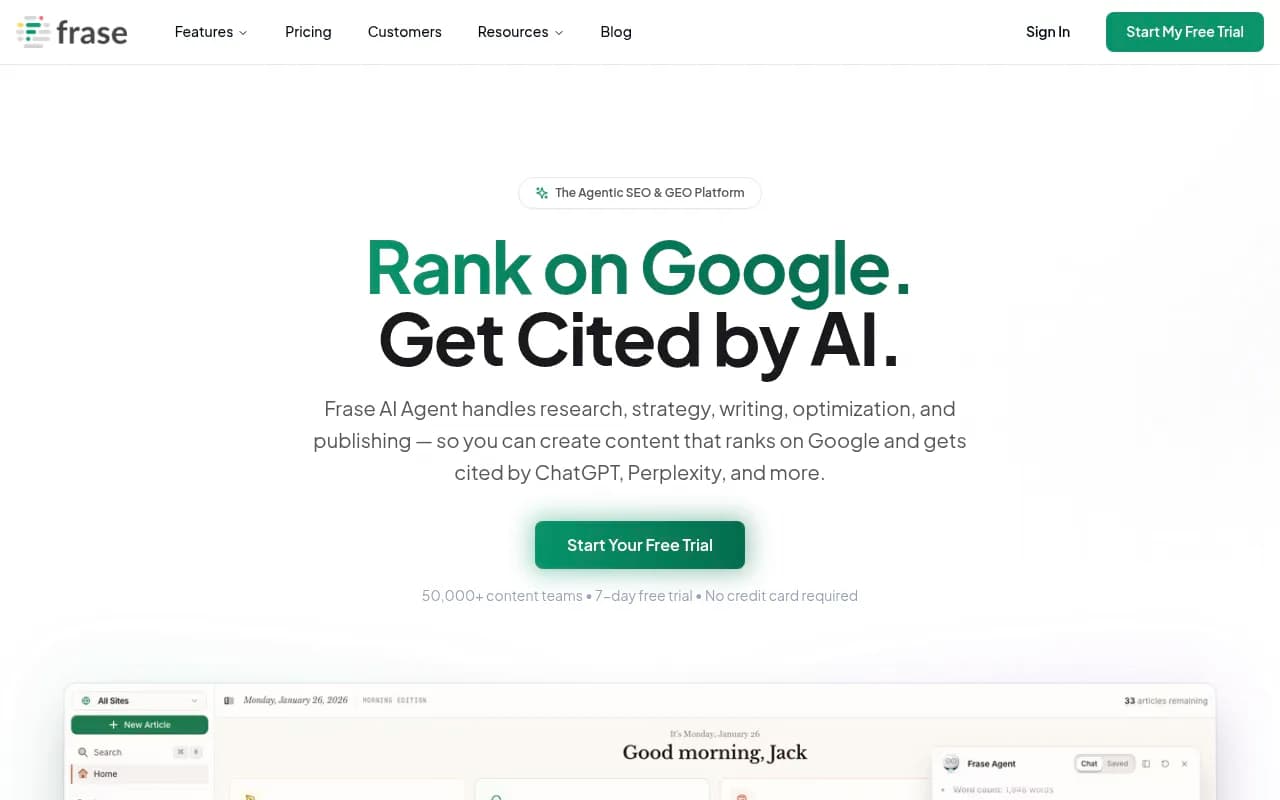
| Frase | Content briefs and optimization | Published | Single-article SEO writing |
Promptwatch is the closest overlap if your real goal is AI visibility rather than raw article volume. It tracks the actual interfaces of ChatGPT, AI Overviews and others, shows IP-verified crawler logs and AI-referred traffic, and its Content Agent can write and publish to Webflow, Framer or WordPress. Plans start at $95 per month for Essential, which is a published number, so confirm current tiers at promptwatch.com/pricing.

If you want more options, the GEO software directory at bestgeosoftware.com lists dozens of visibility and content tools side by side.
Profound


Verdict
AirOps is a capable bulk content engine with real workflow depth and a solid G2 rating. It earns that rating for ease of use and flexibility. It loses points for unpublished pricing, plan limits that differ depending on which review you read, and no independent proof that its output ranks better than a careful editor with a good brief.
Buy it if you publish at volume, have editors in the loop, and run one brand. Skip it if you track multiple brands or markets, need transparent pricing, or mainly want to know why AI engines are not citing you. In that case, start with a visibility tool, find the gaps, and only then decide how much content to automate.
Before you sign anything, get Solo and Pro quotes in writing and ask for the current task limits and engine coverage for the exact tier.