Key takeaways
- Promptwatch is a full-stack GEO platform: it tracks AI visibility, identifies content gaps, generates optimized content, and connects visibility to revenue — all in one place.
- AirOps is primarily a content engineering and workflow automation tool that added AI visibility monitoring; it's strong on execution but thinner on the tracking and attribution side.
- If your team needs to understand why you're invisible in AI search and then fix it systematically, Promptwatch has the deeper toolset. If you already know what to write and need a scalable content production system, AirOps is worth evaluating.
- The two tools aren't direct substitutes — they overlap in content generation but diverge significantly in monitoring depth, crawler logs, citation analytics, and traffic attribution.
- Pricing is meaningfully different: Promptwatch starts at $99/mo, AirOps targets enterprise teams with custom pricing.
Picking a GEO platform in 2026 is harder than it looks. The category has exploded — there are now 20+ tools claiming to help you "rank in AI search" — and the marketing language has converged to the point where every platform sounds like it does everything. AirOps and Promptwatch are two of the most frequently compared options, and on the surface they seem similar: both track AI visibility, both generate content, both target marketing and SEO teams.
But they're built around genuinely different philosophies. One started as a content workflow tool and added monitoring. The other started as a monitoring and analytics platform and added content generation. That origin story shapes almost everything about how each product works in practice.
This breakdown goes feature by feature so you can make an actual decision.
What each tool is, in plain terms
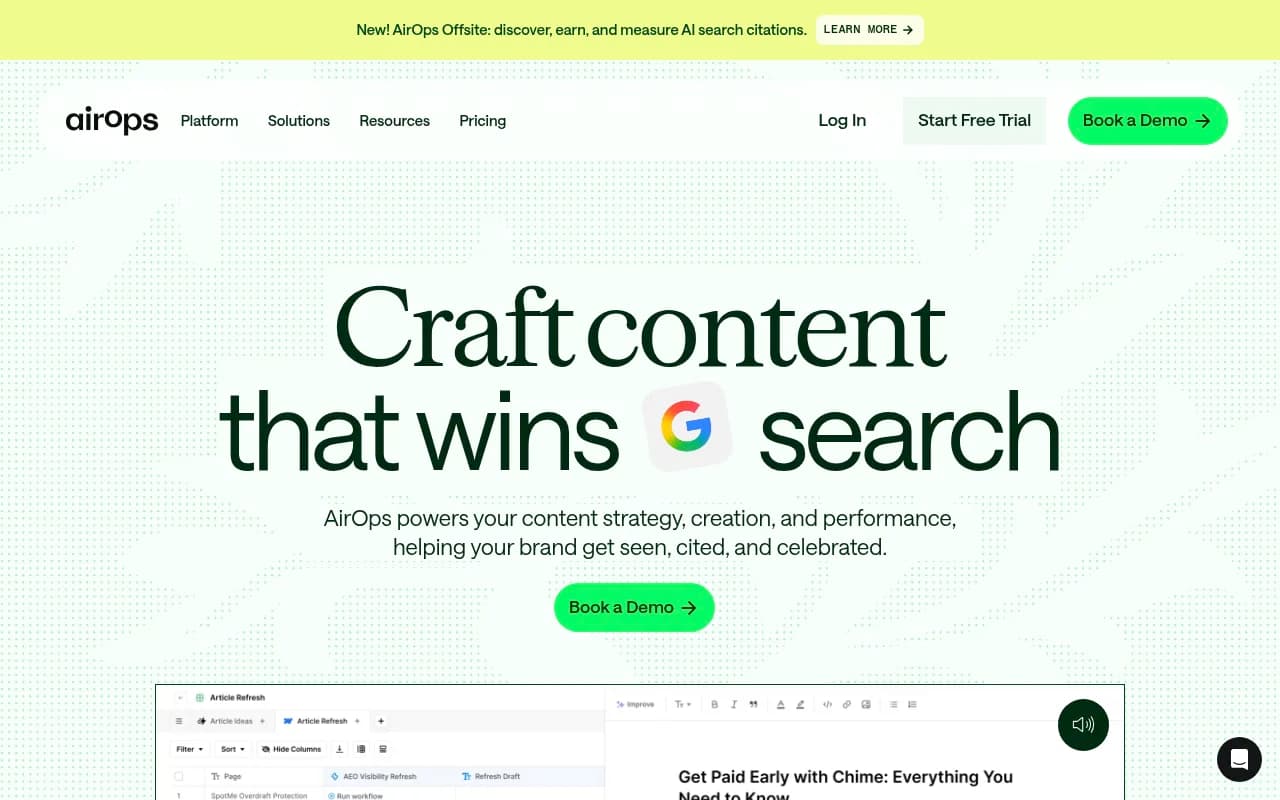
AirOps describes itself as a content engineering platform for AI search visibility. Its core proposition is connecting AI search insight to content execution at scale. The Quill agent, launched in May 2026, automates content workflows end-to-end — from topic discovery to draft to publish. AirOps is positioned squarely at enterprise content teams that need to produce a high volume of AI-optimized content and have the internal infrastructure to support it.
Promptwatch is a GEO and AI visibility platform used by 1,480+ brands and agencies. It tracks how brands appear across 10+ AI models (ChatGPT, Perplexity, Claude, Gemini, Grok, DeepSeek, Copilot, Mistral, Meta AI, Google AI Overviews), identifies the specific prompts where competitors are visible but you aren't, generates content designed to close those gaps, and then tracks whether that content actually gets cited. The loop is: find gaps → create content → measure results.

The distinction matters: AirOps is primarily a production system. Promptwatch is primarily an optimization system with production capabilities built in.
Feature-by-feature comparison
AI model coverage
Promptwatch monitors 10 AI models in real user interfaces, not just through APIs. This matters because what AI models say in their actual products (with browsing, citations, shopping recommendations) can differ from what the API returns. You're tracking the thing your customers actually see.
AirOps covers the major models but focuses its tracking on a narrower set. Its strength is less about breadth of model coverage and more about workflow automation once you know what to write.
Prompt tracking and intelligence
Promptwatch lets you define custom prompts and tracks your visibility across all monitored models for each one. It also provides volume estimates and difficulty scores per prompt, and shows query fan-outs — how a single prompt branches into sub-queries that AI models actually process. This helps you prioritize: which prompts are high-traffic, which are winnable, which are already dominated by competitors.
AirOps tracks prompts and provides visibility data, but the prompt intelligence layer (volume, difficulty, fan-outs) is less developed. Its value proposition is more about using prompt data to trigger content workflows than about deep prompt analytics.
Citation and source analysis
Promptwatch shows exactly which pages, Reddit threads, YouTube videos, and external domains AI models cite when answering relevant prompts. This is genuinely useful because it tells you where to publish content, not just what to write. It also tracks offsite citations — brand mentions in third-party listicles, Reddit posts, and YouTube videos that are driving AI visibility outside your own site.
AirOps has citation tracking but it's less granular on the offsite side. The platform is more focused on helping you create content that earns citations than on mapping the full citation ecosystem.
AI crawler logs
This is one of the clearest differentiators. Promptwatch provides real-time logs of AI crawlers (ChatGPT's GPTBot, Claude's ClaudeBot, Perplexity's PerplexityBot, etc.) hitting your website. You can see which pages they read, errors they encounter, how often they return, and when a page moves from "crawled" to "cited." This is the only way to understand why your content is or isn't being picked up.
AirOps does not offer AI crawler logs as a core feature. If diagnosing crawl issues is important to your team, this gap is significant.
Content gap analysis
Promptwatch's Answer Gap Analysis shows exactly which prompts your competitors are visible for that you're not. It surfaces the specific topics, angles, and questions AI models want to answer but can't find on your site. This is the starting point for any content strategy that's actually grounded in AI search data rather than guesswork.
AirOps approaches this differently. Its Quill agent can identify content opportunities, but the gap analysis is less tied to real prompt data and competitive citation mapping. It's more about content ideation at scale than surgical gap identification.
Content generation
Both tools generate content. But the inputs are different.
Promptwatch's Content Agents generate articles, listicles, comparisons, and briefs using real prompt data, citation data, prompt volumes, persona targeting, search results, screenshots, brand guidance, and competitor analysis. The output is content engineered to answer specific gaps AI models are already exposing.
AirOps is genuinely strong here — probably stronger than Promptwatch on pure content production volume and workflow automation. The Quill agent can handle end-to-end content pipelines at enterprise scale. If you need to produce hundreds of pages per month with consistent brand voice and structured approval workflows, AirOps is built for that.
The tradeoff: AirOps content generation is powerful but less tightly coupled to real-time AI visibility data. Promptwatch's content generation is more directly informed by what's actually missing from AI responses right now.
Traffic attribution and revenue connection
Promptwatch connects AI visibility to actual traffic and revenue. Page-level tracking shows which pages are being cited, how often, and by which models. Agent analytics shows the timeline from publish to crawl to citation. Traffic attribution connects visibility scores to actual site visits and conversions.
AirOps is weaker on this end of the loop. It's built around content production, not revenue attribution. If your team needs to prove that GEO work is driving pipeline, Promptwatch has the reporting infrastructure; AirOps largely doesn't.
Reddit and YouTube insights
Promptwatch surfaces Reddit discussions and YouTube videos that directly influence AI recommendations. This matters because AI models frequently cite Reddit threads and YouTube content in their responses, and knowing which discussions are shaping AI answers gives you a channel to influence that most competitors ignore.
AirOps does not have Reddit or YouTube insight features.
ChatGPT Shopping tracking
Promptwatch tracks when your brand appears in ChatGPT's product recommendations and shopping carousels. This is a relatively new feature and one that almost no other GEO platform offers.
AirOps does not have ChatGPT Shopping tracking.
Multi-language and multi-region
Promptwatch supports monitoring in any language, from any country, with customizable personas that match how your actual customers prompt. This is important for international brands.
AirOps supports multi-language content generation but its monitoring capabilities are more US/English-centric.
Integrations and API
Both tools offer API access. Promptwatch also integrates with Cloudflare, Fastly, Vercel, server logs, and Google Search Console for crawler and attribution data, plus Looker Studio for custom reporting.
AirOps has deeper integrations on the content workflow side — CMS connections, approval workflows, and publishing pipelines that Promptwatch doesn't try to replicate.
Full comparison table
| Feature | Promptwatch | AirOps |
|---|---|---|
| AI models monitored | 10 (ChatGPT, Perplexity, Claude, Gemini, Grok, DeepSeek, Copilot, Mistral, Meta AI, Google AI Overviews) | Major models (narrower coverage) |
| Custom prompt tracking | Yes | Yes |
| Prompt volume & difficulty scoring | Yes | Limited |
| Query fan-outs | Yes | No |
| Citation & source analysis | Deep (incl. offsite) | Basic |
| AI crawler logs | Yes (Professional+) | No |
| Answer gap analysis | Yes | Partial |
| Content generation | Yes (gap-informed) | Yes (workflow-scale) |
| Content briefs | Yes | Yes |
| Traffic attribution | Yes | Limited |
| Page-level citation tracking | Yes | No |
| Reddit & YouTube insights | Yes | No |
| ChatGPT Shopping tracking | Yes | No |
| Multi-language / multi-region | Yes | Partial |
| Competitor heatmaps | Yes | Limited |
| CMS / publishing integrations | Limited | Strong |
| API access | Yes | Yes |
| Looker Studio integration | Yes | No |
| Starting price | $99/mo | Custom (enterprise) |
| Free trial | Yes | Demo-based |
Pricing
Promptwatch has transparent, published pricing:
- Essential: $99/mo — 1 site, 50 prompts, 5 articles/mo
- Professional: $249/mo — 2 sites, 150 prompts, 15 articles/mo, crawler logs, state/city tracking
- Business: $579/mo — 5 sites, 350 prompts, 30 articles/mo
- Agency/Enterprise: custom pricing
Annual billing discounts are available, and there's a free trial.
AirOps does not publish pricing publicly. It targets enterprise teams and requires a demo/sales conversation. Based on market positioning, it's significantly more expensive than Promptwatch's entry tiers.
For smaller marketing teams or agencies that need to prove ROI before committing to a large contract, Promptwatch's transparent pricing and free trial are a practical advantage.
Where each tool wins
Promptwatch wins when:
- You need to understand why you're invisible in AI search, not just that you are
- Crawler log data matters to your team (diagnosing indexing issues, tracking crawl-to-citation timelines)
- You want offsite citation tracking — Reddit, YouTube, third-party listicles
- Revenue attribution is a requirement, not a nice-to-have
- You're running multi-model, multi-region campaigns
- Budget matters and you want transparent pricing
AirOps wins when:
- You already have a clear content strategy and need to execute it at high volume
- Your team needs enterprise-grade content workflow automation (approval flows, CMS publishing, brand voice enforcement)
- You're a large organization with dedicated content operations infrastructure
- The Quill agent's end-to-end automation fits your production model
What the market says
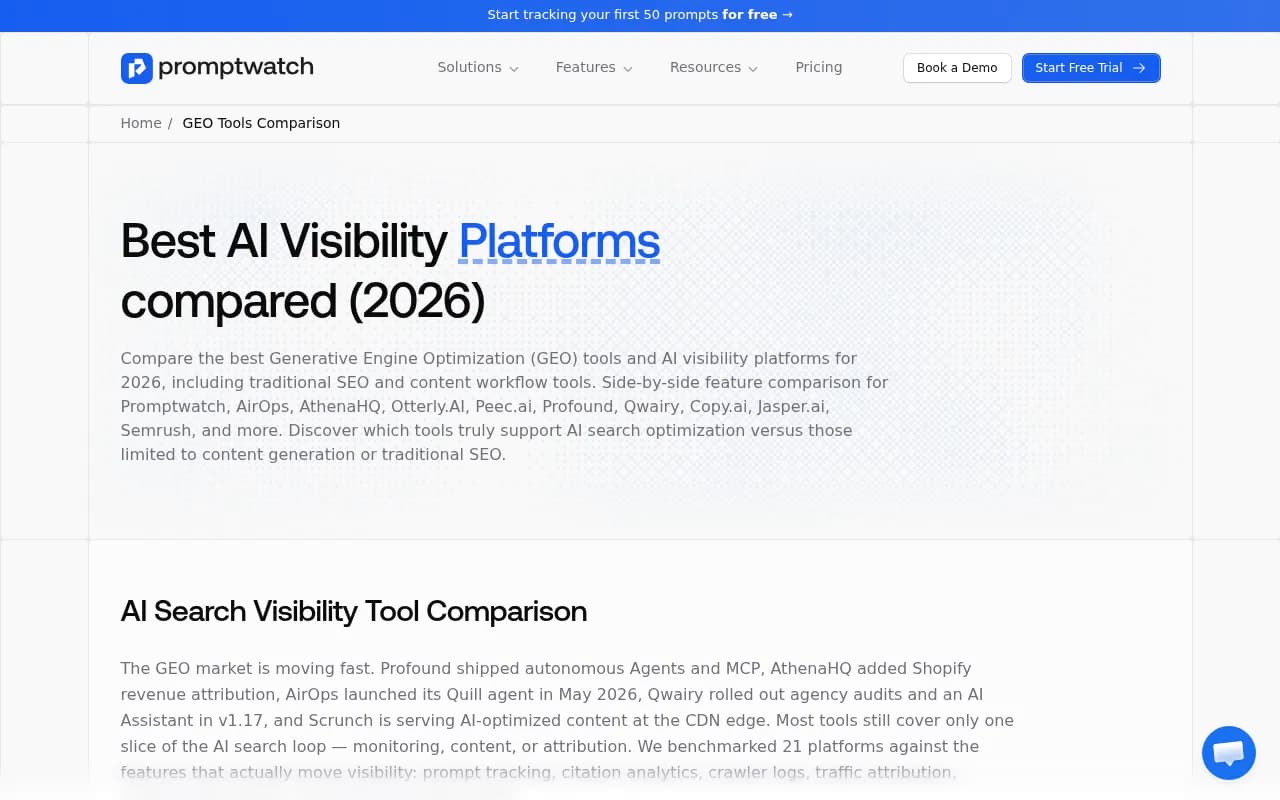
In a 2026 comparison of 12 GEO platforms, Promptwatch is the only tool rated as a "Leader" across all categories — monitoring, content, attribution, and enterprise extensibility. AirOps is positioned as a "Visionary" in most independent analyses: strong on content automation, but thinner on the monitoring and analytics depth that GEO teams need to make strategic decisions.
The Otterly.AI comparison matrix (which is reasonably neutral since Otterly is a competitor to both) categorizes Promptwatch as having the "broadest feature set, full stack" and AirOps as "workflow automation + monitoring" — which is a fair summary of the tradeoff.
The honest verdict
If you're a GEO team trying to systematically improve AI search visibility — tracking where you're invisible, figuring out why, creating content to fix it, and proving the results — Promptwatch is the more complete tool. The crawler logs alone are something most competitors don't offer, and the connection between gap analysis, content generation, and traffic attribution is tighter than anything AirOps currently provides.
AirOps is a serious tool for content production at scale. If you're an enterprise team that needs to ship hundreds of AI-optimized pages per month with structured workflows, it's worth a demo. But it's not a GEO analytics platform — it's a content engineering platform that includes some GEO monitoring. The distinction matters when you're trying to diagnose and fix an AI visibility problem rather than just produce more content.
For most marketing and SEO teams evaluating these two tools in 2026, the question is really: do you need to understand your AI visibility problem better, or do you already understand it and just need to execute faster? Promptwatch answers the first question. AirOps answers the second.
If you're not sure which problem you have, start with Promptwatch — the gap analysis will tell you.