Key takeaways
- Otterly.AI has the lowest headline price ($29/mo) but the real cost for all seven AI engines runs closer to $76/mo once you add Claude, Gemini, and AI Mode as paid add-ons.
- Google AI Overviews and Perplexity cite roughly 10 sources per answer, while ChatGPT cites closer to 5, per Promptwatch's citation data, meaning small brands have better odds breaking into Google's AI surfaces than ChatGPT's.
- No single cited domain holds more than 4% of ChatGPT's citation share, so this isn't a winner-take-all game the way Google page-one rankings used to be.
- The category average price sits around $337/mo according to Rankability's 2026 survey of 30+ tools, which makes anything under $100/mo genuinely rare, not just "budget-friendly marketing copy."
- Monitoring alone doesn't fix anything. If your budget allows for it, a platform that also generates and publishes content (not just a dashboard) saves you the second hire you'd otherwise need.
Why small businesses can't skip this anymore
I'll be honest, a year ago I would have told a small business owner to wait on AI visibility tracking. Not anymore. If your customers are asking ChatGPT "what's the best [your category] for [their situation]" and you have no idea whether you show up, you're flying blind on a channel that's already sending real traffic and real customers to your competitors.
The problem for small businesses specifically isn't whether to monitor, it's how to do it without burning through a marketing budget that's already stretched across five other tools. Most of the platforms in this category were built with enterprise budgets in mind. Pricing pages that look reasonable at first glance often hide seat fees, per-engine add-ons, and prompt-pack upsells that turn a $99/mo tool into a $400/mo tool by the time you've added Claude and Gemini tracking.
This guide walks through the platforms that actually work for lean teams, what they really cost once the add-ons are counted, and what to check before you sign up.
What "AI brand monitoring" actually covers
Before comparing tools, it helps to know what you're buying. Most platforms in this space offer some mix of:
- Prompt tracking: running a list of natural-language queries against ChatGPT, Perplexity, Gemini, Claude, and Google AI Overviews/AI Mode, then recording whether and how your brand appears.
- Citation analysis: which pages, articles, or reviews the AI actually pulled from when it mentioned you or a competitor.
- Sentiment tracking: whether the AI describes your brand positively, negatively, or neutrally.
- Competitor comparison: seeing who's winning the same prompts you care about.
- Content generation or briefs: some platforms stop at reporting; others actually help you write and publish the content that gets you cited.
That last point matters more than most vendors admit. A dashboard that tells you "you're invisible for this prompt" is only useful if you have someone who can turn that insight into a published page. Small teams usually don't have that spare capacity, which is why platforms that combine tracking with content execution are worth a premium over pure trackers.
The real pricing picture (not the marketing pricing)
Headline prices in this category are notoriously misleading. Here's what several popular options actually cost once you need multi-engine coverage, based on current published pricing.
| Platform | Headline price | What's actually included | Real cost for full coverage |
|---|---|---|---|
| Otterly.AI | $29/mo (Lite) | 15 prompts, ChatGPT + Perplexity + AI Overviews only | ~$76/mo once Claude, Gemini, and AI Mode add-ons are included |
| Peec AI | €70/mo (Starter, annual) | 50 prompts, 3 of 6 models, 1 project | Extra models cost €25-115/mo depending on tier |
| Semrush AI Visibility Toolkit | $99/mo | 1 domain, 25 prompts, 300 daily AI Analysis queries | +$99/mo per extra domain, +$99/mo per seat, +$60/mo per 50 prompts |
| Profound | $99/mo (Starter) | ChatGPT only, 50 prompts, 1 seat | $399/mo (Growth, annual) needed for 3 engines |
| Promptwatch | $95/mo (Essential) | All LLMs tracked, 50 prompts, 6,000 responses, 5 AEO articles/mo, MCP + API | No per-engine add-ons; multi-model coverage included at every tier |
That last row is worth sitting with for a second. Most tools in this space charge extra for each additional AI engine you want covered, which quietly turns a $29 or $99 plan into something closer to the category's $337/mo average. Promptwatch bundles ChatGPT, Gemini, Claude, Perplexity, Grok, DeepSeek, Copilot, and Google's AI surfaces into every plan starting at $95/mo, without the per-model upsell.

Platform-by-platform breakdown
Otterly.AI: cheapest way in, with a catch
Otterly.AI is the most widely cited "budget" option, and for good reason: $29/mo genuinely gets you monitoring across ChatGPT, Perplexity, and Google AI Overviews. Unlimited team seats on every plan, including the cheapest one, is a real differentiator; most competitors charge per seat.
The catch is that Claude, Gemini, and Google AI Mode aren't included in that $29. They're separate add-ons that scale by tier, and on the entry plan alone they add roughly $47/mo. If your customers are asking Gemini or Claude questions about your category, and increasingly they are, you'll end up paying closer to $76/mo for genuinely complete coverage. Still cheap relative to the category, just not as cheap as the homepage suggests.
Otterly.AI

Peec AI: unlimited seats, à la carte models
Peec repriced in 2026 and now starts around €70/mo (about $76) on annual billing for 50 prompts and 3 of 6 tracked models. Sentiment tracking only kicks in from the Pro tier up. Like Otterly, seats are unlimited on every plan, which is genuinely useful for a small team where three or four people all want dashboard access without extra line items.
The model-selection structure (pick 3 of 6, pay extra for more) is a reasonable middle ground if you know exactly which two or three AI engines matter to your customers and don't need everything tracked from day one.

Semrush AI Visibility Toolkit: convenient if you're already a Semrush customer
If you're already paying for Semrush's core SEO plan (starting at $139.95/mo), bolting on the AI Visibility Toolkit for $99/mo keeps everything in one dashboard. For a business starting from zero, though, this is one of the more expensive paths into AI monitoring once you factor in that the AI toolkit is generally an add-on, not a standalone replacement for traditional SEO tracking. Extra domains, seats, and prompt packs each add $99, $99, and $60/mo respectively, and those add up fast for a small business running more than one site or brand.
[tool:semrush] [tool:semrush-ai-toolkit]
Profound: built for a bigger budget than most small businesses have
Profound's Starter tier looks approachable at $99/mo, but it only covers ChatGPT and caps you at 50 prompts with one seat. To get three engines tracked you're looking at $399/mo on the Growth tier, annual billing required to hit that price. Reviewers consistently describe Profound as better suited to mid-market and enterprise budgets than true small-business ones, and the per-engine, per-seat cost stacking is exactly why.
Profound

Promptwatch: monitoring plus the work of fixing what you find
Most tools in this list stop at telling you where you're invisible. Promptwatch's agents go a step further: content gap analysis flags exactly which prompts you're losing and why, and the Content Agent can draft and publish AEO-optimized articles straight to Webflow, Framer, or WordPress on a schedule, either through a review inbox or fully automated. For a small business without a dedicated content team, that's the difference between a dashboard you check anxiously once a month and a system that actually closes gaps for you.
The Essential plan at $95/mo covers one site, 50 prompts, and 6,000 responses across every major AI model, plus five AEO articles a month, roughly the same price as Semrush's or Profound's entry tiers, but without the per-engine add-on tax. It also comes with a 7-day free trial, and there's a free Explore tier (10 prompts, ChatGPT only) if you just want to test the waters before committing. Crawler log access shows you exactly when ChatGPTBot, ClaudeBot, PerplexityBot and others visit your site, which is something almost none of the budget trackers offer.
Other small-business-friendly options worth a look
A handful of newer entrants target the SMB price point specifically:
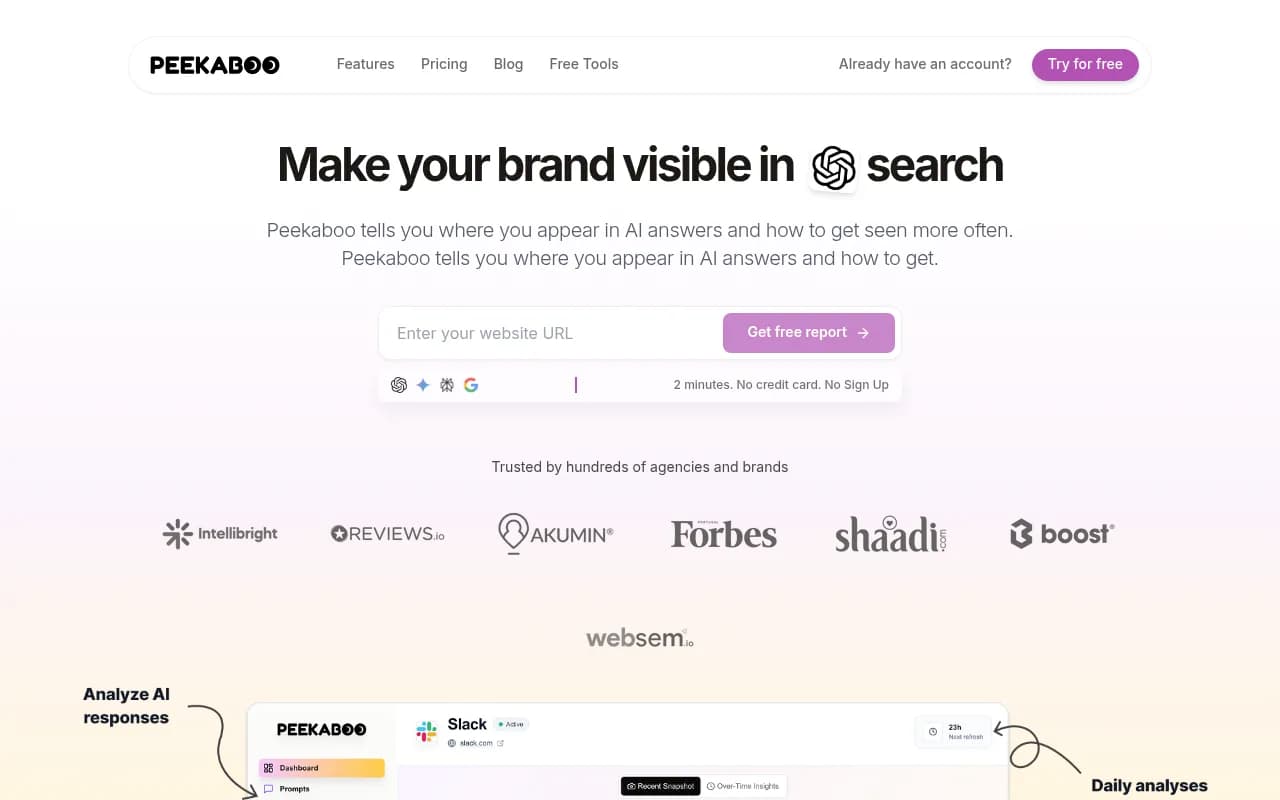
- AI Peekaboo positions itself as agency-ready and affordable, with white-label reporting included on every tier, not just the top one.
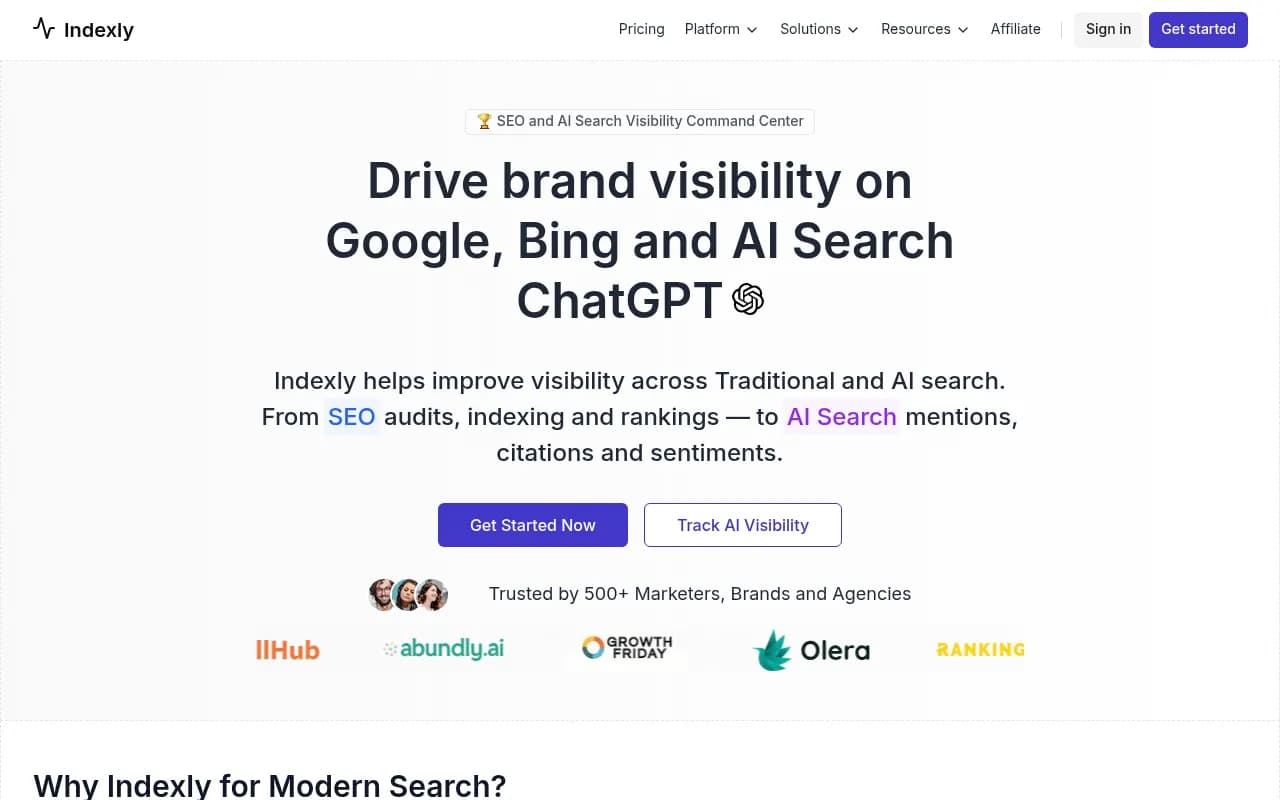
- Indexly leans into lead generation on top of visibility tracking, including LinkedIn and Reddit presence monitoring to see how community discussion feeds AI answers.
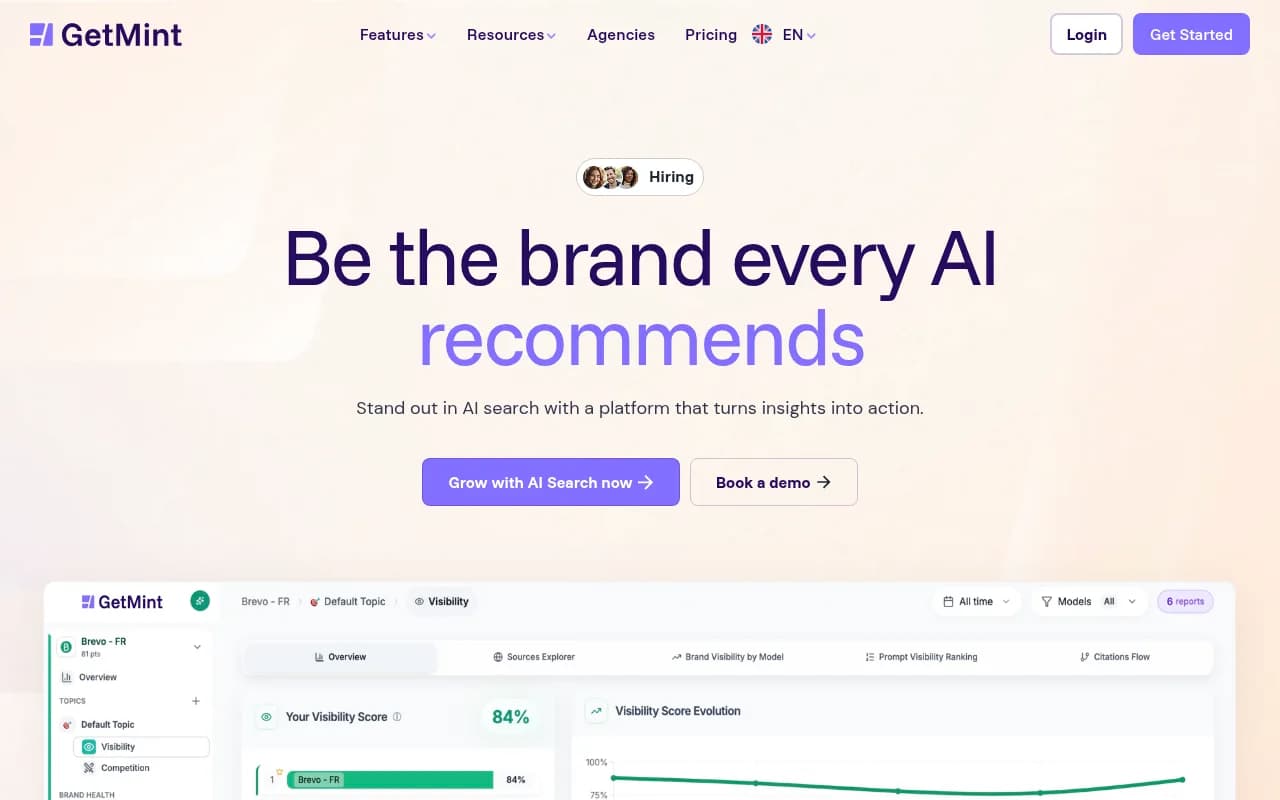
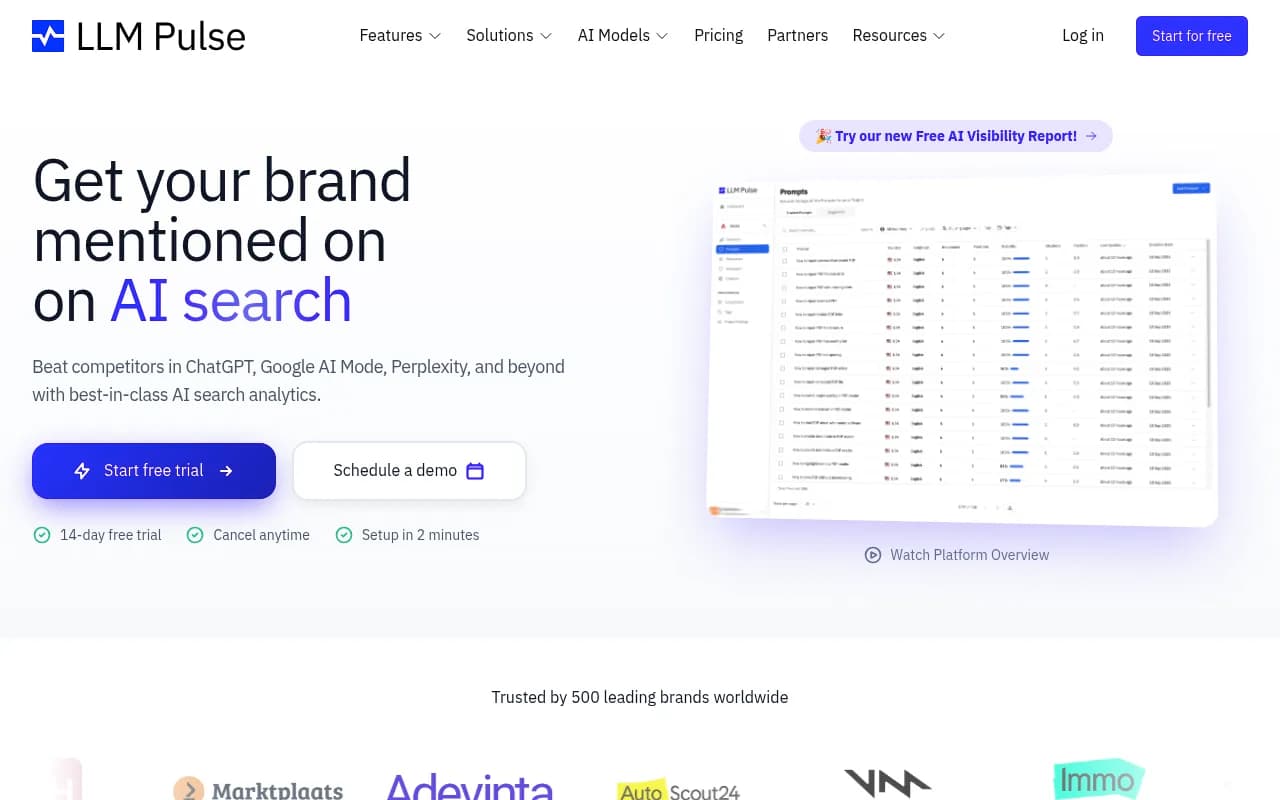
- GetMint and LLM Pulse are lighter-weight trackers worth a look if you just want a basic pulse check before committing to a full platform.
What actually gets cited (so you know what to track)
Knowing which AI engines to prioritize matters as much as picking a tool. According to Promptwatch's analysis of sources cited per response, ChatGPT cites about 5 sources per answer, Google AI Overviews cites around 10, and Perplexity is remarkably consistent at almost exactly 10 sources every time. Microsoft Copilot is the wildcard, having swung from under 2 to nearly 17 sources per response within weeks. That gap matters: a small business with limited content resources gets more "citation slots" to compete for on Google's AI surfaces and Perplexity than on ChatGPT.
Content type matters too. Promptwatch's July 2026 breakdown of what ChatGPT cites found product pages now account for nearly a third of all citations, almost double their share back in March. Listicles, how-tos, and comparison pages are all growing categories worth targeting if you run a services or product business. If you sell something with a clear price and spec sheet, your product pages themselves are citation assets, not just conversion pages.
And don't ignore Reddit. Promptwatch's June 2026 ChatGPT citation share data shows Reddit is the single most-cited domain on ChatGPT Search, at 3.71% of all citations, more than six times the runner-up Wikipedia. That share dropped sharply from 6.11% in May, which shows how quickly these numbers move, but Reddit presence in your niche subreddits is still one of the higher-leverage, lower-cost things a small business can do for AI visibility.
Common mistakes small businesses make here
A few patterns keep showing up across reviews and SEO practitioner advice, and they're worth flagging before you buy anything:
- Only measuring Google rankings and organic traffic, and assuming that tells you anything about AI visibility. It doesn't, and it's cited as the single most common mistake businesses make in this space.
- Blocking AI crawlers by accident through overly aggressive CDN or WAF rules, or by serving JavaScript-only pages that crawlers can't render.
- Letting brand and entity details (business name, address, About page, press mentions) go inconsistent across the web, which undermines the trust signals AI models rely on.
- Publishing thin, generic content ("we help businesses grow") that gives AI nothing specific to cite. Detailed pricing, process, and service specifics get cited; vague marketing copy doesn't.
- Treating website traffic as a visibility metric. Traffic tells you what happens after someone clicks; it says nothing about whether you're being surfaced in the answer itself.
Before paying for any tool, it's worth manually testing your brand and a handful of category queries in ChatGPT, Perplexity, and Gemini yourself, and writing down what comes back. That baseline costs nothing and tells you fast whether you have a real problem worth paying to solve.
How to choose, based on your situation
If you're not sure where to start, here's a rough decision path:
- Tight budget, just want a pulse check: Otterly.AI's Lite plan, accepting that full multi-engine coverage costs closer to $76/mo than $29.
- Already paying for Semrush and want everything in one place: the AI Visibility Toolkit add-on, budgeting for seat and domain costs as you scale.
- Want monitoring and the content work done for you, not just a dashboard: Promptwatch's Essential plan, which bundles multi-model tracking with actual AEO content production from $95/mo.
- Need white-label reports for clients: AI Peekaboo or Peec AI's agency tiers.
Whichever you pick, budget for growth in prompt count and engine coverage from day one. Nearly every platform in this category prices its entry tier around a narrow slice of engines and prompts, and the real cost of "complete" coverage tends to land closer to the category's $337/mo average than the headline number suggests. Compare a shortlist side by side before committing, and if you want to browse a wider set of GEO and AI visibility tools beyond the ones covered here, the directory at bestgeosoftware.com is a good place to keep looking.