Key takeaways
- AI search traffic to retail sites grew 1,100% year over year according to Adobe, making AI visibility a genuine revenue channel -- not just a vanity metric.
- The four platforms in this guide take very different approaches: Promptwatch optimizes content for AI citation, Relixir focuses on enterprise GEO workflows, Yext manages structured data and listings, and Uberall handles multi-location local search.
- For most retail and consumer brands that want to both track and fix their AI visibility, Promptwatch is the most complete option -- it's the only one here that closes the loop from gap analysis to content creation to traffic attribution.
- If your primary concern is local search and listing management across hundreds of physical locations, Yext or Uberall may be a better fit, though neither was built with AI citation optimization as a core use case.
- Free trials are available for Promptwatch; Relixir, Yext, and Uberall typically require a demo or custom quote.
Why retail brands need to think about AI visibility right now
Something changed in the last 18 months. Shoppers who used to Google "best running shoes under $150" and click through to a product page are now asking ChatGPT or Perplexity the same question -- and getting a direct answer. They may never click a traditional search result at all.
Adobe's data put a number on this: AI-driven traffic to U.S. retail sites grew 1,100% year over year. That's not a rounding error. And Pew Research found that when Google shows an AI Overview, click-through rates on traditional results drop from 15% to 8%. The AI summary itself only gets clicked 1% of the time -- but it still shapes what the user does next.
For retail and consumer brands, this creates two problems at once. First, you need to show up in AI-generated answers. Second, you need to understand which AI engines are citing you, for which queries, and what your competitors are doing better. That's what AI visibility platforms are built to solve.
The four platforms we're comparing here -- Promptwatch, Relixir, Yext, and Uberall -- each approach this differently. Let's break down what each one actually does, where it fits, and where it falls short.
The four platforms at a glance
| Platform | Primary use case | AI engines monitored | Content generation | Local/multi-location | Pricing model |
|---|---|---|---|---|---|
| Promptwatch | AI search visibility + GEO optimization | 10+ (ChatGPT, Perplexity, Claude, Gemini, Grok, DeepSeek, Copilot, Mistral, Meta AI, Google AI Overviews) | Yes -- built-in AI writing agent | No | $99-$579/mo (self-serve) |
| Relixir | Enterprise GEO engine | ChatGPT, Perplexity, Gemini, Claude | Yes -- enterprise workflows | No | Custom / enterprise |
| Yext | Structured data, listings, AI search | Google AI Overviews, Bing, some LLMs | Limited | Yes -- core strength | Custom / enterprise |
| Uberall | Multi-location local + AI search | Google AI Overviews, Bing, some LLMs | No | Yes -- core strength | Custom / enterprise |
Promptwatch: built for the full optimization loop
Promptwatch is the platform I'd point most retail and consumer brands to first, and the reason is straightforward: it's the only one here that doesn't stop at telling you what's wrong.
Most AI visibility tools are dashboards. They show you a score, maybe a list of prompts where you're not appearing, and then leave you to figure out what to do next. Promptwatch is built around a three-step loop: find the gaps, create content that fills them, then track whether it worked.

The gap analysis piece is called Answer Gap Analysis. It shows you the specific prompts where competitors are getting cited but you're not -- not just "you're missing category X" but the actual questions, with prompt volume estimates and difficulty scores. For a retail brand, this might surface that ChatGPT recommends three of your competitors when someone asks "best sustainable activewear brands" but never mentions you. Now you know exactly what to fix.
The content generation side is where Promptwatch separates from most of the field. The built-in AI writing agent generates articles, listicles, and comparisons grounded in citation data from over 880 million citations analyzed. This isn't generic content -- it's engineered around what AI models actually cite. You can target specific personas, incorporate competitor analysis, and publish content that's designed to get picked up by ChatGPT, Claude, Perplexity, and others.
Then there's the tracking layer. Page-level visibility scores show which of your pages are being cited, how often, and by which models. Traffic attribution connects AI visibility to actual revenue through a code snippet, Google Search Console integration, or server log analysis. You can see whether your new content is moving the needle.
A few capabilities worth calling out for retail specifically:
- ChatGPT Shopping tracking monitors when your brand appears in ChatGPT's product recommendations and shopping carousels -- increasingly relevant as ChatGPT expands its commerce features.
- Reddit and YouTube insights surface discussions that influence AI recommendations. For consumer brands, Reddit threads about your product category often end up cited in AI answers.
- AI Crawler Logs show you in real time which AI crawlers are hitting your site, which pages they're reading, and any errors they're encountering. If GPTBot keeps hitting a 404 on your best category page, you'll know.
- Multi-language and multi-region monitoring matters for brands with international presence. You can monitor AI responses in any language, from any country.
Pricing runs from $99/month (Essential: 1 site, 50 prompts, 5 articles) to $579/month (Business: 5 sites, 350 prompts, 30 articles). Agency and enterprise plans are available on custom pricing. There's a free trial, which is rare in this space.
Relixir: enterprise GEO with a workflow focus
Relixir positions itself as an end-to-end GEO (Generative Engine Optimization) engine for enterprise brands. The core idea is similar to Promptwatch -- track visibility, identify gaps, generate optimized content -- but the execution is aimed squarely at large organizations with complex approval workflows and multiple stakeholders.
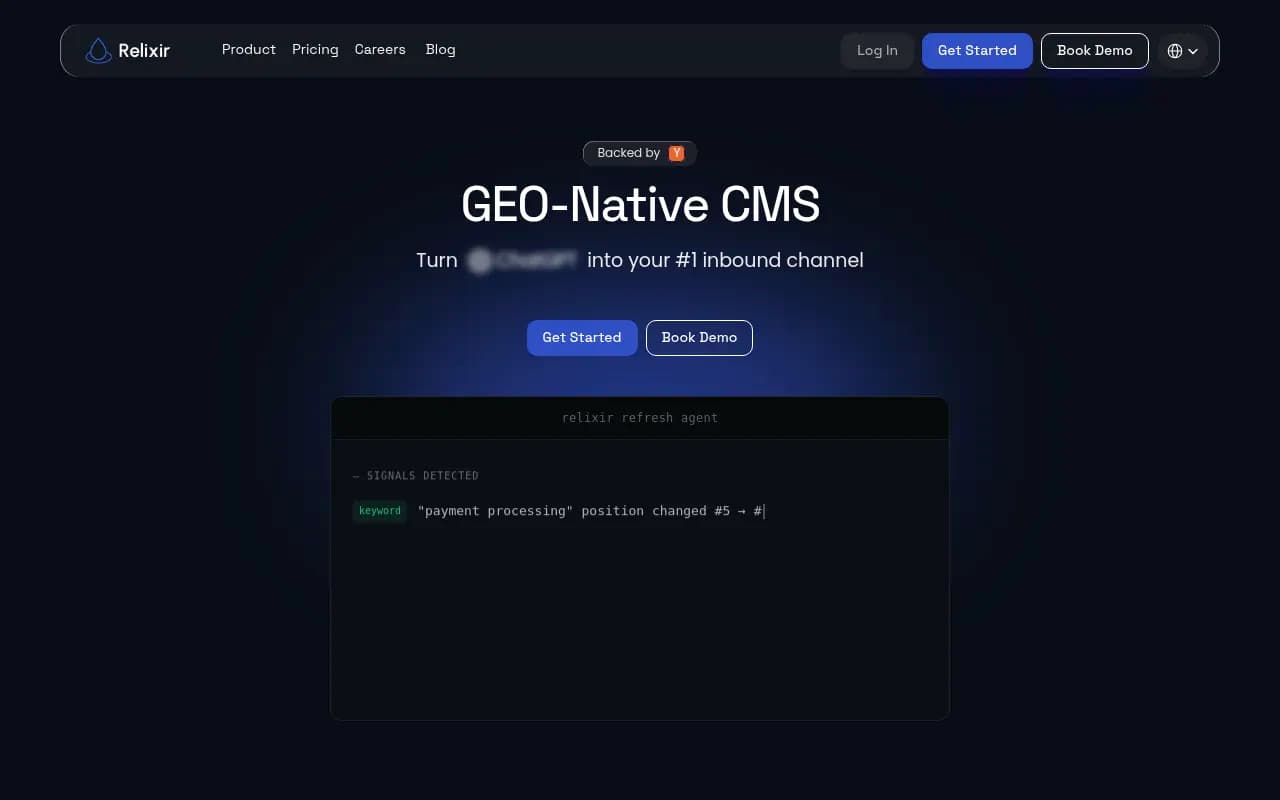
Where Relixir shines is in its workflow infrastructure. Enterprise brands with legal review requirements, brand guidelines, and multi-team content processes will find more structure here than in Promptwatch's more self-serve approach. The platform supports content pipelines that can route drafts through approval stages before publishing.
The monitoring side covers the major AI engines -- ChatGPT, Perplexity, Gemini, Claude -- and provides competitive benchmarking. Relixir also does prompt simulation, running queries on your behalf and logging how AI models respond to questions in your category.
The tradeoffs: Relixir is custom-priced, which typically means it's out of reach for mid-market brands. It also doesn't have the breadth of AI engine coverage that Promptwatch does (10+ models vs. four primary ones), and it lacks some of the more specialized retail features like ChatGPT Shopping tracking or Reddit/YouTube citation analysis. For a Fortune 500 consumer brand with a dedicated GEO team, it's worth evaluating. For a $50M DTC brand, the price and complexity are probably overkill.
Yext: structured data and listings at scale
Yext has been in the business of managing brand information across the web for over a decade. Its AI visibility story is an extension of that: if you control how your brand data appears in structured formats, you're better positioned to be cited accurately by AI engines that pull from those sources.
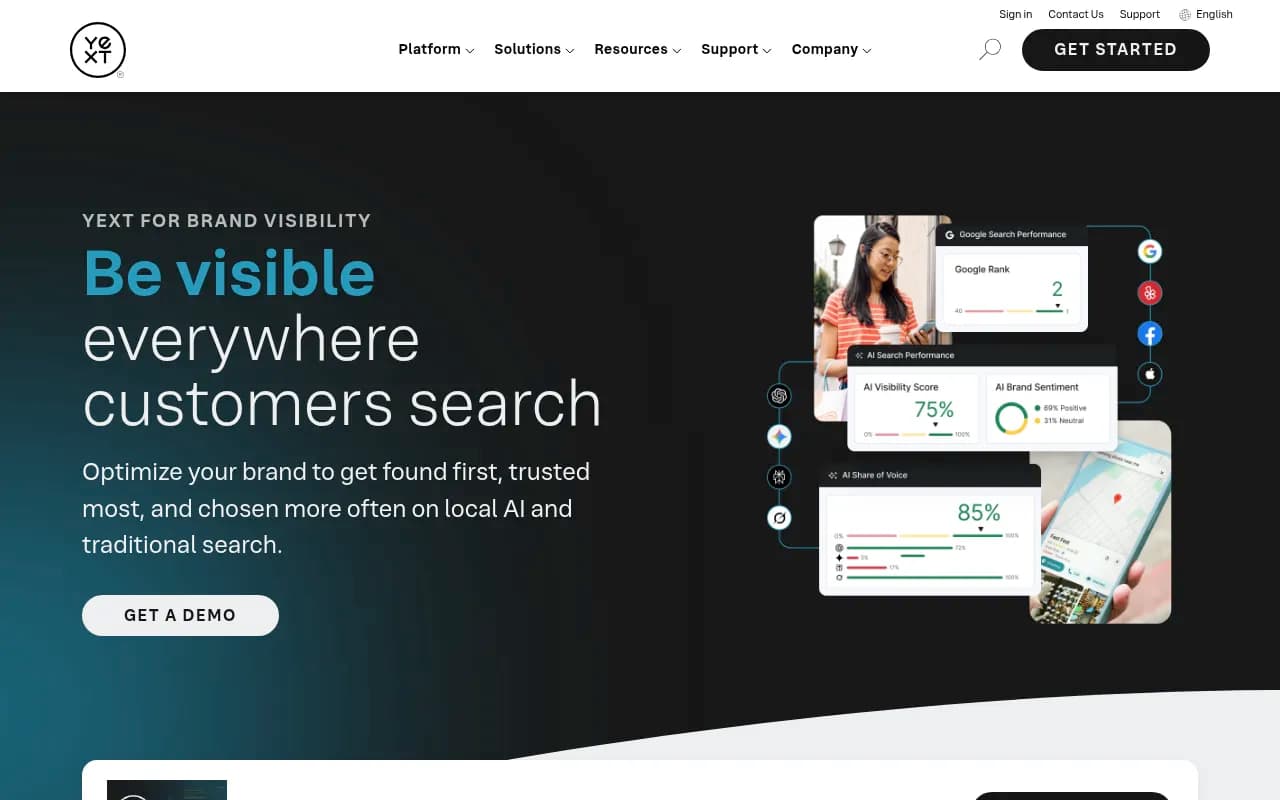
For multi-location retail brands -- think a clothing chain with 200 stores, or a restaurant group -- Yext's core value is still listing management. It syncs your location data, hours, menus, and other structured information across Google, Bing, Apple Maps, and dozens of other directories. When AI engines pull from those sources to answer "is there a [brand] near me" or "what are [brand]'s hours on Sunday," accurate data matters.
Yext has added AI search monitoring features, including some coverage of Google AI Overviews and Bing's AI answers. But it's not a GEO optimization platform in the same sense as Promptwatch or Relixir. It doesn't have a content generation engine built around AI citation data, it doesn't do answer gap analysis against competitors, and it doesn't track which of your content pages are being cited by ChatGPT or Claude.
Where Yext makes sense: you're a multi-location retail brand and your primary AI visibility concern is local search accuracy -- making sure AI assistants give correct information about your stores. Where it doesn't: you want to improve how AI models recommend your brand in category-level queries, or you want to create content that gets cited in AI answers.
Uberall: local marketing with AI search coverage
Uberall is a multi-location marketing platform that has expanded into AI search visibility as local search and AI search have started to converge. Its core product manages listings, reviews, and local pages across search engines and directories for brands with many physical locations.
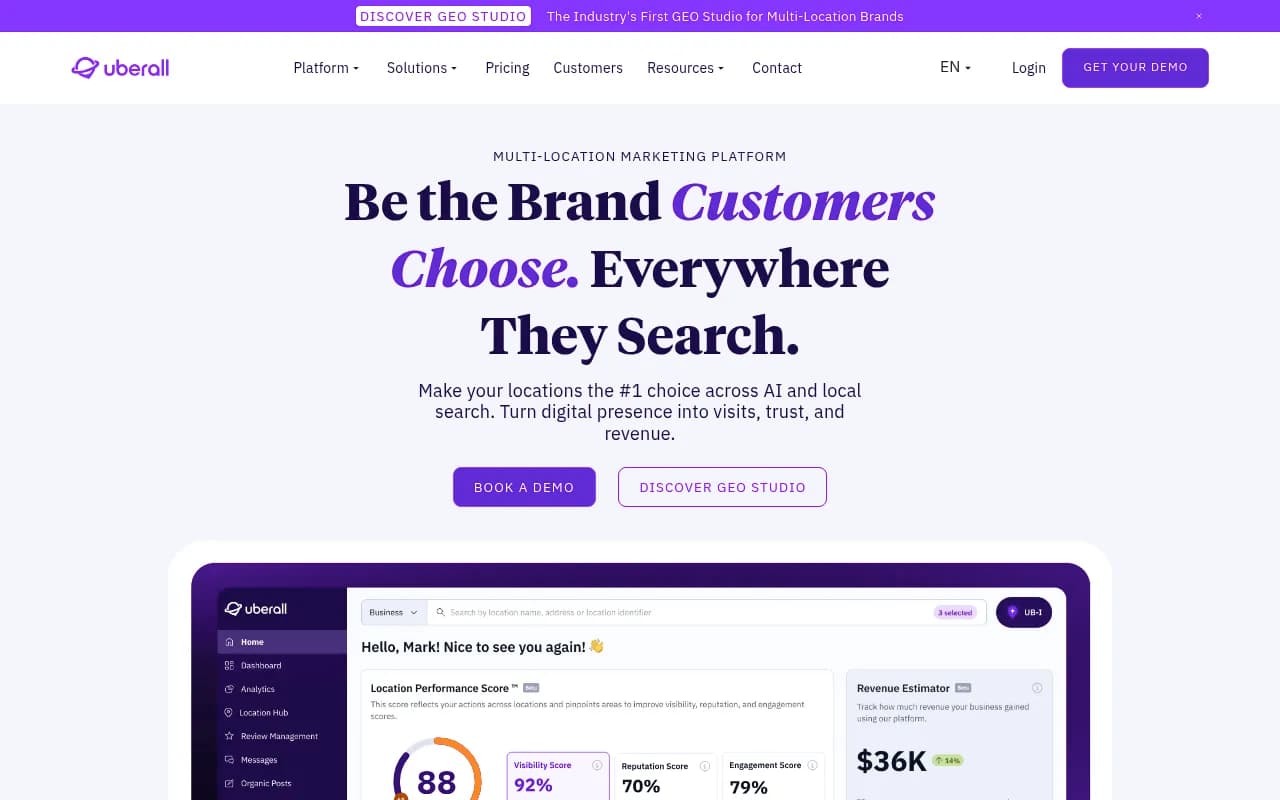
The AI visibility angle for Uberall is primarily about local AI search -- the kind of queries where someone asks Google's AI Overview or an AI assistant about nearby stores, local availability, or location-specific information. Uberall helps ensure your location data is accurate and consistent enough to be cited correctly in those answers.
Like Yext, Uberall is strong at what it was built for: multi-location brands that need to manage hundreds or thousands of location profiles at scale. Review management, local page optimization, and listing sync are all solid. The AI search monitoring features are more recent additions and don't go as deep as dedicated GEO platforms.
What Uberall doesn't do: it won't tell you why ChatGPT doesn't recommend your brand when someone asks for the best products in your category, and it won't help you create content to fix that. For retail brands where the AI visibility problem is about brand recommendation rather than local search accuracy, Uberall isn't the right tool.
Head-to-head: which platform for which retail scenario
Let's get concrete about use cases, because the right choice really does depend on what problem you're trying to solve.
Scenario 1: DTC brand that wants to appear in AI product recommendations
You sell skincare products online. You want ChatGPT to recommend you when someone asks "best retinol serums for sensitive skin." You're not appearing, your competitors are, and you don't know why.
Best fit: Promptwatch. The Answer Gap Analysis will show you exactly which prompts your competitors are winning. The content generation tools will help you create the articles and comparisons that AI models want to cite. The ChatGPT Shopping tracking will tell you when you start appearing in product carousels. Relixir could work too if you're enterprise-scale, but Promptwatch is more accessible and has more retail-specific features.
Scenario 2: Multi-location retailer worried about local AI search accuracy
You have 150 store locations. You want to make sure that when someone asks Google's AI Overview "is there a [brand] store near downtown Chicago," they get accurate hours and directions.
Best fit: Yext or Uberall. This is a listing management problem, and both platforms are built for it. Yext has slightly broader directory coverage; Uberall has stronger review management. Either will serve you better than a GEO optimization platform for this specific need.
Scenario 3: Large consumer brand with both local and AI recommendation concerns
You're a national retailer with physical stores and a growing DTC channel. You need local search accuracy AND you want to improve how AI models recommend your brand in category queries.
Best fit: Promptwatch for AI recommendation optimization, plus Yext or Uberall for local listing management. These tools solve different problems and aren't really competing for the same budget. A brand at this scale probably needs both.
Scenario 4: Enterprise brand with complex content workflows
You're a Fortune 500 consumer goods company with a legal team that reviews all content before publication, a brand team with strict guidelines, and a GEO team that needs to coordinate across regions.
Best fit: Relixir for GEO workflows, potentially alongside Yext for listings. Relixir's enterprise workflow infrastructure is more suited to this environment than Promptwatch's more self-serve approach.
Feature comparison: what each platform actually covers
| Feature | Promptwatch | Relixir | Yext | Uberall |
|---|---|---|---|---|
| AI engine monitoring (breadth) | 10+ models | 4 primary | Limited | Limited |
| Answer gap analysis | Yes | Yes | No | No |
| AI content generation | Yes | Yes | No | No |
| ChatGPT Shopping tracking | Yes | No | No | No |
| Reddit/YouTube citation insights | Yes | No | No | No |
| AI crawler logs | Yes | No | No | No |
| Multi-location listing management | No | No | Yes | Yes |
| Review management | No | No | Yes | Yes |
| Traffic attribution | Yes | Partial | No | No |
| Self-serve pricing | Yes ($99/mo+) | No | No | No |
| Free trial | Yes | No | No | No |
The bigger picture: monitoring vs. optimization
One thing worth saying plainly: there's a real difference between tools that monitor AI visibility and tools that help you improve it.
Monitoring tells you where you stand. Optimization tells you what to do about it and then helps you do it. Most platforms in this space -- including many not in this comparison -- are monitoring-only. They give you a dashboard, a score, maybe a list of gaps, and then leave you to figure out the rest.
Promptwatch is the clearest example of a platform that closes the loop. The gap analysis, content generation, and traffic attribution are all connected. You find a gap, you create content to fill it, you track whether it worked. That cycle is what makes it useful for retail brands that actually want to move their numbers, not just report on them.
Relixir takes a similar approach but targets a different buyer. Yext and Uberall are genuinely useful for multi-location brands, but they're solving a different problem -- one that's about data accuracy and listing management rather than AI recommendation optimization.
For most retail and consumer brands reading this in 2026, the question isn't whether to invest in AI visibility -- Adobe's traffic data makes that case clearly enough. The question is which platform matches your actual problem. If you're not sure where to start, Promptwatch's free trial is a low-risk way to see what your AI visibility gaps actually look like before committing to anything.