Key takeaways
- Most AI visibility platforms track brand name mentions, but AI engines like ChatGPT and Perplexity respond to entity-level queries -- products, people, categories, and concepts -- not just brand searches.
- Entity tracking requires a platform that can monitor unbranded prompts, map competitor visibility, and surface content gaps at the topic level.
- A handful of platforms go beyond monitoring to help you fix gaps with content generation and optimization -- the majority stop at the dashboard.
- Promptwatch is the only platform in 2026 rated as a leader across all GEO categories, combining entity tracking, answer gap analysis, and AI content generation in one workflow.
- For most teams, the right question isn't "does this tool track my brand?" -- it's "does this tool help me appear when buyers ask about my category?"
Why entity tracking matters more than brand monitoring
Here's a scenario that plays out constantly: a buyer opens ChatGPT and types "what's the best project management tool for remote engineering teams?" They're not searching for your brand. They're asking about a category, a use case, a problem. If your brand doesn't appear in that response, you've lost the sale before the buyer even knew you existed.
That's the entity problem. AI engines like ChatGPT, Perplexity, Claude, and Google AI Overviews don't just respond to branded queries. They respond to concepts -- product categories, job titles, industries, use cases, locations, and named features. An "entity" in this context is any distinct concept an AI model has learned to associate with specific sources, brands, or content.
Most AI visibility platforms were built to answer one question: "Is my brand mentioned?" That's useful, but it's only part of the picture. The more important question is: "When buyers ask about my category, do I show up -- and if not, why?"
Platforms that track entity mentions go further. They monitor:
- Unbranded category prompts ("best CRM for startups")
- Product and feature-level queries ("tools with built-in A/B testing")
- Competitor entity associations ("alternatives to [competitor]")
- Persona-specific queries ("what do CMOs use for competitive intelligence")
- Topic clusters that feed into branded awareness
The gap between brand monitoring and entity monitoring is the gap between knowing you exist and understanding whether you're winning the category.
What "entity tracking" actually looks like in practice
Before comparing platforms, it helps to be specific about what entity-level tracking involves technically.
When an AI model answers "what are the best tools for tracking AI search visibility?", it's drawing on a web of associations: which brands are cited in relevant content, which Reddit threads discuss the category, which YouTube videos explain the topic, which pages are crawled frequently by AI agents. Your visibility in that response isn't just about your brand name -- it's about whether your content, your citations, and your entity associations are strong enough to pull you into the response.
Entity tracking at a platform level means:
- Running prompts that don't include your brand name at all
- Tracking which entities (competitors, categories, features) appear alongside you or instead of you
- Mapping citation sources -- not just "you were mentioned" but "you were mentioned because of this page"
- Monitoring how AI crawlers interact with your site, which pages they read, and whether those pages are turning into citations
- Surfacing content gaps where competitors are visible for entity-level prompts but you're not
That last point is where most platforms fall short. They'll show you a dashboard of your citation count. They won't tell you that your competitor is getting cited for "best tool for [use case]" because they published a comparison page three months ago that you haven't written yet.
The platforms worth considering in 2026
The AI visibility tool market has exploded. There are now dozens of platforms claiming to track your brand across ChatGPT, Perplexity, and Google AI Overviews. Most of them do roughly the same thing: run a set of prompts, count mentions, show a trend line. The differences that matter are in depth, actionability, and how well they handle entity-level tracking beyond your brand name.
Here's an honest breakdown of the platforms worth knowing about.
Promptwatch -- best for end-to-end entity and brand visibility
Promptwatch is the most complete platform in this category. Where most tools stop at "here's your mention count," Promptwatch is built around a loop: find the gaps, create content to fill them, track the results.

For entity tracking specifically, a few capabilities stand out. The Answer Gap Analysis shows exactly which prompts competitors are visible for but you're not -- including unbranded category queries. You can see the specific topics and angles AI models want answers to but can't find on your site. That's entity-level intelligence, not just brand monitoring.
The platform also tracks AI crawler behavior at the page level: which pages ChatGPT, Claude, and Perplexity are reading, how often they return, and when a crawled page turns into an actual citation. That's important for entity tracking because it tells you whether your content about a specific topic is being discovered at all, not just whether your brand name appears somewhere.
Promptwatch monitors 10 AI models including ChatGPT, Perplexity, Google AI Overviews, Google AI Mode, Claude, Gemini, DeepSeek, Grok, Copilot, and Meta AI. It also tracks Reddit threads and YouTube videos that influence AI recommendations -- two channels that directly shape entity associations in AI responses and that most competitors ignore.
Pricing starts at $99/month for the Essential plan (1 site, 50 prompts, 5 articles). The Professional plan at $249/month adds crawler logs, city/state tracking, and 150 prompts. A free trial is available.
Profound -- best for enterprise teams with large prompt sets
Profound

Profound is a strong enterprise option with deep prompt coverage and solid competitive benchmarking. It runs thousands of branded and unbranded prompts daily across major AI engines and reports share-of-voice at the category level. For entity tracking, it handles unbranded queries well and gives you a clear picture of where competitors are winning category-level prompts.
The limitation is that Profound is primarily a monitoring platform. It shows you the data but doesn't generate content to fix the gaps. For teams with dedicated content resources who just need the intelligence layer, that's fine. For teams that want an integrated workflow from gap to content to result, it falls short.
Otterly.AI -- solid monitoring, limited depth
Otterly.AI

Otterly.AI covers the basics well: brand mentions across ChatGPT, Perplexity, and Google AI Overviews, with clean reporting and a straightforward interface. It's a reasonable starting point for teams new to AI visibility tracking.
For entity tracking, it's limited. The platform is primarily brand-focused, and the prompt sets tend to be narrower than what you'd need to map full category visibility. There's no content gap analysis, no crawler log data, and no content generation capability. It's a monitoring dashboard, not an optimization platform.
Peec AI -- good for prompt discovery

Peec AI has a specific strength worth noting: prompt discovery. It helps you understand not just where you appear, but where you should appear -- surfacing the prompts and topics in your category that you're not currently tracking. That's genuinely useful for entity-level work because it expands your prompt set beyond the obvious branded queries.
The platform is more limited on the action side. Like most monitoring tools, it shows you the gap but doesn't help you close it.
AthenaHQ -- monitoring-focused with clean UX

AthenaHQ has a clean interface and covers multiple AI engines. It's monitoring-focused and works well for teams that need to report on AI visibility without needing to act on it directly. Entity tracking is possible through unbranded prompt sets, but the platform doesn't have content gap analysis or generation capabilities built in.
Rankscale -- agency-focused tracking
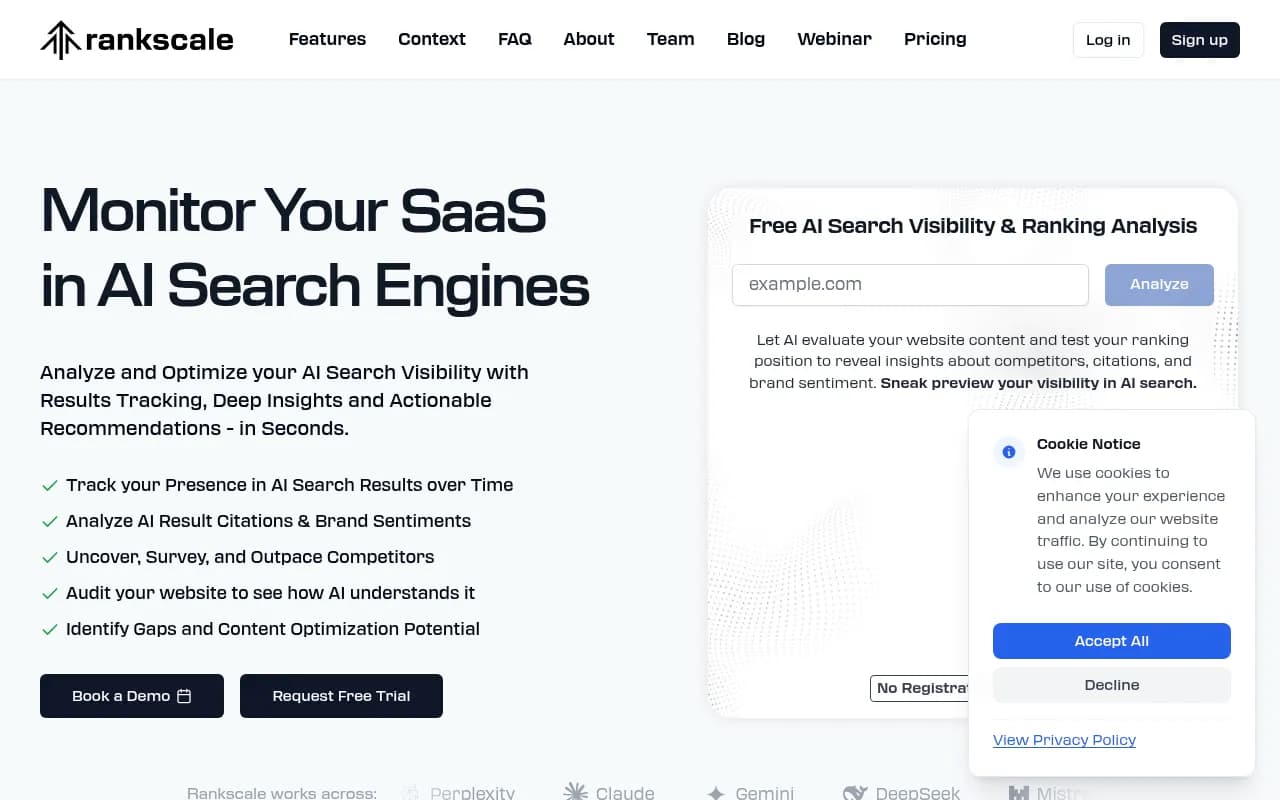
Rankscale is built with agencies in mind, with multi-client management and white-label reporting. For entity tracking, it covers the basics but doesn't go deep on unbranded category analysis or content gap identification. Useful for agencies that need to show clients AI visibility data without necessarily optimizing it.
Scrunch AI -- AI-powered SEO tracking
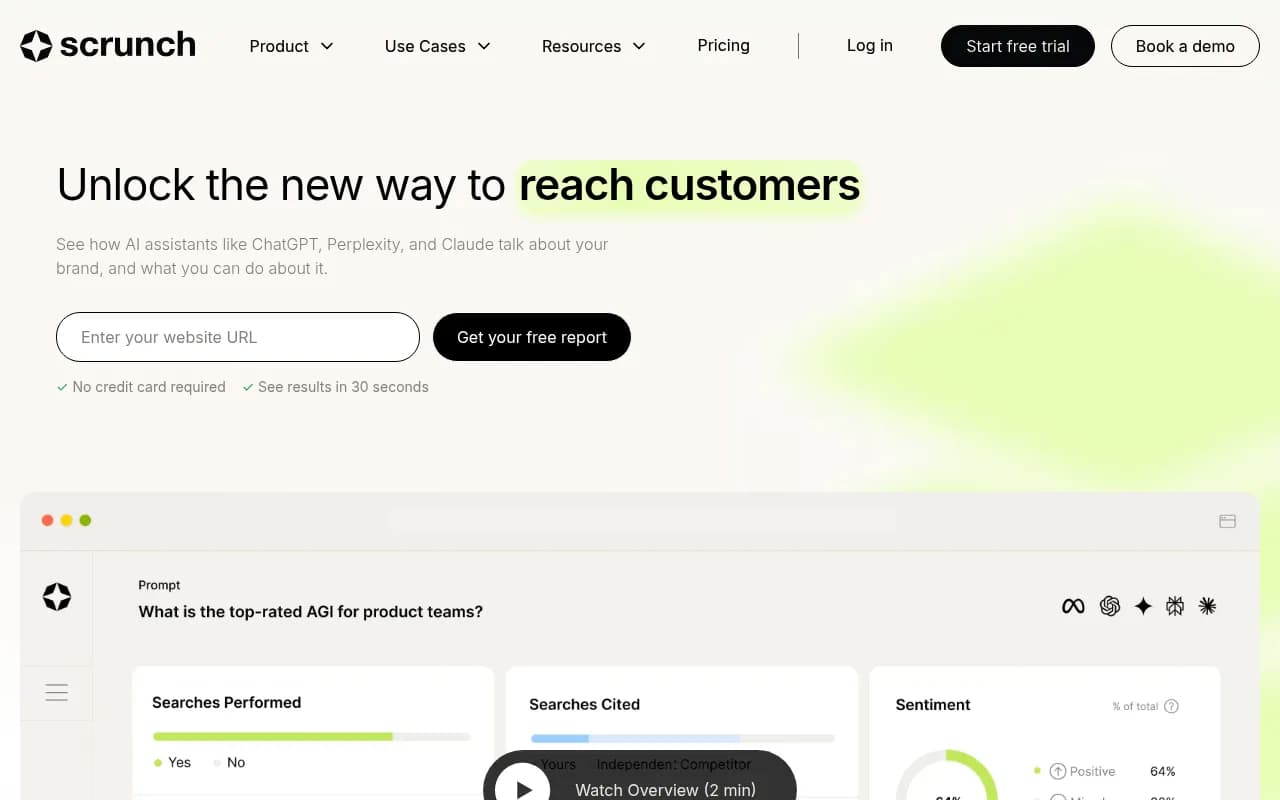
Scrunch AI combines traditional SEO tracking with AI visibility monitoring. It's a reasonable option for teams that want both in one platform, though the AI visibility features are less mature than dedicated GEO platforms.
SE Ranking's AI Search Toolkit
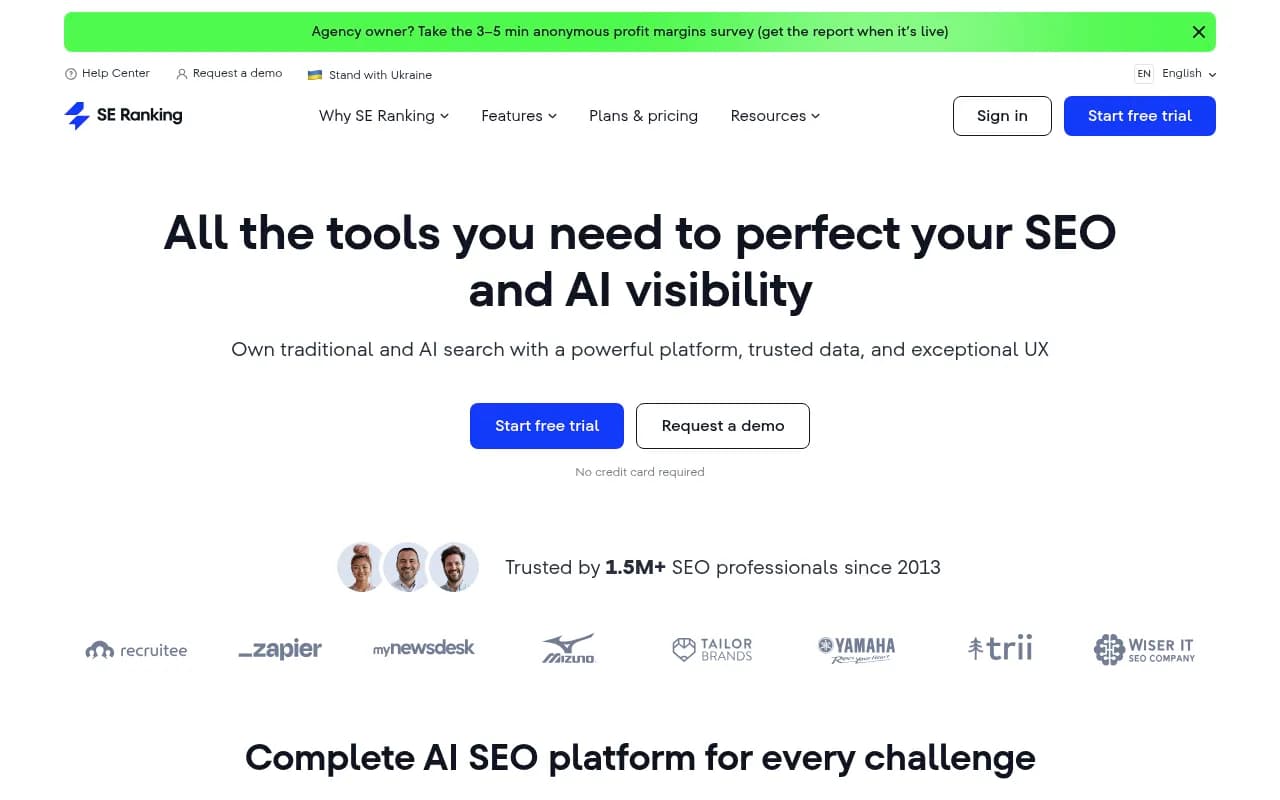
SE Ranking added AI search tracking to its existing SEO platform. The advantage is integration with traditional SEO data -- you can see how AI visibility correlates with organic rankings. The AI-specific features are less deep than dedicated platforms, but for teams already using SE Ranking for SEO, it's a low-friction way to add AI monitoring.
Feature comparison: entity tracking capabilities
| Platform | Unbranded prompts | Competitor entity mapping | Content gap analysis | AI content generation | Crawler logs | Reddit/YouTube tracking |
|---|---|---|---|---|---|---|
| Promptwatch | Yes | Yes | Yes | Yes | Yes | Yes |
| Profound | Yes | Yes | No | No | No | No |
| Otterly.AI | Limited | Limited | No | No | No | No |
| Peec AI | Yes | Limited | No | No | No | No |
| AthenaHQ | Limited | Yes | No | No | No | No |
| Rankscale | Limited | Limited | No | No | No | No |
| Scrunch AI | Limited | Limited | No | No | No | No |
| SE Ranking | Limited | Limited | No | No | No | No |
The pattern is consistent: most platforms handle branded monitoring reasonably well, but entity-level tracking -- especially unbranded category prompts, content gap analysis, and the ability to act on what you find -- is where the field thins out quickly.
How to actually use entity tracking: a practical workflow
Knowing which platform to use is one thing. Knowing how to use it for entity tracking is another. Here's a workflow that works.
Step 1: Map your entity landscape
Before you run a single prompt, list the entities your brand should be associated with. This includes:
- Your product category ("AI visibility platform", "GEO tool", "brand monitoring software")
- Use cases ("track brand in ChatGPT", "monitor AI search citations")
- Buyer personas ("marketing director", "SEO agency", "enterprise CMO")
- Competitor names (for "alternatives to" and comparison queries)
- Named features or methodologies your category uses
This list becomes your prompt set. Most teams start too narrow -- they only track their brand name and a handful of obvious queries. The entity approach forces you to think about the full category.
Step 2: Run unbranded category prompts
Set up prompts that don't include your brand name at all. "What are the best tools for tracking AI search visibility?" is more valuable than "Is [your brand] mentioned in AI responses?" because it shows you the competitive landscape, not just your own position.
Track these prompts across multiple AI engines. ChatGPT and Perplexity often give different answers for the same query. Google AI Overviews pulls from different sources than Claude. Your entity visibility will vary by model, and you need to know where the gaps are.
Step 3: Identify which entities you're missing
Look at the responses to your unbranded prompts. Which competitors appear? Which features are highlighted? Which use cases are covered? Any entity that appears consistently in AI responses but isn't associated with your brand is a gap.
Tools like Promptwatch surface this automatically through Answer Gap Analysis -- you can see exactly which prompts competitors are winning that you're not. For platforms without this feature, you'll need to do this manually by reviewing response data.
Step 4: Create content that fills the gaps
This is where most teams get stuck. They have the data but don't know what to do with it. The answer is usually content: pages that directly address the entity associations you're missing.
If competitors are getting cited for "best AI visibility tool for agencies" and you're not, you probably need a page that directly addresses agency use cases, with the specific language and structure that AI models tend to cite. That might be a comparison page, a use case guide, a listicle, or a detailed feature breakdown -- the format matters less than whether the content directly answers the prompt.
Step 5: Track the results at the page level
Once you publish, track whether AI crawlers are finding and reading the new content, and whether it's turning into citations. Page-level tracking tells you which specific pages are being cited, by which models, and how often. That feedback loop is how you know whether your entity optimization is working.
Common mistakes when setting up entity tracking
A few things trip up teams new to this:
Tracking only branded prompts. If every prompt in your set includes your brand name, you're measuring brand awareness in AI, not category visibility. You need unbranded prompts to understand your entity position.
Using too few prompts. AI visibility varies significantly by prompt phrasing. "Best AI visibility tool" and "top platforms for tracking brand mentions in ChatGPT" might return completely different results. A broader prompt set gives you a more accurate picture.
Ignoring citation sources. When an AI model cites your brand, it's usually because of a specific page -- a blog post, a comparison article, a Reddit thread. If you don't know which sources are driving citations, you can't replicate or build on them.
Not tracking competitors' entity associations. Your competitors' entity strength is as important as your own. If a competitor is consistently associated with your target category across multiple AI engines, that's a strategic signal, not just a data point.
Treating AI visibility as separate from content strategy. Entity tracking is most useful when it directly informs what you publish. The teams getting the best results are using gap analysis to prioritize content, not just to report on where they stand.
Which platform should you choose?
For most marketing teams and agencies in 2026, the choice comes down to what you need to do with the data.
If you need a complete workflow -- from entity gap identification to content creation to citation tracking -- Promptwatch is the only platform that covers the full loop. The combination of Answer Gap Analysis, AI content generation grounded in real prompt data, and page-level crawler tracking is genuinely differentiated from what monitoring-only tools offer.
If you're at an enterprise with a large content team and just need the intelligence layer, Profound is worth evaluating for its depth of prompt coverage.
If you're just starting out and want to understand the basics before committing to a full platform, Otterly.AI or Peec AI give you a low-cost entry point -- just know you'll hit their limits quickly once you start asking harder questions about entity visibility.
The honest summary: most platforms in this category are dashboards. They show you where you stand. Promptwatch is the one that helps you change where you stand -- and for entity tracking specifically, that distinction matters more than any individual feature.