Key takeaways
- Almost every AI visibility vendor now claims an MCP server, but the differences that matter are tool count, read-vs-write access, and which pricing tier actually unlocks it
- Read-only MCP servers (like Profound's 17 tools) let an agent answer questions but can't act on them without a browser trip back to the dashboard
- Platforms with write and apply tools, including Promptwatch, LLM Pulse, Otterly.AI, and Foglift, let an agent add prompts, tag competitors, or apply a content fix inside the same conversation
- MCP access is frequently gated behind mid-tier or top-tier plans even when the feature page implies it's everywhere, so check the live pricing page, not the marketing copy
- Bundled suites like SE Ranking expose 200+ MCP tools total, but only a fraction touch AI search specifically, so compare tools-per-subject rather than raw counts
Why MCP support suddenly matters for SaaS teams
A year ago, "do you have an API" was the question developer-led SaaS teams asked AI visibility vendors. Now it's "do you have an MCP server, and can my agent write to it." The shift makes sense once you think about how a dev team actually works: they're not opening five dashboards a day, they're running Claude Code, Cursor, or an internal agent that needs to pull citation data, check crawler logs, and kick off a fix, all without leaving the terminal.
Model Context Protocol, introduced by Anthropic and now adopted across OpenAI and Microsoft's ecosystems, standardizes how an AI assistant talks to a tool. For AI visibility platforms specifically, that means an agent can ask "which prompts are we losing citations on this week" and, on the better platforms, immediately follow up with "now fix the page and rescan it" — all inside one chat session.
The catch: not all MCP servers are built the same. Third-party testing in August 2026 found the gap between vendors is enormous, ranging from 17 read-only tools on some platforms to 85+ read-and-write tools on others. If you're picking a platform to sit inside your agent workflow, that gap is the whole decision.
What separates a real MCP integration from a checkbox
Three things actually differentiate MCP servers in this category, and none of them show up if you just skim a feature page:
Tool count and scope. A platform advertising "MCP support" might mean 15 tools or 200. When the AI visibility feature sits inside a bigger SEO suite, most of those tools are unrelated to AI search at all. SE Ranking's MCP server, for example, exposes 217 total tools across its whole SEO product, but only around 40 of those touch AI search and prompts specifically. Compare tools-per-subject, not the headline number.
Read versus write. Ask a read-only server which prompts you're losing on, and it'll tell you. Ask it to fix that, and you're back in the browser. Profound's 17 MCP tools are explicitly read-only by design, according to its own documentation — solid for pulling analytics into a report, useless for closing the loop. Tools that can create prompts, tag competitors, apply a recommendation, or trigger a rescan are what actually let an agent do the work end to end.
Which plan unlocks it. This is the one that trips up budget-conscious teams. Otterly.AI's MCP access starts on its $189/month Standard plan, not the $29/month Lite tier. A German competitor, Mentionable, gates MCP to Pro and Agency tiers starting at €149/month. Always check the live pricing page before you assume MCP ships with entry-level access.
Platform comparison: MCP depth, access model, and pricing
| Platform | MCP tool count | Read/write | Auth | MCP starts at | Best for |
|---|---|---|---|---|---|
| Promptwatch | Full stack via MCP server + Agent Chat | Read + write + apply | OAuth / API key | Essential, $95/mo | Dev-led SaaS teams wanting monitoring, crawler logs, and content generation in one agent workflow |
| LLM Pulse | ~85 tools | Read + write | OAuth 2.1 or API key | Starter, ~€49/mo | Teams that want the widest MCP surface for bulk prompt and competitor management |
| Otterly.AI | 17 tools (11 read, 6 write) | Read + write | OAuth 2.0 only | Standard, $189/mo | Agencies already inside Otterly's dashboard workflow |
| Profound | 17 tools | Read-only | OAuth | Not published on pricing page | Teams that just need clean reporting pulled into agent context |
| SE Ranking | 217 total, ~40 on AI search | Mixed | OAuth 2.1 or API key | SE Visible, ~$79/mo (annual) | Teams that want AI visibility bundled inside a full SEO suite |
| Semrush | Not published | Mixed | OAuth 2.0 or API key | Starter, $199/mo | Teams already standardized on Semrush for traditional SEO |
| Ahrefs Brand Radar | ~22 tools | Read-oriented | OAuth | Brand Radar, from $398/mo | Ahrefs-native teams tracking brand mentions alongside backlinks |
A few platforms outside this table are worth a mention too. Foglift ships a hosted MCP server with 29 tools including scan, batch scan, apply-recommendation, and recipe-run actions, plus a local stdio option via an npm package for Cursor and Windsurf — a genuinely developer-first approach, though its AI visibility coverage tops out at five engines. Mentionova doesn't lead with MCP but is worth knowing about if Reddit citation tracking specifically matters to your stack, since it's one of the only platforms treating Reddit as a tracked engine rather than a footnote.
Where Promptwatch fits for developer teams
Promptwatch is the one platform on this list that treats MCP as part of a bigger agentic system rather than a bolt-on API wrapper. Its MCP server and Agent Chat sit on top of the same data that powers the dashboard: crawler logs from ChatGPTBot, ClaudeBot, PerplexityBot, and 400+ other bots, citation tracking classified into 22 content types, Reddit and YouTube citation reports, and Content Agents that can plan, write, and publish to Webflow, Framer, or WordPress on a schedule.

For a developer-focused SaaS team, the practical difference is this: instead of an agent that can only answer "are we cited in ChatGPT," you get one that can also ask "why aren't we being crawled on this page," pull the crawl-to-citation path per URL, and then trigger a content fix, all without switching tools. That's the read-write-apply loop most competitors, including several with bigger MCP tool counts on paper, don't actually close. It also connects through the official ChatGPT plugin, a Claude Connector, and works inside Cursor via its MCP server, which matters if your team already lives in those tools daily.
Pricing starts at Essential, $95/month for one site, 50 prompts, and MCP/API access included from that tier, not gated behind an enterprise sales call the way some Profound-tier features are.
LLM Pulse: the widest MCP surface
LLM Pulse currently has the largest documented MCP tool count in this category at roughly 85 read and write tools, based on third-party testing from August 2026. Write tools cover project creation, bulk prompt addition, competitor management, tagging, annotations, and triggering technical GEO reports.
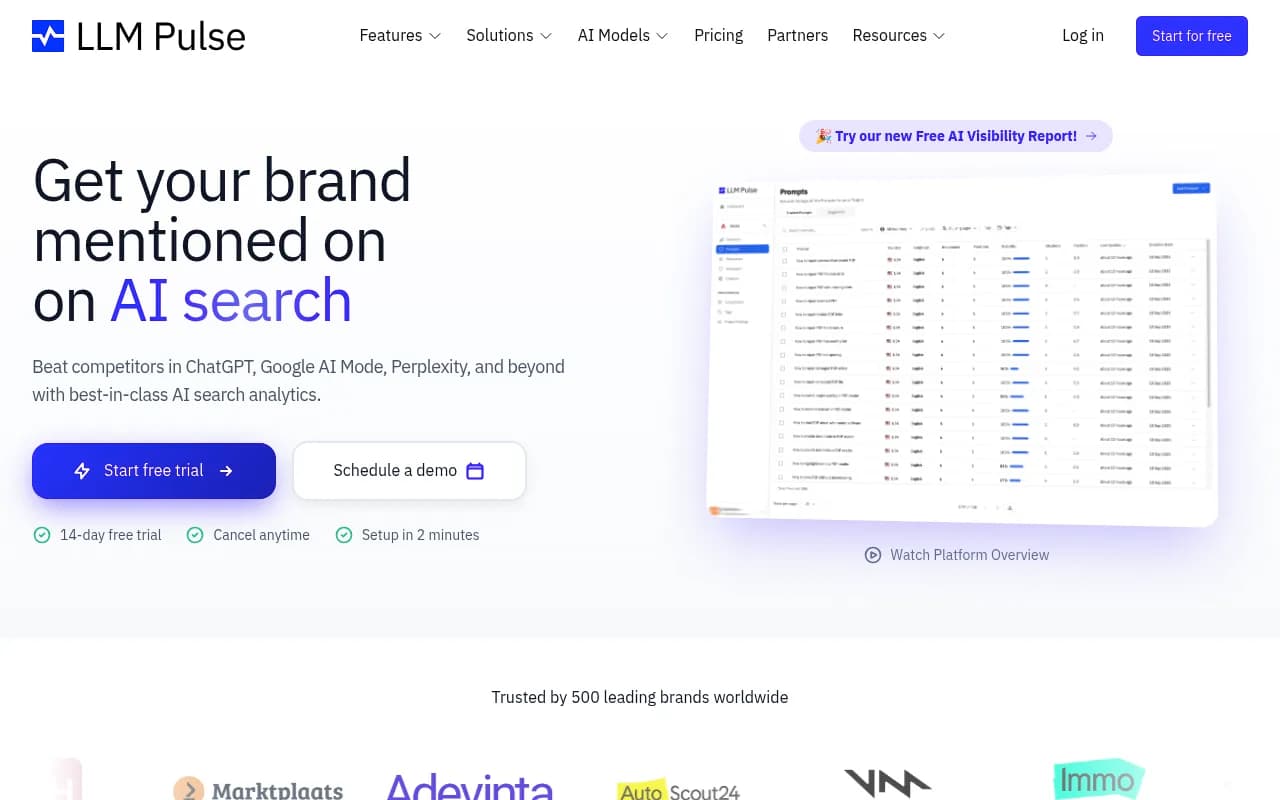
If your team wants to script large-scale prompt management — hundreds of prompts across multiple brands or client accounts — this is the deepest toolkit available today. Pricing starts around €49/month for 50 prompts across five models, scaling to €1,199/month for 2,400 prompts at the top end.
Otterly.AI and Profound: two different philosophies
Otterly.AI sits in between: 17 tools split 11 read and 6 write, with the write side covering prompt creation, deletion, and tag management. The catch is that MCP only activates on the $189/month Standard plan and above, not the $29/month Lite tier.
Otterly.AI

Profound takes the opposite approach on purpose. Its 17 MCP tools are read-only by design according to its own documentation, which makes it a clean choice if your workflow is "pull data into an agent and generate a report," but a poor fit if you want the agent to also fix what it finds.
Profound

SE Ranking, Semrush, and Ahrefs Brand Radar: AI visibility inside a bigger suite
If your team is already standardized on a traditional SEO platform, bolting AI visibility onto it can be simpler than adding a fourth or fifth tool.
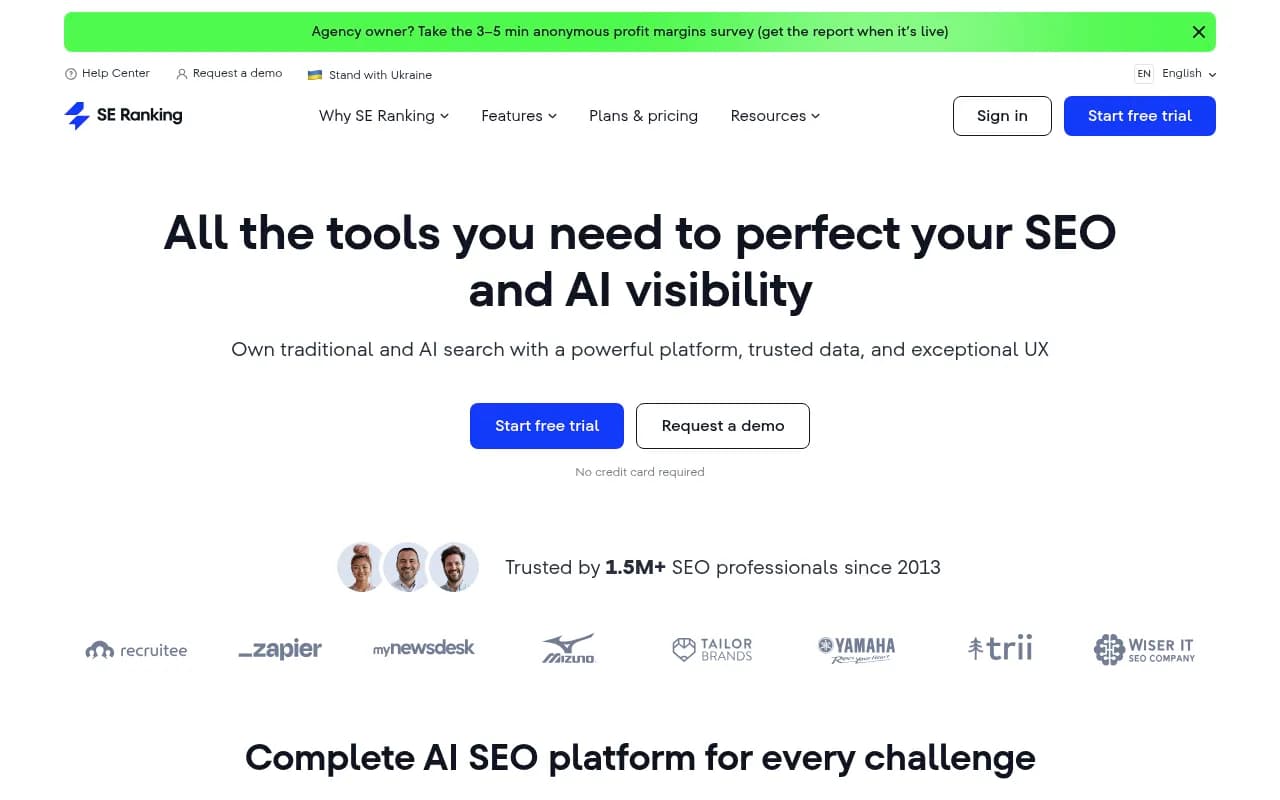
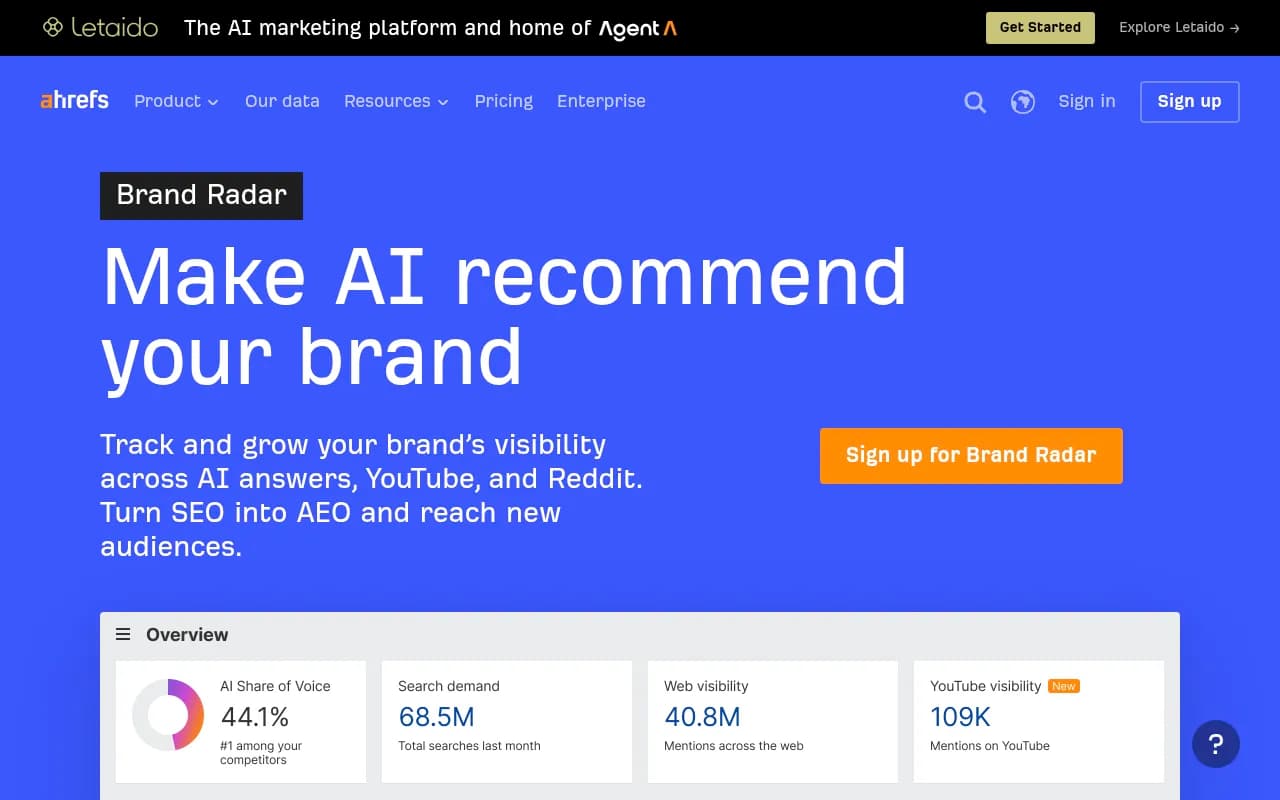
SE Ranking's MCP server answers tools/list without authentication, which is actually how third-party testers got an exact tool count: 217 total, with roughly 40 touching AI search specifically. Semrush and Ahrefs Brand Radar both offer MCP or API access at higher tiers, but neither publishes exact tool counts the way SE Ranking's open discovery endpoint allows. The tradeoff with all three: you get AI visibility bundled with backlinks, rank tracking, and site audits, but the AI-specific tooling is a smaller slice of a much bigger, more expensive product.
How to verify an MCP claim before you buy
Don't take a vendor's feature page at face value. Third-party researchers verify MCP claims by sending an unauthenticated tools/list call to the published MCP endpoint. A 401 response with resource_metadata signals a modern OAuth protected-resource setup; some servers, like SE Ranking's, respond without authentication at all and hand over the full tool catalogue directly. If you're evaluating a platform for a developer team, ask for the MCP endpoint URL during the sales process and run this check yourself before signing anything.
Also confirm which specific plan includes MCP. Feature pages routinely imply broad availability when the reality is a mid-tier or top-tier gate. Get this in writing or check the pricing page directly rather than trusting a sales deck.
What the underlying citation data tells you about content strategy
Worth keeping in mind regardless of which platform you pick: ChatGPT surfaces roughly 5 citations per web-search-triggered response, while Google AI Overviews and Perplexity each cite closer to 10, according to Promptwatch's average sources per response data. With ChatGPT offering only about 5 slots, narrowly-focused, single-intent pages have a much better shot at making the cut than broad pillar content.
ChatGPT's search behavior has also gotten leaner. Promptwatch's query fanout data shows average query length collapsed from around 117 characters in December to roughly 53 characters by April, meaning ChatGPT increasingly searches like someone typing keywords rather than full sentences. That's a real argument for writing headings that read like short search queries rather than marketing copy.
And for SaaS teams specifically, Promptwatch's July 2026 citation type breakdown found product pages are now the single most-cited content type in ChatGPT at roughly a third of all citations, up from around 18% in March. If your pricing and feature pages are thin or out of date, that's the format ChatGPT is increasingly pulling from directly.
Which platform to pick, by team shape
If you're a small dev-led SaaS team that wants one platform handling monitoring, crawler diagnostics, and content publishing through an agent, Promptwatch's combination of MCP access, Agent Chat, and Content Agents covers the most ground without needing a second tool for the "fix it" half of the job.
If you're running high-volume, multi-client prompt management and want the deepest scriptable tool surface, LLM Pulse's 85-tool MCP server is currently the widest in the category.
If your team just wants clean data pulled into an internal dashboard with no write access needed, Profound's read-only approach is a reasonable, lower-risk choice.
If you're already paying for SE Ranking, Semrush, or Ahrefs for traditional SEO, check whether their AI visibility MCP tools cover enough of what you need before adding a dedicated platform on top.
For a broader look at platforms outside the MCP-specific lens, the GEO software directory at bestgeosoftware.com and the agentic SEO tools directory at agenticseotools.com are useful places to keep tabs on new entrants as this category keeps moving fast.