Key takeaways
- GEO tools track and improve how often ChatGPT, Gemini, Perplexity and Google AI Overviews mention and cite your firm or tax product. They are a different category from AI tools you use to do accounting work, like OCTA Flow, Blue J or CoCounsel Tax.
- For accounting and tax prompts, the pages that get cited are mostly product pages, landing pages and listicles. Promptwatch Data (Sep 28 to Oct 4, 2026) puts product pages at 22.4% of ChatGPT citations and landing pages at 16.8%.
- Tax software vendors should care about documentation, G2 and Capterra profiles. Accounting firms should care about service pages, local entity data and third-party mentions.
- Pick a platform that does more than report a score. Crawler logs, content gap analysis and publishing matter more than a pretty dashboard.
- Start with a free baseline scan, then decide whether you need a monitor-only tool or a full optimization platform.
Two categories people mix up
Search for "AI tools for accounting firms" and you will mostly find tools that do the work: tax research, bookkeeping, workpapers, document extraction. Tidyflow's August 2026 roundup organizes them by workflow, and Thomson Reuters compares CoCounsel Tax, Blue J, Bloomberg Tax AI Assistant, TaxGPT and CCH AnswerConnect for research. OCTA's list focuses on prep work around the return, like workpapers, provisions and 1099s.
Those are useful. They are also not what this guide covers.
GEO, short for generative engine optimization, is about the other direction. A prospective client asks ChatGPT "who is the best CPA for a small SaaS company in Austin?" or a controller asks Perplexity "best tax software for multi-state S corps." Does your firm or product show up? Is it described accurately? Which pages did the AI pull from?
That is a visibility problem, and it needs different tools.
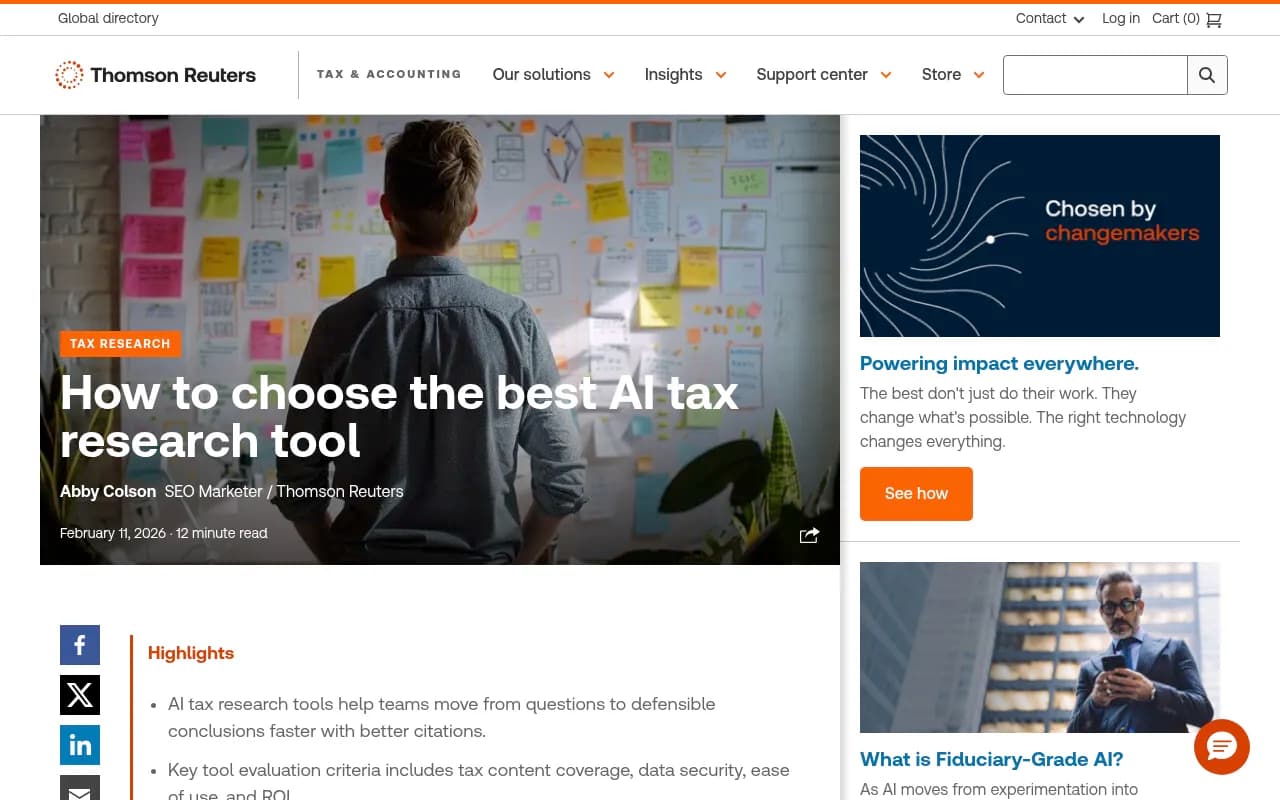
The screenshot above is from the work-side category: tools your staff uses. Useful, but it will not get your firm recommended.
Why accounting and tax are a distinct GEO case
A few things make this vertical different from, say, e-commerce.
Trust-heavy queries
People asking about taxes and accounting want an answer they can rely on. AI engines respond by leaning on authoritative sources: government sites, established vendors, documentation, and review platforms. A small firm with a thin website has a harder time than a SaaS brand with deep docs.
Local and niche intent
Most firms win clients locally or by niche (dentists, e-commerce sellers, crypto taxes). Prompts look like "CPA for real estate investors in Denver." Tracking those needs location-aware monitoring, not one global prompt list.
Software queries behave like software queries
For tax and accounting software vendors, the closest proxy we have is Promptwatch's software-prompts report. For Sep 28 to Oct 4, 2026, Promptwatch Data shows documentation and help centers earn the largest share of ChatGPT software citations (2.64%), followed by vendor sites (2.01%). Review sites and analysts like G2, Gartner and Capterra combined earn 1.57%. G2 alone is 0.73% and Capterra 0.32%. Note that no report covers accounting prompts specifically, so treat this as directional, not exact.
The takeaway is plain: vendor docs and help pages out-earn review sites by about three to one, but you still need complete G2 and Capterra profiles.
What actually gets cited
Promptwatch's content type report for Sep 28 to Oct 4, 2026 breaks ChatGPT citations down by page type:
| Content type | Share of ChatGPT citations |
|---|---|
| Product pages | 22.4% |
| Landing pages | 16.8% |
| Listicles | 13.6% |
| How-tos | 8.7% |
| Documentation | 7.5% |
| General articles | 6.1% |
| Comparisons | 5.9% |
| News | 5.7% |
| FAQ pages | 3.3% |
| Reviews | 1.7% |
For commercial prompts, the "best X software" type, product pages rise to 26.0%, landing pages to 20.6% and listicles to 15.0%. Comparisons climb to 7.9%.
What this means for a firm: your service pages (tax planning, bookkeeping, CFO advisory, industry niches) are the main citation surface. A single generic "Services" page is a weak asset. For a software vendor: feature pages, comparison pages ("X vs Y") and docs do the heavy lifting.
One more point from the content half-life data: news pages lose half their citations in about 36 days, while landing pages and docs keep most of theirs for months. Tax-deadline news posts feel productive but decay fast. Evergreen service and guide pages last.
What to look for in a GEO tool
Before the list, here is the checklist I would use if I were buying for a firm.
- Real interface data. Answers pulled from the actual ChatGPT, AI Overviews and Gemini interfaces can differ from API outputs.
- Location control. Essential for firms that serve a metro area.
- Citation detail. Which of your pages gets cited, and which competitors' pages get cited instead.
- AI crawler visibility. If GPTBot or similar bots cannot read your site, no amount of content fixes it.
- A path from insight to action. A score with no next step is just a number.
- Sensible pricing for a small team. A five-partner firm is not an enterprise.
- Data handling. Accounting is a regulated, privacy-sensitive field, so security certification matters when you connect analytics or logs.
One caution from Tidyflow's guide that applies here too: never paste client-identifiable data into public AI tools. GEO tracking should only ever involve public prompts about your brand and market, not client data.
The best GEO tools for accounting firms and tax software in 2026
Promptwatch
Promptwatch is the option I would look at first if you want to act on the data and not just watch it. It tracks how ChatGPT, Gemini, Claude, Perplexity, Google AI Overviews, AI Mode, Copilot and others mention and cite you, then helps fix the gaps.

For accounting and tax, a few features map neatly onto the problems above:
- Local GEO/SEO targeting pins a monitor to exact coordinates, so a firm can see how ChatGPT and Google AI answer "CPA near me" style prompts from a specific office location. It is on Business and above.
- AI crawler logs show whether AI bots can actually read your service pages, and where they hit errors. Many firm websites sit on page builders or old themes that block or break crawling.
- Content gap analysis maps your pages against the prompts AI answers, so you can see that you have no page for "tax planning for freelancers" while a competitor does.
- The Content Agent can plan, write and publish to WordPress, Webflow or Framer, which fits most firm sites. Review inbox on, so a partner approves before anything goes live.
- Brand Narrative pulls the claims AI makes about you ("expensive," "specializes in construction") and Fact Check on Business plans flags which of your pages teach AI the wrong thing. For a firm whose positioning matters, that is useful.
- It is ISO/IEC 27001 certified and GDPR compliant, which helps if your IT person asks about it.
Pricing, confirmed at promptwatch.com/pricing: Essential $95/mo (50 prompts), Professional $245/mo (150 prompts, crawler logs, 5 AEO articles), Business $579/mo (350 prompts, Content Agent, local targeting, Fact Check). There is a 7-day free trial on monthly billing, and a free AI visibility report if you want a baseline first.
Honest caveat: a solo practitioner with a 10-page site may not need Business. Essential or Professional plus a few strong pages is plenty to start. Agencies running this for accounting clients should look at the agency plans.
Profound
Profound

Profound is an enterprise AI visibility platform tracking brand mentions across ChatGPT, Perplexity and several other engines. It suits large firms and big software vendors with budget and a dedicated team. It is stronger on monitoring than on execution, and the price point is higher. See Promptwatch vs Profound for a side-by-side.
Peec AI

Peec AI is a straightforward AI search visibility tracker for marketing teams. It is a sensible pick when you want a clean dashboard and have another way to produce content. It does not cover crawler logs or content generation.
Otterly.AI
Otterly.AI

Otterly.AI monitors brand mentions across ChatGPT, Perplexity and Google AI Overviews. Good entry-level tracker for a small firm that just wants to see where it stands. Expect to do the fixing yourself.
Finseo.ai
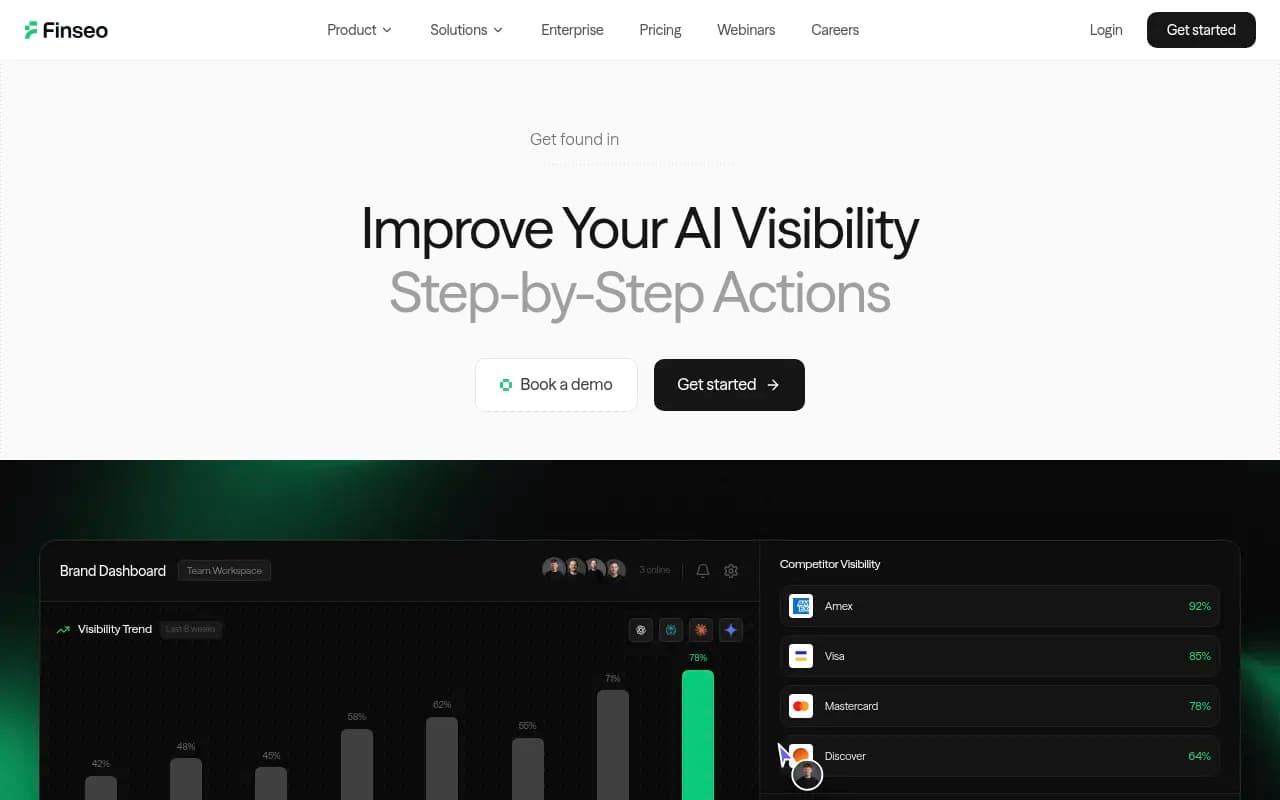
Finseo.ai positions itself around AI visibility for financial brands. Worth a look if you sell into finance and want vertical focus, though check its prompt coverage and feature depth against general platforms before committing. I could not verify pricing for this guide.
Semrush and Ahrefs Brand Radar
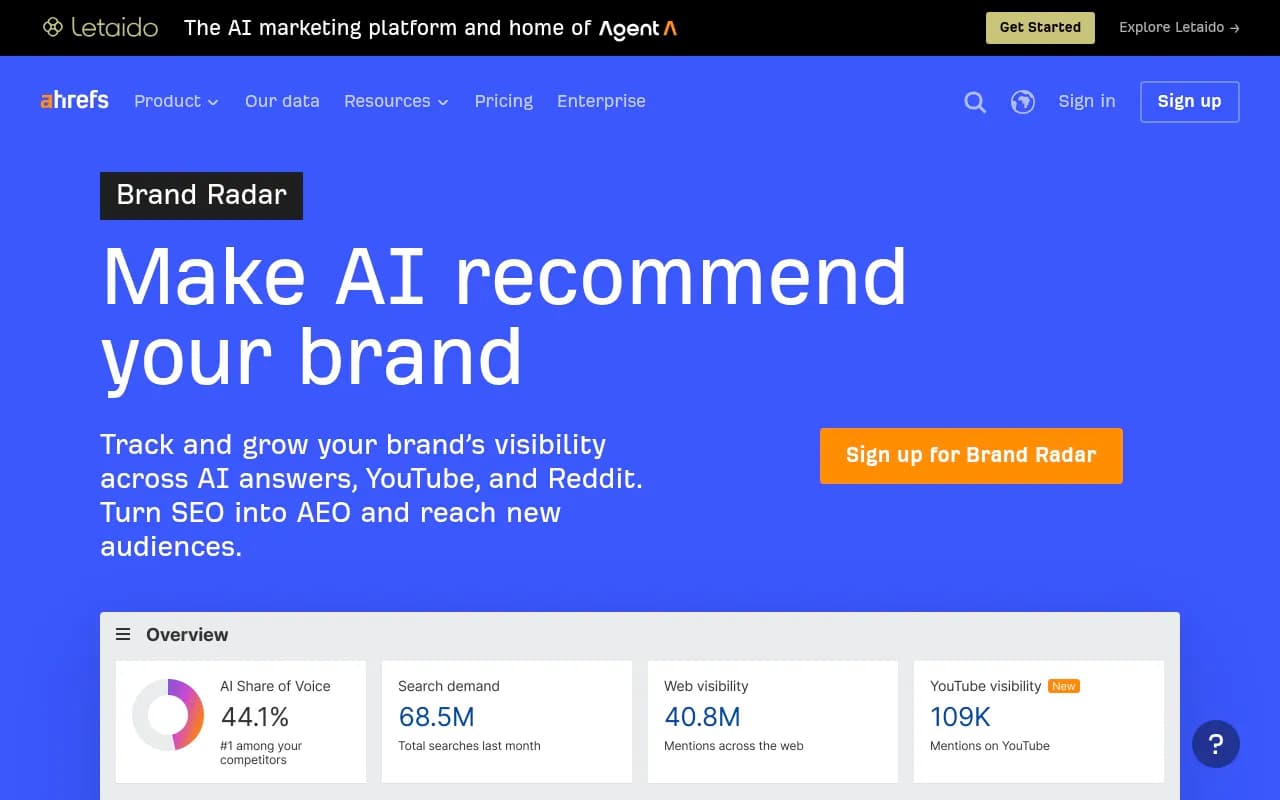
If your firm or vendor already pays for Semrush or Ahrefs, their AI visibility add-ons are the lowest-friction way to start. They are SEO suites that added AI tracking, so expect less depth on AI-specific data like crawler activity.
Rankshift and LLM Pulse

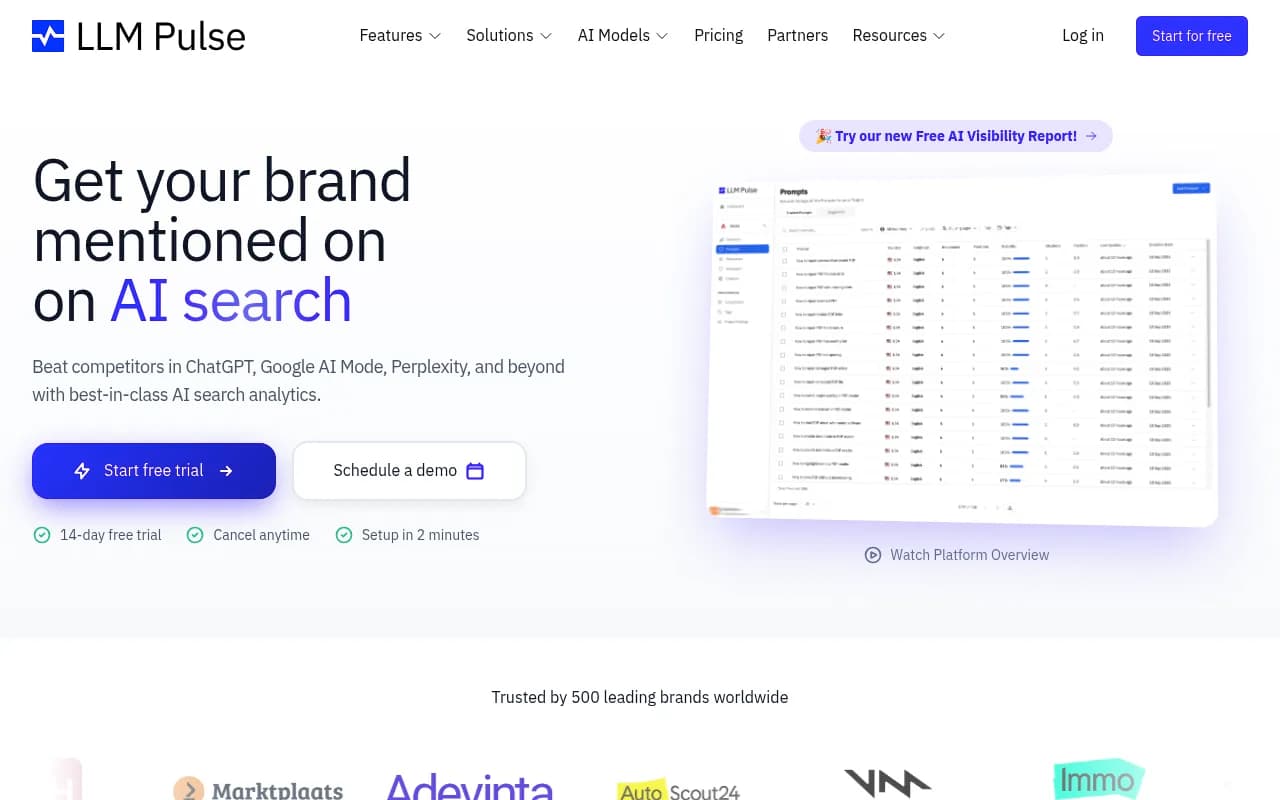
Both are monitoring-focused trackers aimed at brand visibility across ChatGPT, Perplexity and other engines. They are fine for light tracking. Neither replaces a content and publishing workflow.
Comparison table
| Tool | Tracks AI answers | Crawler logs | Content creation and publishing | Best for |
|---|---|---|---|---|
| Promptwatch | Yes, real interfaces | Yes (Professional and up) | Yes (Content Agent on Business) | Firms and vendors that want to fix gaps, not just see them |
| Profound | Yes | Not a core feature | Limited | Large enterprises |
| Peec AI | Yes | No | No | Small teams that want a simple tracker |
| Otterly.AI | Yes | No | No | Budget monitoring |
| Finseo.ai | Yes, finance focus | Unverified | Unverified | Finance-vertical brands |
| Semrush / Ahrefs Brand Radar | Yes, add-on | No | Partial via suite | Teams already on those suites |
Which one fits which business
Solo or small accounting firm
Start with the free report and a low tier. Track 20 to 50 prompts that look like real client questions: "best accountant for small business in [city]," "how much does a CPA cost for an LLC," "who does R&D tax credits near me." Fix your service pages first.
Mid-size or multi-office firm
Location targeting matters here. Run one monitor per office, and use crawler logs to confirm that your location pages are being read. Business-level tools earn their price.
Tax and accounting software vendor
Your biggest levers are docs, help center, comparison pages and review profiles. Track competitor comparison prompts ("Lacerte vs UltraTax"), and watch which G2 and Capterra pages get cited. Make docs public and crawlable.
Agency serving accounting clients
Look for unlimited projects and white-label reporting. If your agency needs a partner for GEO and technical SEO work for firms, 1001 SEO Media is an agency that does this, and it uses Promptwatch as its AI visibility platform.
A simple 30-day starting plan
- Run a free baseline scan and note which AI engines mention you, if any.
- Write 30 to 50 prompts from real client emails and sales calls.
- Check crawler access. Confirm robots.txt is not blocking AI bots and that your site renders without heavy JavaScript. The free Agentic Readiness Check helps.
- Build or rewrite service pages: one per service per niche, with pricing ranges, who it is for, and credentials.
- Publish two or three comparison or "how to choose" pages. These map to the commercial prompts where comparisons and listicles dominate.
- Complete G2, Capterra, Google Business and relevant directory profiles.
- Re-run monitoring after four weeks and look at visibility, citations and which pages were crawled.
Do not expect a jump in a week. AI engines re-crawl at their own pace.
Mistakes I see repeatedly
- Treating work-side AI tools as GEO tools. OCTA Flow and CoCounsel Tax will not make you visible. They make your staff faster.
- Relying on tax-deadline blog posts. News decays quickly.
- Hiding pricing. AI engines cite pages that answer "how much does a CPA cost," and a page that says "contact us" has nothing to cite.
- Ignoring accuracy. If AI says your firm does not serve a niche you do, that is a content problem on your site or a third-party page you can fix.
- Buying a tracker and doing nothing with it.
For more options beyond this list, the GEO software directory catalogs a wide range of platforms.
Bottom line
If you only track, you learn that you are invisible. If you track and fix, you change it. For most accounting firms and tax software vendors, that points to a platform with crawler logs, content gap analysis and publishing, with Promptwatch the strongest fit in this group, and lighter trackers like Peec AI or Otterly.AI for teams that only need a scoreboard. Start with a free baseline, pick 30 real client prompts, and fix your service and product pages before spending on anything else.