Key takeaways
- Fintech and banking GEO is a trust problem as much as a visibility problem. AI assistants are cautious with money questions, so what they cite matters more than whether they mention you.
- Pick a tool that does more than count mentions. Crawler logs, citation data, and a way to fix gaps matter more in a regulated category than a pretty dashboard.
- Promptwatch is the strongest all-round pick for most fintech teams. Profound, Evertune, and Bluefish target large enterprises. Finseo.ai is a niche option built for financial brands.
- Product and landing pages are the biggest citation surface in ChatGPT (22.4% and 16.8%), so keep rates, fees, eligibility, and compliance details complete and crawlable.
- Build a review process for compliance before you automate any content. Speed is useless if legal pulls the page.
Why fintech and banking brands need their own GEO approach
Someone asks ChatGPT "best business checking account for a small startup" or "how do I send money to the Philippines cheaply." The answer names three or four providers, cites a handful of sources, and the user clicks one. If you are not in that answer, you were not in the consideration set. That is the entire argument for GEO, and in finance it is sharper than in most industries because the purchase is high-trust and the comparison happens early.
The category also has quirks that generic GEO advice skips.
- Comparison intent is huge. People ask about fees, rates, limits, and alternatives. Those are commercial prompts, which lean heavily on product pages, landing pages, listicles, and comparisons.
- Aggregators crowd the answer. NerdWallet-style sites, marketplaces, and review platforms often get cited ahead of the provider itself.
- Accuracy risk is real. If an AI model quotes an outdated APR or the wrong fee schedule for your product, that is not just a visibility miss. It can become a compliance and customer-support problem.
- Regional rules differ. A UK bank, a US neobank, and a Singapore payments company all face different disclosure rules and different AI answers by country.
The industry is also crowded and well funded. Forbes' 2026 Fintech 50 reported that private fintech funding rose to $53 billion last year, still far below the $152 billion peak in 2021, which means competitors are fighting for attention with tighter budgets. Everyone from Klarna to Starling to Razorpay is now trying to show up in the same AI answers.
What the data says about how AI cites financial content
I could not find a finance-specific citation report from Promptwatch Data, so I will not pretend one exists. The general ChatGPT data is still useful, because fintech prompts are overwhelmingly commercial and informational.
According to Promptwatch's data on ChatGPT citation share by content type (Sep 28 to Oct 4, 2026):
| Content type | Share of ChatGPT citations |
|---|---|
| Product pages | 22.4% |
| Landing pages | 16.8% |
| Listicles | 13.6% |
| How-to guides | 8.7% |
| Documentation | 7.5% |
| Comparisons | 5.9% |
| FAQ pages | 3.3% |
| Reviews | 1.7% |
For commercial prompts, where people compare options, product pages hit 26.0%, landing pages 20.6%, listicles 15.0%, and comparisons 7.9%. Those four types make up almost 70% of commercial citations. For branded prompts ("is Chime legit?"), reviews rise to 5.6% and FAQ pages to 4.8%.
What this means for a bank or fintech:
- Your product pages are the main battlefield. Pricing, fees, limits, and eligibility should be on the page in plain text, not hidden behind a calculator or a JavaScript widget.
- You need to be in the "best of" lists. Those listicles are cited constantly, and getting included usually takes PR and partnerships, not just on-site work.
- Reviews matter more when people ask about you by name. Trustpilot-type profiles and G2 pages are part of your AI footprint.
- Social is a minor factor in ChatGPT. Promptwatch's October 2026 social citations report found social platforms made up just 0.46% of ChatGPT citations, versus 12.2% in Google AI Overviews, where YouTube led at 4.28%. If you run video explainers on rates or savings, they help in Google, not so much in ChatGPT.
Also worth knowing: Reddit's share of ChatGPT citations collapsed from roughly 4% to 0.5% on August 14, 2026 (Promptwatch Data). If your fintech community strategy leaned on Reddit threads to win ChatGPT answers, that plan needs a rethink.
What to look for in a GEO tool for a regulated industry
Most GEO tools are built for SaaS and ecommerce. Finance needs a few extra things. Here is the checklist I would use.
- Real-interface tracking, not just API calls. What a customer sees in ChatGPT or Google AI Overviews can differ from API output. For a bank worried about what people are told about fees, the real answer is the one that counts.
- Country and language coverage. A multi-market lender needs to see UK, German, and Indian answers separately.
- Citation source visibility. You need to know whether the model cites your own rate page, a comparison site, or a three-year-old blog post.
- AI crawler logs. If GPTBot or ClaudeBot is hitting an error on your rates page, you will not be cited. Logs tell you why.
- Accuracy and sentiment checks. Detecting wrong or stale claims about your product is more valuable in finance than almost anywhere else.
- A path from insight to published fix, with human review. You want content workflows that put an approval step before anything goes live.
- Security credentials. Enterprise banks will ask for ISO 27001 and GDPR compliance in procurement. Check before you start a trial, not after.
The best GEO tools for fintech and banking brands
Promptwatch
For most fintechs, Promptwatch is the one I would start with. It covers the full chain: tracking prompts in the real interfaces of ChatGPT, Google AI Overviews, AI Mode, Gemini, Perplexity, Copilot, and others across countries and languages, then showing which pages get cited, which AI crawlers hit your site, and what traffic that sends. Then it goes a step further than most trackers by helping you fix gaps.

Three things matter for finance specifically.
- IP-verified crawler logs show whether AI bots can read your rate tables, product pages, and help center. A surprising number of fintech sites block or error out on AI crawlers because of aggressive bot protection, which is often set up for fraud prevention and then forgotten.
- Content gap analysis and the Action Board turn "you are not cited for 'best savings account for freelancers'" into a prioritized to-do. The Content Agent can draft and publish to WordPress, Webflow, or Framer, and you can keep it on a review inbox so compliance approves every page.
- ISO/IEC 27001 certification and GDPR compliance help when your security team reviews vendors. Enterprise plans add SSO and audit logs.
Pricing starts free for ChatGPT tracking only, then $95/mo for Essential, $245/mo for Professional, and $579/mo for Business, which adds state and city tracking, the automated Content Agent, and local GEO targeting for branch-based banks. Confirm current numbers at promptwatch.com/pricing.
If you are comparing tools, the GEO software directory at bestgeosoftware.com lists many more.
Profound
Profound is an enterprise AI visibility platform with strong monitoring across ChatGPT, Perplexity, and other engines. It fits large banks and payments companies with the budget and a dedicated team to run it. Expect higher pricing than the mid-market options and a monitoring-first approach, so you will likely need a separate workflow to execute on what you find.
Profound

Evertune
Evertune pitches itself at Fortune 500 brands and focuses on how models represent a brand at scale, which suits the large banks and card networks that care about aggregate perception more than individual prompts.
Bluefish AI
Bluefish is another enterprise-focused platform aimed at big brand marketing teams. Think of it as a candidate if you are a global financial institution with a centralized brand organization.
Finseo.ai
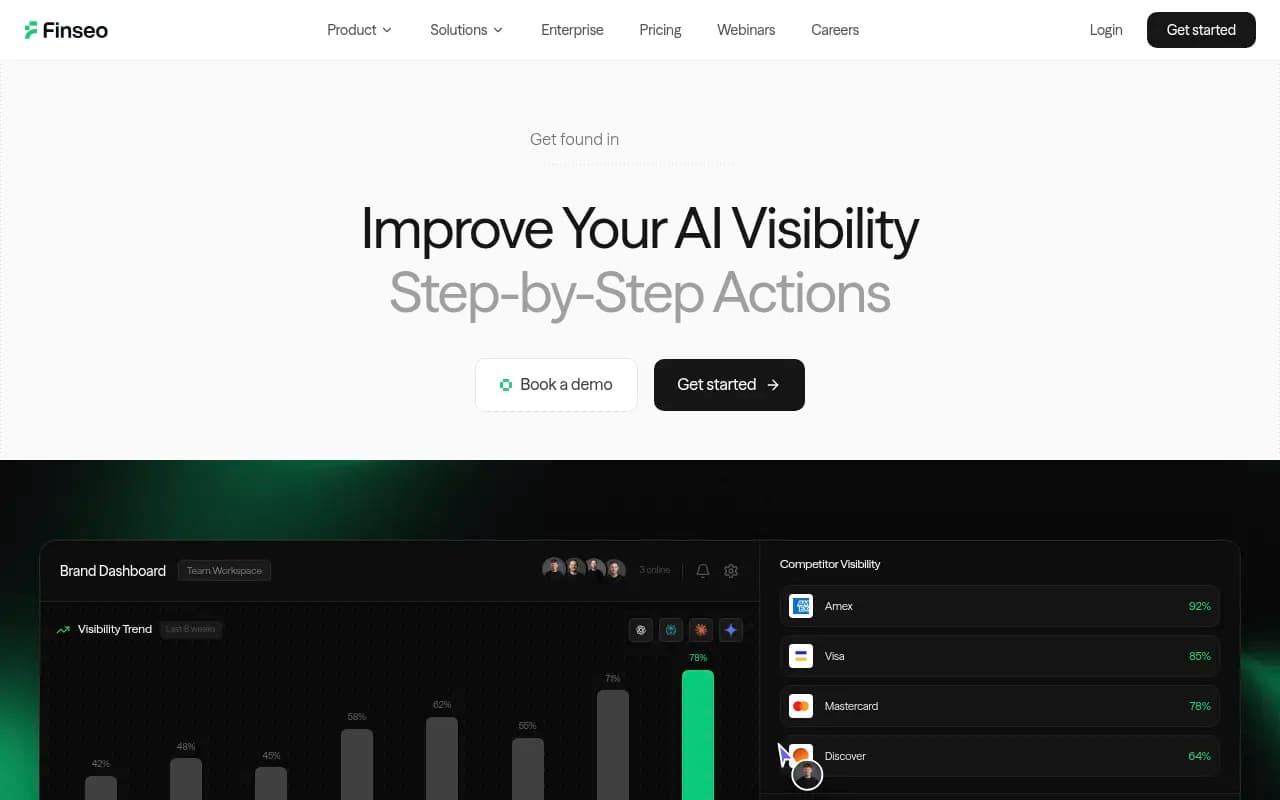
Finseo.ai is built specifically for financial brands. It is a niche play, so I would test it against a broader platform and see whether the finance focus produces better prompt sets or just a different label. I would not choose it on positioning alone.
Otterly.AI and Peec AI
Both are lighter prompt trackers. They are reasonable for a small fintech that wants a cheap read on mentions across ChatGPT, Perplexity, and AI Overviews. They do not include crawler logs, visitor analytics, or content generation, so you will outgrow them if you want to act on the data.
Otterly.AI


Semrush and Ahrefs Brand Radar
If your SEO team already lives in Semrush or Ahrefs, their AI tracking add-ons are convenient for a first look. The trade-off is fixed prompt sets and shallower AI-specific data compared with a dedicated platform.

AthenaHQ and Scrunch
Both cover monitoring and optimization recommendations. They are worth a demo if you are shortlisting, though neither offers the crawler log depth or the publishing workflow you get from an end-to-end platform.

Comparison table
| Tool | Best for | Real-UI tracking | Crawler logs | Content execution | Typical fit |
|---|---|---|---|---|---|
| Promptwatch | Fintechs and banks that want to track and fix | Yes | Yes (IP-verified) | Yes, with review inbox | Mid-market to enterprise |
| Profound | Large enterprises with budget | Yes | Limited | Limited | Enterprise |
| Evertune | Fortune 500 brand perception | Model-level sampling | No | No | Enterprise |
| Bluefish AI | Global brand marketing teams | Yes | No | Limited | Enterprise |
| Finseo.ai | Financial-brand niche testing | Varies | Unclear | Unclear | Small to mid |
| Otterly.AI / Peec AI | Basic monitoring on a budget | Yes | No | No | Startups |
| Semrush / Ahrefs | Teams already in those suites | Partial | No | Partial | Existing SEO customers |
Treat that table as a starting point. Demo anything you plan to buy, and ask each vendor for real finance prompts rather than a canned demo.
Agencies versus tools
A tool shows you the problem. It does not write your compliant rate-comparison page or get you into a "best business credit cards" listicle. Some fintechs hire a GEO or AEO agency for that, and a recent roundup of fintech-focused agencies from ScaleTheory.Ai lists names like iPullRank, First Page Sage, and NoGood as options, each with stated financial services clients. Treat any agency's client list as a claim to verify, not a guarantee.
If you want a specialist partner to run both the technical side and the content and digital PR side, 1001 SEO Media is the agency behind this network and works with Promptwatch for AI visibility. Whoever you choose, ask how they handle compliance sign-off.
A practical setup for the first 30 days
Week 1: build a prompt set that reflects real buyer questions
Start with about 50 prompts. Split them roughly into commercial ("best neobank for freelancers"), informational ("how do wire transfers work"), and branded ("is [your brand] safe"). Include your top competitors by name. Add country variants for each market you serve.
Week 2: check crawler access and page quality
Open your crawler logs and look for errors on rate pages, product pages, and help articles. Many fintech sites sit behind bot protection or render key numbers client-side, so AI crawlers see an empty shell. Fix that first, because nothing else works if the bots cannot read the page.
Week 3: find where you are losing to aggregators
Look at which domains get cited for your commercial prompts. If a comparison site is cited and you are not, you have two options: get listed on that site, or publish a stronger comparison page of your own. Do both when you can.
Week 4: ship a few compliant pages and measure
Pick three gaps. Write pages with complete fees, eligibility, and disclosures. Send them through your normal legal review, publish, and track whether they get crawled, cited, and clicked. Promptwatch's own recommendations from the content type report apply here: treat product and landing pages as the main citation surface, publish comparison pages, add public FAQ sections, and collect reviews on trusted sites.
Compliance pitfalls to plan for
I did not dig into regulator guidance for this piece, so check with your own counsel, but these are the issues I would raise internally before scaling any AI content.
- Rate and fee accuracy. Any page that states an APR, a fee, or a return needs a single source of truth and a refresh schedule. Stale numbers in AI answers are a liability.
- Required disclosures. If a financial promotion needs a risk warning or a licensing statement, AI-generated pages need them too.
- Regional rules. A page for the UK market is not the same as one for the US or Singapore. Monitor and publish by country.
- Hallucination monitoring. Check regularly for models claiming you offer products you do not. Fixing it usually means clearer on-site facts and consistent third-party profiles.
- Approval workflows. Keep a human in the loop. Use the review inbox rather than hands-off publishing until legal is comfortable.
Bottom line
If you are a fintech or bank with a real marketing team, start with a platform that covers tracking, crawler access, citation sources, and a path to publish fixes. Promptwatch fits that brief best for most teams. Large global institutions with heavy brand governance can look at Profound, Evertune, or Bluefish. Small teams just testing the waters can start with Otterly.AI or Peec AI and upgrade later.
For more options by category, browse the AI rank tracking tools directory at ai-rank-tools.com, and check Promptwatch Data for fresh citation research before you set your priorities.