Key takeaways
- AI search engines like ChatGPT, Perplexity, and Google AI Overviews are now a primary discovery channel for buyers — your product launch strategy needs to account for this.
- Establish a pre-launch AI visibility baseline at least 4-6 weeks before launch so you have something meaningful to compare against.
- The best GEO tools in 2026 go beyond monitoring: they help you find content gaps, generate optimized content, and track which pages AI models actually cite.
- Expect 40-60% monthly variance in AI citations — a single snapshot is never enough. You need ongoing tracking, not a one-time audit.
- Tools like Promptwatch close the loop between visibility data and content action, which is what separates optimization platforms from monitoring dashboards.
Why product launches now have an AI visibility problem
When someone asks ChatGPT "what's the best project management tool for remote teams" or "which CRM should I use for a small SaaS company," they're not browsing a list of results. They're getting a direct answer — and if your product isn't in that answer, you don't exist for that buyer.
This is the core challenge of launching a product in 2026. Traditional launch metrics (press coverage, backlinks, traffic spikes) still matter, but they don't tell you whether AI models are picking up your brand and recommending it in relevant conversations. A product can have great PR coverage and still be invisible in AI search.
Generative Engine Optimization (GEO) tools exist to close this gap. They track how and when AI engines mention your brand, which competitors they recommend instead, and what content you'd need to create to change that. For a product launch, this means two distinct phases: the pre-launch baseline and the post-launch measurement window.
Phase 1: Pre-launch — establish your baseline
You can't measure improvement without a starting point. Most teams skip this step and then wonder why their post-launch AI visibility data is hard to interpret.
What to measure before launch
Before your product goes live, you want to understand:
- Category-level visibility: When someone asks about your product category, who does the AI recommend? Are you mentioned at all, even in passing?
- Competitor citation share: Which competitors are being cited most often, and for which types of prompts?
- Prompt coverage: What questions are buyers asking AI engines that relate to your product? Which of those questions does your current content answer?
- Sentiment and positioning: When AI models do mention your brand (or your category), what language do they use? Is your positioning accurate?
This baseline work should start 4-6 weeks before launch. That gives you time to identify gaps and create content that might get crawled and indexed before launch day.
Tools for pre-launch baseline tracking
Promptwatch is the most complete option here. Its Answer Gap Analysis shows exactly which prompts competitors are being cited for that you're not — so you can see the specific content your site is missing before you launch. The prompt volume and difficulty scoring helps you prioritize which gaps are worth closing in the pre-launch window.

Profound is another strong choice for enterprise teams. It tracks visibility across ChatGPT, Claude, Perplexity, and other models with solid prompt intelligence features.
Profound

Otterly.AI works well for teams that want a quick, low-friction way to start monitoring brand mentions across ChatGPT, Perplexity, and Google AI Overviews before launch.
Otterly.AI

Peec AI is a solid mid-market option for marketing teams that want clean dashboards and multi-model tracking without enterprise pricing.

Phase 2: Launch day and the immediate window
The 72 hours around a launch are chaotic. You're managing press, social, support, and internal stakeholders simultaneously. GEO tracking tends to get deprioritized — which is exactly when it matters most.
A few things happen during a launch that affect AI visibility:
- New pages go live (product pages, landing pages, announcement posts)
- Press coverage creates new external citations
- Backlink profiles shift
- AI crawlers may or may not pick up your new content quickly
The gap between "your content is live" and "AI models are citing it" can be days or weeks. Understanding this lag is one of the most useful things GEO tools can show you.
Tracking AI crawler activity
Promptwatch's AI Crawler Logs show you in real time which AI crawlers (GPTBot, ClaudeBot, PerplexityBot, etc.) are hitting your pages, which pages they're reading, and when a page moves from "crawled" to "cited." This is genuinely useful during a launch because it tells you whether your new product pages are even being discovered — not just whether they're ranking.
Most monitoring-only tools don't have this. If you're launching a product and want to know why ChatGPT isn't mentioning your new feature page yet, crawler logs are the fastest way to diagnose the problem.
Scrunch AI and AthenaHQ also offer monitoring capabilities, though neither has the same depth of crawler-level data.


Phase 3: Post-launch — measuring the impact
This is where most teams focus, but the data is only meaningful if you did the pre-launch baseline work. Post-launch GEO measurement breaks into a few categories:
Citation share tracking
How often is your product being mentioned in AI responses compared to competitors? This is the core metric. You want to see it trending upward in the weeks after launch, particularly for high-intent prompts like "best [category] tool" or "[category] alternatives."
Promptwatch tracks this with competitor heatmaps that show your citation share vs. competitors across different AI models. You can see whether ChatGPT is picking you up faster than Perplexity, or whether Google AI Overviews is lagging behind.
LLMrefs is a lighter-weight option for teams that primarily want to track citation frequency across multiple models without the full GEO platform overhead.
LLMrefs
Rankshift focuses specifically on ChatGPT and Perplexity tracking, which covers the two highest-traffic AI search surfaces for most B2B products.

Prompt-level tracking
Not all prompts are equal. A mention in response to "what is [category]" is less valuable than a mention in response to "what's the best [category] tool for [specific use case]." Post-launch, you want to know which specific prompts your product is winning and which it's losing.
Promptwatch's Prompt Intelligence feature assigns volume estimates and difficulty scores to each prompt, so you can prioritize which wins to build on and which losses to address with new content.
AthenaHQ also does prompt-level tracking, though its strength is monitoring rather than helping you act on what you find.
Content gap analysis and fixing what's broken
Here's where most monitoring-only tools fall short. They'll show you that you're not being cited for a particular prompt. They won't tell you why, or what to do about it.
Promptwatch's Answer Gap Analysis maps your current content against AI responses and shows you the specific topics, angles, and questions that AI models want answers to but can't find on your site. The Content Agents then generate articles, listicles, and comparisons grounded in that real prompt data — not generic SEO filler.
This matters a lot post-launch. If your product page is live but AI models are still recommending a competitor for a key use case, the fix is usually a specific piece of content that addresses that use case directly. Knowing exactly what to write (and having a tool that can help you write it) is the difference between a GEO platform and a GEO dashboard.
AirOps is worth mentioning here as a content engineering option for teams that want to build custom workflows around content creation for AI search.
Search Atlas combines AI-powered SEO automation with content publishing, which can be useful for teams that want to move quickly post-launch.
Comparison: GEO tools for product launch tracking
| Tool | Pre-launch baseline | Crawler logs | Content gap analysis | Content generation | Post-launch tracking | Best for |
|---|---|---|---|---|---|---|
| Promptwatch | Yes | Yes | Yes | Yes (Content Agents) | Yes | Full-cycle GEO |
| Profound | Yes | No | Limited | No | Yes | Enterprise monitoring |
| Otterly.AI | Basic | No | No | No | Basic | Quick monitoring setup |
| Peec AI | Basic | No | No | No | Basic | Mid-market teams |
| AthenaHQ | Yes | No | Limited | No | Yes | Monitoring-focused teams |
| Scrunch AI | Basic | No | No | No | Basic | Brand mention tracking |
| LLMrefs | No | No | No | No | Yes | Citation frequency only |
| Rankshift | Basic | No | No | No | Yes | ChatGPT/Perplexity focus |
| AirOps | No | No | Yes | Yes | No | Content engineering |
Offsite visibility: the part most teams miss
Your product pages and blog posts are only part of the AI visibility picture. AI models cite Reddit threads, YouTube videos, review sites, and third-party listicles heavily. After a launch, you want to know whether:
- Your product is appearing in "best of" lists that AI models cite
- Reddit discussions about your category mention your product
- Review platforms like G2 or Capterra are showing up in AI responses for your category
Promptwatch tracks offsite citations — which external pages, Reddit posts, and third-party domains are driving AI visibility for your brand. This is a channel most teams ignore entirely, and it's often where the fastest wins are post-launch.
Getting your product listed in the right places (relevant Reddit communities, industry comparison posts, YouTube reviews) can move AI citation share faster than publishing new content on your own site.
Practical launch checklist for GEO tracking
Here's a condensed version of what this looks like in practice:
6 weeks before launch
- Set up your GEO tracking tool and define 20-50 prompts relevant to your product category
- Run a competitor citation analysis to see who's winning and for which prompts
- Identify content gaps and prioritize the highest-volume, most winnable ones
- Publish content targeting those gaps so it has time to get crawled before launch
2 weeks before launch
- Verify AI crawlers can access your new product pages (check robots.txt, JavaScript rendering)
- Set up crawler log monitoring so you'll know when GPTBot and PerplexityBot start hitting your new pages
- Snapshot your baseline citation share across all tracked prompts
Launch week
- Monitor crawler logs daily to confirm new pages are being discovered
- Watch for any immediate citation changes, especially if you're getting press coverage
- Track competitor responses — do they publish new content in response to your launch?
4-8 weeks post-launch
- Compare citation share against your pre-launch baseline
- Identify which prompts you've won and which are still going to competitors
- Use content gap analysis to prioritize the next round of content
- Track offsite citations to see which external mentions are driving AI visibility
A note on AI visibility variance
One thing that catches teams off guard: AI citation data is noisy. Expect significant week-to-week variance even when nothing has changed on your end. Models retrain, context windows shift, and the same prompt can return different results on different days.
This is why single-point snapshots are misleading. You need at least 4-6 weeks of post-launch data before drawing conclusions about whether your launch improved AI visibility. Tools that aggregate data over time and show trends are more useful than those that only show current-state snapshots.
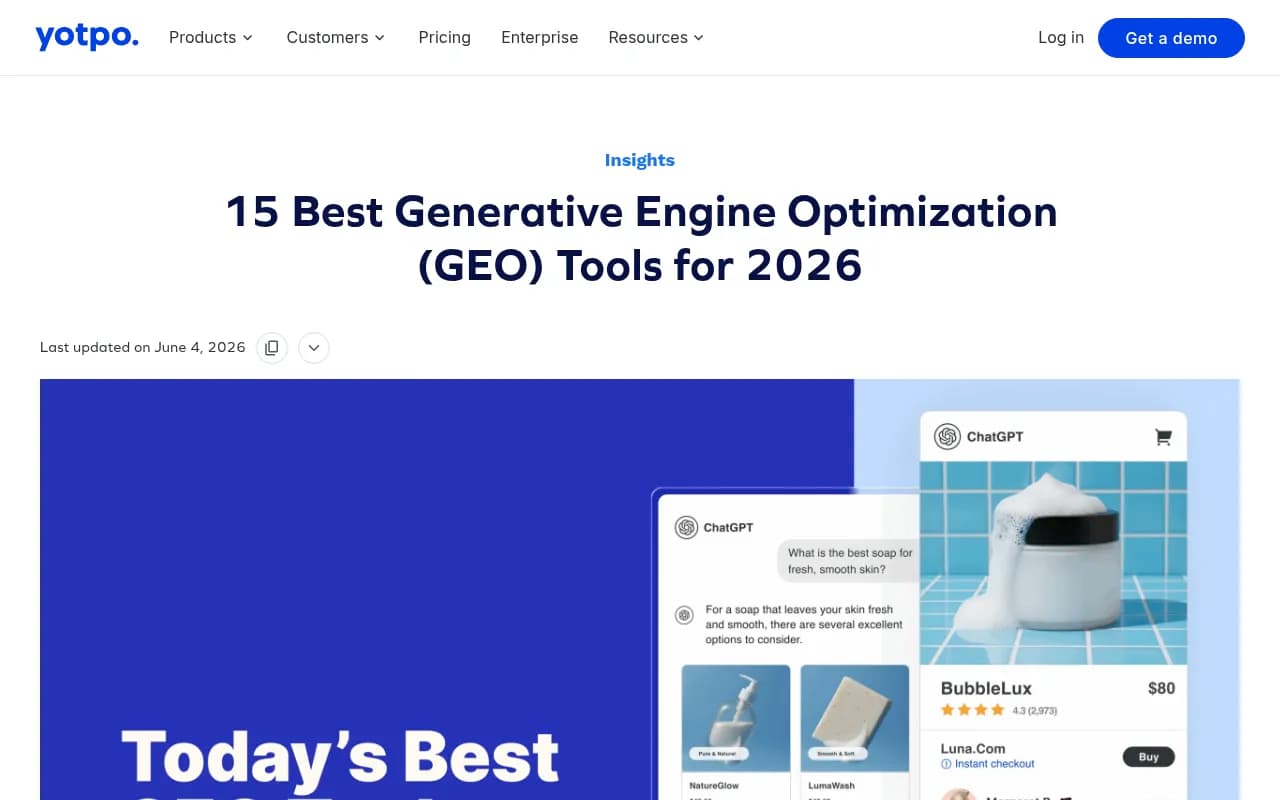
The research from Yotpo's 2026 GEO tools analysis puts monthly citation variance at 40-60% — which is high enough that a one-week dip after launch doesn't necessarily mean anything is wrong.
Choosing the right tool for your situation
If you're a startup launching your first product and want a single tool that covers the full cycle, Promptwatch is the most complete option. It handles pre-launch gap analysis, crawler monitoring, post-launch citation tracking, and content generation in one platform. The Professional plan at $249/month covers 2 sites and 150 prompts, which is enough for most product launches.
If you're at an enterprise with an existing SEO stack and primarily want monitoring depth, Profound or Scrunch AI are worth evaluating alongside Promptwatch.
If you're on a tight budget and just want basic monitoring to see whether your launch is moving the needle in AI search, Otterly.AI or Peec AI will get you started — just know you'll need to do the content gap analysis and optimization work manually.
The honest reality is that most GEO tools will tell you what's happening. Fewer will help you change it. For a product launch, where you have a specific window to build AI visibility momentum, the tools that close the loop between data and action are worth the investment.