Key takeaways
- 73% of B2B buyers use AI search engines before making software decisions in 2026, making comparison query visibility a direct pipeline issue for SaaS companies
- Most GEO tools only monitor -- they show you where you're invisible but don't help you fix it. The best tools close that loop with content generation and optimization
- Comparison queries ("best CRM for startups", "HubSpot vs Salesforce") are the highest-intent prompts in SaaS -- and the hardest to win without deliberate optimization
- Promptwatch is the only platform rated a "Leader" across all GEO categories in 2026, combining tracking, gap analysis, and AI content generation in one workflow
- For teams that just need monitoring, Otterly.AI, Peec AI, and Profound are solid options -- each with different strengths and price points
Why comparison queries are the most valuable AI prompts in SaaS
When someone types "best project management software for remote teams" into ChatGPT or asks Perplexity "is HubSpot or Salesforce better for a 50-person company," they're not browsing. They're buying. These are the prompts where AI search engines function as the decision layer -- and if your product isn't cited, you don't exist in that moment.
This is a different problem from traditional SEO. Ranking on page one for "project management software" still gets you a click. But when ChatGPT answers the same question with a curated list of three tools and yours isn't one of them, there's no page two. The answer is the destination.
The shift is happening fast. SparkToro's analysis of Similarweb clickstream data from January to April 2026 found that roughly 68% of Google searches ended without a click -- and that's before accounting for the users who skipped Google entirely and went straight to ChatGPT or Perplexity. OpenAI reported approximately 900 million weekly active users in February 2026. For SaaS companies selling to B2B buyers, this isn't a future trend. It's the current reality.
Comparison queries specifically matter because:
- They signal high purchase intent -- someone comparing tools has already decided to buy something
- AI engines treat them differently from informational queries, often citing specific product pages, review sites, and comparison articles
- Winning a comparison query means being recommended alongside (or instead of) your direct competitors
- The same prompt asked across ChatGPT, Perplexity, Claude, and Gemini can produce wildly different results -- you need visibility across all of them
This guide covers the tools built to track, analyze, and improve your visibility in exactly these queries.
What makes a GEO tool good for SaaS comparison tracking
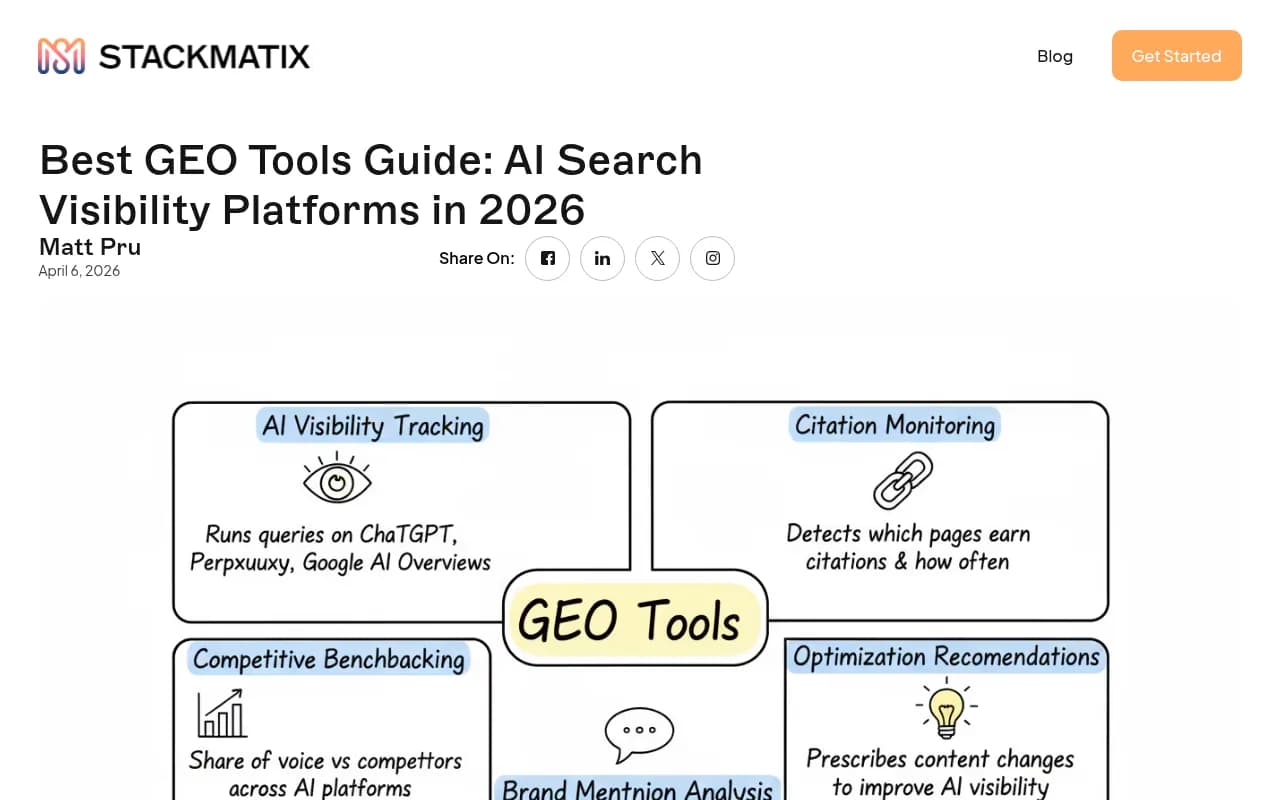
Not all AI visibility tools are built the same. The category has exploded in 2026, and most tools do one thing: run your target prompts through AI engines and report back whether your brand appeared. That's useful, but it's the floor, not the ceiling.
For SaaS comparison queries specifically, you want a tool that can:
Track the right prompts. Generic brand monitoring ("does ChatGPT mention [brand]?") misses the point. You need to track comparison-style prompts: "best [category] tools," "[your product] vs [competitor]," "alternatives to [competitor]," and "what [category] software should I use for [use case]." The best tools let you build these prompt sets and track them at scale.
Show competitor visibility. If you're not in a comparison response but your competitor is, you need to know that. Competitor heatmaps and share-of-voice data tell you who's winning and by how much.
Explain why. Citation analysis -- which pages, Reddit threads, review sites, and third-party content AI engines are pulling from -- tells you where the gap actually lives. Is it your own site? A G2 listing? A Reddit thread you don't control?
Help you fix it. This is where most tools fall short. Monitoring tells you there's a gap. Content gap analysis and content generation tools help you close it.
Track across multiple AI engines. ChatGPT, Perplexity, Claude, Gemini, Google AI Overviews, and Grok don't always agree. A tool that only checks one engine gives you an incomplete picture.
The best GEO tools for SaaS comparison query tracking in 2026
Promptwatch -- best overall for SaaS teams that want to act, not just monitor
Promptwatch is the most complete platform in this category. Where most competitors stop at reporting, Promptwatch runs a full loop: find the gaps, generate content to fill them, track the results.

For SaaS comparison queries, the Answer Gap Analysis is the standout feature. It shows you exactly which prompts your competitors are visible for that you're not -- including comparison queries like "best [category] for [use case]" where you're missing from the AI response entirely. You see the specific content your site is missing, not just a score.
The Content Agents then generate articles, listicles, and comparison pieces grounded in real prompt data, citation analysis, and competitor research. This isn't generic AI content -- it's built around the exact gaps the AI models are already exposing.
Promptwatch also tracks AI crawler activity in real time (which pages ChatGPT, Claude, and Perplexity are crawling, how often, and whether they're resulting in citations), monitors Reddit and YouTube for discussions that influence AI recommendations, and tracks ChatGPT Shopping appearances for SaaS products that appear in product recommendation carousels.
It covers 10 AI engines: ChatGPT, Perplexity, Claude, Gemini, Google AI Overviews, Google AI Mode, Grok, DeepSeek, Copilot, and Meta AI.
Pricing starts at $99/month (Essential: 1 site, 50 prompts, 5 articles). The Professional plan at $249/month adds crawler logs, 150 prompts, and 15 articles per month. Business is $579/month for 5 sites and 350 prompts.
Profound -- best for enterprise SaaS with compliance requirements
Profound is the strongest dedicated monitoring platform in the category. It tracks 10+ AI engines with deep data, strong reporting, and the kind of audit trail that enterprise legal and compliance teams want to see.
Profound

Where Profound excels is in the depth of its tracking data and the quality of its brand mention analysis. For large SaaS companies running formal AI visibility programs, it's a serious tool. The tradeoff is price (it sits at the higher end of the market) and the fact that it's primarily a monitoring platform -- there's no built-in content generation to act on what you find.
Otterly.AI -- best for teams that want simple, affordable monitoring
Otterly.AI is a clean, accessible monitoring tool that tracks brand mentions across ChatGPT, Perplexity, and Google AI Overviews. It's easy to set up and gives you a clear view of where your brand appears in AI responses.
Otterly.AI

For SaaS teams just getting started with AI visibility tracking, Otterly.AI is a reasonable entry point. It won't help you fix what it finds -- there's no content generation, no crawler logs, no gap analysis -- but for basic monitoring of comparison queries, it works.
Peec AI -- best for marketing teams that want clean dashboards
Peec AI focuses on share-of-voice tracking across AI engines. It's well-designed, gives you a clear view of how your brand compares to competitors in AI responses, and is priced accessibly for mid-market SaaS teams.

Like Otterly.AI, Peec AI is a monitoring tool. It tells you where you stand but doesn't help you improve. For teams that already have a content operation and just need the data layer, it's a solid choice.
AthenaHQ -- best for teams that want structured prompt libraries
AthenaHQ takes a more structured approach to prompt tracking, with a focus on building comprehensive prompt libraries that cover your full competitive landscape. It's particularly useful for SaaS teams that want to map out every comparison query in their category and track visibility systematically.

The platform is monitoring-focused -- no content generation -- but the prompt management features are strong. If you're the kind of team that wants to track 200+ prompts across five competitors, AthenaHQ handles that well.
Scrunch AI -- best for teams that want AI-specific SEO insights
Scrunch AI combines AI visibility tracking with content optimization recommendations. It's not as deep as Promptwatch on the content generation side, but it gives you more actionable direction than pure monitoring tools.

For SaaS teams that want to understand not just where they're missing but what kind of content tends to get cited in their category, Scrunch AI is worth evaluating.
Semrush -- best for teams already standardized on Semrush
If your team lives in Semrush for traditional SEO, the AI Toolkit adds a layer of AI search monitoring without requiring a separate platform. It's not as deep as dedicated GEO tools -- the prompts are more fixed, there's no AI traffic attribution, and Reddit tracking is absent -- but for teams that want a single platform, it's a reasonable option.
The honest caveat: Semrush's AI features are an add-on to a traditional SEO platform, not a purpose-built GEO tool. For serious comparison query tracking, you'll hit its limits quickly.
SE Ranking -- best for agencies managing multiple SaaS clients
SE Ranking has added solid AI visibility features to its existing rank tracking and site audit platform. For agencies that manage multiple SaaS clients and want to track AI visibility alongside traditional SEO metrics in one place, it's a practical choice.
Frase -- best for teams that want to monitor and create content in one tool
Frase pairs AI visibility tracking with content research and writing tools. It's not as deep on the monitoring side as Profound or Promptwatch, but for smaller SaaS teams that want to track comparison queries and then immediately start writing content to address gaps, the integrated workflow is appealing.
Feature comparison: GEO tools for SaaS comparison queries
| Tool | Comparison query tracking | Competitor visibility | Content generation | Crawler logs | Reddit/YouTube tracking | Pricing (starting) |
|---|---|---|---|---|---|---|
| Promptwatch | Yes, with gap analysis | Heatmaps + share of voice | Yes (Content Agents) | Yes | Yes | $99/mo |
| Profound | Yes | Yes | No | No | No | Higher-end |
| Otterly.AI | Basic | Limited | No | No | No | Lower-end |
| Peec AI | Yes | Share of voice | No | No | No | Mid-range |
| AthenaHQ | Strong prompt library | Yes | No | No | No | Mid-range |
| Scrunch AI | Yes | Yes | Limited | No | No | Mid-range |
| Semrush | Fixed prompts | Limited | No | No | No | Add-on to Semrush |
| SE Ranking | Yes | Yes | No | No | No | Mid-range |
| Frase | Yes | Limited | Yes | No | No | Lower-mid |
How SaaS comparison queries actually work in AI engines
Understanding how AI engines handle comparison queries helps you optimize for them more effectively.
When someone asks ChatGPT "what's the best CRM for a 50-person B2B sales team," the model doesn't just retrieve a list. It synthesizes information from its training data, recent web browsing (where available), and cited sources. The factors that influence whether your product appears include:
Citation frequency. If your product is mentioned in a high volume of relevant pages -- review sites, comparison articles, Reddit discussions, YouTube videos -- the model is more likely to include it. GEO research suggests citation frequency accounts for roughly 35% of AI answer inclusions.
Content specificity. Generic product pages rarely get cited in comparison responses. Pages that directly address specific use cases ("best CRM for remote sales teams"), comparison angles ("HubSpot vs Salesforce for SMBs"), and specific buyer questions tend to perform better.
Third-party validation. AI engines heavily weight G2 reviews, Capterra listings, Reddit threads, and independent comparison articles. Your own site matters, but so does your presence across the broader web.
Recency. Models with web access (Perplexity, ChatGPT with browsing) weight recent content. A comparison article published six months ago may outperform an older page on your own site.
Structured data. Schema markup and structured data increase citation rates -- one analysis puts the improvement at around 45% for pages with proper markup versus those without.
The implication: winning comparison queries requires a multi-front strategy. Your own site needs pages that directly address comparison queries. Your G2 and Capterra profiles need to be current and detailed. Reddit threads in your category need to include accurate information about your product. And you need to track all of this systematically.
Building a comparison query tracking program
Here's a practical approach to setting up AI visibility tracking for SaaS comparison queries.
Step 1: Map your comparison query universe
Start by listing every comparison query relevant to your product:
- Category queries: "best [your category] software," "top [category] tools for [use case]"
- Direct comparisons: "[your product] vs [competitor A]," "[your product] vs [competitor B]"
- Competitor alternatives: "alternatives to [competitor]," "[competitor] alternatives"
- Use-case specific: "best [category] for [industry]," "best [category] for [company size]"
For a mid-sized SaaS product, this list typically runs 50-200 prompts. Tools like Promptwatch can help you generate this list systematically using prompt fan-out analysis, which shows how a single query branches into related sub-queries.
Step 2: Establish your baseline
Run your prompt set across the AI engines you care about most. For B2B SaaS, ChatGPT, Perplexity, and Google AI Overviews are usually the priority. Track:
- Which prompts you appear in
- Where you appear (first mention, third mention, not mentioned)
- Which competitors appear in prompts where you don't
- Which sources the AI engines are citing
Step 3: Identify your highest-value gaps
Not all gaps are equal. Prioritize prompts based on:
- Estimated query volume (how many people are asking this)
- Purchase intent (comparison queries > informational queries)
- Competitive difficulty (prompts where you're close to appearing vs. ones where competitors dominate)
- Your ability to create content that addresses the gap
Step 4: Create content to close the gaps
This is where most teams stall. Identifying gaps is the easy part. Creating content that actually gets cited by AI engines requires understanding what those engines are already pulling from -- which pages, which formats, which angles.
Tools like Promptwatch's Content Agents generate content grounded in this data. If you're doing it manually, study the pages that AI engines are currently citing for your target prompts and reverse-engineer what makes them citation-worthy.
Step 5: Track the results
After publishing, monitor whether AI engines start crawling and citing your new content. The timeline from publish to crawl to citation varies by engine -- Perplexity tends to pick up new content faster than ChatGPT's training-based knowledge. Crawler log data tells you when AI bots are visiting your pages and whether those visits are converting to citations.
What to watch out for when evaluating GEO tools
A few things that aren't always obvious when comparing platforms:
API outputs vs. real user interfaces. Some tools query AI engines through their APIs, which can produce different results than what real users see in the actual ChatGPT or Perplexity interface. If a tool is showing you API outputs, the data may not reflect real-world visibility. Tools that test in actual user-facing interfaces give you more accurate data.
Fixed vs. custom prompts. Some tools (including Semrush's AI features and Ahrefs Brand Radar) use fixed prompt sets. This is fine for general benchmarking but limits your ability to track the specific comparison queries that matter for your product. Look for tools that let you define your own prompt library.
Monitoring vs. optimization. Most tools in this category are monitoring dashboards. They show you data. The tools that also help you act on the data -- through content gap analysis, content generation, or specific optimization recommendations -- are more valuable for teams that want to move the needle, not just measure it.
Coverage across AI engines. Check which engines a tool actually tracks. Some only cover ChatGPT and Perplexity. For SaaS buyers, Google AI Overviews and Claude are also significant traffic sources.
The bottom line
AI search has become the first stop for B2B SaaS buyers evaluating tools. Comparison queries -- "best CRM for startups," "HubSpot vs Salesforce," "alternatives to Asana" -- are where purchase decisions get made, and they're happening in ChatGPT and Perplexity before buyers ever visit your website.
The tools in this guide give you visibility into where you stand. The difference between them comes down to what you can do with that visibility. If you want to track and fix, Promptwatch is the most complete option. If you want enterprise-grade monitoring, Profound is strong. If you're just getting started and want something simple, Otterly.AI or Peec AI will get you moving.
Whatever you choose, start tracking now. The brands building AI visibility today are the ones that will dominate comparison queries six months from now -- and the gap between those who are optimizing and those who aren't is widening fast.