Key takeaways
- Microsoft Copilot cites content differently than ChatGPT or Perplexity: it pulls from Bing's index, rewrites your question into a "grounding query," and assembles answers from chunks of several pages at once rather than ranking whole pages.
- Bing Webmaster Tools' AI Performance report is free and is the only first-party source of Copilot citation data, but it only covers Copilot, not ChatGPT, Perplexity, or AI Overviews.
- Many GEO platforms advertise Copilot coverage, but it's frequently gated behind an add-on or enterprise tier. Confirm the exact plan before you buy, not just the marketing page.
- Copilot's citation behavior is unusually volatile. Promptwatch's data shows its average sources per response swinging from under 2 to nearly 17 within weeks, so judge performance on monthly trends, not single snapshots.
- Otterly.ai, Rankshift, and Scrunch AI include Copilot at their entry price. Profound and some others push it to higher tiers, which matters a lot if Copilot is your priority surface.
Why Copilot gets ignored, and why that's a mistake
Every GEO roundup opens with ChatGPT. Fair enough, it has the user base. But Copilot sits inside Bing, Edge, Windows, and Microsoft 365, which means it's showing up in front of enterprise buyers who are mid-research, mid-procurement, inside tools they already trust at work. If your brand doesn't show up there, a competitor's does, and the buyer never sees you in the comparison they're building in their head.
Part of the reason Copilot gets skipped is that it's genuinely confusing to track. "Copilot" isn't one product. There's Copilot in Bing and Edge (the only place public GEO really applies), Microsoft 365 Copilot (which cites internal tenant data, not the open web), and Copilot Studio (a builder for custom copilots grounded on sources a company chooses, not something you can influence as an outside brand). Most of this guide is about the first one: the public, Bing-powered Copilot that can actually cite your website.
How it builds an answer, per Microsoft's own documentation, goes roughly like this: your question gets rewritten into a structured retrieval query, Bing fetches candidate pages, a GPT model summarizes them with numbered citations, and you see the answer plus citation cards. The retrieval rewrite matters a lot. Copilot isn't searching your literal prompt, it's searching a reformulated version of it, which is why conflating "grounding queries" with actual user prompts is, according to one GEO analyst, the single most common error in reading Copilot performance data.
Selection also happens at the chunk level, not the page level. Copilot parses pages into pieces, scores those pieces for relevance and authority, and assembles an answer from several sources simultaneously. You're not competing to be the best overall page anymore. You're competing to own one extractable chunk, sitting next to three or four other domains that own the rest.
What makes Copilot's citation behavior different
According to Promptwatch's Average Sources Per Response data, ChatGPT cites roughly 5 sources per web-search answer and Google AI Overviews cites about 10, holding fairly steady over time. Perplexity is the most consistent of the four, landing close to 10 sources per answer day after day. Copilot is the outlier: its average has swung from under 2 sources per response to nearly 17 within a few weeks, before settling back toward the low end. That's not a brand doing something right or wrong, that's Microsoft actively re-architecting how Copilot retrieves and attributes sources.
The practical implication: judge Copilot performance on monthly trends, not weekly snapshots. A dip this week might just be Microsoft's retrieval pipeline shifting underneath everyone at once.

There's also a scarcity angle. When Copilot's citation count sits at the low end, it offers fewer citation slots than any other engine tracked, scarcer even than ChatGPT. Fewer slots means each one is worth more, and it means being edged out by a competitor hurts more too.
Bing Webmaster Tools: the free first-party starting point
Before spending money on a third-party tracker, set up Bing Webmaster Tools. Its AI Performance report, which launched in public preview in February 2026, was the first time a major AI provider gave publishers direct data on how their content gets used in AI answers.
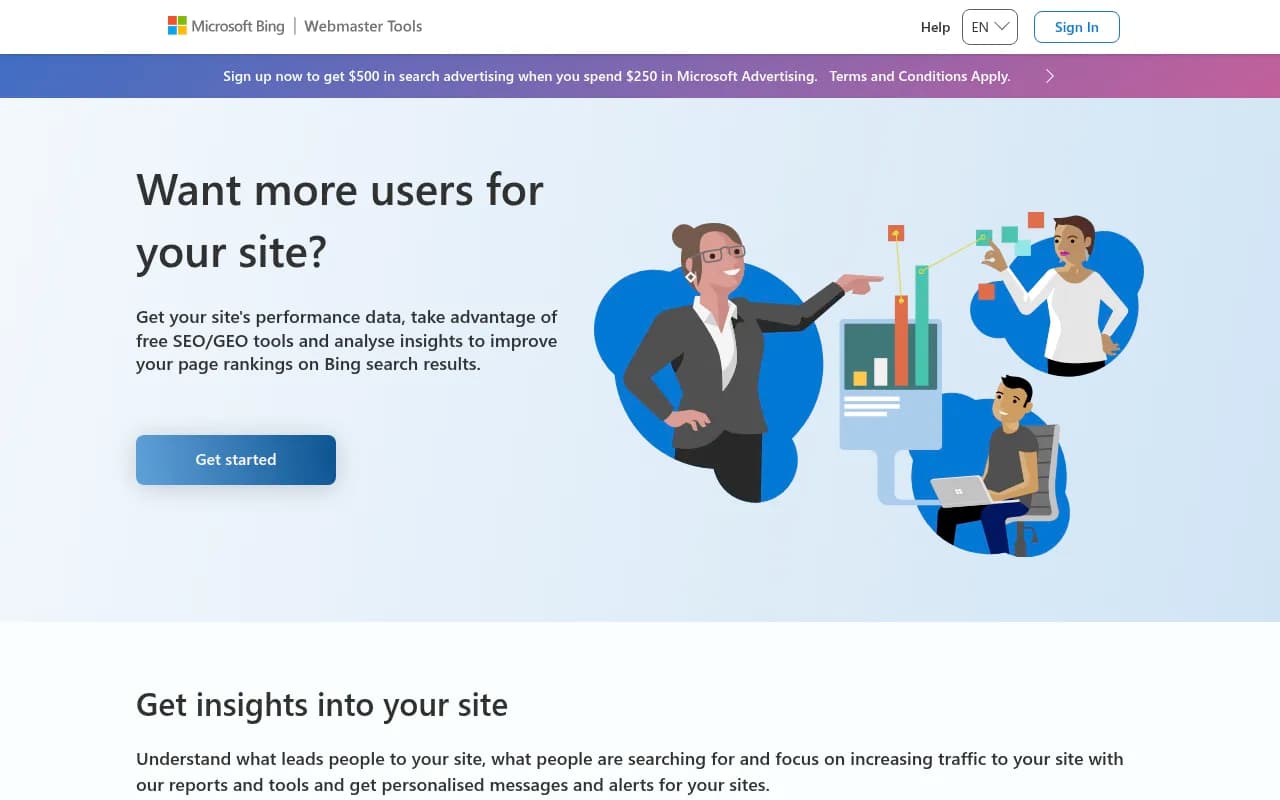
The original release shipped four metrics: Total Citations, Average Cited Pages, Grounding Queries, and Page-Level Citation Activity. A June 2026 update added four more, all still free: Citation Share (your percentage of citations for a given grounding query), Intents (classifying queries into categories like Informational, Commercial, or Research), Topics (AI-clustered themes across your grounding queries), and Compare (period-over-period comparisons).
Scope matters here. This report covers Copilot, AI summaries in Bing, and select partner experiences. It does not cover ChatGPT, Perplexity, or Google AI Overviews, so it's a Copilot-only lens, not a GEO dashboard.
One real example from Otterly.ai's own domain, covering three months of data, found 647 unique grounding queries triggered Copilot to use its content, producing over 30,000 grounding events across 173 pages. Branded queries made up roughly 30% of volume but delivered nearly double the citation density of non-branded queries. Five pages carried almost 75% of all citations, with the homepage alone accounting for a third. That's a steep power-law curve: a handful of pages do almost all the work, and blog posts in a Q&A or how-to format outperformed everything else.
What Bing Webmaster Tools still can't tell you: it won't show competitor citations, won't track ChatGPT or Perplexity, won't reveal the original user prompt (only the reformulated grounding query), and Microsoft is explicit that Citation Share is observational, not a competitive scoreboard. For that, you need a third-party platform.
Comparing GEO tools that actually track Copilot
The catch with most "we support Copilot" claims is the asterisk. Several platforms with broad AI coverage put Copilot behind a paid add-on or an enterprise tier, so the advertised starting price isn't the real price if Copilot is what you need.
| Tool | Copilot on entry plan | Starting price | Notes |
|---|---|---|---|
| Otterly.ai | Yes | $29/mo | Cheapest credible option, 15 prompts, daily runs |
| Rankshift | Yes | ~$69/mo | Positions itself as monitoring plus a path to fixes |
| Scrunch AI | Yes | $250/mo | 4 base engines incl. Copilot, plus AI crawler/bot-traffic analytics |
| Peec AI | Yes (pick 3 engines) | ~€70/mo (annual) | Copilot selectable among 3 chosen models |
| LLM Pulse | Yes, but paid add-on | ~€49/mo base | Copilot tracking costs extra on top of the base tier |
| Profound | No on entry tier | $99/mo | Copilot gated to Enterprise, reportedly $2,000-$5,000+/mo |
| Ahrefs Brand Radar | Yes | Custom | Tracks via 405M+ search-backed prompts plus custom recurring prompts |
| Cognizo | Yes | $499/mo | Treats Copilot citations as a "supply chain" to prioritize by frequency and ease of placement |
Otterly.AI



Profound

Cognizo
A few notes worth pulling out of that table:
Otterly.ai is the honest cheap option. At $29/month with 15 daily prompts, it won't give you deep analytics, but it gets Copilot into your monitoring stack without a sales call.
Scrunch AI's pricing mechanic is worth understanding before you buy: each AI engine tracked counts as a separate prompt credit, so tracking one query across 4 engines (including Copilot) burns 4 credits, not 1. The headline prompt volume looks bigger than what you'll actually get in practice. Its standout feature is AI crawler analytics, tracking named bots like GPTBot and PerplexityBot hitting specific pages, a useful complement to Bing's citation-only view since it shows crawl behavior across providers, not just Microsoft's.
Profound is a cautionary tale for anyone specifically chasing Copilot. Its trial and Starter tier focus almost entirely on ChatGPT, and Copilot doesn't show up until Enterprise, which can run into the thousands per month. If Copilot is your priority, this is the wrong place to start, even though Profound is strong elsewhere.
Cognizo takes an interesting angle: it treats Copilot citations as a "citation supply chain" problem, prioritizing third-party domains by how often they're cited for your category's grounding queries and how easy it is to get accurate info placed there, rather than by raw domain authority. A high-frequency, easy-to-place directory listing might matter more than a hard-to-reach, high-authority outlet.
Common mistakes to avoid
A few patterns show up across nearly every source researching this topic:
Treating Bing SERP position as a Copilot citation proxy is the most common one. They're different mechanisms. Copilot's retrieval pipeline can skip a page ranking well on Bing in favor of a lower-ranked page that happens to contain a better-structured chunk for the query.
Confusing grounding queries with actual user prompts is close behind. Bing rewrites the question before retrieval, so the phrase you see in a report isn't what the user typed.
Reacting to short-term swings in citation volume is a waste of energy given how volatile Copilot's platform-level behavior is right now. A week-over-week drop is more likely Microsoft adjusting its retrieval system than anything your content did.
Blocking GPTBot, Bingbot, or CCBot in robots.txt by accident removes your site from Copilot's retrieval pipeline entirely. Double-check your robots.txt allows these before troubleshooting anything else.
Finally, over-indexing on your own pages while ignoring third-party placements is a missed opportunity. Most citations in a typical Copilot answer belong to domains you don't own, so earned coverage can move your visibility faster than tweaking your own site alone.
A practical starting stack
For most teams, a reasonable approach looks like this: set up Bing Webmaster Tools' AI Performance report first, it's free and gives you first-party ground truth on what Copilot is actually citing from your site. Layer a third-party tracker on top to get competitor visibility and cross-engine comparison, since Bing's tool won't show you what's happening on ChatGPT or Perplexity. If budget is tight, Otterly.ai gets Copilot into the mix cheaply. If you want crawler-level detail across engines, Scrunch AI is worth the higher price. And if you're already deep in an AI visibility platform like Promptwatch that tracks Copilot alongside ChatGPT, Gemini, Claude, Perplexity, and Google's AI surfaces from one dashboard, the goal isn't just to see where you're cited, it's to get content shipped that fixes the gaps.
If you want to browse the broader category before deciding, the GEO software directory at bestgeosoftware.com lists platforms by feature set and pricing side by side, which is a faster way to shortlist than reading eight separate vendor blogs.
The bottom line
Copilot isn't going to behave like a stable, predictable search engine any time soon. Microsoft is still reworking how it retrieves and cites sources, which means the data you get today may look different in a month. That's not a reason to ignore it. It's a reason to start tracking it now, with Bing Webmaster Tools as your free baseline and a third-party platform layered on for competitive context, so you're building a trend line instead of reacting to noise.