Key takeaways
- Prospective students now ask ChatGPT, Gemini and Perplexity which schools to apply to. EAB reports that the share of college-bound students using AI in college search rose from 26% in spring 2025 to 46% in late 2025 (quoted in the 5W PR Online Universities AI Visibility Index).
- ChatGPT leans on product and landing pages. For a university, that means program pages, admissions pages and FAQs are your main citation surface.
- Reddit-seeding no longer helps in ChatGPT, but YouTube, Facebook and Instagram still matter for Google AI Overviews.
- A tracker alone is not enough. Look for crawler logs, content gap analysis and a way to ship fixes.
- Pricing and features change fast. Confirm every figure on the vendor's own pricing page before you buy.
Why universities need GEO tools at all
Google used to be the front door. Now a 17-year-old (or a working nurse researching an MSN) asks an assistant "best online computer science degree for working adults" and gets a shortlist of five schools. If yours is not on it, you never see the impression, so you never see the lost applicant either. Your analytics will not tell you.
The 5W PR index of 25 online universities shows how lopsided this gets. Its estimates put WGU at roughly 14% AI citation share, and WGU, SNHU and ASU Online together at about 35%. Seven established names, including DeVry, Strayer and Colorado Technical, each sit under 0.5%. Those are an agency's estimates, so treat them as directional. But the shape is believable: a few schools soak up most of the answers, and big brand names do not guarantee a spot.
A Search Influence survey of graduate prospects found 78% would use ChatGPT and 56% Gemini (I could not verify the sample size or date, so take it as a signal, not a benchmark). The practical takeaway is that you should track more than one assistant.
What the citation data says about higher ed pages
This is where I would start before shopping for any tool. Promptwatch Data looked at ChatGPT citations from Sep 28 to Oct 4, 2026:
| Content type | Share of ChatGPT citations |
|---|---|
| Product pages | 22.4% |
| Landing pages | 16.8% |
| Listicles | 13.6% |
| How-tos | 8.7% |
| Documentation | 7.5% |
| General articles | 6.1% |
| Comparisons | 5.9% |
| News | 5.7% |
| FAQ pages | 3.3% |
| Reviews | 1.7% |
The report does not mention universities. Mapping it to higher ed is my inference: program pages behave like product pages, admissions and "why us" pages behave like landing pages, and rankings roundups are the listicles. If that holds, your degree-program pages are doing most of the work, so thin or duplicated program pages are a bigger problem than a quiet blog.
For commercial prompts ("best MBA programs for career changers"), product pages hit 26.0% and landing pages 20.6%. For informational prompts, how-tos climb to 10.7%, which is an argument for real application guides rather than generic admissions blurbs.
One more caution on freshness. The content half-life report found news loses half its citations in about five weeks, while landing pages and docs keep most of theirs for months. Campus news is not where your durable visibility comes from.
Social platforms are not equal
In the October 2026 social citation report, all seven tracked social platforms together made up only 0.46% of ChatGPT citations. Google AI Overviews got 12.2% of its citations from social platforms, roughly 26 times ChatGPT's share. In AI Overviews that was YouTube 4.28%, Facebook 2.38%, Reddit 2.15% and Instagram 1.61%. Perplexity sat at 2.7%.
So if your campus-tour videos live on YouTube and your program pages are well structured, you are covering AI Overviews. Reddit threads about your school mostly matter for reputation now, since ChatGPT's Reddit citations collapsed on August 14, 2026.
What to look for in a GEO tool for a university
Higher ed has quirks that generic SaaS buyers do not worry about. Here is the checklist I would hand a marketing director.
- Program-level prompt tracking. You are not one brand. You are 80 programs, each competing with different schools. The tool should group prompts by topic (nursing, data science, executive MBA) and compare you with a different competitor set per topic.
- Persona and location control. An international master's applicant and a local community-college transfer ask different questions. Look for persona prompts and country, state or city tracking.
- Real interface data. Answers from the actual ChatGPT or AI Overviews interface can differ from API outputs.
- Crawler visibility. Many university sites run heavy JavaScript, portals, and aggressive bot rules. If GPTBot or PerplexityBot gets blocked or errors out, no amount of content helps. You want logs that show it.
- Citation sources. Which third-party sites feed the answers? In online education, programmatic sites like Nurse.org and ComputerScience.org and accreditor pages (AACSB, ABET, CCNE) show up in the 5W index. You need to see who is being cited instead of you.
- Accuracy checks. AI can state wrong tuition, wrong accreditation or the wrong application deadline. A tool that surfaces the claims AI makes about you is more useful than a score.
- Security and procurement fit. Universities have vendor reviews. ISO 27001 and GDPR compliance help, and I would ask any vendor about data handling. I did not verify FERPA specifics for any tool, so ask directly. Prompt tracking itself should not need student records at all.
- Enrollment attribution. Can you tie AI-referred visits to inquiries or applications? Even partial attribution beats guessing.
The best GEO tools for higher education in 2026
I have not tested every one of these inside a university account, and I did not verify competitor pricing for this guide. The notes below reflect each tool's positioning. Check current plans on each vendor site.
Promptwatch
Promptwatch is the one I would shortlist first for a university with a real content team, because it goes past monitoring. It tracks ChatGPT, Gemini, Perplexity, Google AI Overviews, AI Mode, Copilot, Claude and others from their real interfaces, then traces which of your pages get cited and which third-party pages win instead.

For higher ed specifically, a few features map well:
- Topics and personas let you split prompts by program and by applicant type, with a persona radar showing where one audience sees you less than another.
- Brand Narrative pulls out the individual claims AI makes about you ("strong nursing outcomes", "expensive for out-of-state students"). Fact Check on the Business plan lets you mark a claim wrong and find the page teaching it.
- IP-verified AI crawler logs show whether bots can read your program pages and where they hit errors.
- Content gap analysis maps your pages against prompts AI answers, and the Content Agent can draft and publish to WordPress, Webflow or Framer. Many universities run on Webflow or WordPress for marketing sites, so that fits, though a heavily customized CMS will need more work.
- Weekly site audits catch orphaned pages and missing sitemap entries, common on sprawling .edu sites.
- Visitor analytics measure AI-referred traffic and conversions. Note that ChatGPT stopped sending a referrer on October 8, 2026, so UTM tagging matters.
Pricing, as listed: Essential $95/mo, Professional $245/mo, Business $579/mo. Business is the first plan with the Content Agent, state and city tracking and Fact Check. Confirm on promptwatch.com/pricing. You can start with the 7-day free trial or the free AI visibility report, which scans how ChatGPT, Gemini and Perplexity talk about your institution. Agencies handling several institutions should look at the agency plans.
See also the head-to-head pages, such as Promptwatch vs Profound.
Profound
An enterprise-oriented visibility platform that tracks brand mentions across ChatGPT, Perplexity and several other engines. It has strong monitoring, and it tends to suit large organisations with budget. Based on Promptwatch's comparison, it lacks Reddit tracking, ChatGPT Shopping and agentic execution. Worth a demo if you are a large research university with an enterprise procurement team.
Profound

Scrunch AI
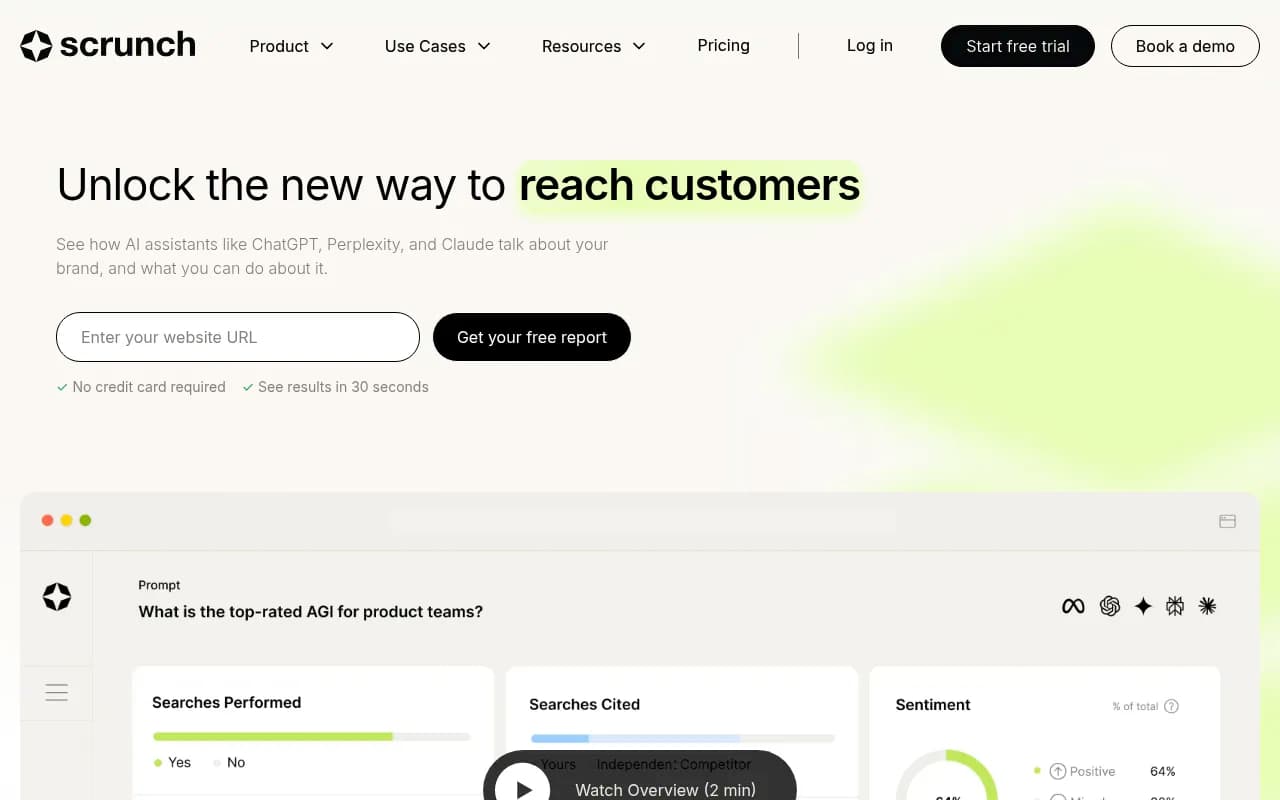
Another monitoring-first platform with a solid feature set and a higher price point than basic trackers. Reasonable for central marketing teams that want reporting and already have separate content production.
Otterly.AI
A lightweight way to start. It monitors mentions across ChatGPT, Perplexity and AI Overviews. It does not give you crawler logs or content generation, so it fits a small admissions office that just wants to see what is happening before committing.
Otterly.AI

Peec AI
Simple AI visibility tracking aimed at marketing teams. Another good "first dashboard" pick, with the same caveat: tracking without the fix.

Semrush and Ahrefs Brand Radar
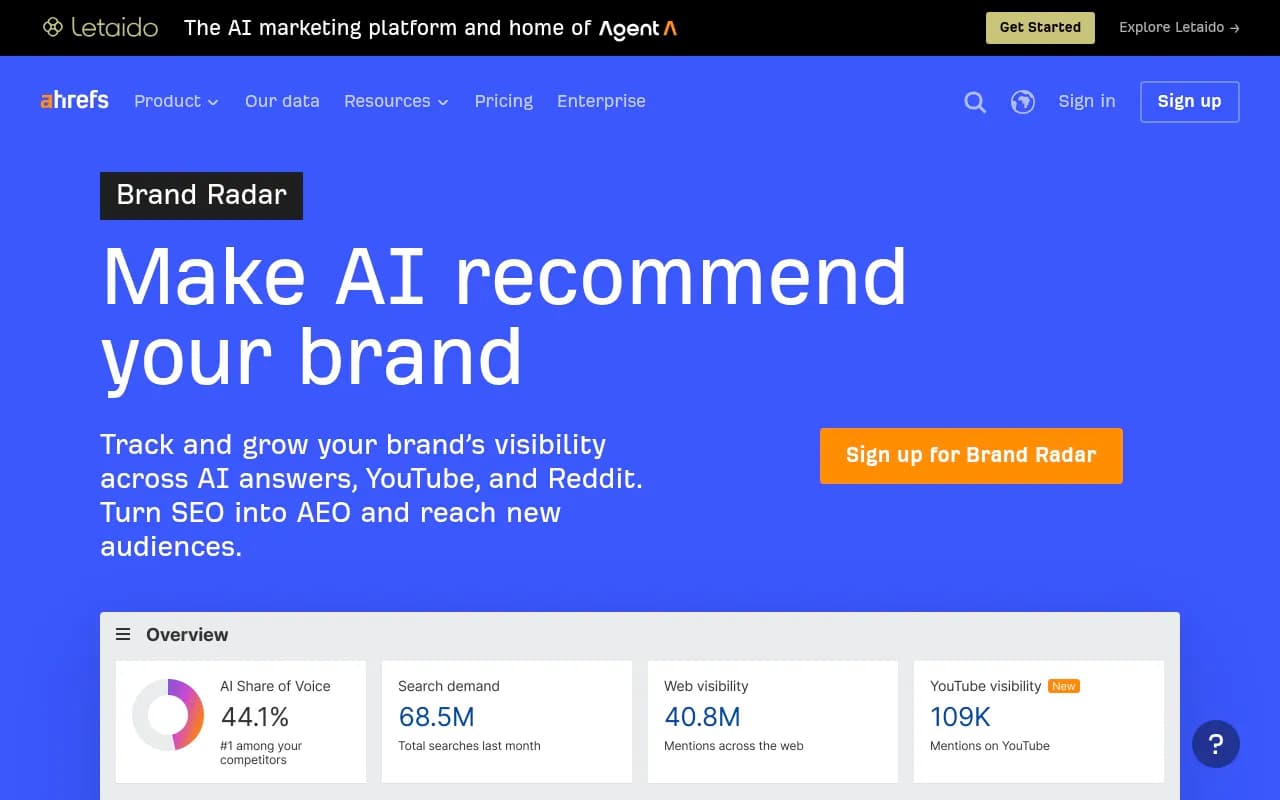
If your SEO team already lives in Semrush or Ahrefs, their AI modules are convenient. They are SEO suites adding AI tracking, so expect fixed prompt sets and less AI-specific depth, such as no crawler logs.
Evertune and Bluefish
Both are positioned at Fortune 500 style enterprise buyers. Probably more than most colleges need, but they are in the conversation for very large systems.
Comparison table
| Tool | Type | Crawler logs | Content creation | Best for |
|---|---|---|---|---|
| Promptwatch | End-to-end visibility and optimization | Yes, IP-verified | Content Agent with CMS publishing (Business and up) | Universities that want to find and fix gaps |
| Profound | Enterprise monitoring | Check with vendor | Limited | Large institutions with enterprise budgets |
| Scrunch AI | Monitoring | Check with vendor | Limited | Central marketing reporting |
| Otterly.AI | Basic tracker | No | No | Small teams testing the waters |
| Peec AI | Basic tracker | No | No | Quick dashboards |
| Semrush / Ahrefs Brand Radar | SEO suite add-on | No | Suite tools | Teams already in those suites |
The crawler and content columns reflect Promptwatch's own 2026 comparison and vendor positioning. Verify before purchase.
What about agencies?
Several agencies now sell higher-ed GEO, including Carnegie, EAB, Elliance and Web Tonic. Web Tonic's list of 13 agencies ranks Web Tonic first, so read any "top agencies" listicle for what it is. If you need outside help, ask for named university clients, a clear reporting process and which tool they use to measure results. 1001 SEO Media is one option for teams that want a senior-specialist SEO and GEO partner without long-term contracts; they use Promptwatch for AI visibility measurement.
A practical 30-day plan
Week 1: baseline
Run a free visibility check, then build 30 to 50 prompts covering your top three programs. Include branded ("is [University] good for nursing"), comparison ("[University] vs [Competitor] MBA") and category prompts ("best online MBA for working professionals"). Tag them by program.
Week 2: access and accuracy
Check robots.txt and CDN rules for AI crawlers. The free AI Crawler URL Inspector and Agentic Readiness Check are quick starts. Then read what AI says about tuition, deadlines and accreditation and list the errors.
Week 3: fix the cited surfaces
Rewrite the program pages that should be winning. Put the facts AI needs (length, cost, format, outcomes, accreditation) in plain crawlable text, add FAQs, and publish real how-to application guides. Look at which third-party sites AI cites for your category and consider whether you can earn presence there, for example accreditor or association directories.
Week 4: measure and repeat
Compare visibility, citation share and AI-referred inquiries. Pages that did not move go back on the list. Google Search Console data next to AI data helps spot pages that rank but never get cited.
Mistakes I would avoid
- Judging success by one assistant. Google AI Overviews, ChatGPT and Perplexity cite very different sources.
- Chasing Reddit and social mentions for ChatGPT. The data says it barely cites them now.
- Buying a tracker and assuming the dashboard is the strategy.
- Treating the whole institution as one brand. Program-level gaps are where enrollment is won.
- Trusting self-ranked agency lists without asking for proof.
If you want to compare more options, the GEO software directory at bestgeosoftware.com lists many of them. Start with the free visibility scan, look at what AI actually says about your top program, and let that gap decide which tier you need.