Key takeaways
- Searchable is a well-funded AI visibility platform, but its credit-based pricing, thin entry tier, and monitoring-first design create real friction for mid-market teams that need to move fast
- Most alternatives fall into two camps: pure monitoring tools (cheaper, simpler, but still leave you doing all the work) and full-cycle platforms that track visibility AND help you fix gaps
- For teams that want to close the loop from "we're invisible here" to "we published content and our citations went up," the shortlist is much shorter than most comparison articles suggest
- Pricing varies wildly -- from $50/month for basic tracking to $579+/month for platforms with content generation, crawler logs, and multi-model coverage
- The right choice depends on whether you need monitoring, execution, or both
Searchable launched with a lot of noise. A £40M seed round, a founding team with real pedigree, nearly 1,000 customers including American Express and KPMG, and six figures in ARR within 24 hours of its invite-only launch. That's genuinely impressive.
But impressive fundraising and impressive product are two different things. When mid-market marketing teams sit down to actually evaluate Searchable against their workflow, a few friction points keep coming up:
The starter plan gives you 1 domain and 50 prompts for $50/month -- the most restrictive entry tier in this category. The pricing model is credit-based, which means cost-per-prompt varies significantly depending on your tier and usage patterns. There's no white-label reporting, which matters if you're an agency. And while content briefs exist inside the platform, there's no in-platform publishing, content automation, or campaign workflow to turn those briefs into actual published content.
None of this makes Searchable a bad product. It makes it a product that doesn't fit every team. If you're a growth operator who wants a platform that doesn't just report AI visibility but actively drives it, you need to look at what else is out there.
Here's an honest look at 8 alternatives worth evaluating in 2026.
How we evaluated these platforms
The category is crowded and getting more crowded. To cut through the noise, we focused on a few things that actually matter for mid-market brands:
- Does it cover the AI engines your customers actually use (ChatGPT, Perplexity, Google AI Overviews, Claude, Gemini)?
- Does it go beyond monitoring to help you fix what it finds?
- Is the pricing model predictable at scale?
- Does it have the depth -- crawler logs, prompt volumes, competitor heatmaps -- to inform real strategy decisions?
With that frame in mind, here's the comparison.
Quick comparison: 8 Searchable alternatives
| Platform | Best for | Starting price | Execution layer | Crawler logs | Free trial |
|---|---|---|---|---|---|
| Promptwatch | Full-cycle GEO: track + fix + measure | $99/mo | Yes (Content Agents) | Yes (Pro+) | Yes |
| Profound | Enterprise compliance teams | Custom | No | No | No |
| Otterly.AI | Budget monitoring, small teams | ~$49/mo | No | No | Yes |
| Peec AI | Simple brand tracking | ~$49/mo | No | No | Yes |
| LLM Pulse | Clean UI, straightforward pricing | ~$49/mo | No | No | Yes |
| Metaflow AI | Growth operators, AEO + content | Free trial | Yes | Limited | Yes |
| ScrunchAI | Mid-market monitoring | Custom | No | No | No |
| AthenaHQ | Monitoring-focused mid-market | Custom | No | No | No |
1. Promptwatch -- best for teams that want to track and fix
Most platforms in this category show you where you're invisible. Promptwatch is the one that helps you do something about it.

The core workflow is what sets it apart. Answer Gap Analysis shows you exactly which prompts competitors are being cited for that you're not -- not as a vague "you're missing coverage here" observation, but as specific prompts with volume estimates and difficulty scores. From there, Content Agents generate articles, listicles, comparisons, and briefs grounded in that real prompt data. Then page-level tracking shows you when AI models start citing your new content, with a timeline from publish to crawl to citation.
That cycle -- find gaps, generate content, track results -- is what makes it an optimization platform rather than a monitoring dashboard.
A few things stand out for mid-market teams specifically. The AI Crawler Logs (available on Professional and above) show you in real time which pages ChatGPT, Claude, and Perplexity are reading, what errors they're hitting, and how often they return. Most competitors don't have this at all. The platform also tracks Reddit threads and YouTube videos that influence AI recommendations -- a channel most tools ignore entirely.
Coverage spans 10 AI models: ChatGPT, Perplexity, Google AI Overviews, Google AI Mode, Claude, Gemini, Meta/Llama, DeepSeek, Grok, Mistral, and Copilot.
Pricing starts at $99/month (Essential: 1 site, 50 prompts, 5 articles), $249/month (Professional: 2 sites, 150 prompts, 15 articles, crawler logs), and $579/month (Business: 5 sites, 350 prompts, 30 articles). Agency and enterprise pricing is available separately. The model is seat-based and predictable -- no credit burn surprises.
The main trade-off: it's not the cheapest entry point if you genuinely only need basic monitoring. But if you need to actually move your visibility numbers, the execution layer justifies the price.
2. Profound -- best for enterprise compliance and governance
Profound targets enterprise teams with strict compliance requirements -- think financial services, healthcare, and large B2B brands where every data point needs to be auditable.
Profound

The platform covers 9+ AI search engines and has a strong reputation for data depth. It's used by teams that need to report AI visibility to executive stakeholders and need the numbers to hold up under scrutiny.
Where it falls short for mid-market teams: pricing is custom and tends to run high. There's no content generation layer, no Reddit or YouTube tracking, and no AI crawler logs. It's a monitoring platform, full stop. If your team needs to act on what it finds, you'll be doing that work in a separate tool.
For a 50-person marketing team that needs to move fast, Profound can feel like buying a reporting tool when you needed a workflow platform.
3. Otterly.AI -- best for budget-conscious monitoring
Otterly.AI is one of the more established names in AI search monitoring, and it's genuinely good at what it does: tracking brand mentions across ChatGPT, Perplexity, and Google AI Overviews at a price point that doesn't require budget approval.
Otterly.AI

The interface is clean, setup is fast, and the monitoring data is reliable. For a small team that just wants to know "are we showing up in AI search results?" without a lot of complexity, Otterly.AI delivers.
The ceiling is also clear. No crawler logs. No content generation. No visitor analytics or traffic attribution. No Reddit or YouTube insights. It's a monitoring dashboard, and a good one, but it stops there. Teams that outgrow basic monitoring tend to move on relatively quickly.
4. Peec AI -- best for simple brand tracking
Peec AI takes a similar position to Otterly.AI: clean, affordable, focused on monitoring. It's particularly strong on brand sentiment tracking -- not just whether you're cited, but how AI models are framing your brand in their responses.

The pricing is straightforward, which is a real advantage over Searchable's credit-based model. You know what you're paying each month.
Like most monitoring-only tools, Peec AI doesn't help you act on what it finds. Content optimization, crawler logs, and competitive gap analysis aren't part of the picture. It's a solid starting point for teams just entering the AI visibility space, less useful for teams that have already moved past "we need to know where we stand" to "we need to improve where we stand."
5. LLM Pulse -- best for clean UX and transparent pricing
LLM Pulse has built a following among marketing teams who find other platforms either too expensive or too complex. The interface is genuinely well-designed, the pricing is transparent, and the core monitoring functionality covers the major AI engines.
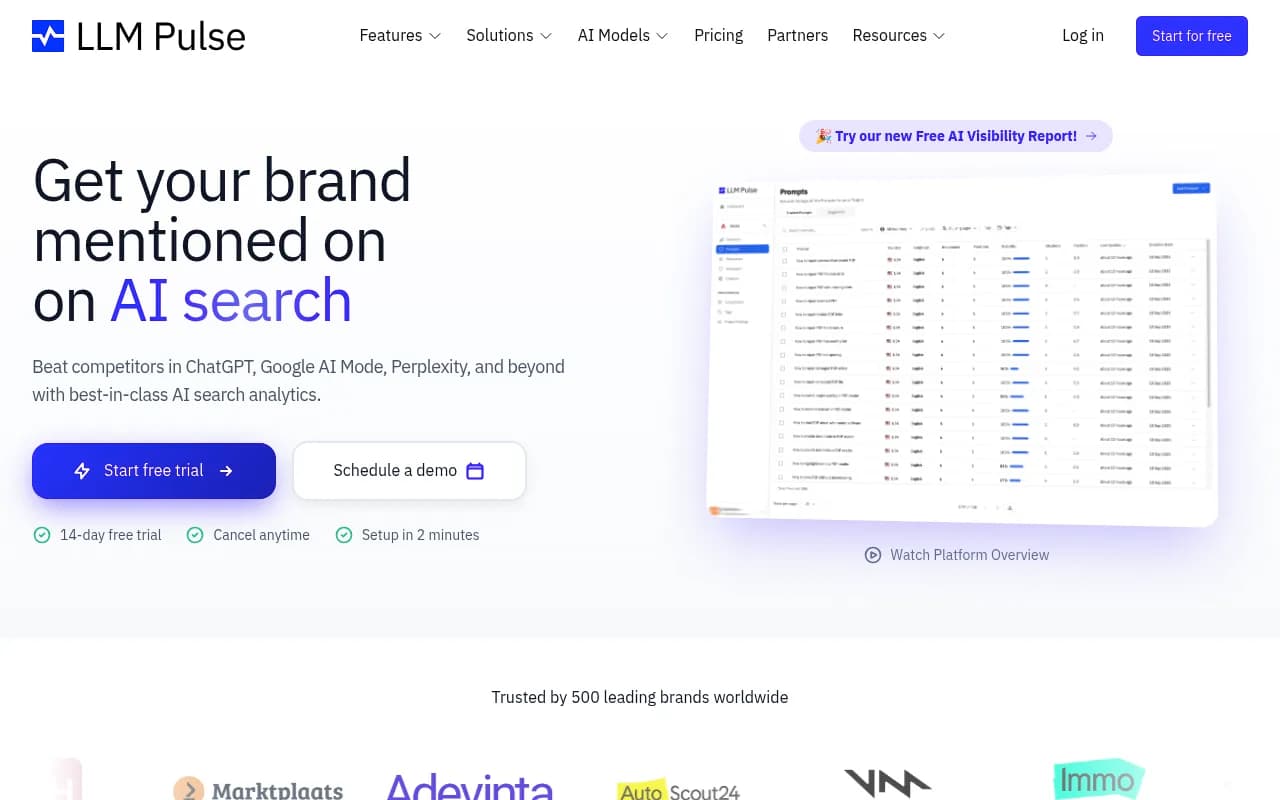
It's a good fit for teams that want to track AI visibility without a long onboarding process. The trade-off is the same as most tools in this tier: monitoring is the product. There's no execution layer, no content generation, and no crawler data.
One thing worth noting: LLM Pulse has been active in publishing comparison content (including their own Searchable alternatives guide), which suggests they're investing in the category. Whether that translates to product depth over time remains to be seen.
6. Metaflow AI -- best for growth operators who want AEO + content
Metaflow AI positions itself as an AEO platform with a content execution layer, which puts it in a similar category to Promptwatch. The focus is on growth operators who want to track AI visibility and generate content that improves it.
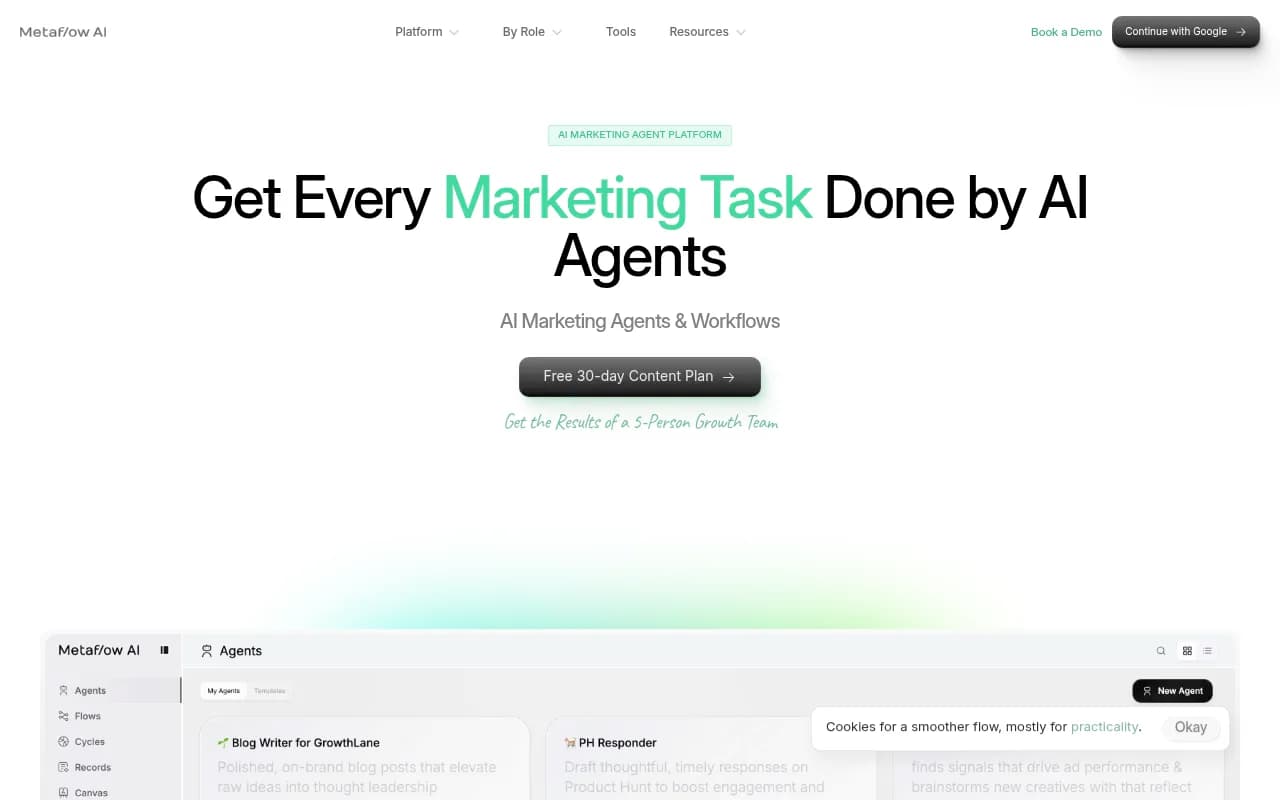
The platform has a free trial available, which makes it easy to evaluate without commitment. Coverage and depth are still maturing compared to more established platforms, and third-party validation (G2 reviews, documented case studies) is thinner than you'd want before committing to it as a primary tool.
Worth evaluating if you're cost-sensitive and want some execution capability, but do the trial carefully and test the content quality before committing.
7. ScrunchAI -- best for mid-market monitoring with a clean interface
ScrunchAI tracks brand mentions across LLMs with a focus on making the data accessible to non-technical marketing teams. The interface is polished and the reporting is clear.
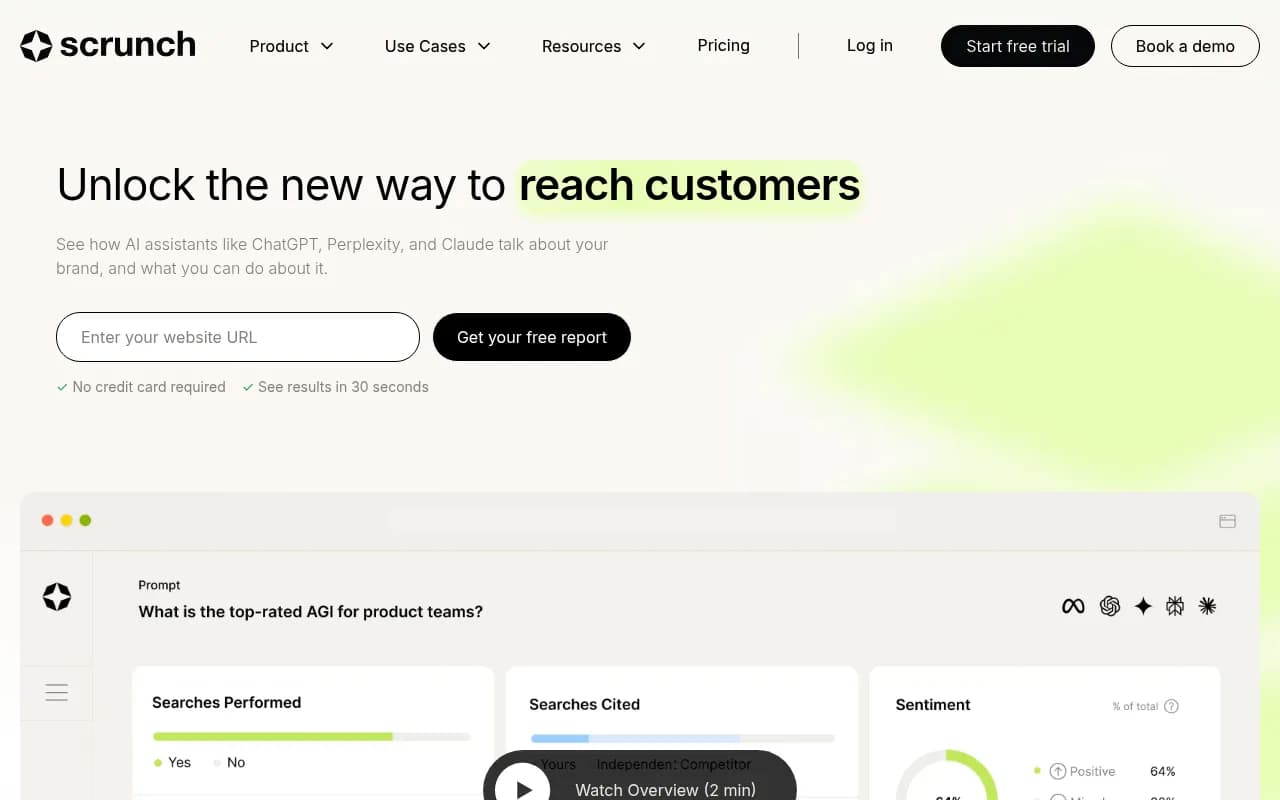
It's a reasonable monitoring option for mid-market teams that don't need the full execution stack. Pricing is custom, which can be a friction point if you're trying to evaluate it quickly. Like most tools in this tier, there's no content generation, no crawler logs, and no traffic attribution.
8. AthenaHQ -- best for monitoring-focused mid-market teams
AthenaHQ has positioned itself as a serious mid-market option with strong monitoring capabilities. The platform covers the major AI engines and provides competitive visibility data that's useful for strategy conversations.

The honest limitation: AthenaHQ is monitoring-focused. Content optimization and generation aren't part of the platform. If your team needs to track AI visibility and report on it, AthenaHQ is a credible option. If you need to actually move your numbers, you'll need additional tools in your stack.
What most of these tools get wrong
There's a pattern worth naming directly. The majority of AI visibility platforms -- including Searchable, Otterly.AI, Peec AI, AthenaHQ, and others -- are built around the same core proposition: we'll show you where you're visible and where you're not.
That's useful. But it's only the first step.
The teams that are actually winning in AI search right now aren't just monitoring their visibility. They're using that data to identify specific content gaps, publishing content that addresses those gaps, and then tracking whether the new content gets cited. The monitoring is table stakes. The execution is the competitive advantage.
Most platforms stop at step one. The ones that don't -- Promptwatch being the clearest example in this category -- are the ones worth looking at most carefully if you're serious about improving your AI search presence rather than just measuring it.
How to choose
Here's a simple decision framework:
If you're just starting out and want to understand your current AI visibility without a big budget commitment, Otterly.AI, Peec AI, or LLM Pulse are reasonable starting points. They're affordable, easy to set up, and give you a baseline.
If you're a mid-market brand that already knows you have an AI visibility problem and needs to fix it, the shortlist gets much shorter. You need a platform with content generation, crawler logs, and traffic attribution -- not just a dashboard. Promptwatch is the most complete option in this category right now.
If you're an enterprise team with strict compliance requirements and a dedicated analytics function, Profound is worth evaluating despite the price.
If you're an agency managing multiple clients, look carefully at white-label reporting capabilities and multi-site pricing before committing to anything.
The credit-based pricing model that Searchable uses is worth scrutinizing regardless of which platform you evaluate. Predictable monthly pricing (like Promptwatch's seat-based model) is easier to budget and scale than per-prompt credits that vary by tier.
Final thought
The AI search visibility category is moving fast. Platforms that were "monitoring-only" 18 months ago are adding execution features. Platforms that launched with big funding rounds are still figuring out product-market fit. The landscape in mid-2026 is genuinely different from what it was at the start of the year.
The one thing that hasn't changed: the teams winning in AI search are the ones who treat it as an optimization problem, not a reporting problem. Pick a platform that helps you close the loop.