Key takeaways
- Traditional SEO crawlers (Screaming Frog, Sitebulb, Lumar, OnCrawl) were built for Googlebot -- AI crawlers like GPTBot and ClaudeBot behave differently, and most of these tools only partially address that gap
- Screaming Frog leads on raw technical control and now supports live AI integrations (OpenAI, Gemini, Anthropic) during crawls -- useful for classifying content quality on the fly
- Sitebulb wins on visual reporting and stakeholder communication; its new Cloud product closes the gap with enterprise tools
- Lumar (formerly DeepCrawl) and OnCrawl are enterprise-grade platforms with stronger data pipeline integrations, but come at a price
- None of these tools natively track whether AI search engines are actually citing your pages -- for that, you need a dedicated AI visibility platform alongside your crawler
Why "AI crawler readiness" is now a real thing you need to audit
A year ago, most SEO teams were still treating AI search as a curiosity. That's changed. ChatGPT, Perplexity, Google AI Mode, and Gemini are now sending real traffic -- and they crawl your site through bots like GPTBot, ClaudeBot, PerplexityBot, and Google-Extended. These bots don't behave like Googlebot.
They tend to prioritize clean, structured content. They struggle with JavaScript-heavy pages. They care about whether your content directly answers questions, not just whether it has the right keywords. And if your robots.txt is blocking them -- which it might be, because many sites added blanket AI bot blocks in 2023 and 2024 -- they simply won't index you.
So "AI crawler readiness" is really about two things:
- Can AI bots actually access and read your pages?
- Is the content on those pages structured in a way that AI models will use it?
Traditional SEO crawlers can help with the first question more than the second. Let's look at what each of the main tools actually offers.
Screaming Frog SEO Spider
Screaming Frog is still the go-to for most technical SEOs who want raw crawl data fast. It's a desktop crawler (with a cloud option now available) that gives you granular control over what gets crawled, how, and at what speed.
For AI crawler readiness specifically, Screaming Frog has added something genuinely useful: live AI integrations during crawl. You can connect it to OpenAI, Gemini, Anthropic, or a local Ollama model and run classifications, intent analysis, or thin content detection as pages are crawled. That's not a gimmick -- it means you can flag pages that are unlikely to be cited by AI models because they're too thin, too vague, or structurally weak.
What Screaming Frog does well for AI readiness:
- Custom robots.txt analysis -- you can check whether GPTBot, ClaudeBot, PerplexityBot are blocked or allowed
- JavaScript rendering mode (via Chromium) to see what AI bots actually see on JS-heavy pages
- Custom extraction using XPath/regex to pull structured data, FAQ schema, and entity markup
- AI classification of pages during crawl (with API integration)
- Log file analysis to see if AI bots are actually hitting your server
What it doesn't do: it won't tell you whether your pages are being cited in AI responses, or how your visibility compares to competitors. It's a crawl tool, not an AI visibility platform.
Best for: SEOs who want maximum technical control and are comfortable working with raw data. If you're running a custom audit workflow and want to pipe crawl data into your own analysis, Screaming Frog is hard to beat.
Sitebulb
Sitebulb takes a different approach. Where Screaming Frog gives you data, Sitebulb gives you prioritized insights with visual reporting that non-technical stakeholders can actually understand.

The tool has expanded significantly with Sitebulb Cloud, which moves crawling off your local machine and into a managed environment. This matters for AI crawler readiness work because you can schedule regular crawls and get alerts when things change -- like if a deploy accidentally blocks GPTBot.
For AI readiness auditing, Sitebulb's strengths are:
- Clear visual presentation of crawlability issues, with explanations of why they matter
- Hint-based auditing that surfaces issues in plain language (useful when briefing developers)
- Structured data validation -- it checks schema markup that AI models rely on
- Internal linking analysis to understand how AI bots navigate your site
- Upcoming MCP (Model Context Protocol) integration, which will let you query audit data through AI interfaces directly
The MCP integration is worth watching. If it ships as described, it could let you ask natural language questions about your crawl data -- "which pages are blocking AI bots?" or "which pages have no structured data?" -- without digging through spreadsheets.
Sitebulb's limitation is similar to Screaming Frog's: it audits what's on your site, but doesn't connect that to what AI models are actually citing or recommending.
Best for: Agencies and in-house teams that need to present audit findings to clients or leadership. The visual reports are genuinely better than anything Screaming Frog produces out of the box.
Lumar (formerly DeepCrawl)
Lumar is the enterprise option in this comparison. It was rebranded from DeepCrawl in 2023 and has since expanded beyond pure crawling into a broader website optimization platform.
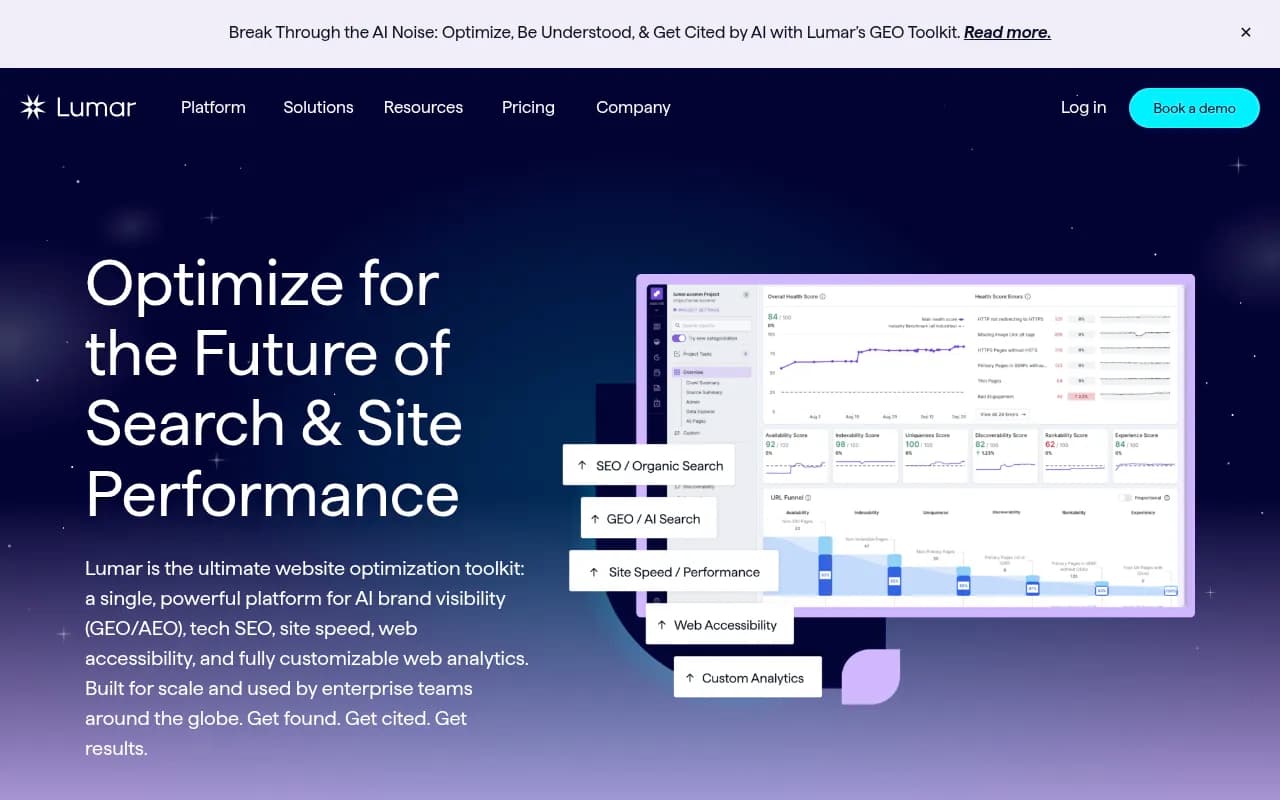
For large sites (think 500K+ pages), Lumar's crawl infrastructure is more capable than desktop tools. It handles JavaScript rendering at scale, integrates with Google Search Console and Analytics, and can be configured to crawl as specific bots -- including custom user agents that mimic AI crawlers.
For AI crawler readiness, Lumar's relevant capabilities include:
- Custom bot user agent configuration (you can crawl as GPTBot to see what it sees)
- Large-scale structured data auditing
- Integration with log file analysis to track actual bot behavior
- Change detection and alerting when crawlability issues appear
- API access for custom reporting and data pipelines
The tradeoff is cost and complexity. Lumar is priced for enterprise teams with dedicated technical SEO resources. If you're a small agency or a startup, the pricing will feel steep relative to what you actually need.
Lumar also has a GEO-adjacent angle now -- it's positioning itself around broader website health for AI search, not just traditional SEO. Whether that translates into concrete AI visibility features or just marketing language is something worth pressing their sales team on.
Best for: Enterprise SEO teams managing large, complex sites who need scalable crawling with strong data integration. The bot impersonation feature is particularly useful for AI readiness audits.
OnCrawl
OnCrawl sits in a similar enterprise tier to Lumar, with a particular strength in log file analysis and data science integrations.
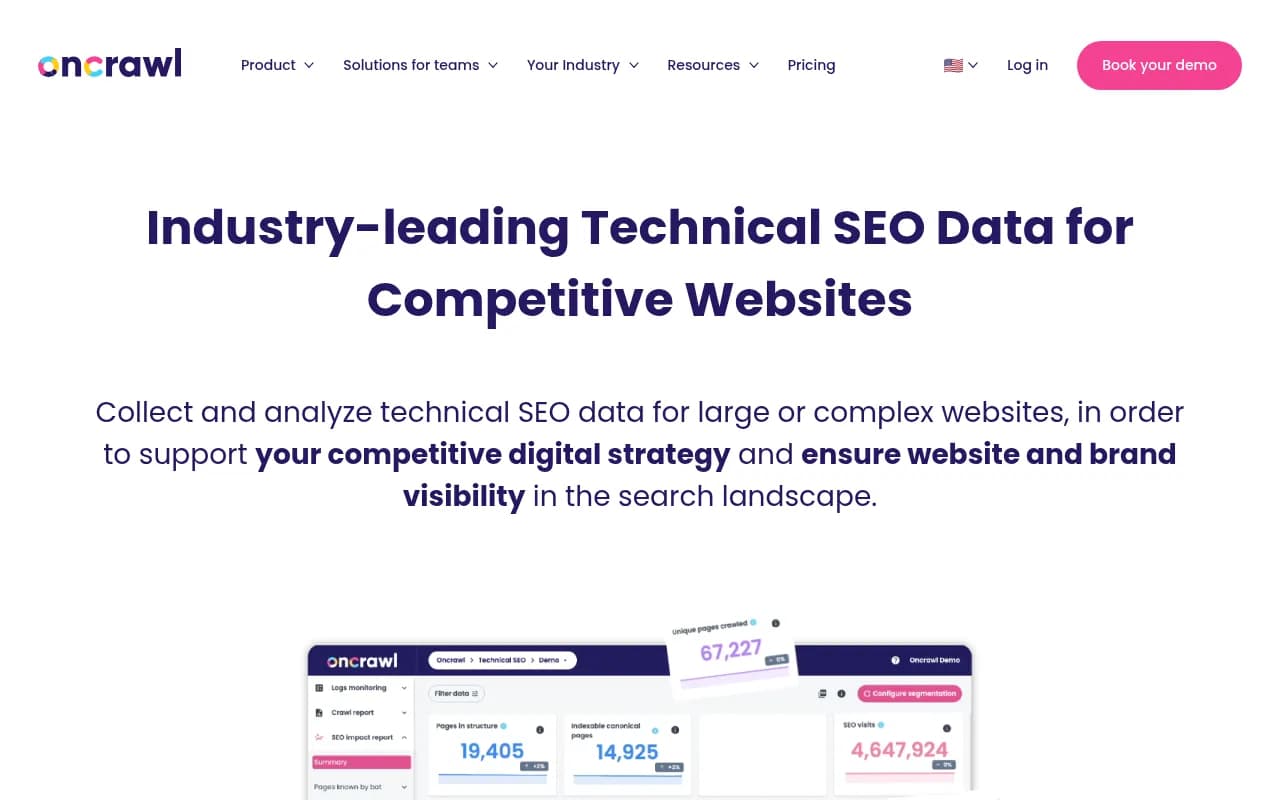
Where OnCrawl differentiates is in connecting crawl data with actual bot behavior from server logs. This is directly relevant for AI crawler readiness: you can see exactly which pages GPTBot, ClaudeBot, or PerplexityBot have visited, how often, and whether they're encountering errors. That's real data, not inferred behavior.
OnCrawl's relevant features:
- Log file analysis with bot segmentation (including AI crawlers)
- Crawl + log correlation to identify pages that are crawled but not visited by bots, or vice versa
- Python API and data export for custom analysis
- Structured data and schema auditing
- Integration with BI tools (Looker, Tableau, BigQuery)
The data science angle is OnCrawl's real differentiator. If your team has analysts who want to build custom models on top of crawl and log data, OnCrawl gives you more flexibility than the other tools here. But it's also the most technical to set up and operate.
OnCrawl has faced some competitive pressure in 2025-2026 as Sitebulb Cloud has closed the feature gap at a lower price point. Worth comparing both directly if you're evaluating enterprise options.
Best for: Data-driven SEO teams with log file access and the technical capacity to work with raw data exports. The log analysis + crawl correlation is genuinely powerful for understanding AI bot behavior.
Head-to-head comparison
| Feature | Screaming Frog | Sitebulb | Lumar | OnCrawl |
|---|---|---|---|---|
| AI bot user agent simulation | Partial (custom UA) | Partial (custom UA) | Yes (configurable) | Yes (configurable) |
| robots.txt AI bot analysis | Yes | Yes | Yes | Yes |
| JavaScript rendering | Yes (Chromium) | Yes | Yes (at scale) | Yes |
| Log file analysis | Yes (basic) | Limited | Yes | Yes (advanced) |
| Structured data auditing | Yes | Yes | Yes | Yes |
| Live AI integration during crawl | Yes (OpenAI, Gemini, Anthropic, Ollama) | No | No | No |
| Visual/stakeholder reporting | Basic | Excellent | Good | Basic |
| Scale (pages per crawl) | Medium | Medium-Large | Very Large | Very Large |
| Cloud/scheduled crawls | Yes (paid add-on) | Yes (Cloud product) | Yes | Yes |
| Pricing | £259/yr (unlimited) | From ~$179/mo | Enterprise pricing | Enterprise pricing |
| Best for | Technical control | Reporting & agencies | Large-scale enterprise | Data science teams |
What these tools can't do (and what fills the gap)
Here's the honest limitation of all four tools: they tell you whether AI bots can crawl your site. They don't tell you whether AI models are actually citing your pages, how your visibility compares to competitors, or which content gaps are costing you AI search traffic.
That's a different problem requiring a different tool. Platforms like Promptwatch track actual AI citations across ChatGPT, Perplexity, Google AI Mode, Gemini, and other models -- showing you which pages get cited, how often, and by which AI engine. The crawler log feature in Promptwatch also shows real-time logs of AI bots hitting your site, which pages they read, and when those pages move from crawl to citation.

Think of it this way: Screaming Frog or Sitebulb tells you your front door is unlocked. Promptwatch tells you whether anyone actually walked in.
For a complete AI search readiness workflow, you probably need both: a technical crawler to fix accessibility issues, and an AI visibility platform to track whether those fixes are translating into actual citations and traffic.
Recommended workflows
For agencies auditing client sites
Use Screaming Frog for the initial crawl -- check robots.txt for AI bot blocks, run JavaScript rendering to identify pages that render poorly, and use the custom extraction to pull schema markup. Then use Sitebulb Cloud for the ongoing monitoring and to generate client-facing reports. The combination gives you technical depth plus presentation quality.
For in-house teams at mid-size companies
Sitebulb Cloud handles most of what you need for regular AI readiness monitoring. Set up scheduled crawls, configure alerts for bot-blocking changes, and use the hint system to prioritize fixes. Pair it with a log file analysis tool (even basic server log parsing) to verify that AI bots are actually visiting your priority pages.
For enterprise SEO teams
Lumar or OnCrawl for the crawl infrastructure, depending on whether your priority is scale (Lumar) or log analysis depth (OnCrawl). Either way, you'll want to connect crawl data with actual AI visibility data -- which means integrating with a platform that tracks real AI citations, not just crawl access.
For teams starting from scratch
Screaming Frog's paid license (£259/year for unlimited crawls) is still one of the best value purchases in SEO. Start there, learn what AI bots can and can't access on your site, fix the obvious issues (unblock GPTBot if you've blocked it, add FAQ schema, fix JS rendering issues), then layer in monitoring tools as your needs grow.
The robots.txt issue nobody talks about enough
One thing worth flagging separately: a significant number of sites still have blanket AI bot blocks in their robots.txt from the 2023-2024 period when there was a lot of anxiety about AI scraping. If you blocked GPTBot, ClaudeBot, PerplexityBot, or Google-Extended, you've effectively opted out of AI search visibility.
All four tools in this comparison will surface this -- it's a basic robots.txt check. But it's worth running this audit immediately if you haven't, because the fix is simple (remove the disallow rules for bots you want to allow) and the impact can be significant.
The nuance is that you might want to block some AI bots for specific reasons (training data concerns, for instance) while allowing others. Screaming Frog and Sitebulb both let you test robots.txt rules against specific user agents, which makes it easy to audit your current configuration and model the impact of changes.
Bottom line
There's no single tool here that does everything. Screaming Frog is the most technically capable and the only one with live AI integration during crawls. Sitebulb is the best for teams that need to communicate findings clearly. Lumar and OnCrawl are the right choices when you're operating at enterprise scale or need deep log analysis.
What all four share is a focus on the supply side of AI crawler readiness: can bots get in, and is the content technically accessible? The demand side -- are AI models actually using your content, and how do you improve that -- requires a different category of tool entirely.
If you're serious about AI search visibility in 2026, a technical crawler is the foundation. But it's just the foundation.