Key takeaways
- Google AI Overviews now appear on a significant share of commercial and informational queries, making AI visibility tracking a real marketing priority in 2026.
- Most tools in this space are monitoring-only: they show you where you're invisible but don't help you fix it.
- Promptwatch is the only platform in this comparison that closes the full loop: track visibility, identify content gaps, and generate content engineered to get cited.
- Semrush is a strong choice if you're already using it for traditional SEO and want AI visibility layered on top.
- SE Ranking (via SE Visible) and Conductor each have specific strengths but meaningful gaps when it comes to acting on the data.
Why Google AI Overviews changed the game
If you've searched Google recently, you've probably noticed the AI-generated summary that appears before any organic results. That's Google AI Overviews (AIO) -- and it's now showing up on a wide range of queries, from product comparisons to how-to questions to brand research.
The brands cited in those summaries get visibility before a user ever scrolls to a blue link. The brands that aren't cited? They might as well not exist for that query.
This creates a real problem for marketers. Traditional rank tracking tells you where you rank in organic results. It says nothing about whether Google's AI is citing your content, recommending your brand, or pulling from a competitor instead. You need a different kind of tool.
In 2026, a handful of platforms have emerged to fill this gap. This guide compares four of the most talked-about options: Promptwatch, Semrush, SE Ranking (through its SE Visible product), and Conductor.
What to look for in a Google AI Overviews tracking tool
Before diving into the tools, it's worth being clear about what actually matters here. There are two very different things a tool can do:
- Show you where you appear (or don't appear) in AI-generated answers
- Help you change that -- by identifying what content is missing and helping you create it
Most tools do the first. Very few do the second. That distinction matters a lot when you're trying to justify the spend.
Beyond that, the key capabilities to evaluate are:
- Which AI engines are covered (ChatGPT, Perplexity, Gemini, Google AI Overviews, etc.)
- How prompts are managed -- can you set custom prompts that match real buyer queries, or are you stuck with fixed ones?
- Whether you get page-level citation data (which specific URLs are being cited)
- Whether there's any content gap analysis or content generation built in
- How traffic attribution works -- can you connect AI visibility to actual visits and revenue?
With that framework in mind, here's how the four tools stack up.
Promptwatch
Promptwatch is built around what it calls the "action loop": find gaps, create content, track results. That framing is accurate -- it's genuinely different from the monitoring-only tools that dominate this space.

The core workflow starts with Answer Gap Analysis, which shows you the specific prompts where competitors are getting cited but you're not. You see the exact questions AI models are answering without referencing your brand, which gives you a clear content brief rather than a vague directive to "create more content."
From there, the built-in AI writing agent generates articles, listicles, and comparison pieces grounded in citation data from over 880 million citations analyzed. This isn't a generic content generator -- it's producing content based on what AI models actually cite, which is a meaningful difference.
On the tracking side, Promptwatch monitors 10 AI engines: ChatGPT, Perplexity, Google AI Overviews, Google AI Mode, Claude, Gemini, Meta/Llama, DeepSeek, Grok, and Mistral. Page-level tracking shows which specific URLs are being cited and by which models. Traffic attribution ties visibility back to actual visits via a code snippet, Google Search Console integration, or server log analysis.
A few features that stand out compared to the other tools in this comparison:
- AI Crawler Logs: real-time logs of AI crawlers hitting your site -- which pages they read, errors they encounter, how often they return. Most competitors don't have this at all.
- Reddit and YouTube tracking: surfaces discussions that directly influence AI recommendations, which is a channel most platforms ignore.
- ChatGPT Shopping tracking: monitors when your brand appears in ChatGPT's product recommendations and shopping carousels.
- Prompt Intelligence: volume estimates and difficulty scores for each prompt, plus query fan-outs that show how one prompt branches into sub-queries.
Pricing starts at $99/month (Essential: 1 site, 50 prompts, 5 articles), $249/month for Professional (2 sites, 150 prompts, 15 articles, crawler logs), and $579/month for Business (5 sites, 350 prompts, 30 articles). A free trial is available.
The honest limitation: if you're a very small team with no content production capacity, the content generation features are only as useful as your ability to actually publish and iterate. The platform gives you the tools; you still need to use them.
Semrush
Semrush is the tool most marketers already have open in another tab. Its AI visibility features are layered on top of a mature SEO platform, which is both its strength and its limitation.
The AI Visibility Toolkit within Semrush covers ChatGPT, Google AI Overviews, Google AI Mode, Perplexity, and Gemini. It shows brand mention rates, share of voice across AI engines, and how your visibility compares to competitors. For teams that are already doing keyword research, site audits, and rank tracking in Semrush, having AI visibility data in the same interface is genuinely convenient.
The enterprise-tier product (Semrush AIO) goes deeper -- automated reporting, multi-brand management, and more granular segmentation. It's designed for larger organizations with complex reporting needs.
Where Semrush falls short for this specific use case: the prompts are largely fixed. You can't easily build a custom prompt set that mirrors how your actual buyers search. That's a real constraint if your category has specific terminology or your customers ask questions in ways that don't map to generic templates.
There's also no built-in content generation tied to AI citation data, no AI crawler logs, and no Reddit/YouTube tracking. You can identify gaps in a general sense, but the path from "I'm not appearing here" to "here's the content that will fix it" requires leaving the platform.
Pricing for the AI features is add-on territory -- Semrush's base plans start at $139/month, with AI visibility features available at higher tiers or as separate add-ons. For teams that need both traditional SEO and AI visibility in one tool, it's a reasonable consolidation. For teams focused primarily on AI search optimization, the cost-to-capability ratio is less favorable.
SE Ranking / SE Visible
SE Ranking is a well-regarded all-in-one SEO platform, and it has built a dedicated AI visibility product called SE Visible. The positioning is specifically around multi-brand agencies and teams managing multiple clients.
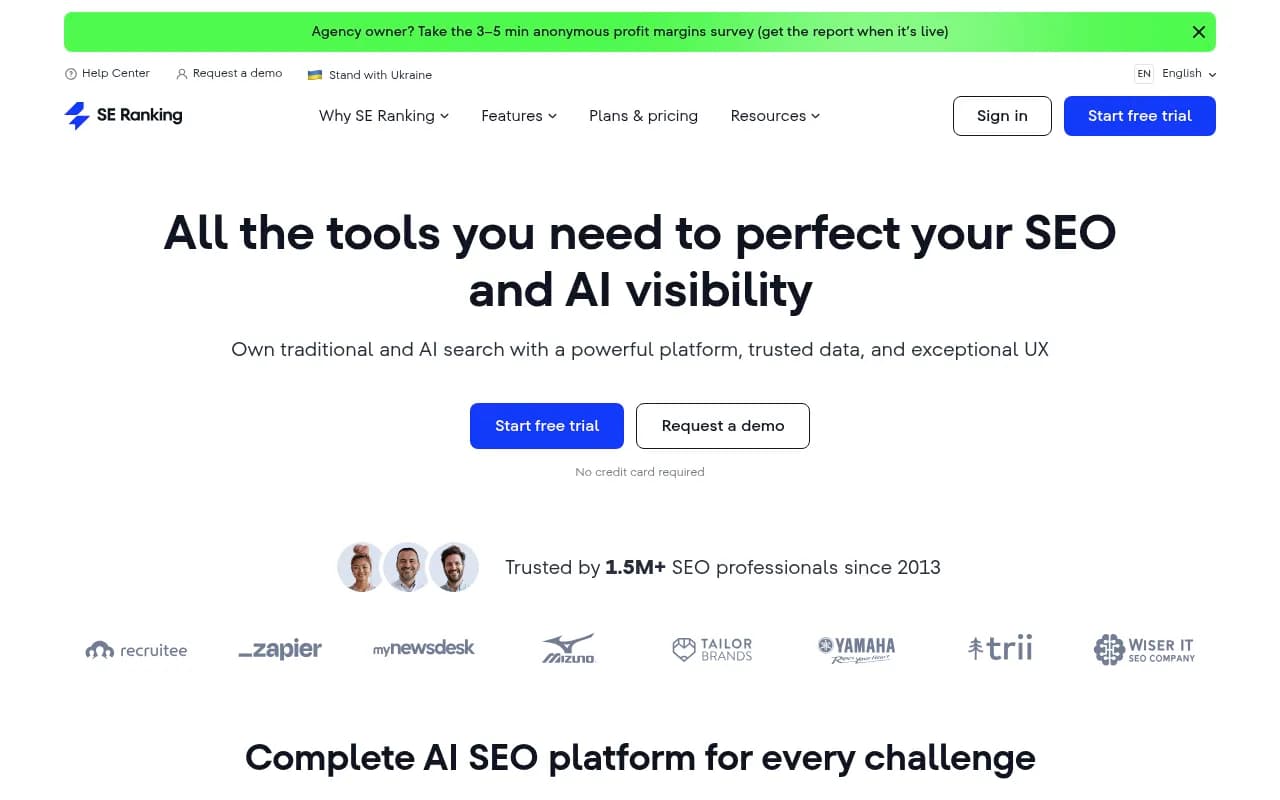
SE Visible covers ChatGPT, Perplexity, Gemini, Google AI Overviews, and Google AI Mode. It offers unlimited seats, which is a genuine differentiator for agencies billing by client rather than by user. The interface is clean, and the competitive comparison features are solid for understanding share of voice across AI engines.
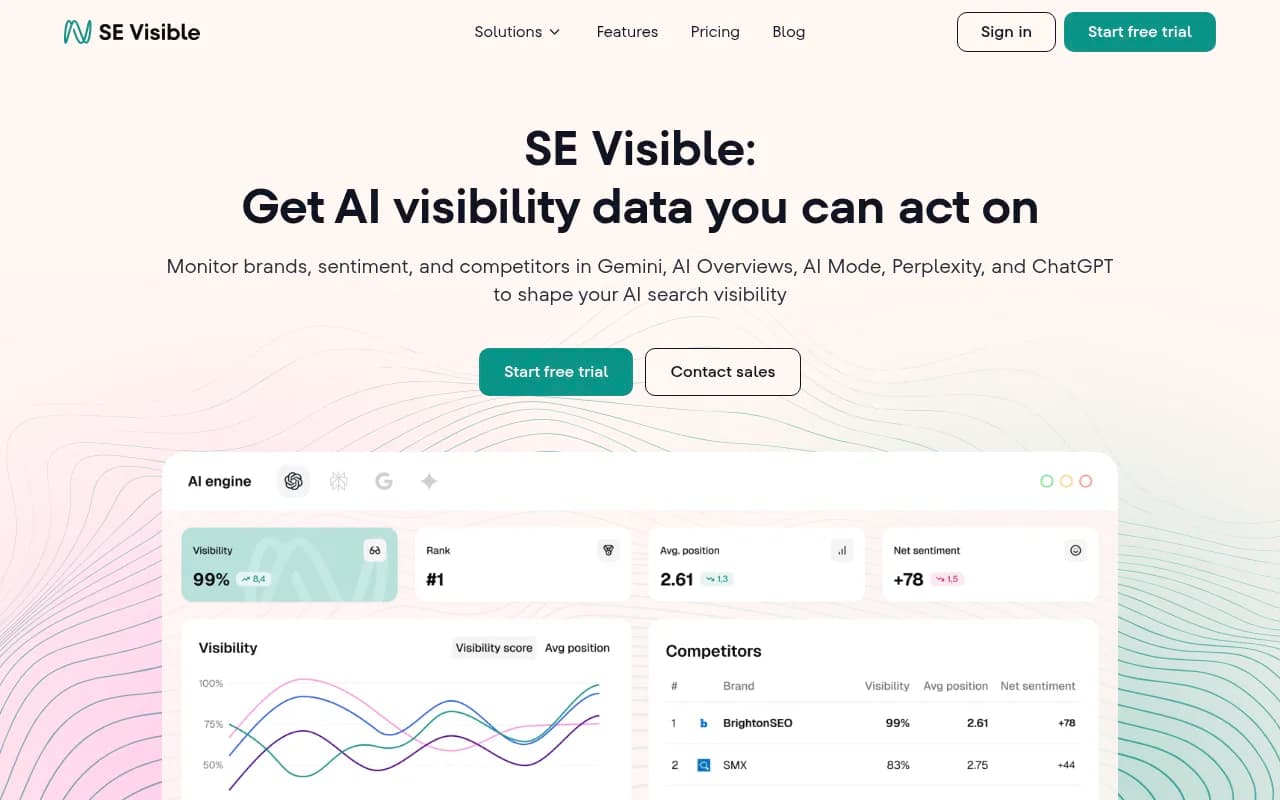
The gap is similar to Semrush: SE Visible is a monitoring tool. It shows you the data but doesn't help you act on it. There's no content gap analysis in the same sense as Promptwatch's Answer Gap Analysis, no built-in content generation, and no AI crawler logs. The platform is good at answering "where are we?" but less equipped to answer "what do we do about it?"
For agencies that need to report AI visibility metrics to clients across multiple brands, SE Visible is genuinely useful. For teams that want to move from visibility data to content strategy to measurable improvement, it's a starting point rather than a complete solution.
Pricing starts at $189/month, which is competitive for agency use cases.
Conductor
Conductor has been around for years as an enterprise SEO and content intelligence platform. More recently, it has added AI search tracking capabilities, including monitoring for brand citations in AI-generated answers.
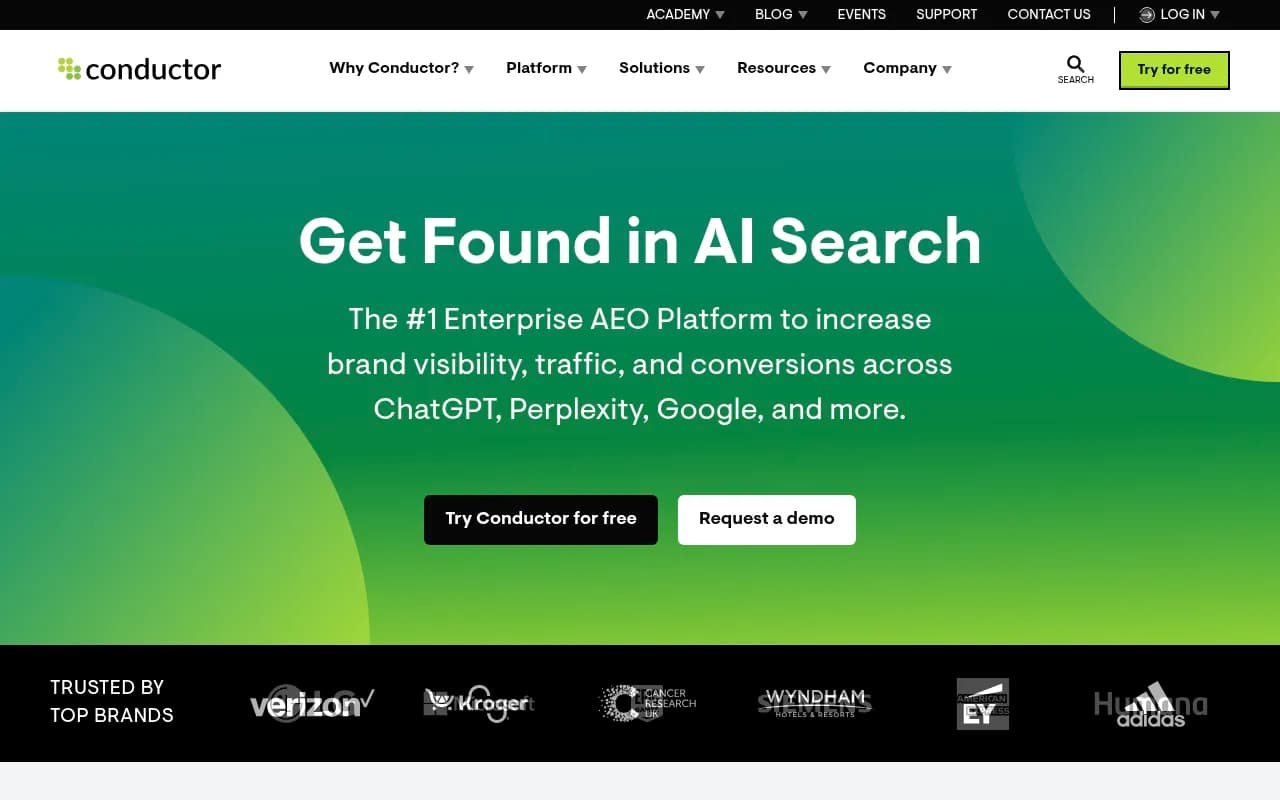
The platform covers Google AI Overviews and other AI engines, and it integrates AI visibility data with its broader content performance and SEO workflow features. For enterprise teams that already use Conductor for content operations, the AI tracking layer is a natural extension.
Where Conductor stands out is in its content workflow features -- it's designed for teams with editorial processes, content calendars, and approval workflows. If your organization already has that infrastructure, Conductor's AI visibility data slots in reasonably well.
The limitations are significant for this specific use case, though. Conductor is primarily built for enterprise content teams, and the pricing reflects that. It's not a tool you'd adopt specifically for AI visibility tracking -- it's a tool you'd use if you're already in the Conductor ecosystem and want AI data added to it. The prompt customization is limited compared to purpose-built AI visibility platforms, and there's no equivalent to Promptwatch's Answer Gap Analysis or content generation tied to citation data.
Head-to-head comparison
| Feature | Promptwatch | Semrush | SE Visible | Conductor |
|---|---|---|---|---|
| Google AI Overviews tracking | Yes | Yes | Yes | Yes |
| Custom prompt sets | Yes | Limited | Yes | Limited |
| Answer gap analysis | Yes | No | No | No |
| Built-in AI content generation | Yes | No | No | No |
| AI crawler logs | Yes | No | No | No |
| Reddit/YouTube tracking | Yes | No | No | No |
| ChatGPT Shopping tracking | Yes | No | No | No |
| Page-level citation tracking | Yes | Partial | Partial | Partial |
| Traffic attribution | Yes (snippet, GSC, logs) | Limited | No | Limited |
| Number of AI engines monitored | 10 | 5 | 5 | 3-4 |
| Prompt volume/difficulty scores | Yes | No | No | No |
| Starting price | $99/mo | $139/mo + add-ons | $189/mo | Enterprise |
| Best for | Full optimization cycle | Existing Semrush users | Multi-brand agencies | Enterprise content teams |
Which tool should you actually use?
The honest answer depends on what you're trying to accomplish.
If you want to track AI visibility and also do something about it -- meaning you want to identify content gaps, generate content that's likely to get cited, and measure whether it worked -- Promptwatch is the clearest choice. It's the only tool here that covers the full cycle rather than stopping at the monitoring step.
If you're already a Semrush power user and you want AI visibility data without adding another subscription, the Semrush AI Toolkit is a reasonable consolidation play. Just go in knowing that you'll need to do the content strategy work separately.
If you're running an agency with multiple clients and your primary need is reporting AI visibility metrics across brands, SE Visible's unlimited seats and clean interface make it worth a look.
If you're at an enterprise with an existing Conductor contract and a large content team, the AI tracking features are worth turning on. But Conductor isn't a tool to adopt from scratch for this use case.
A note on the broader landscape
These four tools are far from the only options. The AI visibility space has exploded in 2026 -- there are now dozens of platforms ranging from basic mention trackers to sophisticated optimization suites.
A few others worth knowing about:

Peec AI is a solid entry-level option for teams that want simple tracking without heavy setup. It covers the major AI engines and is easy to get started with, though it doesn't have the depth of analysis or content generation features of the platforms above.
Profound

Profound is strong for enterprise teams with analyst-driven workflows -- it offers near real-time monitoring, raw data access, and API integrations. The trade-off is complexity; it's built for teams that want to work with the data directly rather than get out-of-the-box recommendations.
Otterly.AI

Otterly.AI is another monitoring-focused option that's popular with smaller teams and agencies. Clean interface, straightforward setup, but like most competitors, it stops at showing you the data rather than helping you act on it.
The bottom line
Google AI Overviews aren't going away. If anything, the share of queries where AI-generated answers appear is growing, and the brands that show up in those answers have a real advantage over those that don't.
The tools that just track your visibility are useful for reporting. The tools that help you improve your visibility are useful for growth. In 2026, the gap between those two categories is where most of the value lives -- and right now, very few platforms have closed it.