Key takeaways
- You can't force ChatGPT, Gemini, Claude or Perplexity to say a fixed message. You can change the evidence they find, and the answers follow.
- Your own product, landing, pricing and docs pages do the most durable work. Promptwatch Data shows they stay cited the longest, while news coverage fades in about five weeks.
- Branded prompts lean on your own pages and on reviews. Fixing third-party profiles and review sites matters as much as fixing your website.
- Social posts are a weak lever for ChatGPT but a real one for Google AI Overviews, mostly through YouTube.
- Control is a loop: capture answers, trace weak claims to sources, fix the evidence, re-test the same prompts.
The honest answer: no, but you have a lot of influence
Nobody can edit what an AI model says about a brand. There is no dashboard where you correct the sentence "Acme is best for small teams" and have it stick. What you can do is control the material the model reads before it writes that sentence: your pages, your reviews, your directory listings, your press, your documentation.
That sounds like a technicality, but it changes the work. You stop asking "how do I make the AI say X" and start asking "what does the public record say about us, and does it say X clearly?" Most wrong answers trace back to something boring: an old directory description, a pricing page nobody updated, a competitor comparison that outranks yours.
The angle of several recent playbooks (MaxAEO, friction AI, a Medium piece from Blush Grey) is roughly the same. You control inputs, not outputs. I agree, with one caveat: some of those posts are vendor content, and their scoring rubrics and monitoring cadences are suggestions, not tested benchmarks. Treat them as a starting point.
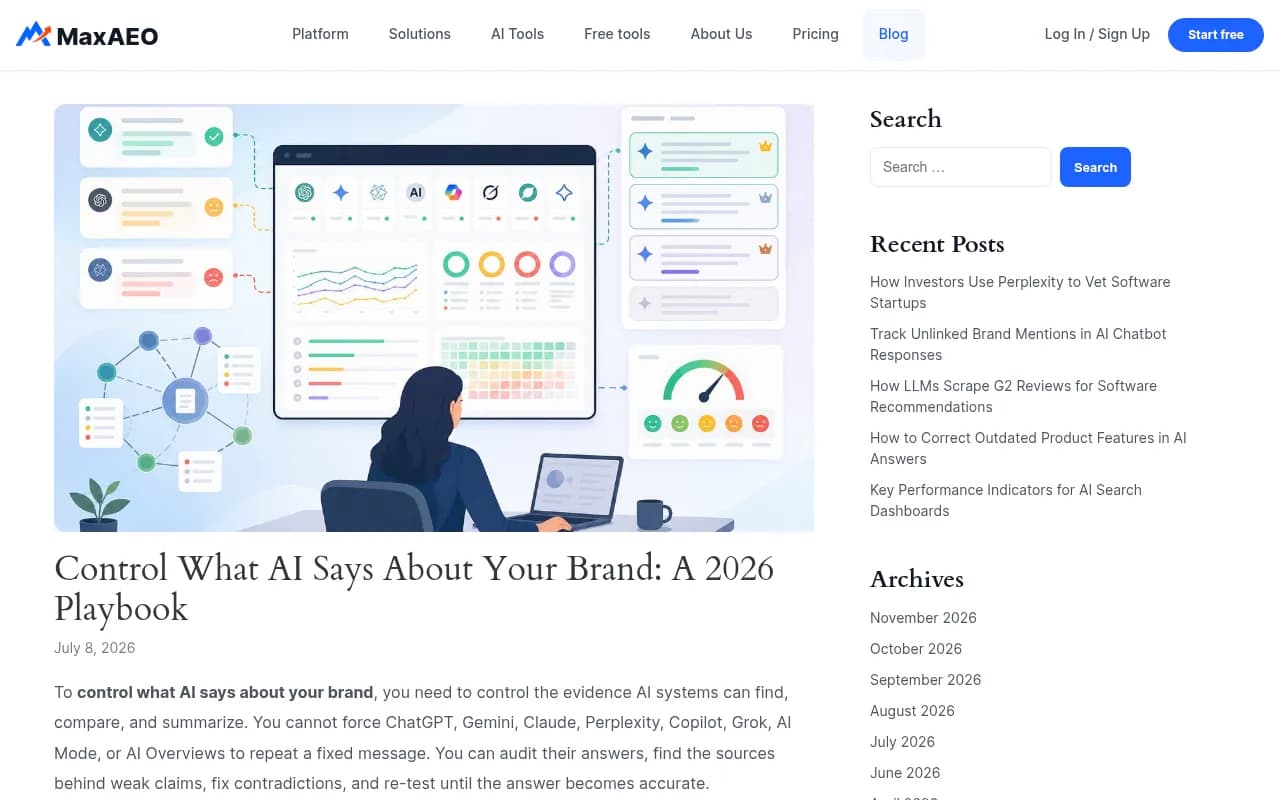
How AI forms an answer about your brand
Three things feed a brand answer:
- Training data. What the model absorbed in pre-training. It is slow to change and you can't touch it directly. This is why old reputational baggage sticks around in models that answer without searching.
- Live retrieval. ChatGPT Search, Perplexity, Google AI Overviews and AI Mode fetch pages at answer time. This is the layer you can change in days or weeks.
- Entity resolution. How the model decides which company you are. If your name is a common word or resembles another brand, unclear signals lead to mixed-up answers.
For most brands, retrieval is where the leverage is. And retrieval is dominated by your own pages, more than people expect.
What ChatGPT cites when someone asks about you
Promptwatch Data looked at ChatGPT citations from Sep 28 to Oct 4, 2026. For branded prompts, which are the ones that name your company, product pages were 23.3% of citations and landing pages 22.8%. That is almost half coming from the brand's own site. Reviews rose to 5.6%, more than three times their share across all prompts. Social posts rose to 3.0%, FAQ pages were 4.8% and press releases 2.1%.
Two practical readings. First, if ChatGPT says something wrong about you, there is a good chance one of your own pages is the source or at least failed to contradict it. Second, reviews carry far more weight on branded questions than on generic ones, so the review sites in your category are part of your brand surface whether you manage them or not.
What works
Fix your own landing, pricing, product and docs pages first
This is the least glamorous advice and the best supported. In Promptwatch's tracking of every page ChatGPT cited on July 6, 2026, followed for 90 days, landing pages and docs lasted longest. After 30 days, 78% of landing pages and 76% of docs were still cited. After 60 days it was 69% and 67%. Product pages, reviews and how-tos reached their half-life at 74 to 77 days.
So a corrected pricing page keeps working for months. Be specific on those pages: plans, limits, integrations, who it is for, who it is not for, security and compliance details. Vague copy gives the model nothing to quote, and it will fill the gap from somewhere else.
Add a plain-language FAQ about your brand
Branded prompts pull FAQ pages at nearly 5%. Write the questions buyers actually ask, including the uncomfortable ones: is it expensive, does it work for enterprise, how does it compare to X. Answer them directly. If you don't, a third-party page will.
Clean up third-party evidence
AI does not only trust you. Go through the places that describe you:
- Software directories, app marketplaces and review-site profiles
- Partner and integration pages
- Executive bios and company summaries on conference and press sites
- Analyst and database entries
Correct category labels, old pricing notes, outdated screenshots and "best for small teams" descriptions you outgrew two years ago. This is dull and manual and it often fixes more than any new content does.
Collect reviews where your category looks
Because reviews more than triple in share on branded prompts, a thin or stale review presence is a real liability. Ask customers to review on the sites buyers in your market use, and reply to complaints. A platform like Trustpilot is one example for consumer-facing brands, and G2 shows up heavily in software answers.
Publish proof, not slogans
Case studies with a named use case, a buyer segment and a measured result give a model something to cite when it recommends you for that use case. "Trusted by teams everywhere" gives it nothing.
Use structured data and clear entity signals, as a supporting measure
Schema markup, consistent company naming, a Wikidata entry or Wikipedia article where you qualify, and a clean About page help the model identify you correctly. This matters most if your name is ambiguous. I would not expect it to move sentiment on its own. Tools like WordLift focus on structured data and entities if you want help with the markup.
Make sure AI crawlers can read your site
If your robots.txt or CDN blocks AI crawlers by accident, the best page in the world is invisible. Check access, then look at which bots actually fetch your pages. Promptwatch's free Agentic Readiness Check shows which AI crawlers can read your site.
What works, but only partly
News and press
Press can fix a narrative, but it decays fast. In the same half-life study, half of news pages stopped being cited after 36 days, and almost a quarter were never cited again after day 0. Earned coverage is useful for a quick correction after an incident or launch. Don't count on it to hold a position.
Social posts and Reddit
This depends heavily on the engine. Promptwatch's social citations data for Oct 11 to Nov 9, 2026 shows how lopsided it is:
| Engine | Share of citations from social platforms (Oct) | Share (Nov) |
|---|---|---|
| ChatGPT | 0.46% | 0.64% |
| Perplexity | 2.71% | 1.94% |
| Google AI Overviews | 12.22% | 13.16% |
AI Overviews cites social media about 20 times as often as ChatGPT, and YouTube alone is 6.71% of its citations, more than the other six tracked platforms combined. If Google AI Overviews matters to you, a YouTube presence is a real lever. If ChatGPT matters most, social posting is a minor one. Promptwatch also reported that Reddit's share of ChatGPT citations collapsed from roughly 4% to 0.5% on August 14, 2026, so a Reddit-only strategy for ChatGPT is a bad bet right now.
Engine-specific tuning
Some guides tell you to optimize for Bing for ChatGPT, E-E-A-T for Gemini, and so on. Treat the details with caution, since engines change retrieval behavior often. Promptwatch Data recorded ChatGPT starting to use the site: operator at scale on August 8, 2026, and its citation behavior shifted around the GPT-5.3 rollout earlier in the year. Verify per engine with real prompts instead of trusting a fixed recipe.
What doesn't work
- Publishing vague "AI-optimized" pages. Specific, verifiable answers get quoted. Filler gets ignored.
- Trying to prompt-inject or hide instructions for models. It is unreliable and risks the opposite of what you want.
- Relying on your website alone. Reviews, directories and community discussion shape comparison answers.
- Blocking crawlers broadly. Robots rules and snippet controls have visibility tradeoffs. Block deliberately, per bot, not by reflex.
- Averaging away severe errors. One false security or compliance claim can matter more than fifty neutral mentions. Triage by severity, not by volume.
- Markdown or llms.txt as a silver bullet. Promptwatch Data found markdown files are just 0.05% of AI search citations. Markdown serves AI agents, not AI search. An llms.txt file is cheap to add, but don't expect it to change your answers.
- Fighting a one-off wrong answer. Models vary run to run. Judge by patterns across many prompts and repeats.
A repeatable control loop
- Capture. Build a prompt set that mirrors how buyers ask: direct brand prompts, pricing, security, "X vs Y", "best tool for Z", and objection prompts. Run them across the engines you care about.
- Score. For each answer, ask: is it accurate, is the sentiment fair, does the cited page support the claim, and does it recommend you where you are a strong fit?
- Diagnose. Trace each bad claim to a source or an absence. Is it an old review? A competitor page? A missing page?
- Repair. Fix the owned page, update the third-party listing, or publish the missing answer.
- Re-test. Run the same prompts again after the pages are recrawled. Document anything you can't fix.
Suggested monitoring cadence
| Cadence | What to check | Typical owner |
|---|---|---|
| Daily or weekly | Direct brand, pricing, security and leadership prompts | Brand or growth lead |
| Every two weeks | Competitor comparisons, source changes, review-site shifts | Product marketing |
| Monthly | Scorecard, fixes shipped, unresolved risks | Marketing leadership |
| After events | Launches, price changes, acquisitions, incidents, model updates | Cross-functional team |
That cadence is a reasonable starting point rather than a proven standard. Adjust it to how fast your category changes.
Tools that help with each step
You can run a small version of this loop by hand in ChatGPT and Perplexity. It gets tedious around the fiftieth prompt, which is where monitoring tools come in.
Promptwatch is the one I'd point to for the full loop. It tracks the real interfaces of ChatGPT, Google AI Overviews, Gemini, Perplexity and others, and its Brand Narrative feature pulls the individual claims AI makes about you ("affordable for small teams", "its mobile app lacks features") and groups them by theme. Fact Check lets you mark a claim Accurate or Inaccurate and finds which pages on your site state it or its opposite, so you know where the model is learning the wrong thing. Its crawler logs show whether AI bots can actually read the pages you fixed, and the Content Agent can draft the missing pages. Fact Check is on Business and above, so confirm current plans at promptwatch.com/pricing.

The rest of the market is mostly monitoring. A few worth knowing:
| Tool | Strength | Limit for brand control |
|---|---|---|
| Promptwatch | Monitoring, claim-level Brand Narrative, Fact Check, crawler logs, content creation | Fact Check needs Business or higher |
| Profound | Enterprise monitoring across many engines | Mostly monitoring, higher price point |
| Otterly.AI | Simple mention tracking | No crawler logs or content generation |
| Peec AI | Lightweight visibility tracking | Basic tracker |
| LLMClicks | Hallucination detection angle | Narrower scope |
Profound

Otterly.AI


For a wider look at what's out there, the GEO software directory at bestgeosoftware.com lists dozens of options. For traditional brand-mention tracking across the open web, Brand24 and Brandwatch cover news and social, which still feeds the evidence AI reads.
For free starting points, Promptwatch's AI visibility report scans how ChatGPT, Gemini and Perplexity describe your brand without a login.
Prioritizing: where to spend the first month
If you have limited time, do it in this order:
- Run 20 to 30 brand and category prompts and write down every wrong or missing claim.
- Rank them by severity. Security, pricing, compliance and "is it legit" come first.
- Fix your own pricing, product, landing and docs pages, since those effects last.
- Update the top five third-party profiles and review pages that appear in citations.
- Add the missing FAQ and use-case pages.
- Re-run the same prompts two to four weeks later and compare.
If you also need help building the evidence side at scale, such as digital PR, content and GEO strategy, that is the kind of work an agency like 1001 SEO Media does. For many teams the first month is entirely in-house housekeeping.
The bottom line
You can't command the model, but you can make the truth the easiest thing to find. Start with your own landing, pricing, product and docs pages, because Promptwatch Data shows they are cited for the longest and make up almost half of branded citations. Then clean up reviews and directories, track the same prompts over time, and treat news and social as short-term support. The loop never fully ends, since models and sources keep changing, but the brands that run it monthly are the ones whose answers stop surprising them.