Key takeaways
- Conductor suits content teams that want search intelligence without routing everything through technical specialists. BrightEdge suits organizations where SEO is a technical discipline. Botify suits sites with millions of URLs.
- Conductor, BrightEdge and Botify are enterprise SEO suites with AI tracking added. Promptwatch is an AI visibility platform that tracks, explains and then fixes how AI engines cite you.
- Pricing is opaque for all three suites. Promptwatch publishes its prices at promptwatch.com/pricing.
- Most of the head-to-head claims online come from vendors comparing themselves to rivals. Treat them as marketing and test on your own prompts.
- These platforms are not mutually exclusive. Many enterprises run a crawler-focused suite for classic SEO and a dedicated AI visibility platform on top.
Why this comparison is harder than it looks
Three of these four products started life as enterprise SEO platforms. Conductor, BrightEdge and Botify each built their reputation on keyword tracking, content workflows, or large-scale crawling. All three have since bolted on AI search features. The fourth, Promptwatch, started from the other end: it was built for AI search visibility and works backward into the SEO data.
That difference matters more than any feature checklist. A suite will usually be better at the thing it did first. So the real question is not which tool has the longest feature list. It is which problem you have today.
One caveat before we start. Public information here is thin and often biased. Conductor's own comparison page claims BrightEdge has "delayed data" and "upsell-heavy pricing." BrightEdge-friendly sources say the opposite about Conductor's depth. A third-party comparison from seoClarity ranks both, but seoClarity sells a competing product. I have tried to flag where a claim is vendor marketing rather than verified fact.
The quick comparison
| Conductor | BrightEdge | Botify | Promptwatch | |
|---|---|---|---|---|
| Origin | Enterprise SEO and content | Enterprise SEO command center | Technical SEO and crawling at scale | AI search visibility and GEO |
| Strongest at | Content team adoption, AEO workflows | Technical SEO, on-site automation | Crawl and indexation for huge sites | Tracking, explaining and fixing AI citations |
| AI engines tracked | Nine listed in docs, fewer on marketing pages | Three named on AI Catalyst page | Three to five, varies by page | ChatGPT, Gemini, Perplexity, Claude, AI Overviews, AI Mode, Copilot, Meta AI, Alexa and more |
| Public pricing | Not published above Essentials | Not published | Not published | Published, from $95/mo |
| G2 rating (seoClarity, Sept 2026) | 4.5 from 809 reviews | 4.4 from 877 reviews | 4.4 from 80 reviews | 4.7/5 on G2 |
| Best for | Content-led enterprise teams | SEO-led enterprises with dedicated headcount | Sites with millions of URLs | Teams that want AI search to become a revenue channel |
The G2 numbers for the three suites come from seoClarity's article, checked September 28, 2026, and cover each vendor's broader platform, not just the AI features.
Conductor: the content team's platform
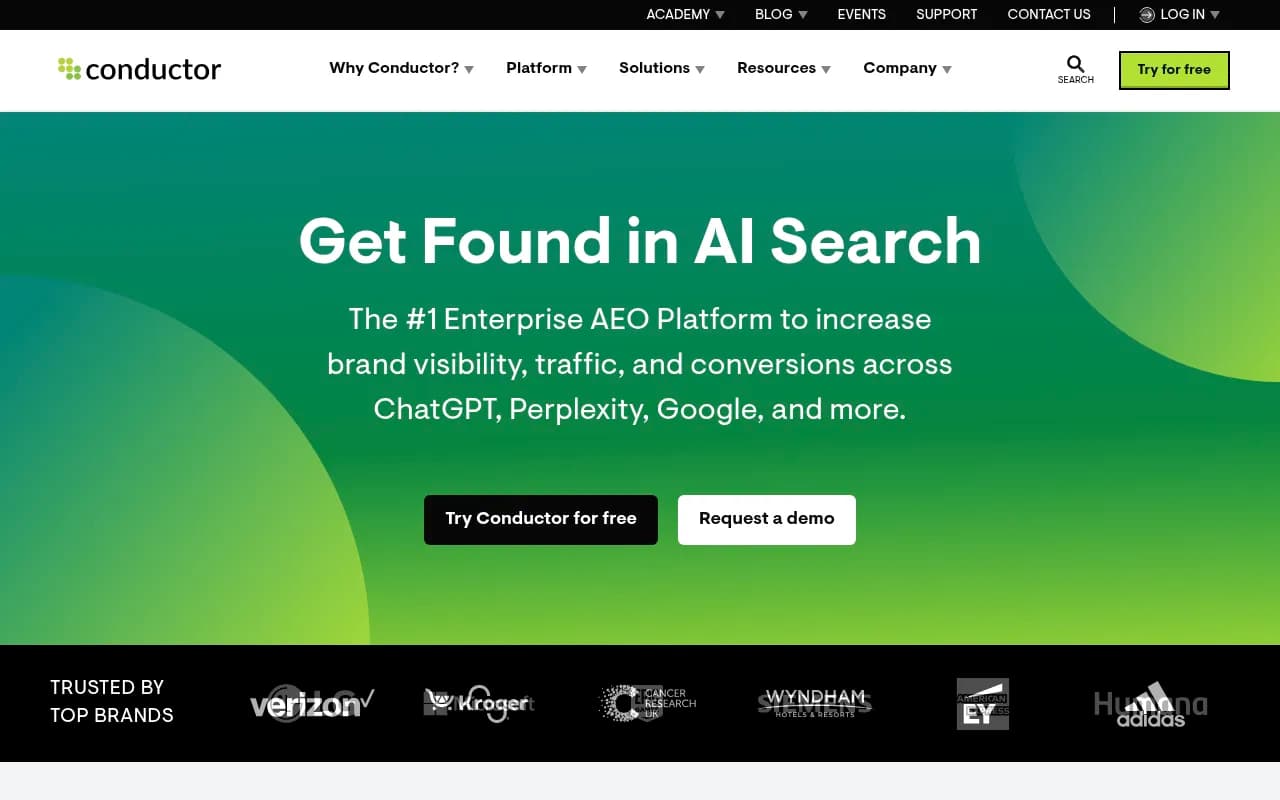
Conductor competes with BrightEdge deal for deal, and in 2026 it leads with answer engine optimization. Its documentation lists nine engine options, including ChatGPT, Claude, Gemini, Google AI Mode, AI Overviews, Grok, Copilot and Perplexity, though its marketing pages list fewer. That gap is worth asking about in a demo.
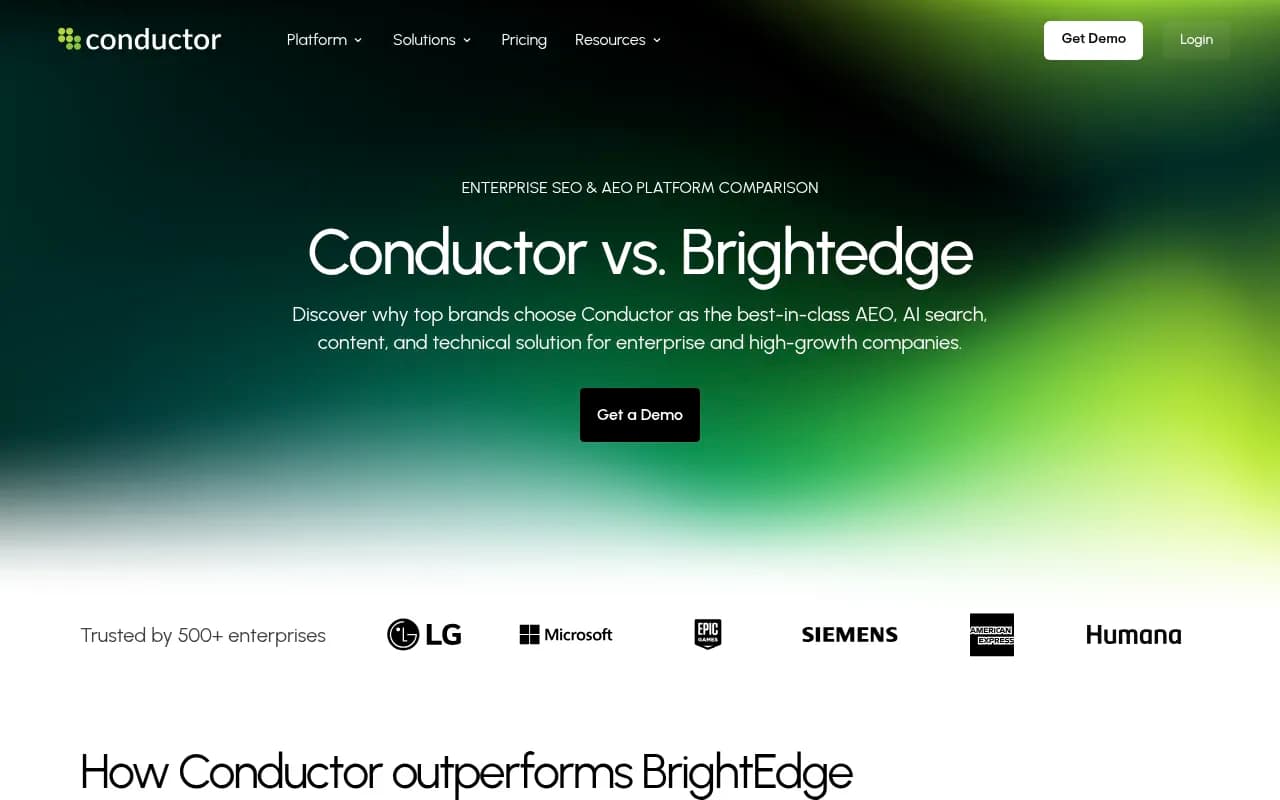
In April 2026 Conductor launched AgentStack, an enterprise suite with native apps for ChatGPT, Claude and Microsoft Copilot, plus APIs and an MCP server. It also publishes benchmark research: its 2026 AEO/GEO report analyzed 3.3 billion sessions across 13,000+ enterprise domains and found AI-referred sessions at roughly 1% of traffic, growing 527% year over year.
Pricing is not public above the entry tier. The Essentials plan (500 tracked keywords, 1,000 pages analyzed, three monitored websites) has a free trial. Growth adds 2,500 AI search credits a year. Enterprise is custom. Credits counted per year is the detail I would push on, because AI tracking can burn through a fixed allowance faster than people expect.
Where Conductor is strong: usability for non-technical stakeholders, dedicated customer success managers, and a readable Share of Voice view that executives can follow.
Where to be careful: a Forrester-style analyst score cited by one comparison site rates it well, but another source says closed-loop attribution still needs manual work and execution is left to your CMS and engineers. One independent critique argues the real problem for lean teams is volume. The platform surfaces more recommendations than a three-person team can ship.
BrightEdge: the technical SEO command center
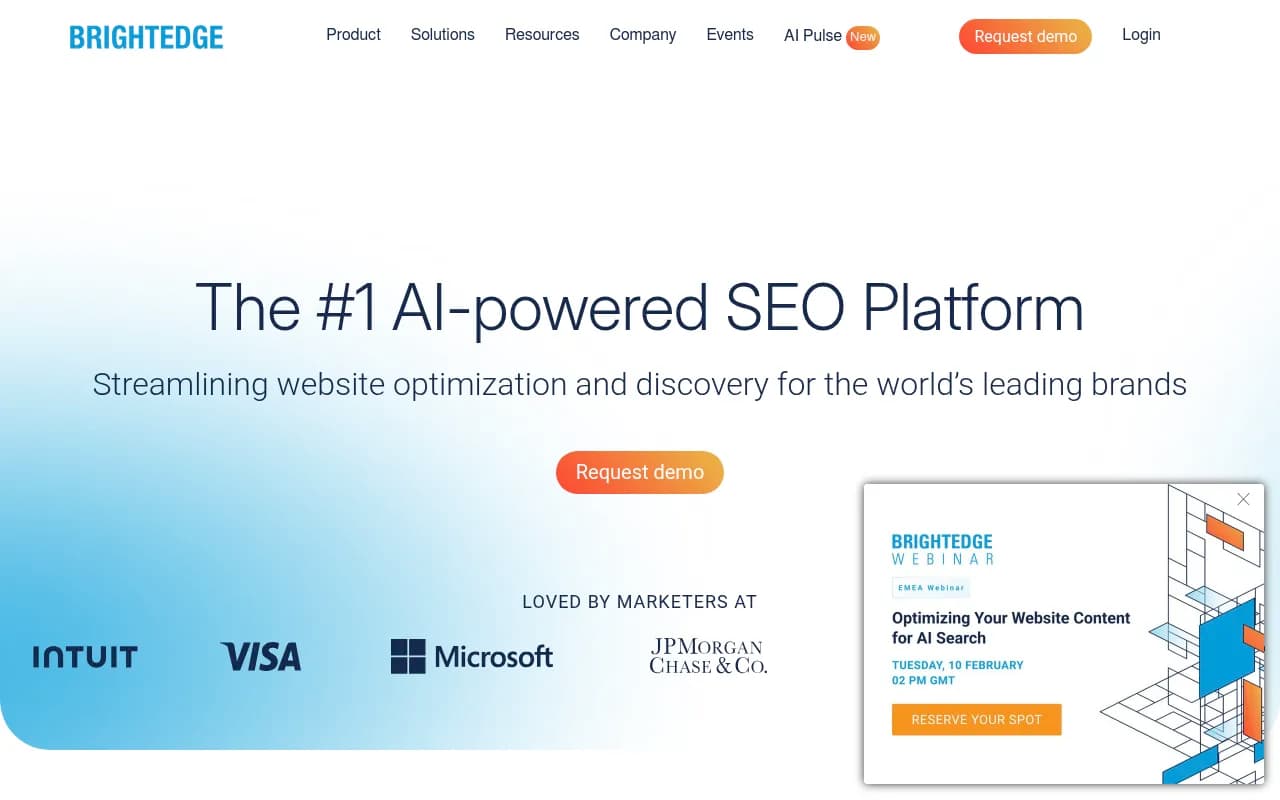
BrightEdge sells itself on one idea: organic search as a measurable business outcome. It is the more technical of the two big suites. One comparison puts it bluntly: BrightEdge is better for technical SEO teams, Conductor is better for content teams.
Its AI visibility comes through AI Catalyst, which it says is included in all BrightEdge SEO Platform subscriptions. That is a real selling point for existing customers. In August 2026 it launched Agent Edge, which serves agent-ready content to AI agents and monitors their visits. BrightEdge also has a Site Agents Suite for technical fixes and an MCP connection.
The weak spots are about transparency. The AI Catalyst page names only three engines. BrightEdge's launch materials mention Gemini, Claude, Copilot and DeepSeek in traffic statistics, but seoClarity could not confirm they are tracked. There is no public pricing, and one roundup noted the pricing URL returned a 404. Another source says onboarding takes months and assumes dedicated SEO headcount.
Its trust page lists SAML/SSO, and it claims 50%+ of the Fortune 500 as customers. Good fit: an existing BrightEdge customer who wants AI reporting inside the subscription already paid for.
Botify: crawl and indexation at massive scale
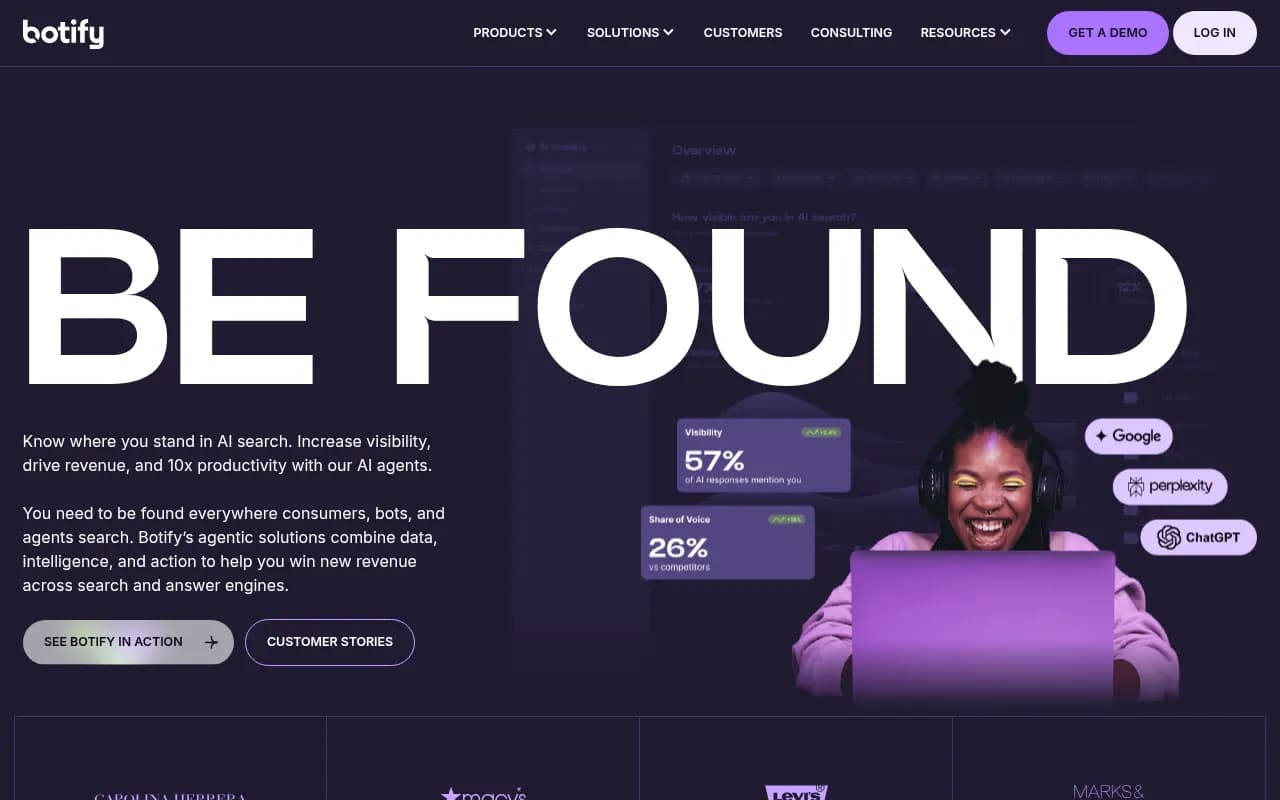
Botify is the odd one out in this group. It is not trying to be a content workflow tool. It is a technical platform for sites with millions of URLs, where crawl budget, indexation and log analysis are the daily problems.
Its AI visibility offering names three to five engines depending on the page, and its FAQ names only the first three. It states submission of content to "search and AI engines" through SmartIndex and can serve content to visiting bots. Pricing is not published and enterprise controls and security details are not published either, which will matter to procurement teams.
The G2 listing is 4.4 from 80 reviews, far fewer than the other two suites, and it covers the broader platform. Botify's honest pitch is that if crawl and log analysis at huge scale is your bottleneck, it is built for exactly that. If you need content planning or deep AI tracking, you will probably pair it with something else.
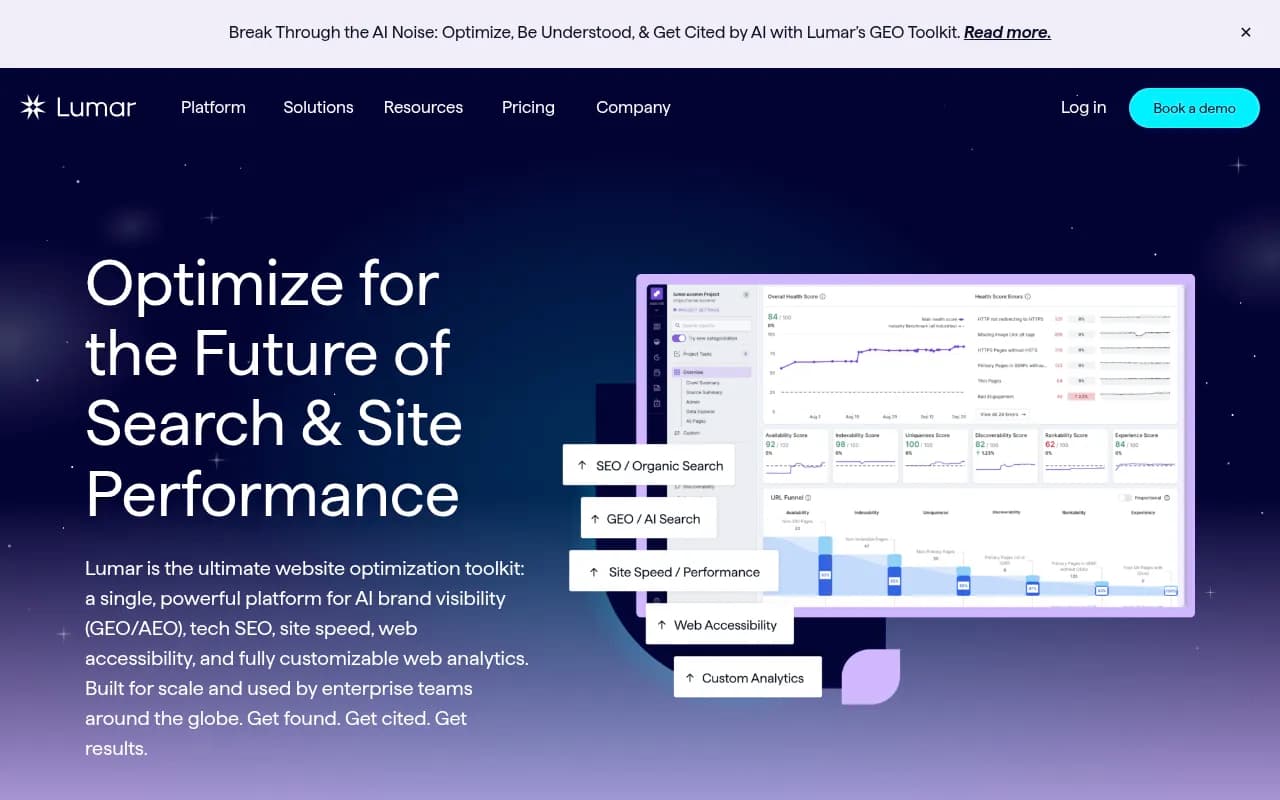
A related category worth knowing is Lumar, which competes on technical crawling plus accessibility and QA.
Promptwatch: AI visibility first, then the fix
Promptwatch comes at the problem differently. Where the suites report on AI visibility as one module among many, it is an AI search visibility and GEO platform that closes a loop: monitor what AI says about you, trace where it gets its answers, act on the gaps, and measure whether the fix worked.

A few things set it apart from the three suites:
- It collects answers from the real interfaces of ChatGPT, Google AI Overviews, AI Mode, Copilot, Gemini, Perplexity, Meta AI and Amazon Alexa in each country and language, rather than relying only on APIs. User-facing answers and citations can differ from API output.
- IP-verified AI crawler logs show whether GPTBot, ClaudeBot, PerplexityBot and others actually read a page, where they hit errors, and whether that crawl turns into a citation. That separates an access problem from a content problem.
- The Content Agent plans, writes and publishes pages against your visibility gaps to WordPress, Webflow or Framer, with a review inbox or fully hands-off. Page Tracker and visitor analytics then show whether the page gets cited and sends traffic.
- Brand Narrative pulls the individual claims AI makes about you, and Fact Check flags which of your pages teach it something wrong.
- It tracks Reddit, YouTube, LinkedIn and Instagram citations, plus ChatGPT Shopping and Ads Radar.
- It is ISO/IEC 27001 certified and GDPR compliant, with SSO, audit logs and a white-label portal on higher tiers.
Pricing is published: Essential $95/mo, Professional $245/mo, Business $579/mo (first plan with the Content Agent, hourly tracking and local targeting), agency plans from $199/mo, and custom Enterprise. Confirm at promptwatch.com/pricing. There is a 7-day free trial on monthly billing and a free AI visibility report.
Honest limits: Promptwatch is not a full classic SEO suite. It brings in Search Console and Bing data and runs weekly site audits, but it does not replace a million-URL crawler like Botify or a keyword-and-backlink platform. Teams that need deep legacy SEO workflows will still want a suite beside it.
On proof, Crisp saw 2x higher conversion rates from AI traffic than traditional channels, and TreeHouse (Pararius) grew AI search to roughly 25% of organic conversions. Read the Crisp case study.
Why per-engine data matters
One reason to be picky about tracking depth: AI engines behave very differently. According to Promptwatch Data on average sources per response, ChatGPT cites about 5 sources per web-search answer, while Google AI Overviews and Perplexity each cite around 10. Copilot swung from under 2 to nearly 17 within a few weeks. A platform that reports one blended score hides all of that.
Crawler behavior is shifting too. Promptwatch's AI crawler traffic report (June 8 to September 6, 2026) shows OpenAI's share of verified AI crawler requests falling from 94.8% to 79.8%, as other operators grew. If your platform cannot show your own bot logs, you cannot compare yourself against that mix. Of the suites, Conductor monitors AI crawlers, while BrightEdge's Agent Edge serves content to visiting agents. Botify can serve content to bots too.
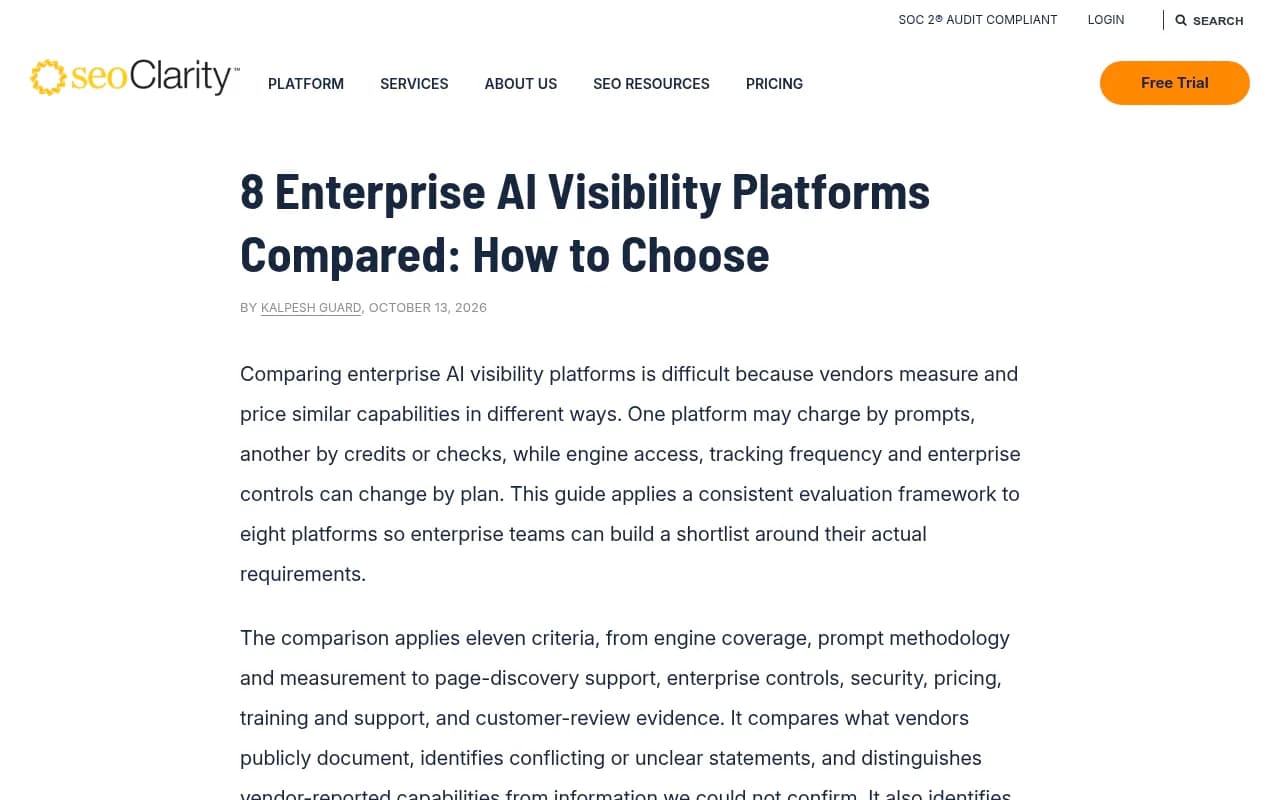
The seoClarity comparison above is useful for its structured grid, but remember its author competes with all of them.
Which team fits which platform
| Your situation | Likely best fit | Why |
|---|---|---|
| Content team that needs to act on search data without technical specialists | Conductor | Easier adoption, dedicated CSMs, accessible reporting |
| Technical SEO org already on BrightEdge | BrightEdge | AI Catalyst is included in the subscription |
| Site with millions of URLs and indexation problems | Botify (or Lumar) | Crawl and log analysis at scale |
| Team that needs to grow AI-driven traffic and revenue | Promptwatch | Tracking plus content creation, crawler logs and traffic attribution |
| Agency managing AI visibility for clients | Promptwatch agency plans | Unlimited projects and prompts from $199/mo |
| Lean team with a backlog it cannot ship | Execution-focused tool (Promptwatch Content Agent, or an automation tool) | Closes the insight-to-action gap |
| Regulated enterprise with strict procurement | Ask all four for security docs | Botify publishes little; others list SSO and certifications |
Stacking rather than choosing
The framing of one winner is often wrong. A common enterprise setup is a suite for classic SEO governance plus a dedicated AI visibility tool. For instance, a retailer might keep Botify for crawl health, and use Promptwatch for prompts, citations and AI traffic. The two do different jobs, and the crawl data helps explain why certain pages never get cited.
If you want the long list of alternatives, the GEO software directory is a useful starting point. Other contenders in the suite tier include seoClarity, Semrush Enterprise and Ahrefs Brand Radar.
How to run a fair evaluation
- Write 30 to 50 prompts your real buyers ask, across branded, competitor and category queries.
- Ask each vendor to run them on the real interfaces of ChatGPT, AI Mode and AI Overviews, not just an API, and to show the raw answers.
- Check how many engines are actually tracked versus what the marketing page says.
- Ask how crawler access is verified. IP-verified logs beat user-agent matching.
- Ask what happens after the insight. Is there a content workflow, CMS publishing, and a way to confirm the fix worked?
- Get pricing in writing, including credit or prompt limits and what counts as an overage.
- Ask for the SOC 2 or ISO 27001 paperwork early.
Bottom line
Pick Conductor if your people are writers and marketers. Pick BrightEdge if you already live there or your SEO team is deeply technical. Pick Botify if your site is enormous and crawl health is the problem. Pick Promptwatch if the goal is to measure and grow what AI engines say about you, and you want the same product to help fix it. For many large teams, the honest answer is two of them together.
If you want to test the AI side quickly, start with the free report or the 7-day trial and run it against your own prompts before you sign a long enterprise contract with anyone.
And if you are weighing whether to hire help instead, agencies such as 1001 SEO Media pair technical SEO with AI search work and use Promptwatch as their GEO platform.