Key takeaways
- Copy.ai and Jasper AI are strong content production tools but neither was designed for Generative Engine Optimization -- they help you write faster, not rank in AI search.
- AirOps bridges the gap with content engineering workflows and some GEO-aware features, but lacks the monitoring and tracking side of the equation.
- Promptwatch is the only platform here built end-to-end for GEO: it tracks your AI visibility, finds content gaps, generates content engineered to get cited, and measures the results.
- If your goal is to appear in ChatGPT, Perplexity, Claude, or Google AI Overviews, the tool you choose matters a lot -- and most writing tools won't get you there.
The question sounds simple: which AI writing tool should you use in 2026? But it splits into two very different questions depending on what you're actually trying to do.
If you want to produce marketing copy faster -- ads, emails, landing pages, social posts -- Copy.ai and Jasper AI are genuinely good at that. They've been refining their content workflows for years and the output quality is solid.
But if your goal is to show up when someone asks ChatGPT "what's the best [your category] tool?" or when Perplexity assembles a recommendation list, that's a different problem entirely. Writing speed doesn't solve it. You need to understand how AI models discover and cite content, find the specific gaps in your coverage, create content that AI engines actually want to reference, and track whether any of it is working.
That's what GEO (Generative Engine Optimization) is about. And most AI writing tools weren't built for it.
Here's an honest look at all four platforms.
What each tool actually does
Copy.ai
Copy.ai started as a short-form copywriting tool and has evolved into a broader marketing workflow platform. It's genuinely fast at producing marketing content -- ads, email sequences, product descriptions, social copy. The GTM (Go-to-Market) workflows it introduced let teams build repeatable content pipelines without starting from scratch every time.
What it doesn't do: Copy.ai has no visibility into how AI models respond to prompts about your brand. It can't tell you which topics you're missing, which competitors are getting cited instead of you, or whether the content it generates is the kind of content AI engines tend to reference. It's a production tool, not an optimization platform.

Jasper AI
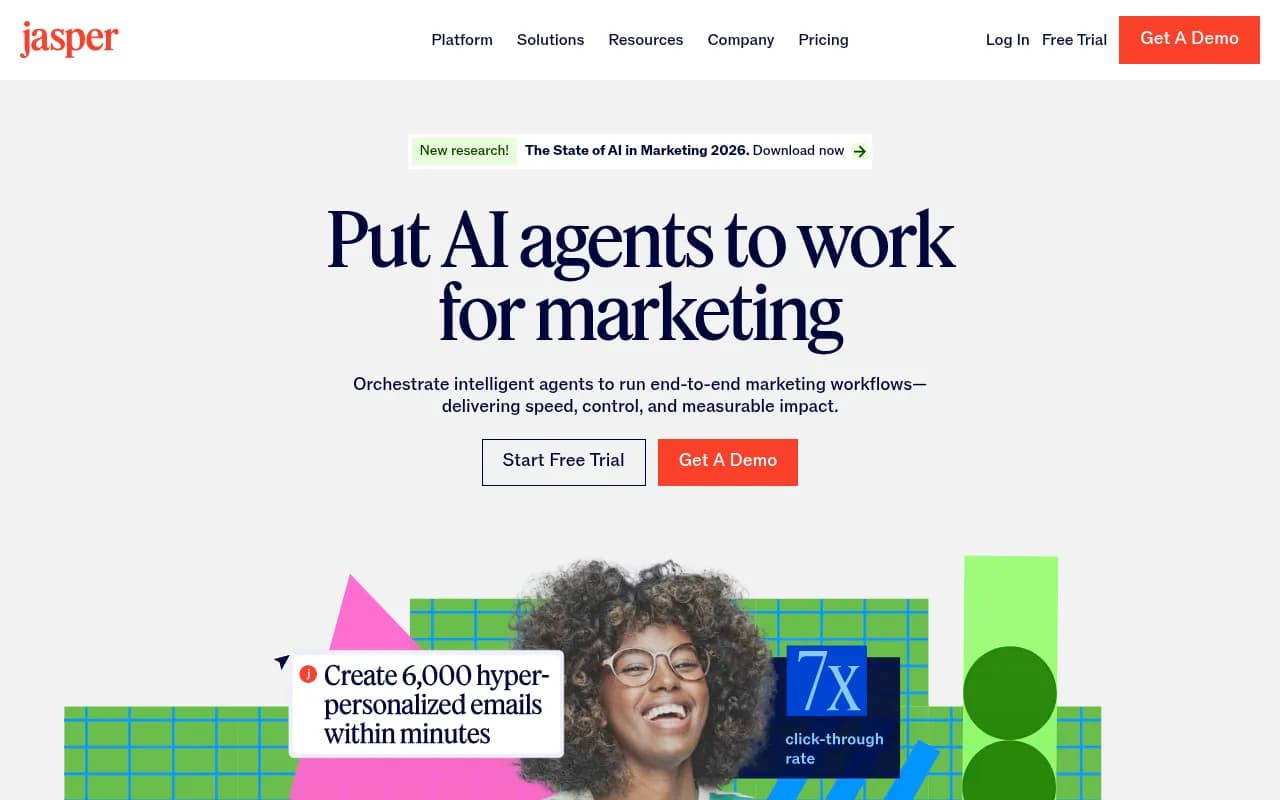
Jasper is probably the most feature-rich pure writing platform in this comparison. It has brand voice controls, a document editor, campaign workflows, and integrations with tools like Surfer SEO for keyword optimization. For teams producing high volumes of long-form content, it's a serious option.
The SEO angle is real -- Jasper's Surfer integration means you can write content that's optimized for traditional search. But traditional SEO and GEO are different games. Optimizing for keyword density and backlinks doesn't directly translate to getting cited by Claude or appearing in Perplexity's answer summaries. Jasper doesn't monitor AI model outputs, doesn't track your brand's AI visibility, and doesn't analyze which prompts your competitors are winning.
AirOps
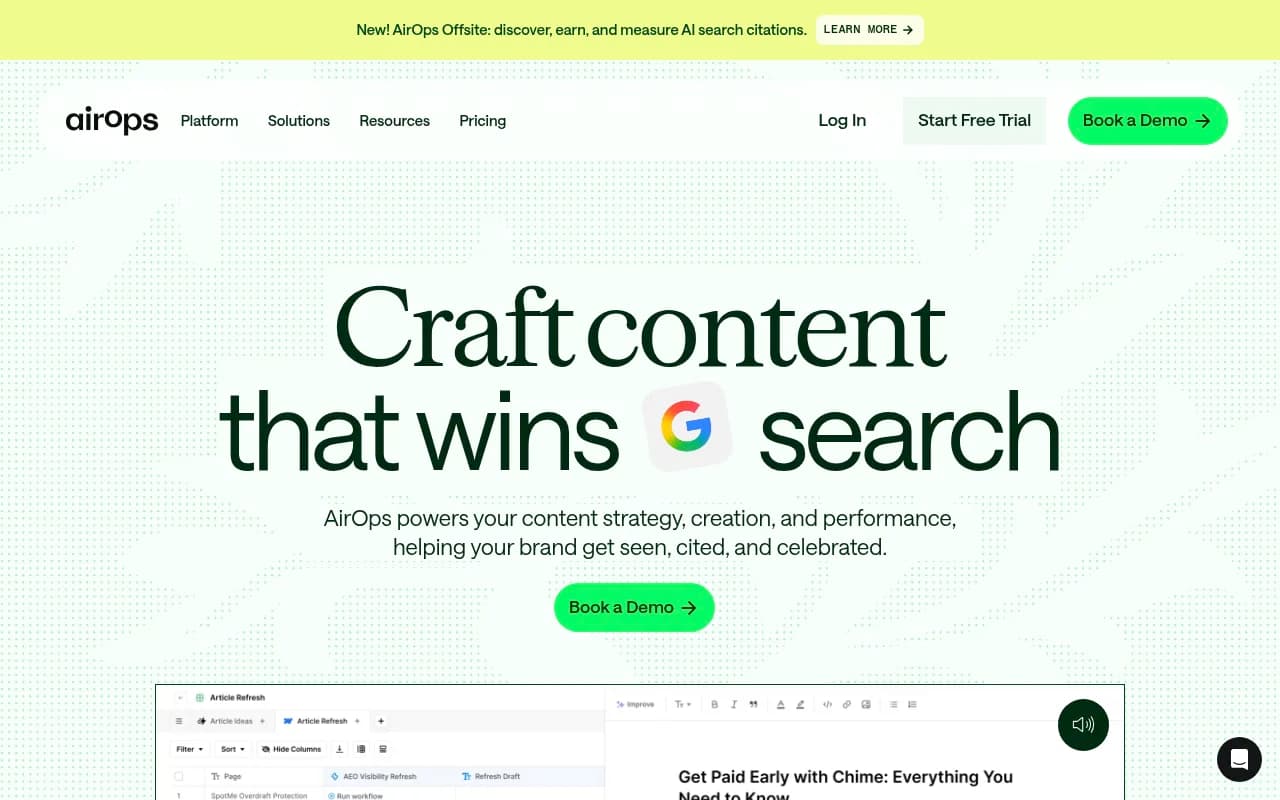
AirOps sits closer to the GEO space than Copy.ai or Jasper. It's positioned as a "content engineering" platform -- the idea being that you build structured workflows for creating content that's designed to rank in AI search, not just traditional search. It has some awareness of how AI models consume and cite content.
Where AirOps falls short is on the monitoring and measurement side. It can help you produce GEO-aware content, but it doesn't give you a real-time picture of your AI visibility, doesn't track which prompts your brand is appearing in (or missing from), and doesn't show you competitor heatmaps across LLMs. You're building content somewhat blind.
Promptwatch
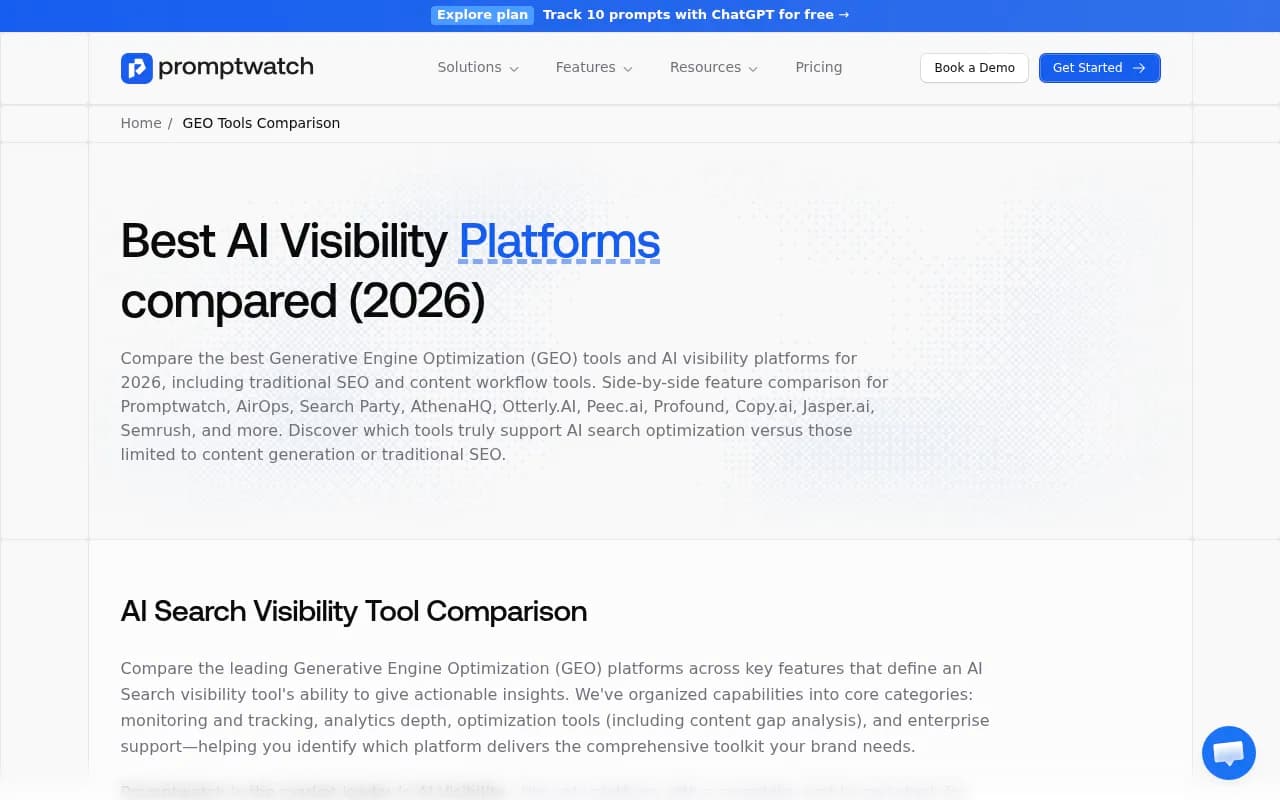
Promptwatch is the outlier here. It's not primarily a writing tool -- it's an AI search visibility platform that happens to include content generation as part of a larger optimization loop.
The core workflow: find where you're invisible in AI search, understand why, generate content specifically designed to fix those gaps, and track whether your visibility improves. That cycle -- gap analysis, content creation, measurement -- is what makes it a GEO platform rather than just another writing tool.

Feature comparison
| Feature | Copy.ai | Jasper AI | AirOps | Promptwatch |
|---|---|---|---|---|
| AI writing / content generation | Yes | Yes | Yes | Yes (GEO-focused) |
| Brand voice controls | Basic | Strong | Moderate | Yes |
| Traditional SEO optimization | No | Yes (via Surfer) | Partial | No (GEO-focused) |
| AI search visibility tracking | No | No | No | Yes (10 AI models) |
| Prompt volume & difficulty scoring | No | No | No | Yes |
| Answer gap analysis | No | No | No | Yes |
| Competitor AI visibility comparison | No | No | No | Yes |
| AI crawler logs | No | No | No | Yes |
| Citation & source analysis | No | No | No | Yes |
| Reddit & YouTube insights | No | No | No | Yes |
| ChatGPT Shopping tracking | No | No | No | Yes |
| Traffic attribution (AI to revenue) | No | No | No | Yes |
| Multi-language / multi-region | Limited | Yes | Limited | Yes |
| Free trial | Yes | Yes | Yes | Yes |
| Starting price | ~$49/mo | ~$49/mo | Custom | $99/mo |
The table makes the split obvious. Copy.ai and Jasper are content production tools. AirOps is content engineering with some GEO awareness. Promptwatch is the only one with a full monitoring-to-optimization stack.
The GEO problem none of the writing tools solve
Here's the thing that often gets missed in these comparisons: producing more content doesn't automatically improve your AI search visibility.
AI models like ChatGPT and Perplexity don't cite content because it's well-written or because it's optimized for keywords. They cite content because it's the most authoritative, specific, and comprehensive answer to a particular question -- and because their crawlers have actually found and indexed it.
If you don't know which questions AI models are asking (and failing to find answers for on your site), you're guessing. If you don't know which of your competitors are being cited instead of you, you're flying blind. And if you can't measure whether your new content is actually improving your AI visibility, you have no feedback loop.
Copy.ai, Jasper, and AirOps all leave you in that position. You can produce content with them, but you don't know if it's the right content, and you can't tell if it's working.
Promptwatch's Answer Gap Analysis shows you the specific prompts where competitors appear and you don't. That's not a vague "content gap" report -- it's the exact questions AI models are answering with your competitor's content instead of yours. You can then use Promptwatch's built-in writing agent to generate articles targeting those gaps, grounded in citation data from 880M+ analyzed citations. Then you track the results at the page level, across all 10 major AI models.
That's a closed loop. The writing tools don't have one.
Who should use what
Use Copy.ai if...
You need to produce marketing copy at volume and speed is the priority. It's genuinely good for short-form content, GTM workflows, and teams that need to ship a lot of assets fast. Just don't expect it to move the needle on AI search visibility.
Use Jasper AI if...
You're running a content team that produces long-form articles for traditional search and you want brand voice consistency across writers. The Surfer SEO integration is useful if Google rankings are your primary goal. For GEO, it won't help much.
Use AirOps if...
You want to build structured content workflows with some awareness of how AI models consume content, and you're comfortable without the monitoring side. It's a reasonable middle ground for teams that already have visibility data from another source.
Use Promptwatch if...
Your goal is to appear in AI search results -- ChatGPT, Perplexity, Claude, Google AI Overviews, Gemini, and others. It's the right tool if you want to understand your current AI visibility, find the specific gaps, create content engineered to close them, and measure the results. It's also the right choice if you want to track AI crawler activity on your site, monitor competitor visibility, or connect AI appearances to actual traffic and revenue.
A note on pricing and value
Copy.ai and Jasper both start around $49/month, which makes them accessible for small teams. But you're paying for writing speed, not GEO results.
Promptwatch starts at $99/month for the Essential plan (1 site, 50 prompts, 5 articles). The Professional plan at $249/month adds crawler logs, more prompts, and city-level tracking. For agencies or larger brands, custom pricing is available.
The question isn't which tool costs less -- it's what you're actually buying. If AI search visibility is a business priority, a $49/month writing tool that doesn't track or optimize for AI search isn't cheaper than a $99/month platform that does. It's just less useful.
The bottom line
Copy.ai and Jasper are good at what they're designed for: making content production faster. If that's your bottleneck, either one will help.
But "built for GEO" is a different standard. It means understanding how AI models discover and cite content, tracking your visibility across those models, identifying the specific gaps your competitors are exploiting, and generating content that's engineered to get cited -- not just content that's well-written.
By that standard, only one platform in this comparison qualifies. Promptwatch was built around the GEO problem from the ground up. The others are writing tools that happen to exist in the same era as AI search.
If you're serious about showing up in ChatGPT, Perplexity, or Google AI Overviews in 2026, that distinction matters.