Key takeaways
- Profound, Scrunch, Bluefish, and Evertune solve different enterprise problems: workflow execution, AI-ready page delivery, brand safety and accuracy, and statistically defensible measurement.
- Funding, pricing, and capability claims differ a lot between sources. Most comparison posts are written by one of the vendors, so treat them as shortlist input, not verdicts.
- Ask every vendor to report citations per engine separately. Slot counts differ by engine, so a blended visibility score hides things.
- Crawler analytics are only trustworthy when they rely on IP-verified logs, not user-agent strings.
- Run at least one demo against a rival that solves the same problem differently, and write down who owns the action layer on your side before you sign.
Why a shortlist is harder than it looks
Every GEO platform sells roughly the same pitch: see how ChatGPT, Gemini, Perplexity, and Google AI Overviews talk about your brand, then fix it. The differences sit underneath. Where does the data come from? Who acts on the findings? What happens when the AI says something wrong?
The four names that come up most often in enterprise conversations are Profound, Scrunch, Bluefish, and Evertune. They are not interchangeable, and a fair amount of the comparison content online is written by one of them. Profound's own pages favor Profound. Evertune's pages favor Evertune. Even Meikai's buyer's guide, which is where some of the framing below comes from, opens by admitting that Meikai is one of the platforms listed and that it is a vendor's point of view, not a benchmark.
So this guide does something modest. It lays out what each vendor says publicly, flags where sources disagree, and gives you a way to test the claims yourself.

The short version: what each platform is for
Meikai's framing groups the platforms by buying situation, and it holds up reasonably well. Profound is workflow-led. Bluefish is execution-led, with a broad marketing suite. Scrunch is led by technical readiness and execution. Evertune is a measurement company at heart.
| Platform | Core idea | Closest buying situation | Main watch-out |
|---|---|---|---|
| Profound | Full AEO program: prompt volumes, agents, crawler analytics, shopping | Workflow-led, large marketing org | Can be heavy if you only need a small prompt set |
| Scrunch | Monitoring plus an Agent Experience Platform that serves AI-ready pages to bots | Technical readiness and delivery | Content generation reported as not shipped; prompts are configured, not sourced from real conversations |
| Bluefish | Five modules: Monitoring, GEO Optimization, Measurement, Commerce, Accuracy | Regulated or reputation-sensitive brands | Reported rigid prompt customization and no real prompt-volume data |
| Evertune | Panel-based measurement of AI visibility and brand perception | Brand and insights teams | Procurement commitment; topic-level rather than prompt-level demand |
That table is a starting position, not a conclusion. Each of those watch-outs comes from a competitor or third party in at least one source, so verify them in a demo.
Profound
Profound is the market's most visible enterprise vendor, and it is also the one with the biggest surface area. Its public materials cover Answer Engine Insights (share of voice, sentiment, citations, regions, personas), a Prompt Volumes dataset built on 1.5B+ real user conversations, Agent Analytics for bot crawl and referral data, shopping analysis, and Agents that research, draft, and publish content. It has integrations with GA4, Tableau, Slack, Cloudflare, Fastly, AWS CloudFront, Vercel, Netlify, and the Claude connector, and it lists HIPAA compliance and SOC 2 Type II.
Profound

Funding figures conflict, which is a good example of why you should date every number. One third-party post cites a $96M Series C at a $1B valuation led by Lightspeed in February 2026. Another roundup lists $155M raised in total. Profound's own comparison page references a $180M Series D at a $1.8B valuation. The last one is vendor-authored and the most recent, so check it before you quote it.
Who it fits: a large marketing organization that already has someone whose job is to act on data. One reviewer put it bluntly: if nobody owns the findings, you are paying enterprise SaaS prices for a dashboard you check once a month. I think that is fair, and it applies to every platform on this list.
Scrunch
Scrunch's distinct move is the Agent Experience Platform (AXP), a delivery layer that serves AI-optimized versions of your pages to crawlers without changing the human-facing site. Alongside that it has prompt and citation monitoring, site maps, technical audits, and agent analytics. Grailstar frames the question well: it is useful when you are asking not just "are we mentioned?" but "can agents access and understand the experience we built?"
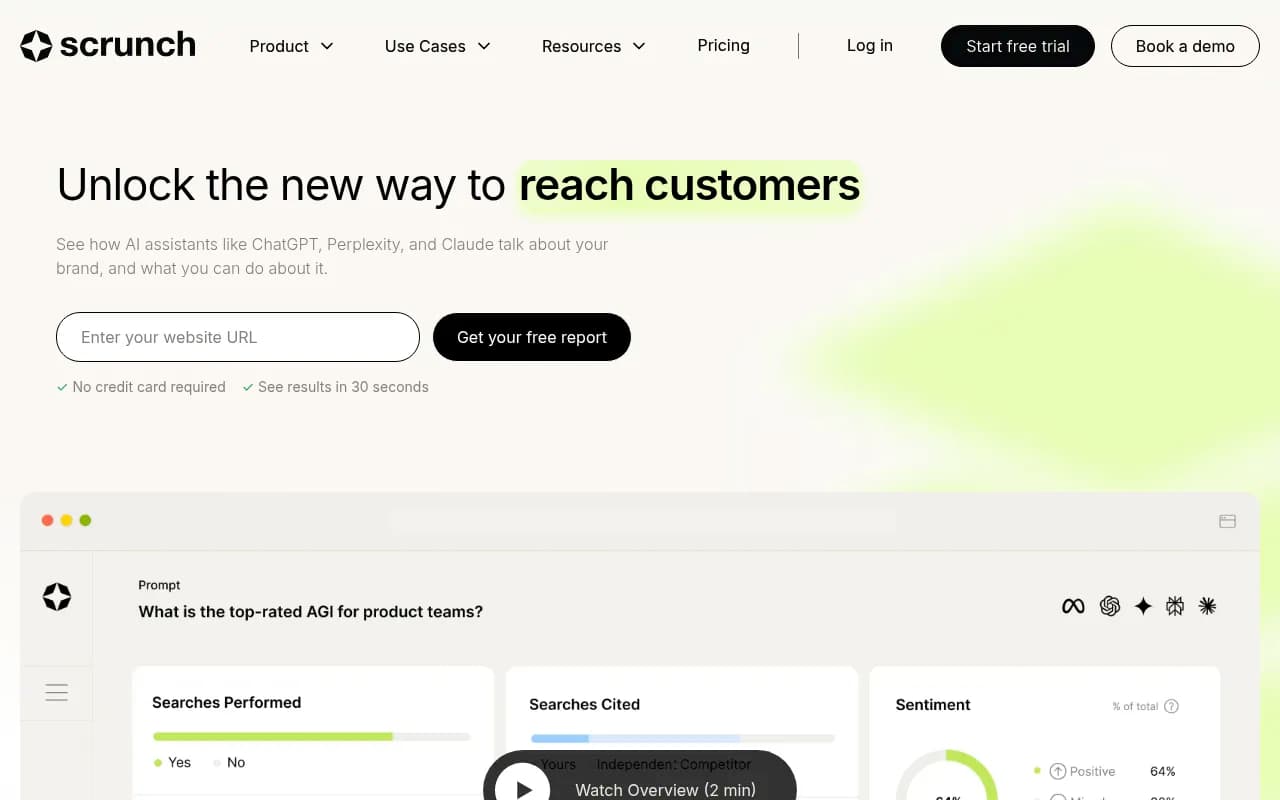
One roundup says Scrunch became a Sitecore company after an acquisition in June 2026, with 500+ brands as customers and a $26M Series A. I could not verify Scrunch's current funding or AXP pricing, so confirm both. If you run Sitecore already, the acquisition is worth asking about directly. If you do not, ask what it means for the roadmap.
The tradeoffs, per Profound's comparison page (so discount accordingly): content generation is not shipped yet, and monitored prompts are configured rather than sourced from real conversations. The same source notes engine coverage up to 9 on the Enterprise plan.
Who it fits: teams with engineering capacity and complex product catalogs. Separate the monitoring, optimization, and delivery-layer requirements in your evaluation. You might need the observability without wanting every infrastructure capability.
Bluefish
Bluefish sells a platform: Monitoring, GEO Optimization, Measurement, Commerce, and Accuracy. The Accuracy module is the distinctive one. For a bank, a pharma company, or a brand with complex products, an AI stating a false fact is a risk issue, not a marketing metric.
Menra reports $68M raised in total, including a $43M Series B in April 2026. One roundup claims 80% of customers are Fortune 500, with Adidas and Tishman Speyer named. Pricing is not published and is sales-led.
The caution, from Grailstar, is the one I would tattoo on every procurement checklist: accuracy monitoring only helps when you have a maintained source of truth and a clear correction workflow. Who approves facts? How do corrections reach outside sources or AI platforms? If you cannot answer that internally, the module will generate alerts nobody acts on.
Some sources also flag gaps. One said Bluefish did not support Claude, Copilot, AI Mode, or DeepSeek as of late 2025. Profound's page calls it early-stage with rigid prompt customization. Both are dated or biased, so test coverage against your target engines before you buy.
Evertune
Evertune's pitch is measurement rigor. According to Botric's write-up, it samples each prompt 100 times across 10+ models and blends in consumer-app data and a consumer panel. Evertune's own page lists 11 platforms, an AI Brand Index (0-100), Consumer Preferences, Word Association, Content Analytics, Content Studio, AI Usage, and Prompt Volumes. It was founded by early Trade Desk team members.
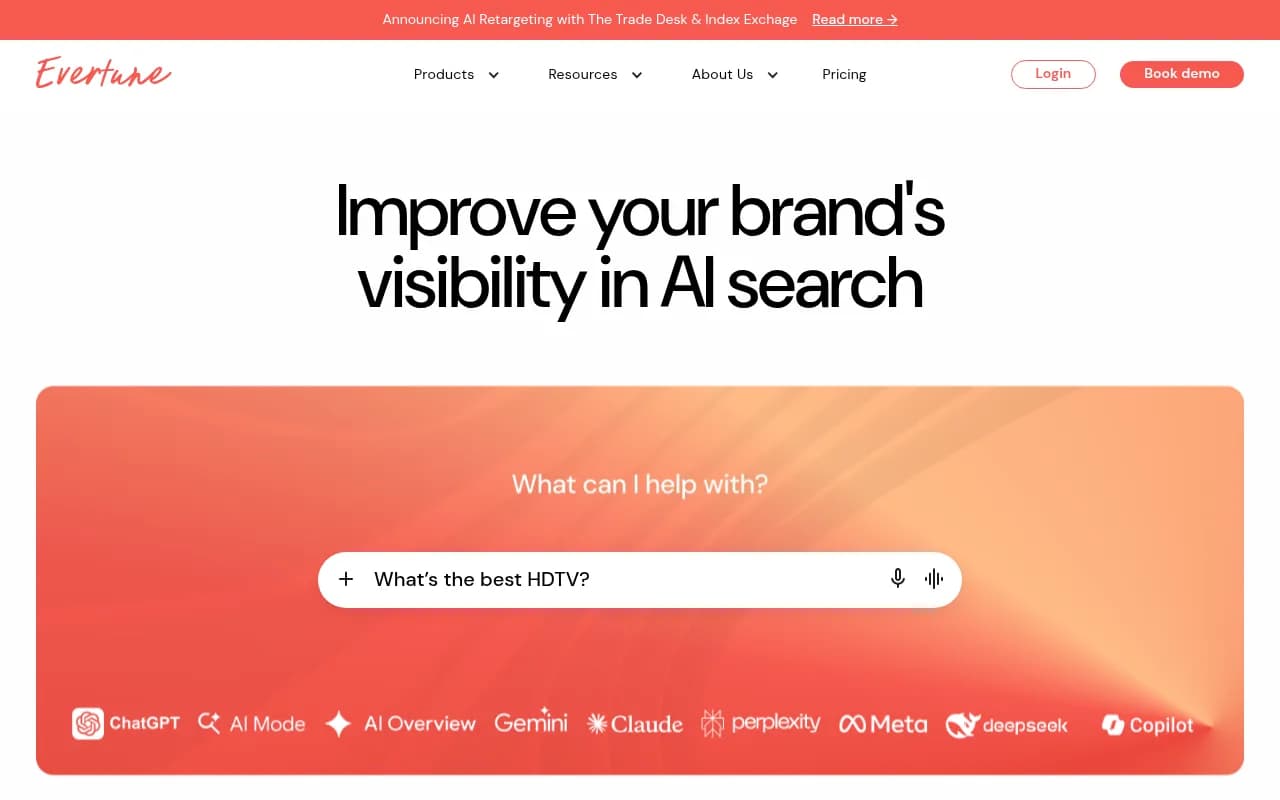
The panel size is another place sources disagree. Evertune's own page describes EverPanel as 25 million real internet users. Menra says roughly 150 million. Ask Evertune which is current and how it is weighted.
Pricing conflicts too. Menra says it is not published and demo-led. A third-party post says there is a Pro plan at $800/mo plus a custom Enterprise tier, and Botric says $3,000/mo with no free trial. Check evertune.ai/pricing yourself. Also ignore the claim that Evertune is "limited to SMBs": that came from a third-party comparison and runs against its Fortune 500 positioning. Funding is reported at roughly $19M to $20M depending on the source.
Who it fits: brand and insights teams, especially in automotive, pharma, or financial services, who need numbers they can put next to traditional brand tracking. Gartner listed it as a Representative Vendor in its 2026 Market Guide for Answer Engine Visibility Tools, according to Botric.
Head-to-head: the dimensions that matter
| Dimension | Profound | Scrunch | Bluefish | Evertune |
|---|---|---|---|---|
| Primary strength | Workflows, prompt volumes, agents | AI-ready page delivery, citation intelligence | Brand safety, accuracy, commerce | Statistical measurement, consumer panel |
| Action layer | Agents, content workflows | AXP delivery layer | Limited per one roundup | Content Studio |
| Pricing visibility | Custom; one source lists $99 Starter and $399 multi-engine | One source lists $250/mo | Not published | Conflicting: not published vs $800/mo Pro |
| Compliance noted in sources | SOC 2 Type II, HIPAA | Not confirmed | Not confirmed | No published SOC 2 Type II per one source |
| Best when | You have a team to run a full AEO program | Engineering can deploy a delivery layer | Misrepresentation is the risk | You must defend the numbers to a board |
Treat the pricing row with suspicion. I found no confirmed current pricing for Profound, Scrunch, or Bluefish, and the entry-level figures come from roundups that may be stale.
Questions that expose real differences
These work better than a feature checklist.
Where does the prompt set come from?
Some platforms track prompts you configure. Others source them from real conversation data. Ask for the method, sample size, and refresh cadence. Ask whether the prompts reflect your customers or a model's guess.
How are citations counted per engine?
Promptwatch Data's average sources per response report found that ChatGPT cites about 5 sources per web-search answer, Google AI Overviews about 10, and Perplexity almost exactly 10 every day. Copilot swung from under 2 to nearly 17 within a few weeks. That report is dated September 2025, and the ChatGPT average drifts with model and retrieval updates, but the lesson stands: a blended visibility score hides these differences. Make each vendor show citations per engine separately.
Are the crawler logs verified?
If a platform offers crawler analytics, ask whether it uses IP-verified logs. Promptwatch's AI crawler traffic data counts only requests whose source IP matches the operator's published ranges, which excludes spoofed user agents. In that data, OpenAI made up 79.8% of verified AI crawler requests from Aug 31 to Sep 6, 2026, down from 94.8% in Jun 8 to Jun 14. The report's advice is useful in a vendor test: compare your own logs against that mix, and if a provider is large in the chart but near zero in your logs, you may be blocked by robots.txt, a CDN, or a WAF rule.
Who owns the fix?
For each finding, ask what happens next. Profound's agents can draft and publish. Scrunch's AXP can serve altered pages. Bluefish flags inaccuracies. Evertune drafts posts in Content Studio. None of that matters without an owner on your side. Name the person before the pilot starts.
What does the contract cover?
SSO, role-based access, audit logs, API and MCP access, and multi-brand structure are table stakes for enterprise. Packaging varies by plan, market, and contract, as Meikai itself notes, so settle details in a trial and not from a features page.
A note on the benchmark problem
Most sources here are biased in one direction or another. Profound's pages favor Profound, Evertune's favor Evertune, and funding numbers were captured at different dates. Two sources disagree on Evertune's panel size and on whether its pricing is public. That is normal for a young category. Cite the date next to every figure, and verify anything you plan to put in a business case.
Other platforms worth a look
The four above are not the whole market. Grailstar's enterprise group adds AthenaHQ, Brandlight, and Goodie. Botric's list includes Rankscale, Peec AI, and Semrush Enterprise AIO. SEO-led teams may prefer to extend what they already own.

If you want a platform that covers monitoring and the action layer in one place, Promptwatch tracks the real interfaces of ChatGPT, Google AI Overviews, Gemini, Perplexity, and others, and adds IP-verified crawler logs, visitor analytics, and a Content Agent that plans and publishes content against your gaps. It is ISO/IEC 27001 certified and GDPR compliant, which helps with security reviews.

For a wider view of the category, the GEO software directory at bestgeosoftware.com lists more options by capability.
Running the evaluation
A reasonable process looks like this.
- Write down your single biggest bottleneck: measurement credibility, content production, technical delivery, or brand accuracy. That picks your lead candidate.
- Shortlist two vendors that solve it differently. A demo against a rival that frames the problem differently teaches more than two demos of similar products.
- Give each the same 30 to 50 prompts, drawn from your real customer questions, and the same markets and languages.
- Compare per-engine citations, not blended scores. Check whether results are stable across days.
- Check crawler analytics against your own server logs.
- Map each finding to a named owner and a deadline.
- Get pricing, seat limits, response volumes, and contract terms in writing.
Match the lead candidate to the bottleneck like this:
- Measurement you can defend to a board: start with Evertune.
- Brand safety and false-claim risk: start with Bluefish.
- AI-ready delivery and technical access: start with Scrunch.
- A full program with agents and workflow automation: start with Profound.
Who sells the platform matters less than who runs it on your side. If you do not have the team, consider whether an agency partner should handle the program. 1001 SEO Media works on GEO and AI search visibility alongside technical SEO, which is the kind of help enterprise teams often need to turn platform data into published work.
Bottom line
Profound is the broadest and most visible. Scrunch is the one to examine if serving pages to AI agents matters. Bluefish fits brands where a wrong AI statement is a risk. Evertune fits teams that need measurement they can defend. Pick the one that matches your bottleneck, test it against a rival, and confirm funding, pricing, and coverage claims directly with each vendor before you sign.