Key takeaways
- Profound and Evertune are strong monitoring platforms with enterprise credibility, but both stop short of helping you act on what they find.
- Botify comes from a traditional technical SEO background and is still catching up on pure AI search visibility features.
- Promptwatch is the only platform in this comparison that closes the full loop: find gaps, generate content, track results -- and connect that visibility to actual revenue.
- For teams that want data AND a path to improving their AI search presence, Promptwatch delivers the most complete ROI story.
- Price matters at enterprise scale: Profound and Evertune are significantly more expensive, which raises the bar for proving returns.
If you're evaluating enterprise AI visibility platforms in 2026, you've probably landed on some combination of Evertune, Profound, Promptwatch, and Botify. They're all credible, all used by real marketing teams, and all positioned around the same core idea: your brand needs to show up when AI engines like ChatGPT, Perplexity, and Google AI Overviews answer questions in your category.
But they're not the same product. Not even close.
The differences matter a lot when you're justifying budget to a CMO or trying to show that AI visibility work actually moves revenue. This guide breaks down each platform honestly, with a focus on ROI potential -- not just feature checklists.
What "ROI potential" actually means for AI visibility tools
Before getting into the platforms, it's worth being precise about what ROI means here. Most AI visibility tools measure your share of voice across LLMs -- how often your brand gets cited versus competitors. That's useful data. But data alone doesn't generate returns.
Real ROI from an AI visibility platform comes from a chain of events:
- You identify prompts where competitors appear and you don't (gap analysis)
- You create content that fills those gaps (content generation or optimization)
- AI models start citing your new content (visibility improvement)
- That visibility drives traffic and conversions you can attribute (revenue connection)
A platform that only does step one is a monitoring tool. It tells you there's a problem. A platform that handles all four steps is an optimization engine. The ROI gap between those two categories is enormous -- especially at enterprise scale where you're paying $500-$2,000+ per month.
With that framing in mind, here's how each platform performs.
Evertune
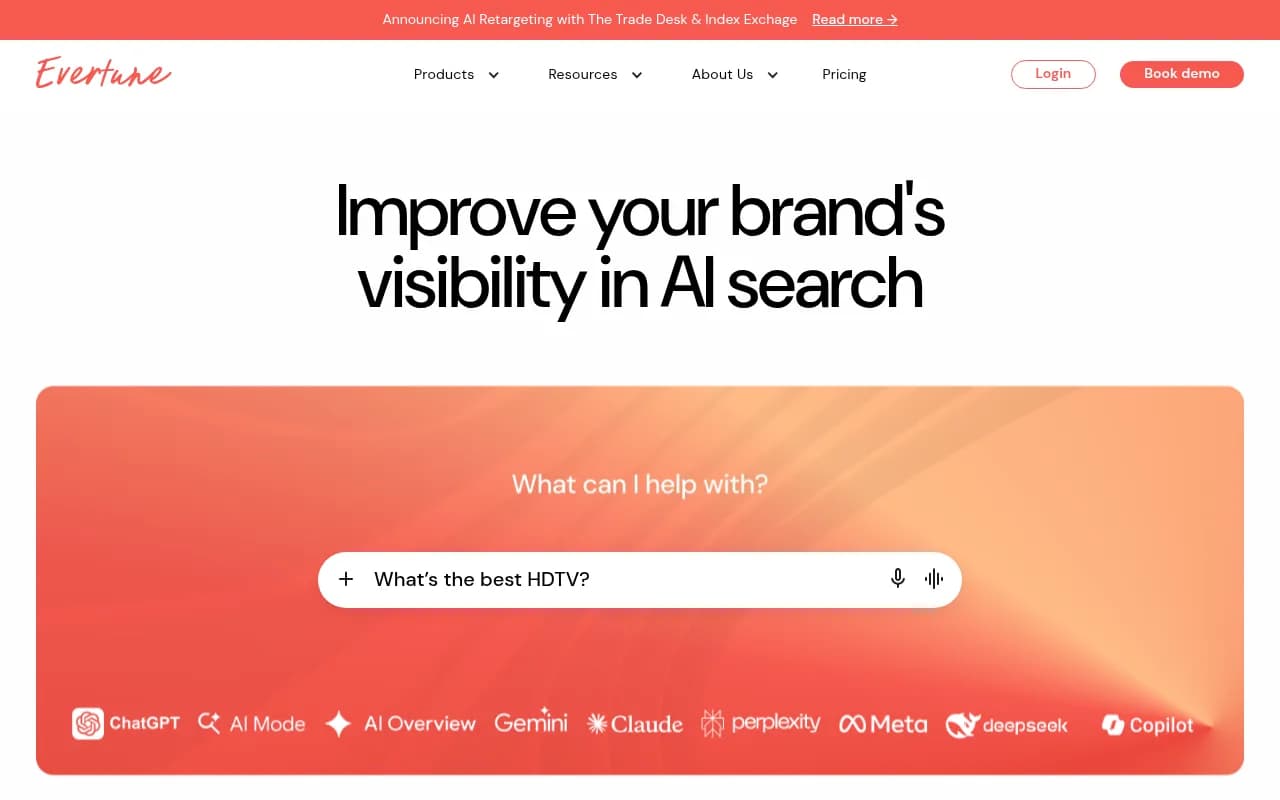
Evertune positions itself as an end-to-end AI visibility platform for enterprise brands, and it does have genuine depth. The platform tracks brand mentions across major AI engines, provides competitive share-of-voice data, and includes brand sentiment analysis that goes beyond simple citation counting. For Fortune 500 teams that care about how they're being portrayed (not just whether they appear), that sentiment layer is genuinely useful.
What Evertune does well:
- Broad AI engine coverage across ChatGPT, Gemini, Claude, Perplexity, and others
- Brand perception analysis alongside visibility metrics
- Enterprise-grade reporting for stakeholder presentations
- Strong positioning for large brands with complex competitive landscapes
Where it falls short on ROI: Evertune's core product is monitoring and analysis. The platform shows you where you're winning and losing visibility, but the path from "we're not being cited here" to "we fixed it" runs through your own team and your own content workflow. There's no built-in content generation, no answer gap analysis that surfaces specific content to create, and no traffic attribution to close the loop with revenue.
For teams with large content operations that just need better data to direct their work, that's fine. For teams that want the platform to do more of the heavy lifting, it's a gap.
Pricing: Evertune targets enterprise accounts and pricing is custom. Expect it to be in the higher tier of this comparison.
Profound
Profound

Profound has built a strong reputation in the enterprise GEO space. The platform covers 10+ AI engines, has processed 400M+ prompt insights according to their positioning, and holds SOC 2 Type II certification -- which matters for enterprise procurement teams dealing with security reviews.
The product is genuinely well-built for monitoring. Prompt tracking is detailed, the competitive benchmarking is solid, and the data quality is generally trusted by the teams using it. One independent analysis gave Profound an AEO score of 92/100, which reflects its strength as a tracking platform.
What Profound does well:
- Comprehensive multi-engine tracking with strong data quality
- SOC 2 Type II compliance for enterprise security requirements
- Detailed prompt-level analytics
- Competitive benchmarking across AI engines
Where it falls short on ROI: Profound is fundamentally a monitoring platform. It tells you what's happening across AI search but doesn't have native tools to help you change it. There's no content generation, no Reddit or YouTube citation tracking (which increasingly influences what AI models recommend), and no built-in traffic attribution. You get excellent visibility data and then need to figure out what to do with it yourself.
That's a real limitation when you're trying to show ROI. Knowing your AI share of voice went from 12% to 18% is meaningful, but connecting that to pipeline or revenue requires work that Profound doesn't help with.
Pricing: Profound is enterprise-priced. Expect significant investment, which means the bar for demonstrating returns is high.
Botify
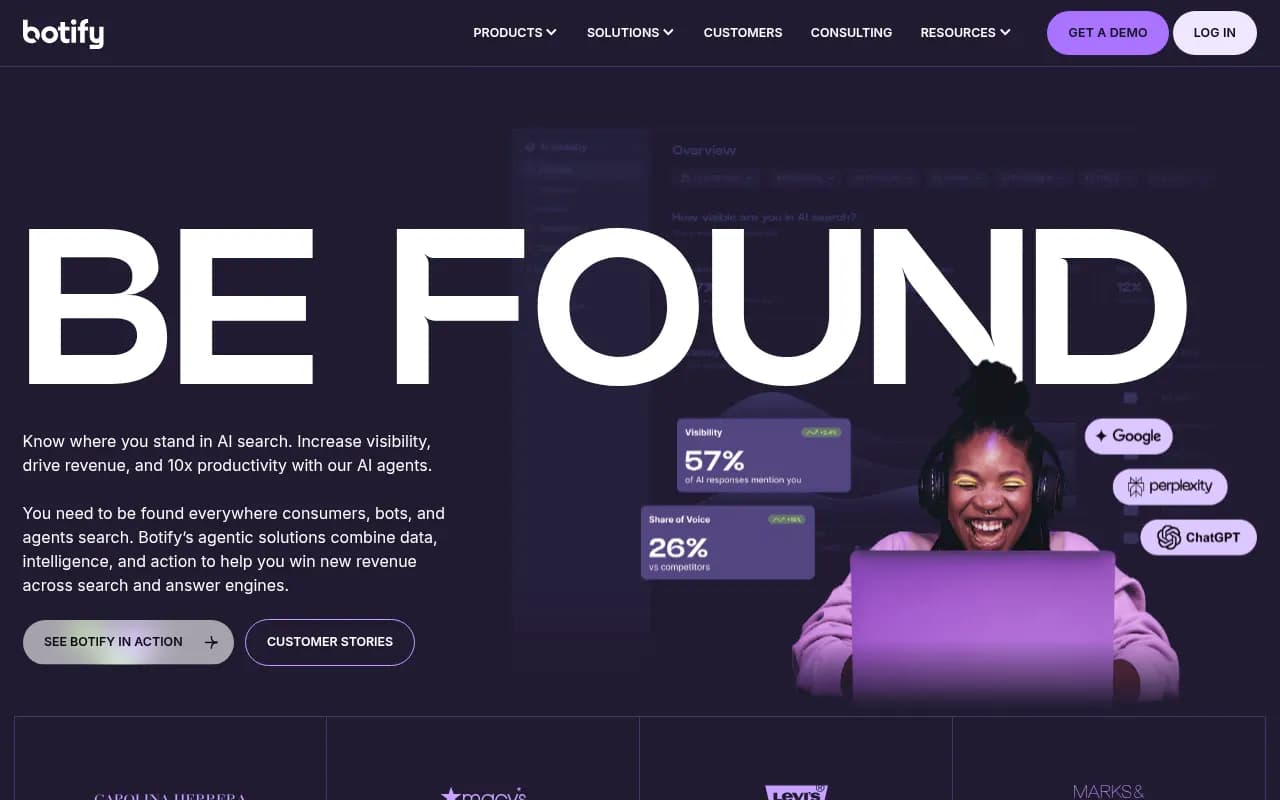
Botify comes at this from a different angle than the other three. It started as a technical SEO platform -- crawling, log analysis, site structure optimization -- and has been expanding into AI search visibility as that category has grown. The result is a platform with genuinely strong technical foundations but a product that's still finding its footing in the GEO space.
What Botify does well:
- Deep technical SEO capabilities (crawling, log file analysis, site health)
- Strong for large-scale websites with complex technical issues
- Established enterprise relationships and procurement processes
- Useful for understanding how AI crawlers interact with your site at a technical level
Where it falls short on ROI: Botify's AI visibility features feel like additions to a technical SEO product rather than a purpose-built GEO platform. The prompt tracking and share-of-voice analysis isn't as deep as Profound or Evertune. Content optimization for AI search isn't a core workflow. And the gap between "technical SEO health" and "AI citation improvement" is wider than Botify's current product bridges.
If your primary need is technical SEO with some AI visibility monitoring layered on top, Botify makes sense. If AI search visibility is your primary objective, you're paying for a lot of technical SEO infrastructure you may not need.
Pricing: Enterprise pricing, custom quotes. Typically positioned as a platform investment for large sites.
Promptwatch

Promptwatch is the platform in this comparison that's built around the full optimization loop rather than just monitoring. The distinction sounds subtle but it changes what the product actually does for you day to day.
The core workflow: Promptwatch's Answer Gap Analysis identifies the specific prompts where competitors appear in AI responses but you don't. Not just "you have gaps" -- but the exact topics, questions, and angles that AI models want to answer but can't find on your site. From there, the built-in AI writing agent generates content (articles, listicles, comparisons) grounded in 880M+ citations analyzed, prompt volume data, and competitor analysis. Then page-level tracking shows which of your pages are being cited, by which AI models, and how often -- with traffic attribution via code snippet, GSC integration, or server log analysis to connect visibility to actual revenue.
That last part matters more than people realize. Most platforms in this space can tell you your AI share of voice is improving. Promptwatch can show you which pages are driving that improvement and what traffic and conversions are coming from AI search specifically.
Additional capabilities worth noting:
- AI Crawler Logs: Real-time logs of ChatGPT, Claude, Perplexity, and other AI crawlers hitting your site -- which pages they read, errors they encounter, how often they return. Most competitors don't have this at all.
- Prompt Intelligence: Volume estimates and difficulty scores for each prompt, plus query fan-outs showing how one prompt branches into sub-queries. This lets you prioritize high-value, winnable prompts instead of guessing.
- Reddit and YouTube tracking: Surfaces discussions that directly influence AI recommendations -- a channel most platforms ignore entirely.
- ChatGPT Shopping tracking: Monitors when your brand appears in ChatGPT's product recommendations and shopping carousels.
- 10 AI models covered: ChatGPT, Perplexity, Google AI Overviews, Google AI Mode, Claude, Gemini, Meta/Llama, DeepSeek, Grok, Mistral, Copilot.
Pricing is also meaningfully different from the enterprise-only alternatives: Essential at $99/month, Professional at $249/month, Business at $579/month. Agency and enterprise plans are available with custom pricing. A free trial is available.
Where Promptwatch has room to grow: The platform is newer than Botify and doesn't have Profound's SOC 2 certification yet, which can slow enterprise procurement in security-conscious organizations. Teams with very large technical SEO needs may still want a dedicated crawler like Botify alongside it.
Head-to-head comparison
| Feature | Evertune | Profound | Promptwatch | Botify |
|---|---|---|---|---|
| AI engine coverage | 6+ | 10+ | 10 | Limited |
| Answer gap analysis | No | No | Yes | No |
| Built-in content generation | No | No | Yes | No |
| AI crawler logs | No | No | Yes | Partial (technical) |
| Traffic attribution | No | No | Yes | Partial |
| Reddit/YouTube tracking | No | No | Yes | No |
| ChatGPT Shopping tracking | No | No | Yes | No |
| Prompt volume & difficulty | No | Partial | Yes | No |
| SOC 2 certification | Unknown | Yes | No | Yes |
| Technical SEO depth | Low | Low | Medium | High |
| Starting price | Custom | Custom | $99/mo | Custom |
| Free trial | Unknown | Unknown | Yes | No |
| Best for | Enterprise brand monitoring | Enterprise monitoring + compliance | Full optimization loop | Technical SEO + AI monitoring |
Which platform delivers the best ROI potential?
The honest answer depends on what your team actually needs.
If you need deep monitoring with enterprise security compliance and your content team will handle optimization independently, Profound is the strongest pure monitoring option. The data quality is good and the SOC 2 certification removes friction from procurement.
If you're a large brand that cares about sentiment and perception alongside citation tracking, Evertune's analysis layer adds value that pure monitoring tools don't offer.
If you're already invested in Botify for technical SEO and want to add some AI visibility monitoring without switching platforms, staying with Botify for the technical layer while adding a specialized GEO tool makes sense.
But if you're asking which platform has the highest ROI potential -- meaning the best chance of turning AI visibility investment into measurable revenue -- Promptwatch wins this comparison. The reason is structural: it's the only platform here that handles the complete chain from gap identification to content creation to traffic attribution. You're not just paying for data; you're paying for a system that helps you act on it.
The pricing difference also matters for ROI math. At $249/month for the Professional plan versus custom enterprise pricing for Profound and Evertune, Promptwatch's break-even point is dramatically lower. A single new customer from improved AI visibility pays for months of the platform.
For most marketing teams evaluating these four options in 2026, the question isn't whether AI search visibility matters -- it clearly does. The question is whether you want a tool that shows you the problem or one that helps you solve it.
How to choose: a practical decision framework
Before signing any contract, run through these questions:
What's your content capacity? If you have a large content team that can act on monitoring data independently, a pure monitoring tool like Profound may be sufficient. If content is a bottleneck, you need a platform with generation capabilities.
How important is traffic attribution? If your leadership wants to see AI visibility connected to revenue, you need a platform with attribution built in. Profound and Evertune don't offer this natively.
What's your security/compliance requirement? If SOC 2 is a hard requirement, Profound or Botify are your options today. Promptwatch is working toward enterprise certifications but doesn't have them yet.
What's your budget flexibility? Promptwatch's transparent pricing makes ROI calculation straightforward. Enterprise-only pricing from competitors makes it harder to model returns before you commit.
Do you have technical SEO needs alongside AI visibility? If yes, Botify's technical depth is hard to match. If AI visibility is the primary objective, a purpose-built GEO platform will serve you better.
The AI search visibility space is moving fast. Platforms that were monitoring-only a year ago are adding optimization features, and the gap between the best and the rest is narrowing. But right now, in mid-2026, the difference between a monitoring dashboard and a full optimization loop is still significant -- and that difference is where ROI lives.