Key takeaways
- Several free checkers (HubSpot AI Search Grader, Ahrefs AI Visibility Checker, Semrush's AI visibility tool, Omnia) let you see how ChatGPT, Gemini and Perplexity describe your brand without a contract.
- Free checks are snapshots. One prompt, one run, one answer is noisy, so run organic, brand-specific and competitor-comparison prompts separately.
- Brand-specific prompts are the best perception test, because their answers draw on fewer sources and each source carries more weight.
- Use free tools to build a baseline and a shortlist. Pay only when you need repeat tracking, citation analysis, or a way to fix what you find.
- Verify each tool's engine coverage and limits on its own page before relying on it. These change often.
Why PR teams should test before they buy
Most AI visibility vendors will happily demo a dashboard full of scores. The problem is that a score tells you very little until you know what the underlying answers look like. PR teams care about something specific: what does the model actually say about us, which claims does it repeat, and which sources does it lean on? A number on a slide does not answer that.
Free tools are a cheap way to get real answers before any procurement conversation starts. They will not replace a monitoring platform. They will tell you whether you even have a perception problem worth paying to track, and they give you a baseline to compare vendors against.
There is a second reason. Going into vendor calls with your own screenshots and your own list of inaccurate claims puts you in control. You stop evaluating the vendor's demo brand and start evaluating your own.
What a free check can and cannot tell you
Be realistic about the limits. Free checkers run a small number of queries, often once, and show you a summary. That is useful for a first look and not much else.
The noise problem is real. Promptwatch Data's analysis of unique domains per ChatGPT response (Sep 28 to Oct 4, 2026) found that 47.6% of ChatGPT responses cite 10 or more different domains, and the picture changes by prompt type:
- Organic prompts (no brand named): 52.5% of responses cite 10 or more domains.
- Competitor comparison prompts: 49.1% cite 10 or more.
- Brand-specific prompts, like "is Asana good for small teams": only 21.3% cite 10 or more, and five domains is the most common count.
Two things follow from this. First, a single organic prompt tells you little, because the answer set is crowded and varies from run to run. Second, brand-specific prompts are where perception gets formed. With fewer sources in play, the review sites and forums that do get cited have outsized influence on how the model describes you.
So when you use a free tool, treat the output as a hypothesis, not a verdict.
The free tools worth trying
The tools below are the ones I would run first. I have not verified current limits or engine lists for all of them, so check each page before you rely on it.
HubSpot AI Search Grader
HubSpot's AI Search Grader is a free, one-time check of what ChatGPT, Perplexity and Gemini say about you, based on their training data. It needs no account. You enter your company name, location, product or service, and industry, and it returns an analysis across five dimensions with a written interpretation.
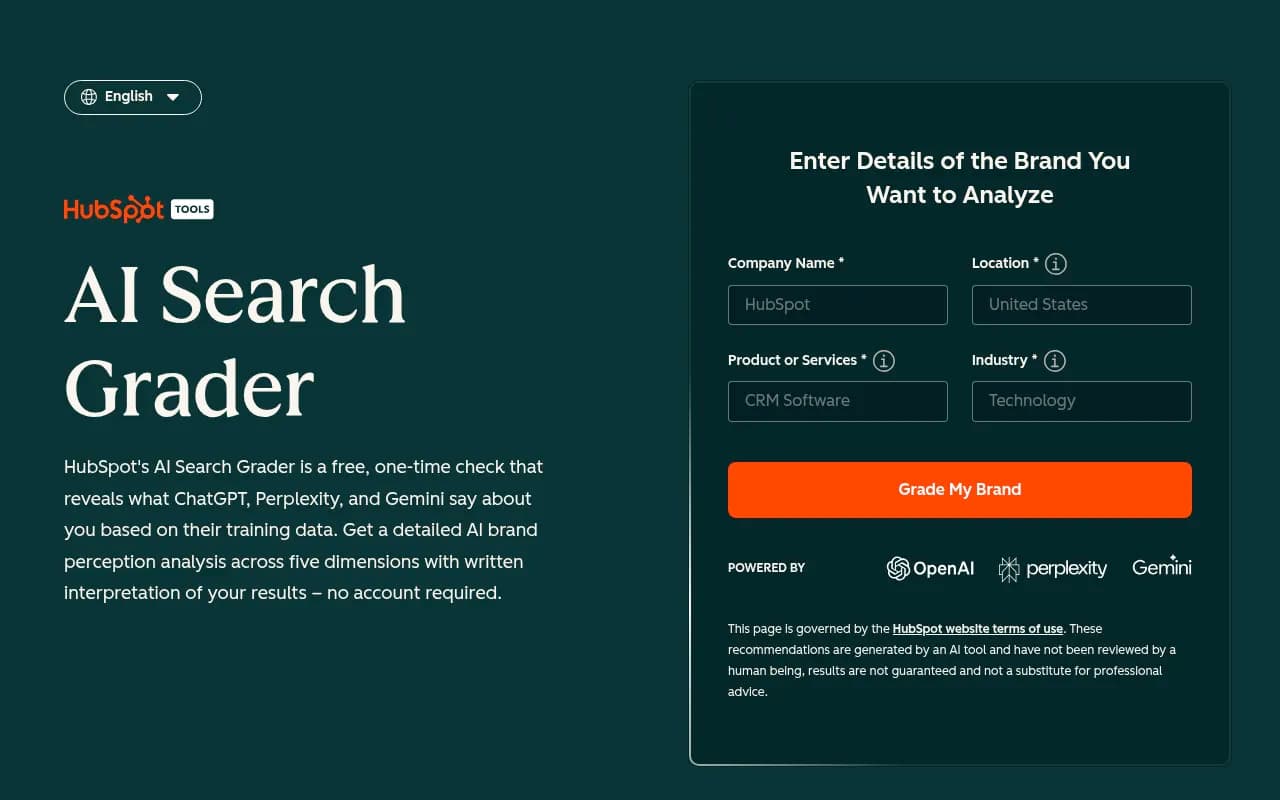
For PR, the written interpretation is the useful part. It reads like a brief you can paste into an internal doc. The caveat is that it reflects training data, so it says more about what models believe than about what they retrieve live. HubSpot also notes the recommendations are AI-generated and not human-reviewed.
Ahrefs AI Visibility Checker
The Ahrefs AI Visibility Checker needs no signup and returns results in seconds. It queries ChatGPT, Gemini, Perplexity, Copilot and Google AI Overviews with search-backed prompts, which are questions derived from what people actually search for, then checks whether each platform mentions your brand. The free tool also covers Google AI Mode, according to Ahrefs' own FAQ.
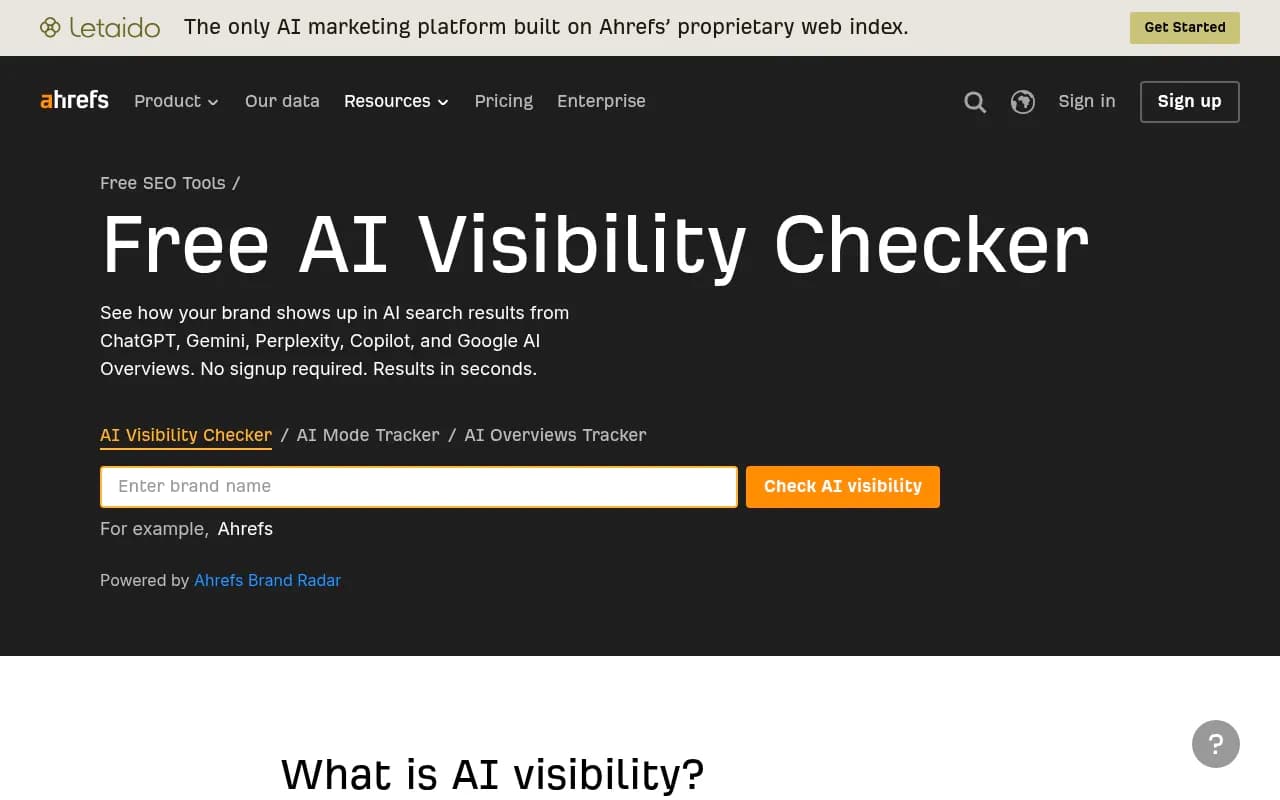
This is the best free option for a mention-or-no-mention gap check across many engines. It is powered by Ahrefs Brand Radar, which adds YouTube and Reddit visibility (in beta) and other reports in the paid product. Ahrefs also says Brand Radar can show any brand's AI visibility, which makes it handy for looking at a market or a competitor before you build a tracking project.

Semrush AI visibility checker
Semrush offers a free AI visibility checker that points you toward its AI Visibility Toolkit for ongoing monitoring. It is a reasonable second opinion if your team already lives in Semrush, and a way to see how AI platforms position your brand.
Omnia free checker
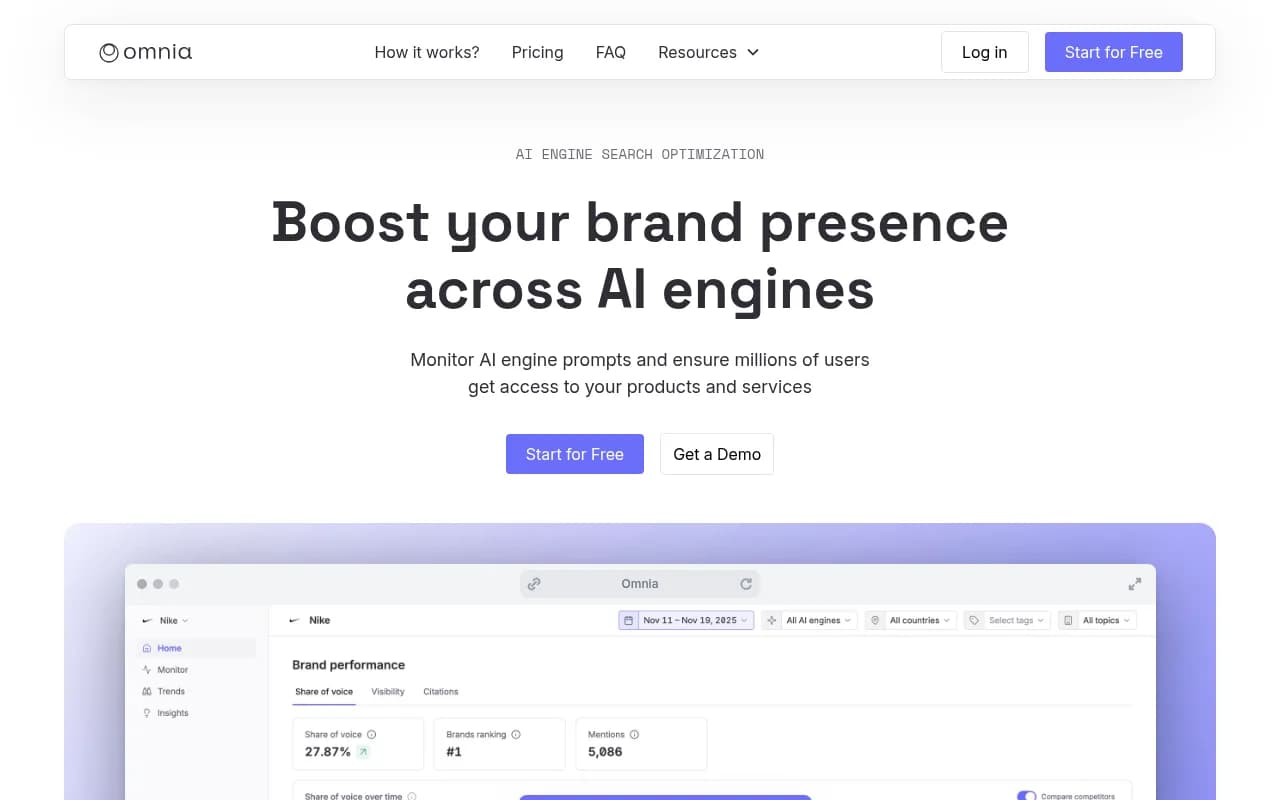
Omnia checks your brand in ChatGPT and Google AI Mode and emails a report in 3 to 5 minutes. The report includes share of voice, cited sources and two suggested actions. Omnia's own FAQ is refreshingly direct that Ahrefs, Semrush and HubSpot all offer free checks with different engines and limits, and that you should pick the one covering the engines your buyers use.
Smaller free options
Topify has a free brand profile and competitor finder that returns your brand profile, unique selling points and top competitors in AI search, powered by ChatGPT, Gemini and Perplexity. It is handy for seeing which competitors the models group you with. Arobis also lists a free AI visibility checker aimed at brands, startups and agencies, with ChatGPT, Gemini, Claude and Perplexity coverage. I would treat both as extras, not primary evidence.
Promptwatch also has a free AI visibility report that scans how ChatGPT, Gemini and Perplexity talk about your brand with no login. It adds a crawler access check and a list of what to fix, which is closer to a PR-and-technical hybrid view than most checkers give you.
Comparison table
| Tool | Account needed | Engines (per vendor pages) | Output | Best for |
|---|---|---|---|---|
| HubSpot AI Search Grader | No | ChatGPT, Perplexity, Gemini | One-time analysis across five dimensions, written interpretation | Narrative read on training-data perception |
| Ahrefs AI Visibility Checker | No | ChatGPT, Gemini, Perplexity, Copilot, AI Overviews, AI Mode | Mention check per platform | Fast gap check across many engines |
| Semrush AI visibility checker | Check the page | Check the page | Brand positioning overview | Teams already using Semrush |
| Omnia | Email for report | ChatGPT, Google AI Mode | Share of voice, cited sources, 2 actions | Citation sources and quick next steps |
| Topify brand profile | Check the page | ChatGPT, Gemini, Perplexity | Brand profile, USPs, competitors | Seeing who AI sees as your rivals |
| Promptwatch free report | No login | ChatGPT, Gemini, Perplexity | Visibility score, crawler access check, fixes | Visibility plus crawlability |
A testing protocol that produces usable evidence
Running each tool once and screenshotting the result is how most teams do this, and it produces an unreliable deck. Here is a better routine that takes an afternoon.
Step 1: write your prompt set first
Before touching any tool, write 15 to 20 prompts split into three buckets:
- Organic: no brand named, like "best [category] for [audience]".
- Brand-specific: "is [your brand] good for [use case]", "[your brand] reviews", "is [your brand] trustworthy".
- Competitor comparison: "[your brand] vs [competitor]".
Keep them in a spreadsheet. Run the same set through every tool and, where you can, directly in ChatGPT, Gemini and Perplexity yourself. Free checkers generate their own prompts, so your manual set is the control.
Step 2: score perception, not just presence
A mention is not the same as a good mention. For each brand-specific answer, record:
- Is the description accurate?
- Which claims repeat across engines (pricing, features, reputation, support)?
- Which competitors appear next to you?
- Which sources are cited?
The repeated claims matter most for PR. If three engines all say your product is "expensive for small teams," that is a narrative, and narratives trace back to specific pages.
Step 3: trace the sources
For brand-specific prompts, the cited review sites and forums shape the answer. Promptwatch Data recommends checking which third-party domains ChatGPT cites about your brand, because they influence how it describes you. Look for outdated review pages, old press coverage, and competitor-authored comparison posts. These are the places a PR team can actually act.
This also explains why tracking source types matters. Promptwatch Data's content type report found product pages were the most cited type in ChatGPT at 22.4% of citations (Sep 28 to Oct 4, 2026), so your own product pages carry more weight than a press release does.
Step 4: repeat on a different day
Run the whole thing again a few days later. If the answers shift a lot, you have confirmed that single-run checks are noisy, and that is a strong argument for paying for repeated tracking. If they stay stable, your baseline is more trustworthy.
Step 5: record collection method and freshness
When you move to vendor evaluation, ask each vendor how they collect data and how fresh it is. Real interface monitoring and API calls can produce different answers, and user-facing citations can differ from API outputs. Promptwatch's guide on how it collects data explains one approach, and it is a useful list of questions to ask any vendor.
Know when free is not enough
Free checkers hit a wall quickly. You will want a paid platform when:
- You need daily or hourly repeat runs, not a single snapshot.
- You need to see exactly which URLs get cited and how that changes over time.
- Stakeholders want sentiment trends and share of voice by competitor, with executive reporting.
- You need to find and correct inaccurate claims, not just see them.
- You manage multiple brands or clients.
One piece of advice from the Arobis comparison stuck with me: if you do not have the team to act on findings, buy execution before you buy another dashboard. Plenty of PR teams have bought a monitoring tool and then had nobody to turn the findings into pages and outreach.
Shortlisting paid platforms with your free baseline
Once you have a baseline, run the same prompt set through each shortlisted vendor's trial or demo, and compare the answers, cited URLs, collection methods and refresh history. That is the approach Unite.ai's roundup recommends before buying, and it works.
Here is how the main categories break down for a PR team.
| Platform | Type | Notes for PR teams |
|---|---|---|
| Promptwatch | End-to-end AI visibility and GEO platform | Brand Narrative extracts the individual claims AI makes about you, Fact Check marks claims accurate or inaccurate and finds the pages teaching the wrong thing, and agents help publish fixes |
| Profound | Enterprise monitoring | Strong monitoring, higher price point; FactCheck can flag inaccurate claims |
| Ahrefs Brand Radar | SEO suite add-on | Good for investigating a market before building a narrow tracking project |
| Otterly.AI | Lightweight tracker | A practical starting point if you want monitoring without an enterprise commitment |
| Semrush AI Toolkit | SEO suite add-on | Fits teams already inside Semrush |
Profound

Otterly.AI

For perception work specifically, Promptwatch is the one I would put on the shortlist. Its Brand Narrative feature pulls the claims AI makes about you and competitors out of tracked responses and groups them by theme such as pricing, features, support and reputation. Fact Check, on Business and higher plans, lets you mark a claim inaccurate and then looks through your crawled pages for the one stating it. That closes the gap between "AI says something wrong about us" and "here is the page to fix." It also tracks the Reddit, YouTube and LinkedIn sources AI cites, which free checkers mostly skip. Pricing starts at $95/mo for Essential, with a 7-day free trial on monthly billing, and you should confirm current details at promptwatch.com/pricing.

If you want to browse beyond these, the GEO software directory at bestgeosoftware.com lists many more options.
Common mistakes with free checkers
- Treating a one-time result as a trend. It is a snapshot.
- Judging on a single engine. Buyers use different assistants, so cover the ones they use.
- Ignoring source data. Mentions without citations tell you nothing about why.
- Mixing old and new numbers. Citation behavior changes fast. Promptwatch Data's older sources-per-response page (about 5 for ChatGPT) and the newer October 2026 domain-count report measure different things and periods, so keep their dates attached and do not blend them.
- Skipping the crawl question. If AI bots cannot read your site, no amount of PR fixes the answers. A free tool like the Agentic Readiness Check shows which AI crawlers can reach you.
A short checklist before any purchase
- Save your own prompt set, answers and screenshots as a dated baseline.
- List the three to five claims AI repeats about you, accurate or not.
- Note the top cited third-party sources for brand-specific prompts.
- Run the same set through each vendor trial.
- Ask each vendor about collection method, refresh frequency and whether they can show the actual cited URLs.
- Pick the tool that helps you act, not just the one with the best dashboard.
Free tools will take you roughly 80% of the way to knowing whether you have a problem. The last 20%, repeatable measurement and a way to fix what you find, is what you pay for. Go in with your own evidence, and the vendor conversation gets much shorter.