Key takeaways
- Goodie AI, Peec AI, and Otterly.AI are primarily monitoring dashboards -- they show you where your brand appears (or doesn't) in AI search engines, but leave you to figure out what to do about it.
- Promptwatch is the only one of the four that closes the full loop: find gaps, generate content engineered for AI citations, track results, and attribute traffic to revenue.
- Otterly.AI covers the most AI engines of the three monitoring tools (up to 6), making it the best pure-monitoring pick if breadth matters.
- Peec AI is the strongest option for GDPR-regulated organizations in the EU, with browser-level rendering and native compliance.
- If you're a marketing or SEO team that needs to actually move the needle on AI visibility -- not just report on it -- the gap between monitoring tools and Promptwatch is significant.
The real question nobody asks before buying
Most comparisons of AI visibility tools focus on the wrong thing. They compare how many LLMs each tool monitors, what the dashboards look like, and whether there's a free trial. Those details matter, but they miss the more important question: what happens after you see the data?
Knowing that ChatGPT mentions your competitor three times more than you in responses about your category is useful. But it's just information. The question is: what do you do with it? Can your tool help you close that gap, or does it just keep showing you the gap every week?
That's the lens I want to use for this comparison. Goodie AI, Peec AI, Otterly.AI, and Promptwatch are all legitimate tools in the AI search visibility space. They're not all trying to do the same thing, though -- and understanding that distinction will save you from paying for the wrong one.
What each tool actually does
Goodie AI
Goodie AI (higoodie.com) is a lightweight monitoring tool that tracks how your brand appears in AI-generated responses. It covers the basics: brand mention tracking, share of voice, and visibility scores across a handful of AI engines.
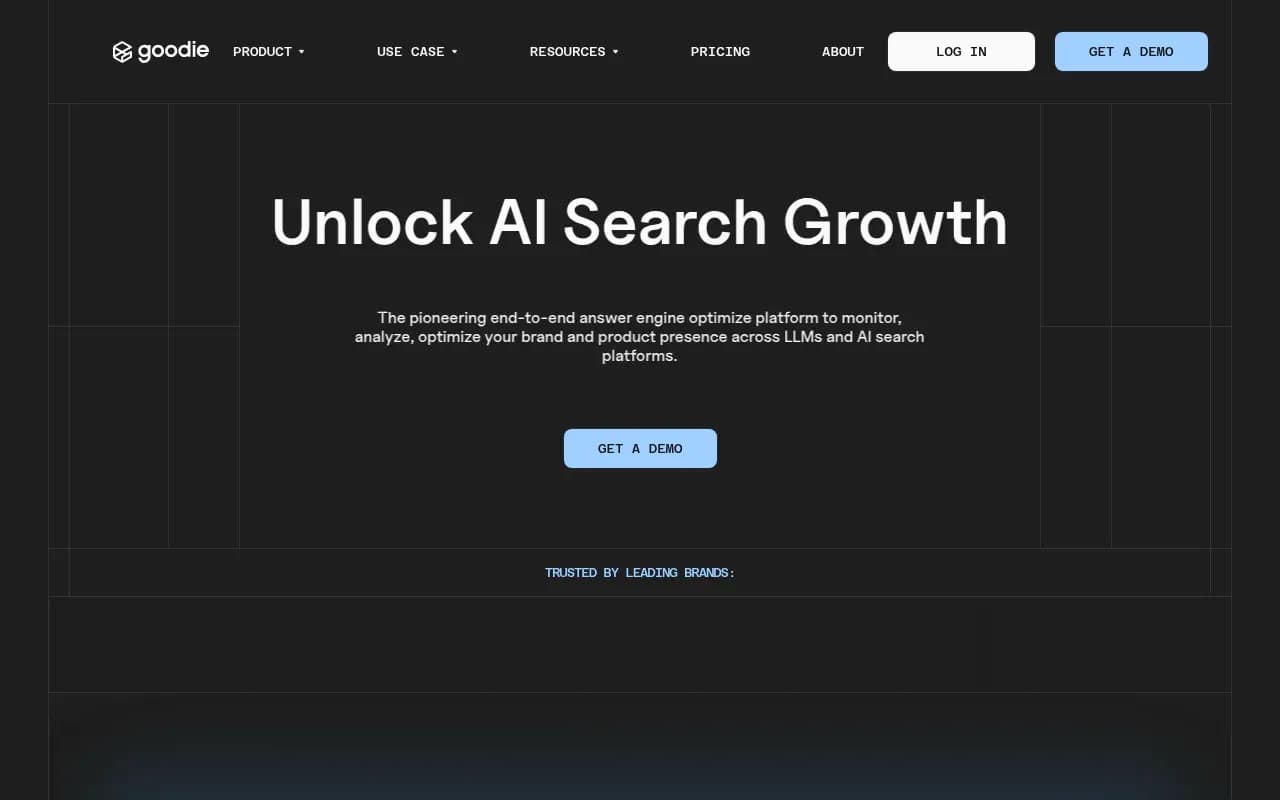
The tool is positioned as an accessible entry point into AI visibility monitoring. It's not trying to be a full platform. For small teams or individuals who just want to know whether they're showing up in ChatGPT or Perplexity responses, it does the job. The interface is clean, setup is fast, and you don't need a technical background to use it.
The limitation is exactly what you'd expect from a monitoring-only tool: it shows you what's happening, not why, and not what to do about it. There's no content gap analysis, no AI writing capabilities, no crawler log data, and no traffic attribution. You get a dashboard. What you do with it is entirely up to you.
Peec AI
Peec AI is a more technically sophisticated monitoring platform, particularly notable for its GDPR-native approach. It uses browser-level rendering rather than raw API calls, which means the responses it captures are closer to what a real user actually sees -- not just what an API returns. Independent testing by ZipTie.dev found that API-based tracking matched manual data only about 60% of the time, so this distinction matters more than it sounds.

Peec AI's base tier covers around 25 prompts across 2-3 platforms, which is limited for serious monitoring. But for EU-based organizations where GDPR compliance is non-negotiable, it's the most purpose-built option in this comparison. It also includes some "Actions" optimization suggestions -- hints about what might improve your visibility -- though this falls short of actual content generation or a full optimization workflow.
The pricing starts at €85/month for the Starter plan (50 prompts, 3 engines). It's not cheap for what you get, but the compliance positioning justifies the premium for the right buyer.
Otterly.AI
Otterly.AI is the most feature-complete of the three monitoring tools. It covers up to 6 AI engines (including ChatGPT, Perplexity, Claude, Google AI Overviews, and others), supports 12-country monitoring, and has a Semrush integration that makes it useful for teams already embedded in that ecosystem. The Lite plan starts at $29/month for 15 prompts and 4 engines, making it the most affordable entry point in this group.
Otterly.AI

For pure monitoring breadth at a mid-market price, Otterly.AI is genuinely good. It's the tool I'd recommend if your only goal is tracking brand mentions and share of voice across multiple AI platforms without spending enterprise money.
But -- and this is the same limitation that applies to Goodie AI -- it stops there. No content gap analysis, no writing tools, no crawler logs, no traffic attribution. Zapier's 2026 roundup of AI visibility tools called out Otterly.AI specifically for affordability, which tells you something about where it sits in the market: it's a cost-effective tracker, not an optimization platform.
Promptwatch
Promptwatch is a different category of tool. It monitors AI visibility across 10 models (ChatGPT, Perplexity, Claude, Gemini, Google AI Overviews, Google AI Mode, Grok, DeepSeek, Meta/Llama, Mistral, and Copilot), but monitoring is just the starting point.

The core difference is what happens after you see the data. Promptwatch's Answer Gap Analysis shows you exactly which prompts your competitors rank for in AI responses that you don't -- not as a vague observation, but as specific content gaps with prompt volumes and difficulty scores. You can see the exact questions AI models are answering with competitor content instead of yours.
From there, the built-in AI writing agent generates articles, listicles, and comparisons grounded in citation data from 880M+ analyzed citations. This isn't generic content -- it's engineered around the specific prompts and topics where AI models are looking for sources. The Professional plan ($249/month) includes 15 articles per month; the Business plan ($579/month) includes 30.
Then there's the tracking layer. Page-level visibility tracking shows which of your pages are being cited, by which models, and how often. AI Crawler Logs (available on Professional and above) show real-time data on which AI crawlers are visiting your site, which pages they're reading, and what errors they're hitting. Traffic attribution connects AI visibility to actual sessions and revenue via a code snippet, Google Search Console integration, or server log analysis.
The platform also includes Reddit and YouTube insights (surfacing discussions that influence AI recommendations), ChatGPT Shopping tracking, competitor heatmaps, and multi-language/multi-region monitoring.
For teams that want to actually improve their AI visibility -- not just measure it -- this is a meaningfully different product.
Side-by-side comparison
| Feature | Goodie AI | Peec AI | Otterly.AI | Promptwatch |
|---|---|---|---|---|
| AI engines monitored | Limited | 3 (base) | Up to 6 | 10+ |
| Starting price | Not published | €85/month | $29/month | $99/month |
| Brand mention tracking | Yes | Yes | Yes | Yes |
| Share of voice | Yes | Yes | Yes | Yes |
| Multi-country monitoring | Limited | Limited | 12 countries | Yes |
| GDPR-native | No | Yes | No | No (EU-based company) |
| Browser-level rendering | No | Yes | No | Yes |
| Answer Gap Analysis | No | No | No | Yes |
| AI content generation | No | No | No | Yes |
| AI Crawler Logs | No | No | No | Yes (Pro+) |
| Traffic attribution | No | No | No | Yes |
| Reddit/YouTube insights | No | No | No | Yes |
| ChatGPT Shopping tracking | No | No | No | Yes |
| Prompt volume/difficulty | No | No | No | Yes |
| Semrush integration | No | No | Yes | No |
| Free trial | Check site | Check site | Yes | Yes |
Who should use which tool
Use Goodie AI if...
You're just getting started with AI visibility and want a simple, low-friction way to see whether your brand is showing up in AI responses. It's a reasonable first step for small businesses or individuals who don't need deep analytics or optimization capabilities.
Use Peec AI if...
You're in the EU, GDPR compliance is a hard requirement, and you want the most accurate response capture available in a mid-market tool. The browser-level rendering is a genuine technical advantage. Just know you're paying for compliance and accuracy, not for optimization.
Use Otterly.AI if...
You want the widest AI engine coverage at an affordable price and you're already using Semrush. It's the best pure-monitoring option in this group for teams that need breadth without enterprise pricing. The $29/month entry point is hard to argue with if you just need to track mentions.
Use Promptwatch if...
You need to actually move the needle. If your goal is to increase how often AI models cite your brand -- not just measure how often they currently do -- then monitoring-only tools will leave you stuck. Promptwatch's combination of gap analysis, content generation, crawler logs, and traffic attribution is the only complete loop in this comparison.
It's used by 6,700+ brands and agencies including Booking.com and Center Parcs. The Essential plan at $99/month covers 1 site, 50 prompts, and 5 articles per month -- a reasonable starting point for teams that want to test the optimization workflow before scaling up.
The monitoring trap
There's a pattern worth naming directly. A lot of teams buy an AI visibility monitoring tool, set up their prompts, get their weekly dashboard, and then... don't know what to do next. The data shows them they're invisible for certain queries. They share it in a Slack channel. Someone says "we should fix that." Nothing changes.
This isn't a criticism of the monitoring tools -- Otterly.AI and Peec AI do what they say they do. The problem is that monitoring without a clear path to action creates a reporting loop that doesn't improve anything.
The question to ask before buying any AI visibility tool is: "After I see the data, what does this tool help me do about it?" If the answer is "nothing -- that's up to you," make sure you have the internal resources to act on the data yourself. If you don't, a platform with built-in optimization capabilities will give you a much better return.
A note on accuracy
One thing worth flagging: not all AI visibility tracking is equally accurate. Tools that query AI models via API often get different responses than what a real user sees in a browser. Peec AI's browser-level rendering addresses this directly. Promptwatch also uses UI simulation for its tracking.
For Goodie AI and Otterly.AI, it's worth checking their methodology documentation to understand how they capture responses. The ZipTie.dev research cited earlier found API-based tracking matched manual data only about 60% of the time -- a meaningful gap if you're making content decisions based on visibility data.
Bottom line
All four tools have a place in the market. Goodie AI is simple and accessible. Peec AI is the compliance-first choice for EU teams. Otterly.AI is the best value for pure monitoring breadth. Promptwatch is the only one that takes you from "here's where you're invisible" to "here's the content that will fix it" to "here's the traffic it generated."
If you're evaluating these tools in 2026, the most useful frame is: are you trying to understand your AI visibility, or are you trying to improve it? The answer determines which category of tool you actually need.