Key takeaways
- Google AI Overviews now appear on roughly 48% of all search queries, up from 31% in February 2025 -- nearly doubling in 12 months.
- Health, informational, and how-to queries trigger AI Overviews most often; health alone sees a 60.7% trigger rate.
- Queries with 8+ words are 7x more likely to generate an AI Overview than short keyword searches.
- Transactional, navigational, and brand-specific queries still predominantly show traditional blue links.
- When an AI Overview appears, organic CTR drops by up to 61% -- but brands cited inside those summaries see 35% more organic clicks than those that aren't.
How widespread are AI Overviews in 2026?
The growth has been fast. According to Otterly.ai's tracking data, Google AI Overviews appeared on 31% of queries in February 2025. By February 2026, that number had climbed to 48%. That's not a gradual drift -- it's a structural shift in how Google delivers search results.
For context: nearly half of all Google searches now return an AI-generated summary before a single blue link. If your SEO strategy doesn't account for this, you're optimizing for a version of Google that no longer fully exists.
But "48% of queries" is an average that hides a lot. The real story is in which query types trigger AI Overviews -- and which don't. The gap between the highest and lowest trigger rates is enormous.
Query types that trigger AI Overviews most often
Informational and how-to queries
This is where AI Overviews dominate. Informational queries -- "how does X work," "what is Y," "why does Z happen" -- are the natural home for AI-generated summaries. Google's model is essentially doing what it was designed to do: synthesizing information so the user doesn't have to click five different pages.
Health-related queries are the clearest example. According to SeoProfy's 2026 analysis, health queries trigger AI Overviews in 60.7% of cases. That's the highest trigger rate of any industry category tracked. Think about what that means: if you run a health information website, more than half your target queries now have an AI summary sitting above your result.
How-to queries follow a similar pattern. Step-by-step instructional content -- "how to change a tire," "how to write a cover letter," "how to fix a leaky faucet" -- consistently generates AI Overviews because the intent is purely informational and the answer is self-contained.
Question-based queries
Pew Research Center's July 2025 analysis of 900 U.S. adults' browsing data found that searches phrased as questions (using words like "what," "how," "why," "when") produce AI summaries more often than keyword-style searches. This makes intuitive sense: a question signals that the user wants an explanation, not a list of links to click through.
The format matters too. Full-sentence queries ("what are the symptoms of vitamin D deficiency") outperform fragmented keyword queries ("vitamin D deficiency symptoms") in terms of AI Overview trigger rates.
Long-tail and multi-word queries
Here's the stat that should reshape how you think about query length: searches containing 8 or more words are 7x more likely to trigger a Google AI Overview than shorter queries, according to Heroic Rankings' 2026 data. Seven times.
This makes sense when you think about what long queries signal. A search like "best way to treat lower back pain at home without medication" is clearly informational, conversational, and complex. Google's AI is well-suited to synthesize an answer. A two-word search like "back pain" is ambiguous -- the user might want information, a local doctor, a product, or something else entirely.
Additionally, 36% of queries that include both a noun and a verb result in an AI Overview. The verb-noun combination signals intent and specificity, which are exactly the conditions where AI summaries add value.
Research and comparison queries
"Best X for Y," "X vs Y," "pros and cons of X" -- these comparative and research-oriented queries frequently trigger AI Overviews. Google's AI can pull together a structured comparison faster than a user could read three separate articles. For brands in competitive categories, this is where AI Overviews are most disruptive: a user searching "best project management software for small teams" might get a full comparison summary without ever visiting your product page.
Query types that still show traditional blue links
Transactional queries
"Buy running shoes," "order pizza near me," "book a hotel in Barcelona" -- these queries have commercial intent. The user wants to complete an action, not read a summary. Google knows this, and AI Overviews appear far less frequently here. Traditional results, shopping carousels, and local packs still dominate transactional searches.
This is actually good news for e-commerce brands. Your product pages aren't being displaced by AI summaries on high-intent purchase queries. The threat is upstream, in the research and comparison phase.
Navigational queries
When someone types "Facebook login" or "Amazon customer service," they're trying to get somewhere specific. There's no synthesis to be done -- the answer is a link. AI Overviews rarely appear for navigational queries, and when they do, they're usually brief and point directly to the destination.
Brand-specific queries
Searching for a specific brand name -- "Nike running shoes," "HubSpot pricing," "Tesla Model 3 review" -- tends to surface traditional results, brand knowledge panels, and review sites rather than AI Overviews. Google seems to recognize that brand queries often have navigational or transactional intent mixed in.
Local queries
"Plumber near me," "best Italian restaurant in Chicago," "dentist open on Saturday" -- local intent queries still predominantly show map packs and local listings. AI Overviews do appear occasionally for local queries, but they're less common than for purely informational searches.
Very short, ambiguous queries
One-to-three word queries that could mean multiple things ("apple," "python," "mercury") don't trigger AI Overviews reliably because the intent is unclear. Google defaults to showing a range of result types and letting the user signal what they actually want.
The low-volume keyword pattern
One finding that surprises a lot of SEOs: AI Overviews appear most often on low-search-volume queries. According to Elementor's 2026 AI SEO statistics, almost 80% of keywords that trigger AI Overviews fall into the 0-40% keyword difficulty range -- meaning they're relatively niche, low-competition terms.
This has two implications. First, the "head terms" you've been optimizing for years are less likely to have AI Overviews than the long-tail variants. Second, the queries where AI Overviews are most common are often the ones where a single authoritative piece of content could earn a citation slot -- because there's less competition for those citation positions.
What AI Overviews actually do to click behavior
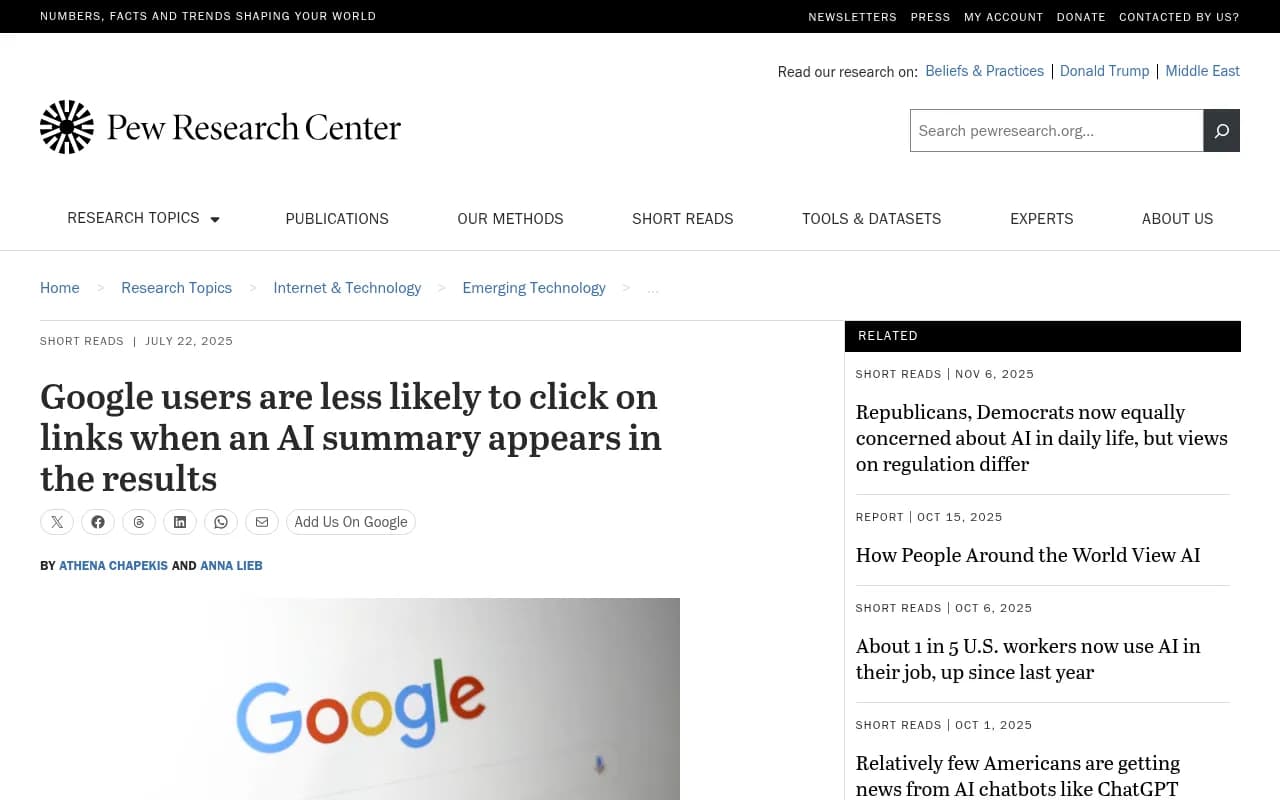
The CTR impact is real and significant. Seer Interactive's study of 25.1 million impressions across 42 organizations found that when an AI Overview appears, organic CTR drops from 1.76% to 0.61% -- a 61% decline. Pew Research Center's browsing data confirms the pattern: users are less likely to click on any links when an AI summary is present, and they very rarely click on the specific sources cited within the summary.
But there's a flip side. Otterly.ai's research found that brands cited inside AI Overviews earn 35% more organic clicks than brands that aren't cited. Being in the summary is meaningfully better than being the #1 blue link below it.
This creates a two-tier reality:
- If you're not cited in the AI Overview, your organic result is getting less traffic than it used to -- even at position one.
- If you are cited, you're capturing attention at the top of the page and getting a citation link that drives more clicks than a standard result.
The implication is clear: for informational queries in your category, getting cited in AI Overviews matters more than ranking #1 in traditional results.
A frequency breakdown by query type
| Query type | AI Overview trigger rate | What still shows |
|---|---|---|
| Health/medical informational | ~60.7% | Some blue links, medical authority sites |
| How-to / instructional | High (50%+) | Step-by-step sites, video results |
| Question-based (what/how/why) | High (45-55%) | Supporting blue links |
| 8+ word long-tail queries | 7x baseline rate | Cited sources, related questions |
| Research / comparison | Moderate-high (35-50%) | Review sites, comparison pages |
| Transactional / purchase | Low (5-15%) | Shopping results, product pages |
| Navigational / brand | Very low (<10%) | Brand pages, knowledge panels |
| Local intent | Low-moderate (10-20%) | Map pack, local listings |
| 1-3 word ambiguous | Low (<15%) | Mixed result types |
Trigger rate estimates based on SeoProfy, Heroic Rankings, and Elementor data compiled through early 2026.
What this means for your content strategy
Stop treating all queries the same
The old approach -- rank for a keyword, get traffic -- doesn't account for the fact that some of your target queries now have a 60% chance of showing an AI Overview. You need to know which queries in your category are triggering summaries and whether you're being cited.
Optimize for citation, not just ranking
For high-trigger query types (health, how-to, informational), the goal shifts from "rank #1" to "get cited in the AI Overview." That means writing content that directly and clearly answers the specific question, uses structured formatting that AI can parse, and demonstrates enough authority that Google's model trusts it as a source.
Protect your transactional traffic
The good news: your product pages, pricing pages, and conversion-focused content are largely safe from AI Overview displacement. Transactional queries still show traditional results. Focus your AI visibility efforts on informational content, and keep your conversion-focused pages optimized for traditional SEO signals.
Track which queries are triggering AI Overviews for your keywords
You can't optimize what you don't measure. Google Search Console doesn't separate AI Overview data from standard organic results, which means you need dedicated tracking to understand your exposure. Tools like Promptwatch track AI Overview appearances across your target queries and show you exactly which pages are being cited -- useful if you want to move from guessing to knowing.

For more focused rank tracking that includes AI Overview monitoring alongside traditional SERP data, tools like AccuRanker and SE Ranking have added AI Overview detection to their rank tracking workflows.
Otterly.AI is another option specifically built around AI Overview monitoring, with tracking for trigger rates, citation presence, and CTR impact.
Otterly.AI

The query length effect in practice
It's worth dwelling on the 8-word threshold because it has real practical implications. Consider these two queries:
- "content marketing" (2 words) -- low AI Overview likelihood, competitive, ambiguous intent
- "how to build a content marketing strategy for a B2B SaaS company" (13 words) -- high AI Overview likelihood, specific intent, clear informational need
The second query is more likely to trigger an AI Overview, but it's also more likely to convert if someone does click through -- because the intent is so specific. This means the queries where AI Overviews are most disruptive are also the ones where your content needs to be most comprehensive and authoritative.
If you're writing content that targets long, specific questions, you're writing content that's both most likely to trigger an AI Overview and most likely to be cited in one. The strategy isn't to avoid these queries -- it's to make your content the source Google's AI reaches for.
The industries most affected
Health and medical information is the clearest case, with a 60.7% trigger rate. But other informational-heavy industries face similar exposure:
- Finance and personal finance (tax questions, investment explanations, budgeting how-tos)
- Legal information (explaining laws, rights, procedures)
- Technology and software (how-to guides, comparisons, troubleshooting)
- Education and learning (concept explanations, study guides)
- Travel research (destination guides, visa requirements, packing lists)
Industries with more transactional or local search behavior -- retail, restaurants, local services -- are less exposed to AI Overview displacement, at least for their core commercial queries.
Tracking your AI Overview exposure
The practical challenge is that most existing SEO tools weren't built for this. Traditional rank trackers tell you your position in the blue links, not whether an AI Overview is appearing above them or whether you're cited in it.
For teams that want to get serious about this, the monitoring workflow needs to include: which of your target keywords trigger AI Overviews, whether your domain appears as a cited source, and how that citation status correlates with actual traffic. Some teams are also tracking competitor citation rates to understand where they're losing visibility.
Semrush and Ahrefs have both added some AI Overview visibility features, though their core strength remains traditional SEO data.
For teams specifically focused on AI search visibility across multiple engines (not just Google), platforms built around GEO tracking give a broader picture of how your content performs across ChatGPT, Perplexity, and Google AI Overviews together.
The bottom line
Google AI Overviews aren't going away, and their reach is still expanding. The 48% query coverage figure from early 2026 will almost certainly be higher by year end. But the distribution is uneven in ways that matter strategically.
If your content targets informational, question-based, or long-tail queries -- especially in health, finance, tech, or education -- you're operating in the highest-trigger-rate territory. Your priority should be earning citation slots, not just rankings. If your content is primarily transactional or local, the immediate threat is lower, but the research and comparison queries that feed your funnel are increasingly AI-mediated.
The brands that will come out ahead aren't the ones that panic about AI Overviews -- they're the ones that figure out which queries matter, track their citation status, and write content that AI models actually want to cite.