Key takeaways
- Negative or inaccurate brand information doesn't stay in one AI model -- it spreads across ChatGPT, Gemini, Perplexity, and others because they often pull from the same underlying sources (Reddit threads, forums, outdated articles).
- AI hallucinations and misinformation are different problems requiring different fixes: hallucinations need authoritative content to displace them; misinformation needs correction at the source.
- Monitoring is only useful if you act on what you find. Catching a negative mention early and publishing corrective content can prevent it from becoming the "accepted" answer across multiple LLMs.
- The most effective defense is a content strategy built around what AI models actually cite -- not generic SEO content, but specific, authoritative answers to the questions your customers are asking.
- Tools like Promptwatch can help you track sentiment across 10+ AI models and identify exactly which prompts are surfacing negative or inaccurate responses about your brand.
The problem nobody warned you about
You've spent years building a brand. Good reviews, solid PR, a well-optimized website. Then someone asks ChatGPT about your company and gets back something that's... wrong. Maybe it's an old controversy that was resolved years ago. Maybe it's a Reddit thread from 2022 where someone had a bad experience. Maybe the AI just made something up entirely.
This isn't a hypothetical. It's happening to brands right now, and the mechanics of how it spreads are worth understanding before you're the one dealing with it.
The core issue is that LLMs don't have a single source of truth. They're trained on massive datasets scraped from the web, and they're continuously updated with fresh retrieval in tools like Perplexity and ChatGPT's web browsing mode. That means a single negative Reddit post, a critical review on an obscure forum, or an outdated news article can end up shaping what millions of people hear about your brand -- not just in one AI model, but across all of them.
How negative mentions actually spread
The shared source problem
Here's the uncomfortable truth: most major LLMs are drawing from a surprisingly similar pool of sources. A Semrush study found that Reddit outranks corporate websites across virtually every industry in AI search results. ChatGPT, Gemini, and Perplexity all weight community content heavily -- which means a single thread with negative sentiment can influence what multiple models say about you.
This is different from traditional SEO, where a bad review on one platform doesn't automatically hurt your rankings on another. With LLMs, the same source can poison the well across the entire ecosystem simultaneously.
Hallucinations vs. misinformation: two different beasts
It's worth separating these because the response strategy differs.
AI hallucinations happen when a model lacks sufficient information and fills the gap with plausible-sounding but fabricated content. If your brand is underrepresented in training data, models may invent product features, pricing, leadership names, or even entire incidents. These aren't malicious -- they're a byproduct of how LLMs work. But they're still damaging.
Misinformation is different. It's when accurate-but-negative (or inaccurate-and-negative) real-world content gets picked up and amplified. An old lawsuit. A competitor's smear campaign. A viral complaint thread. The AI didn't invent it -- it found it, and now it's presenting it as the definitive answer to "what do people think about [your brand]?"
Both spread the same way: through retrieval and training. But hallucinations require you to create authoritative content that gives the model something real to cite. Misinformation requires you to address the source and create counter-narratives that outweigh it.
The cross-model amplification loop
Once a negative narrative exists in one model's responses, it can reinforce itself. Here's why: some AI models use other AI-generated content as training data or as sources for retrieval. If ChatGPT produces a response citing a negative claim, and that response gets indexed or shared, it can become a source that other models pick up. It's a slow loop, but it's real.
There's also the human amplification layer. People screenshot AI responses and share them on social media. A wrong or negative answer from Gemini can end up as a viral post, which then becomes a new source that future AI models retrieve. The original hallucination becomes a "real" piece of content.
What makes your brand vulnerable
Some brands are more exposed than others. A few factors that increase your risk:
Thin or inconsistent online presence. If your brand doesn't have clear, authoritative content explaining what you do, who you serve, and what your values are, models will fill that vacuum with whatever they can find -- which may not be flattering.
Inconsistent messaging across channels. When your website says one thing, your LinkedIn says another, and your press releases say a third, AI models get confused. They may present contradictory information or default to whichever source has more community engagement (often Reddit or review sites).
Unresolved public controversies. Even if an issue was resolved internally, if the online record still shows the complaint without a visible resolution, AI models will keep surfacing it. They don't know the story ended well.
Competitor activity. This is underappreciated. Competitors can -- and do -- create content designed to influence AI responses about your brand. SimilarWeb has documented what they call "negative GEO" tactics: publishing comparison content, seeding review platforms, and creating forum discussions that position your brand negatively relative to theirs.
How to monitor for negative AI brand mentions
Manual spot-checking (the starting point)
The simplest approach is to regularly query major AI models yourself. Ask ChatGPT, Perplexity, Gemini, and Claude questions like:
- "What do people think of [your brand]?"
- "What are the downsides of using [your product]?"
- "Is [your brand] trustworthy?"
- "Compare [your brand] vs [competitor]"
Do this across different phrasings and from different angles. You're looking for inaccuracies, outdated information, and negative framing that doesn't reflect reality.
The obvious downside: this is slow, inconsistent, and doesn't scale. You can't manually query 10 models across 50 prompts every week.
Automated monitoring tools
This is where dedicated AI visibility platforms come in. Several tools in this space can track what specific AI models say about your brand across a defined set of prompts.
Promptwatch monitors across 10 AI models (ChatGPT, Perplexity, Gemini, Claude, Grok, DeepSeek, Copilot, Meta AI, Mistral, and Google AI Overviews) and tracks sentiment at the prompt level -- so you can see not just whether you're mentioned, but whether the mention is positive, neutral, or negative. The crawler logs feature is particularly useful here: you can see which pages AI models are actually reading on your site, which helps explain why certain narratives are forming.

For brands that want a simpler starting point, tools like Peec AI and Otterly.AI offer basic sentiment monitoring, though they're more limited in the number of models they cover and don't provide the content optimization layer.

Otterly.AI

TrackMyBusiness is another option focused specifically on tracking what ChatGPT, Gemini, and Perplexity say about your brand.
For enterprise brands with more complex needs, Profound and Evertune offer deeper analytics, though at higher price points.
Profound

What to look for when monitoring
Don't just track whether you're mentioned -- track the context. Specifically:
- Sentiment: Is the mention positive, neutral, or negative?
- Accuracy: Is the information factually correct?
- Source attribution: What sources is the AI citing? (This tells you where to focus your correction efforts.)
- Competitor framing: Are you being compared unfavorably to competitors? On what dimensions?
- Consistency: Is the same negative narrative appearing across multiple models, or is it isolated to one?
A comparison table of monitoring capabilities across key tools:
| Tool | Models covered | Sentiment tracking | Source attribution | Content generation | Crawler logs |
|---|---|---|---|---|---|
| Promptwatch | 10 | Yes | Yes | Yes (built-in AI writer) | Yes |
| Peec AI | 3-4 | Basic | No | No | No |
| Otterly.AI | 4-5 | Basic | Limited | No | No |
| Profound | 9+ | Yes | Yes | No | No |
| TrackMyBusiness | 3 | Basic | No | No | No |
| Evertune | 8+ | Yes | Yes | No | No |
How to respond when you find negative mentions
Step 1: Identify the source
Before you can fix the narrative, you need to know where it's coming from. If the AI is citing a specific Reddit thread, review site, or news article, that's your target. If it's a hallucination with no clear source, your job is to create content that gives the model something better to cite.
Step 2: Address the source directly
If the negative content lives on a platform you can engage with:
- Reddit: Respond to the thread directly. Don't be defensive -- acknowledge the concern and explain what changed or how it was resolved. A well-handled response can actually become a positive signal.
- Review sites: Respond to negative reviews professionally. Many AI models pull review summaries, and a pattern of thoughtful responses shifts the overall sentiment.
- News articles: If the article is inaccurate, contact the publication with a correction request. If it's accurate but outdated, provide an update and ask if they'll add a note.
Step 3: Create authoritative counter-content
This is the most important long-term lever. AI models cite content that is authoritative, specific, and directly answers the questions users are asking. If the only content addressing a negative topic about your brand is the negative content itself, that's what gets cited.
You need to create content that:
- Directly addresses the concern (don't pretend it doesn't exist)
- Provides accurate, current information
- Is structured in a way that AI models can easily parse (clear headings, direct answers, factual claims)
- Lives on authoritative domains (your own site, plus earned placements on high-authority publications)
The Wix AI Search Lab recommends updating your "about" page and other core pages to ensure they contain accurate, comprehensive information that AI models can use as a primary source. This is good advice, but it's the floor, not the ceiling.
Step 4: Build a broader citation footprint
AI models don't just cite your website. They cite wherever authoritative information about your brand exists. That means:
- Guest articles on industry publications
- Interviews and podcast appearances (transcripts get indexed)
- Wikipedia entries (if your brand qualifies)
- Structured data and schema markup on your site
- Active, accurate profiles on platforms AI models trust (LinkedIn, Crunchbase, etc.)
The more places accurate information about your brand exists, the harder it is for any single negative source to dominate the narrative.
Step 5: Submit feedback to AI platforms
Some AI models have feedback mechanisms. ChatGPT has a thumbs-down button and a "this is harmful or untrue" flag. Perplexity allows feedback on responses. These signals do influence model behavior over time, though the timeline is unpredictable.
This shouldn't be your primary strategy, but it's worth doing when you encounter clear inaccuracies.
Building a proactive defense
Reactive monitoring is necessary but not sufficient. The brands that handle this best have built proactive systems.
Create a brand FAQ designed for AI
Write a comprehensive FAQ on your website that directly answers the questions AI models are likely to be asked about your brand. Not marketing fluff -- actual answers to hard questions. "What are the criticisms of [your brand]?" "How does [your brand] compare to [competitor]?" "What happened with [past controversy]?"
This feels counterintuitive, but it works. When you provide the most complete and accurate answer to a difficult question, AI models prefer your version over a hostile Reddit thread.
Monitor competitor content for negative GEO tactics
If a competitor is publishing comparison content that consistently frames your brand negatively, you need to know about it. Tools like Promptwatch's competitor heatmaps let you see which domains are being cited in responses about your brand and how competitor mentions are framed relative to yours.
Set up alerts for brand mentions across the web
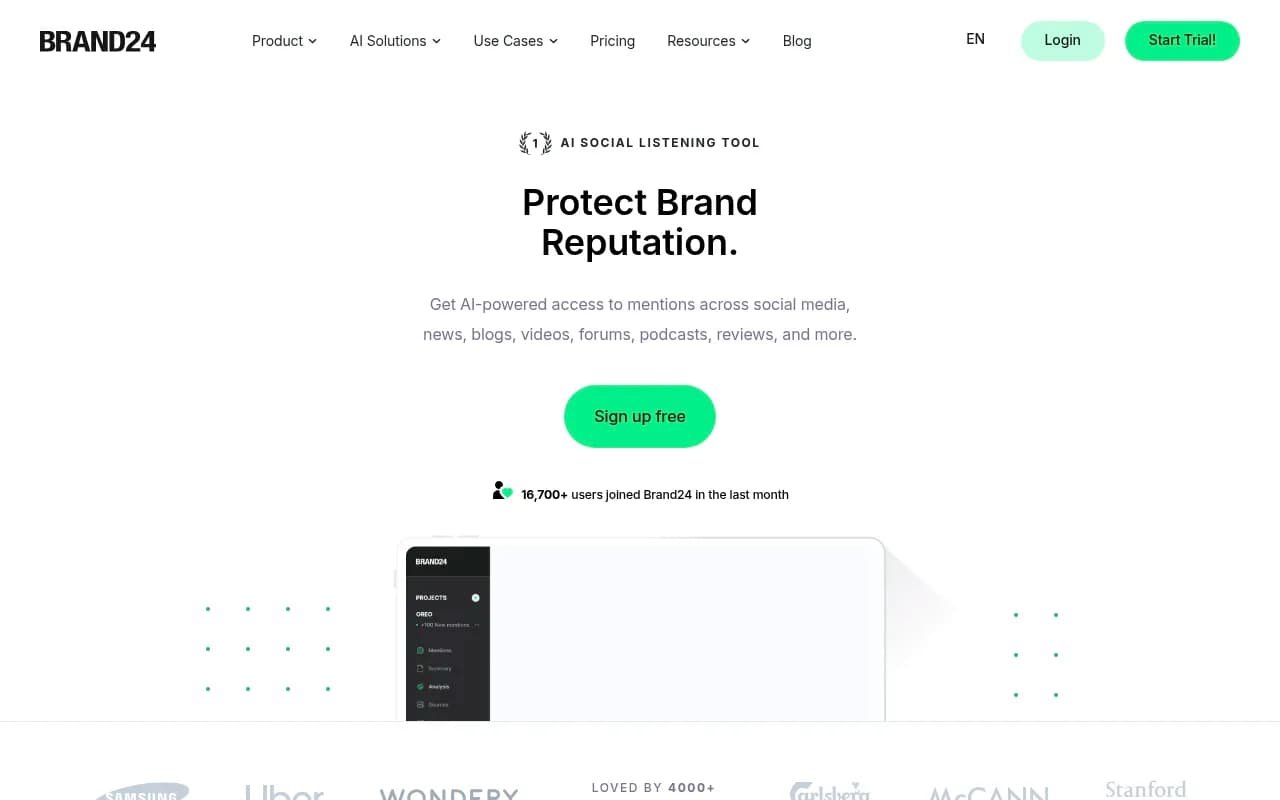
Traditional brand monitoring (Google Alerts, Brand24) still matters because it catches the source content before it influences AI models. If a negative article gets published today, you have a window to respond before it gets picked up in AI training or retrieval.
Build a crisis response protocol
When something goes wrong -- a viral complaint, a news story, a product failure -- you need a playbook that includes the AI dimension. That means:
- Immediately auditing what major AI models are saying about the incident
- Publishing a clear, factual response on your own domain within 24 hours
- Distributing that response through channels AI models are likely to index
- Monitoring daily until the narrative stabilizes
Fast Company noted in 2026 that reputation management is now partly about what ranks and partly about what gets summarized. The brands that respond to crises with clear, indexable content are the ones that control their AI narrative.
The content gap you're probably missing
Most brands focus on what they want AI to say about them. Fewer focus on what AI is currently saying when it can't find good information.
When a model lacks authoritative content to cite, it defaults to whatever it can find -- which is often community content, competitor comparisons, or hallucinated details. The answer gap isn't just a visibility problem; it's a reputation risk.
Running an answer gap analysis (identifying which prompts about your brand or category are returning responses that don't cite your content) reveals exactly where you're exposed. Promptwatch's Answer Gap Analysis does this systematically, showing you the specific prompts where competitors are visible but you're not -- which often correlates directly with where negative or inaccurate narratives are filling the void.
A realistic timeline
Fixing AI brand reputation isn't instant. Here's roughly what to expect:
- Week 1-2: Audit current AI responses across major models. Identify negative mentions, inaccuracies, and gaps.
- Week 2-4: Address source content (respond to reviews, update on-site content, submit feedback to AI platforms).
- Month 1-3: Publish new authoritative content targeting the specific prompts where negative narratives are appearing.
- Month 3-6: Monitor for improvement. AI models update at different rates -- Perplexity's retrieval-based system responds faster than models with longer training cycles.
- Ongoing: Maintain monitoring cadence and continue building citation footprint.
The brands that treat this as a one-time fix tend to get burned again. The ones that build ongoing monitoring into their marketing operations are the ones that stay ahead of it.
Practical tools summary
For monitoring brand sentiment across AI models, the most capable platforms right now are Promptwatch (broadest model coverage, sentiment tracking, content generation, crawler logs), Profound (strong analytics, enterprise-focused), and Peec AI or Otterly.AI for teams that need a simpler starting point.
For traditional brand monitoring that feeds into your AI strategy, Brand24 remains solid for catching source content early.
For content creation designed to improve your AI citation footprint, Promptwatch's built-in AI writing agent generates content specifically engineered to get cited -- grounded in real citation data rather than generic SEO optimization.
The bottom line: negative AI brand mentions are a real and growing risk, but they're manageable if you catch them early and respond with authoritative content. The window between a negative narrative appearing and becoming entrenched across multiple LLMs is real -- and it's worth protecting.