Key takeaways
- Google AI Overviews now appear on a significant portion of searches, and they cut organic CTR by as much as 61% for affected queries -- meaning visibility in the overview itself is the new ranking goal
- You can't rely on traditional rank tracking to know if a competitor is beating you in AI Overviews; you need to actively query, compare, and track citations
- Manual checking works for spot-checks, but systematic competitor benchmarking requires dedicated AI visibility tools
- The gap between "monitoring" and "fixing" matters -- knowing a competitor appears more than you is only useful if you can act on it
- Content structure, topical authority, and answer-first formatting are the main levers for improving your AI Overview citation rate
If you've noticed your organic traffic dipping on queries where you used to rank comfortably, there's a decent chance Google AI Overviews are eating your clicks. According to data from Dataslayer's Search Console analysis, AI Overviews cut organic CTR by around 61% on affected queries. That's not a rounding error -- that's a structural shift in how search works.
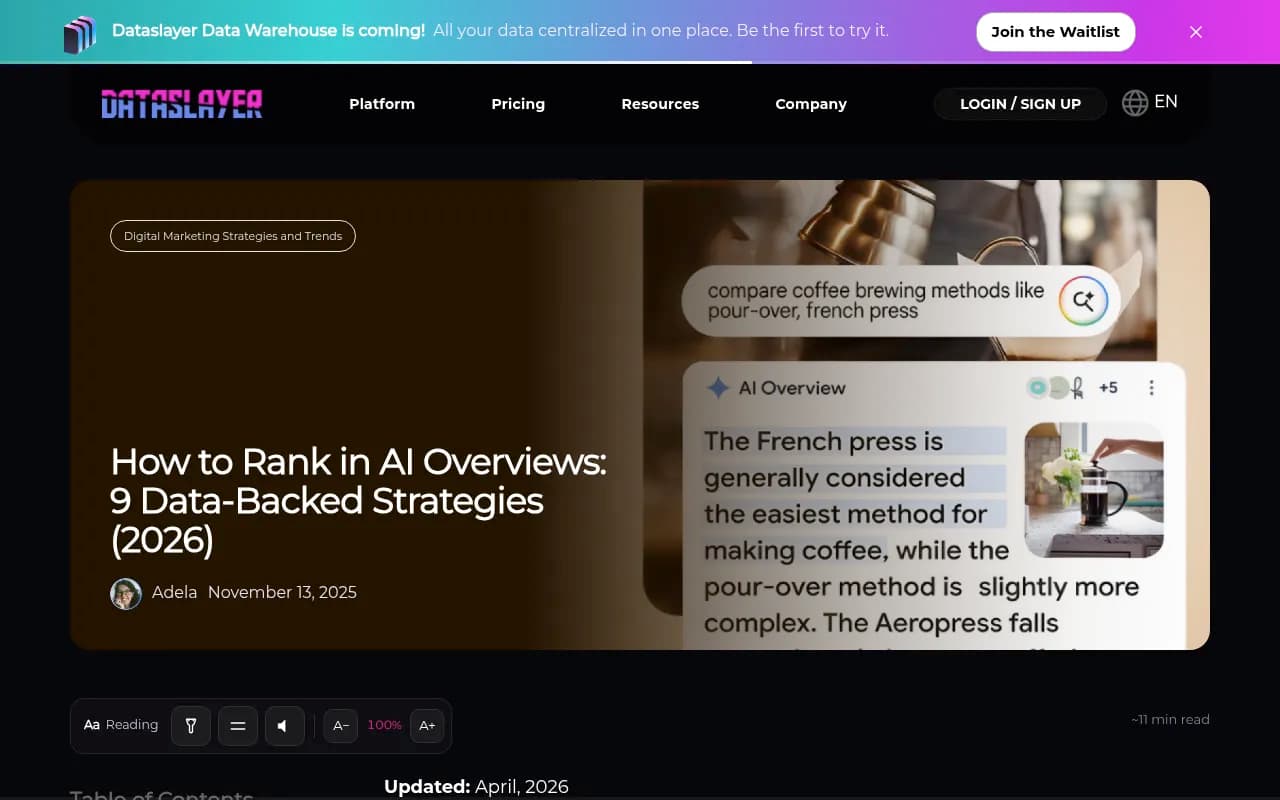
The harder problem is this: you might not even know a competitor is consistently getting cited in AI Overviews while you're invisible. Traditional rank trackers show you position 1-10 in blue links. They don't show you who's being quoted in the AI-generated summary at the top of the page. Those are two completely different things, and confusing them is costing brands real traffic.
This guide walks through exactly how to diagnose the gap, what to look for, and how to close it.
Why AI Overview visibility is different from regular rankings
Before getting into the how, it's worth being clear about what you're actually measuring.
When Google generates an AI Overview, it synthesizes information from multiple sources and typically cites 3-8 pages in the response. Being cited there is not the same as ranking #1 organically. A page that ranks #7 can get cited in an AI Overview. A page that ranks #1 might not appear in the overview at all.
This means your competitor could be invisible in the traditional blue-link results but still be winning the AI Overview citation for the same query -- and getting the brand impression, the trust signal, and potentially the click.
The reverse is also true. You might rank #1 and still lose to a competitor who structured their content in a way that's more useful to Google's AI synthesis engine.
So the question "does my competitor show up in AI Overviews more than me?" is genuinely distinct from "do they outrank me?" and needs its own answer.
Step 1: Run manual spot-checks on your most important queries
The simplest starting point is also the most direct: search Google for the queries that matter most to your business and look at what appears.
A few things to keep in mind:
- AI Overviews don't appear on every query. They're more common on informational and research-oriented searches, less common on navigational or transactional queries.
- They vary by location, device, and whether you're signed in. Use an incognito window, and if you serve a specific region, use a VPN or Google's location parameter to simulate searches from that area.
- The sources cited in the overview are shown as small cards or links below or beside the generated text. Click through to see which domains are being cited.
For each query, note:
- Does an AI Overview appear at all?
- Is your site cited? Which page?
- Are any competitors cited? Which ones, and which pages?
- What angle does the AI Overview take -- is it answering a "what is" question, a comparison, a how-to?
This manual process is slow, but it gives you ground truth. Do it for 15-20 of your most important queries and you'll already have a clearer picture than most teams.
Step 2: Build a competitor comparison matrix
Once you've done a few manual checks, organize what you find. A simple spreadsheet works:
| Query | AI Overview present? | Your site cited? | Competitor A cited? | Competitor B cited? | Notes |
|---|---|---|---|---|---|
| "best [product category]" | Yes | No | Yes | No | Competitor A cited on their comparison page |
| "how to [use case]" | Yes | Yes | Yes | No | Both cited, different sections |
| "[your category] vs [alternative]" | Yes | No | No | Yes | Competitor B has a dedicated comparison page |
| "[specific feature] explained" | No | N/A | N/A | N/A | No overview generated |
After 20-30 queries, patterns emerge fast. You'll start to see which competitors are consistently getting cited, which content formats they're using for those pages, and which query types you're systematically missing.
This matrix also gives you a prioritized list of gaps to close -- which is the actual goal.
Step 3: Use dedicated AI visibility tools for systematic tracking
Manual checking is fine for a one-time audit, but it doesn't scale. If you want to track competitor AI Overview visibility over time -- and across dozens or hundreds of queries -- you need tools built for this.
The landscape of AI visibility tracking has grown quickly in 2026. Here are the main options worth knowing:
Promptwatch is the most comprehensive option for teams that want to go beyond monitoring. It tracks AI Overview citations alongside 10 other AI models, shows you competitor heatmaps, and has an Answer Gap Analysis feature that identifies exactly which prompts competitors are visible for but you aren't. The content generation layer means you can go from "identified gap" to "published content" without switching tools.

Otterly.AI covers Google AI Overviews alongside ChatGPT and Perplexity. It's a solid monitoring tool for teams that primarily want to track brand mentions and citation frequency across AI engines.
Semrush has added AI Overview tracking to its existing rank tracking suite. If you're already a Semrush user, it's worth checking what's available in your plan -- the integration with traditional SEO data is useful, though the AI-specific features are less deep than dedicated platforms.
SE Ranking also tracks AI Overview appearances alongside traditional rankings. Good for teams that want a single platform for both.
Ahrefs has been building out AI search tracking features. Their Brand Radar and AI Overview tracking give you visibility into citation patterns, though the prompt customization is more limited than specialized tools.
What to look for in any tool you use
Not all AI visibility tools are equal. When evaluating options, the key questions are:
| Feature | Why it matters |
|---|---|
| Competitor citation tracking | Can you see which competitors are cited for the same prompts you care about? |
| Query/prompt customization | Can you track the specific queries relevant to your business, or are you stuck with fixed prompts? |
| Historical data | Can you see trends over time, not just a snapshot? |
| Content gap analysis | Does the tool tell you why a competitor is being cited and what content you're missing? |
| Google AI Overviews specifically | Some tools only track ChatGPT/Perplexity -- confirm Google AIO is included |
| Frequency of updates | AI Overview citations change. Daily or near-real-time tracking matters more than weekly. |
Step 4: Analyze what's making competitors' pages get cited
Once you've identified which competitor pages are getting cited in AI Overviews, the next step is understanding why. This is where most teams stop too early -- they see the gap but don't diagnose the cause.
Go to the specific competitor pages being cited and look for these patterns:
Direct answer placement
Pages that get cited in AI Overviews almost always lead with a clear, direct answer to the question. Not a preamble about the company, not a table of contents -- an actual answer in the first 100-150 words. Google's AI synthesis engine is looking for the most quotable, usable answer, and it tends to find it near the top.
If your page buries the answer after three paragraphs of context, a competitor whose page leads with the answer will win the citation.
Structured formatting
Headers that match question phrasing, numbered lists, definition-style formatting ("X is..."), and short paragraphs all make content easier for AI systems to parse and cite. Compare your page structure to the competitor page being cited. If theirs is more scannable, that's likely a factor.
Topical depth and coverage
AI Overviews tend to cite pages that cover a topic comprehensively, not just answer one narrow question. A competitor who has built out a full topic cluster -- covering the main question, related sub-questions, and adjacent concepts -- will tend to get cited more consistently than a site with isolated pages.
Freshness
AI Overviews favor recently updated content for queries where recency matters. Check the "last updated" dates on competitor pages that are getting cited. If they're updating quarterly and you haven't touched a page in two years, that's a factor worth addressing.
Step 5: Check your Google Search Console data for AI Overview signals
Google Search Console doesn't give you direct competitor data, but it does give you your own AI Overview performance -- and that's useful context.
In Search Console, look at:
- Queries where you have impressions but very low CTR (under 1-2%). These are often queries where an AI Overview is appearing and absorbing clicks before users reach your result.
- Pages with declining CTR over the past 6-12 months despite stable or improving rankings. This pattern often indicates an AI Overview started appearing for that query.
- The "Search appearance" filter, which in 2026 includes AI Overview-specific data in some accounts.
Cross-reference this with your manual spot-checks. If a query shows low CTR in Search Console and you can see an AI Overview appearing when you search it, you have a confirmed AI Overview impact case.
Step 6: Track offsite citations and brand mentions
Here's something most teams miss: AI Overviews don't only cite your own website. They cite Reddit threads, YouTube videos, third-party review sites, industry publications, and comparison pages. Your competitor might be winning AI Overview citations not because their website is better, but because they have stronger third-party coverage.
Check whether competitors are being cited through:
- Review aggregators (G2, Capterra, Trustpilot)
- Industry publications and blogs
- Reddit discussions in relevant subreddits
- YouTube tutorials and comparison videos
If a competitor's product is being discussed favorably in a Reddit thread that Google's AI is citing, that's an offsite signal you can work on -- by building your own community presence, getting reviewed on the same platforms, or creating content that earns those third-party mentions.
What to do once you've found the gaps
Finding that a competitor appears in AI Overviews more than you is only useful if you do something about it. The typical action path looks like this:
- Identify the specific queries where the gap exists (from your manual checks or tracking tool)
- Find the competitor pages being cited for those queries
- Audit your own existing content for those queries -- does it exist? Is it structured for AI citation?
- Either update existing pages (add direct answers, improve structure, update freshness) or create new pages targeting the gap
- Track whether your citation rate improves over the following weeks
The time from content update to AI Overview citation can range from a few days to a few weeks, depending on how quickly Google crawls the updated page. Tools like Promptwatch's crawler log feature can show you when AI crawlers are actually hitting your pages, which removes the guesswork.
A realistic benchmark for where you stand
If you're doing this analysis for the first time, here's a rough way to interpret what you find:
- If a competitor is cited in AI Overviews for more than 60% of the queries where you're both targeting the same topic, they have a meaningful structural advantage -- probably in content depth or answer formatting.
- If the gap is 20-40%, it's likely fixable with targeted content updates rather than a full strategy overhaul.
- If you're being cited more than competitors on most queries but still seeing CTR decline, the issue isn't competitive -- it's the AI Overview format itself absorbing clicks that used to go to organic results. That's a different problem requiring a different response (email capture, brand building, conversion optimization on the pages that do get clicks).
The most important thing is to stop treating AI Overview visibility as a mystery and start treating it as something measurable and improvable. The data is there. The tools exist. The main thing separating teams that are winning AI Overview citations from those that aren't is whether they've actually looked.