Key takeaways
- Track in the language your buyers actually use, then keep a small English baseline to spot where English-language sources leak into Dutch answers.
- Build your prompt set from Dutch search volume, not from translated English prompts. Terms under about 50 searches a month are too thin to be key prompts.
- Run every prompt many times and aggregate. A SparkToro finding cited by ClickForest puts the chance of getting the same brand list twice in 100 runs at under 1 in 100.
- Track the answer, the citations and the query fan-outs. Fan-outs show whether the model searched in Dutch or English behind the scenes.
- Confirm Dutch support in a trial before paying. Most pricing pages say nothing about language.
Why Dutch prompts need their own setup
Most AI visibility advice is written for US English. If you sell in the Netherlands, you have two problems. The first is practical: does your tracker actually send Dutch prompts and get Dutch answers back? The second is harder: does the model reason about your category in Dutch at all, or does it quietly translate to English and pull English sources?
A Search Engine Land piece on language choice in prompt tracking makes the second point sharply. Its claim is that models reason internally in English even when asked in another language, so a competitor that owns English coverage can leak into your market's answers. Ramon Eijkemans is quoted in it: "You are not testing Dutch or Japanese. You are testing whether a concept is well-formed in the model's dominant-language memory, which today happens to be English."
I think that is half right and worth testing rather than believing. Google AI Overviews and AI Mode are live in the Netherlands in Dutch (Google announced AI Mode for the Netherlands on 8 Oct 2025), and where local training depth is good, answers draw on local sources. Where it is thin, they cite English ones. Your job is to find out which case you are in, per topic.
Step 1: Decide which language to track in
The Search Engine Land article offers a simple dominance ratio. For each term, pull US-English search volume and Dutch search volume from an SEO tool on the same day, then divide English by Dutch.
| Ratio (US English / Dutch) | What to do |
|---|---|
| 3 or higher | Track in English |
| Between 0.33 and 3 | Track in both |
| 0.33 or lower | Track in Dutch |
| Dutch volume under 50/month | Too thin to be a key prompt |
For most Dutch consumer and local-service brands the ratio will land well under 0.33, so Dutch is the main language. For B2B SaaS and developer tools, expect many terms in the middle band where English matters too, because your buyers search in both.
For the volume pull, any keyword tool with a Dutch database works. Options in this directory include Semrush and Ahrefs, and the free Google Keyword Planner is enough for a first pass.

Step 2: Build a Dutch prompt set that is not just translated English
Translated prompts sound translated. Dutch buyers write differently, mix in English product terms, and use "je" and "u" depending on the category. Start from real data instead:
- Export Dutch queries from Google Search Console for your top pages.
- Pull People Also Ask questions in Dutch for your core topics.
- Check how customers phrase problems in support tickets, reviews and sales calls.
- Add comparison prompts ("X vs Y", "beste ... voor ...") and brand-specific prompts ("is [merk] betrouwbaar?").
Google Search Console is free and gives you the Dutch phrasing that already brings you traffic. Since 31 Aug 2026 it also shows impressions in Google's AI features, according to ClickForest, which makes it a free cross-check on the Google side.
A starter set could look like this for a Dutch energy comparison brand:
wat is de beste energieleverancier voor een klein huishouden?
energiecontract vergelijken zonder gedoe
is [merk] een goede energieleverancier?
[merk] vs [concurrent] dynamisch contract
welke leverancier heeft de beste klantenservice?
Keep 25 to 50 prompts per market to begin. Group them into topics so you can read results by theme rather than as a flat list.
Add the English baseline
Pick 5 to 10 of your most important prompts and run them in English too, with identical intent. This is the constant the Search Engine Land author recommends diagnosing against. If you rank well in English but vanish in Dutch, the model probably does not have enough Dutch-language evidence about you. If you are visible in Dutch and absent in English, that matters less for a purely Dutch business.
Step 3: Choose how to track
You have three realistic routes: manual spot checks, a script against an API, or a dedicated tracker.
Manual checks
Fine for a first afternoon. Open ChatGPT and Perplexity, paste 10 Dutch prompts, and note who is named. The limit is obvious: answers vary run to run, so one run tells you almost nothing. Use it to sanity-check your prompt list, not to report numbers.
A script against the Perplexity API
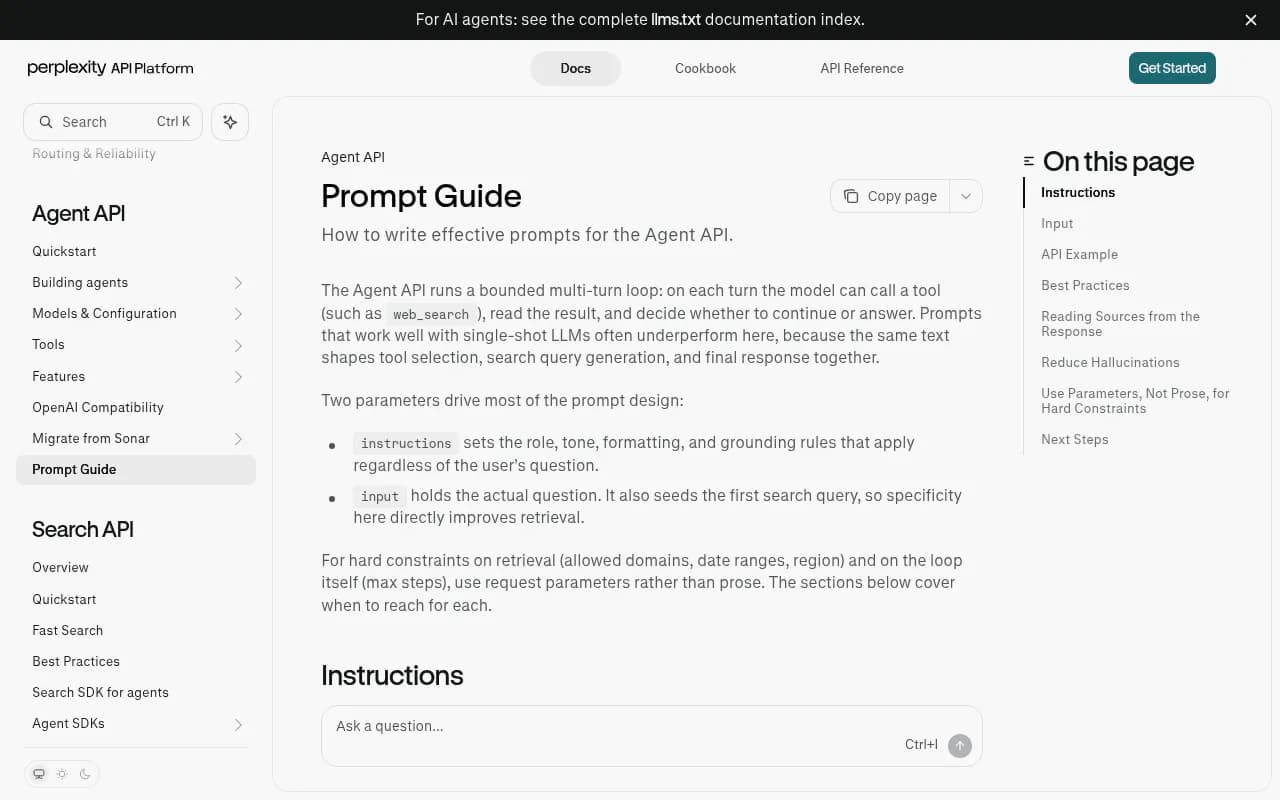
If you have a developer, the Perplexity Agent API is a cheap way to see how Perplexity behaves in Dutch. Two parameters matter: instructions for role, language and grounding rules, and input for the question, which also seeds the first search query. Perplexity's own prompt guide says to use request parameters rather than prose for hard constraints.
A minimal example in Python:
from perplexity import Perplexity

client = Perplexity()

response = client.responses.create(
    effort="low",
    input="Wat is de beste energieleverancier voor een klein huishouden?",
    instructions="Antwoord in het Nederlands. Noem bronnen met domeinnaam. Als zoekresultaten niet relevant zijn, zeg dat expliciet.",
    tools=[{"type": "web_search"}]
)

print(response.output_text)
The useful part is in the raw response: it includes the queries the model generated for its searches. Read those. If your prompt was Dutch and the queries are English, you have just learned something a mention counter would never show you.
One caveat. An API call is not the same as what a person sees in the Perplexity interface, and the same goes for ChatGPT. User-facing answers and citations can differ from API output, so treat scripts as diagnostics, not as your reporting source. I also found no official setting in either product for pinning the country or locale of a tracked prompt, so check how any tool you pick handles location.
A dedicated tracker
For ongoing work you want daily or weekly runs, repeated sampling, citations, and competitor comparison. This is where tool choice gets specific to the Netherlands.
Step 4: Pick a tool that handles Dutch
The honest problem: for most trackers, the pricing page says nothing about language support. You have to test. Run your Dutch prompts during the trial and check that answers come back in Dutch and that brand matching works with Dutch phrasing.
| Tool | Dutch angle | Notes |
|---|---|---|
| Promptwatch | Tracks prompts per country, language and city (vendor claim, verify on the pricing page) | Real-UI tracking of ChatGPT, Perplexity, AI Overviews and more; crawler logs, content tools |
| Briljant | Dutch GEO platform | Described as a Dutch daily tracker for ChatGPT and Perplexity |
| Veesie | Dutch, French and English on every plan | Weekly, not daily; from EUR 29/mo for 20 prompts. Not in our catalog |
| Peec AI | Not documented on pricing page | Prompt tracker, test Dutch in the trial |
| Otterly.AI | Not documented on pricing page | Monitoring only, test Dutch in the trial |
| Semrush / Ahrefs / SE Ranking | Not documented on pricing page | SEO suites with AI tracking added |
| Profound | No public price, large-brand focus | Enterprise monitoring |
The ClickForest comparison where the Veesie and Briljant details come from is published by Veesie's maker, so the ranking in it is biased. The facts about each tool's pricing and language coverage are still useful as a starting checklist.
Promptwatch
Promptwatch is the one I would put on a Dutch shortlist if you want more than mention counts. It runs prompts against the real interfaces of ChatGPT, Perplexity, Google AI Overviews, AI Mode, Gemini and others, per country and language, and it shows query fan-outs, which is exactly what you need to see whether the model searched in Dutch. Its IP-verified AI crawler logs and visitor analytics also tell you whether AI systems can read your Dutch pages and whether the visits convert. It is an Amsterdam company, ISO/IEC 27001 certified and GDPR compliant, which helps with Dutch enterprise procurement. Verify language and location options on promptwatch.com/pricing before committing.

Dutch-built and smaller options
Briljant is a Dutch GEO platform tracking ChatGPT and Perplexity, which fits if you want a local vendor.
Peec AI and Otterly.AI are common choices for prompt tracking at lower price points. Both are monitors rather than optimization platforms, and neither documents Dutch support on its pricing page, so run the trial test.

Otterly.AI

If you want to browse more options, the AI rank tracker directory at ai-rank-tools.com lists a wider set of trackers.
Step 5: Configure the tracking properly
Whatever tool you choose, set these up the same way.
Pin country and language
Set the country to the Netherlands and the language to Dutch for the main monitor. If you serve Belgium too, make a separate monitor for Flemish phrasing, since Google AI Overviews and AI Mode are available in both the Netherlands and Belgium with Dutch supported. For local businesses, add city-level tracking where the plan allows it.
Repeat and aggregate
One run is noise. Because AI answers vary, you want each prompt run daily or at least multiple times a week, and you read the trend, not any single answer. Report visibility as a percentage across runs.
Track fan-outs
This is the Dutch-specific step most people skip. ChatGPT often runs its own web searches behind an answer. Promptwatch's ChatGPT query fanouts data shows the average fanout queries per response moved from 2.15 in early December to about 1.84 by early March, and average fanout query length fell from about 117 characters to the high 80s. The report doesn't break this down by language. My inference, not a finding: ChatGPT's internal queries may not be in Dutch even when your prompt is, so log them and check. See Promptwatch's ChatGPT query fanout report for the daily numbers, and the August 8 site: operator report for a change in how those queries are built.
Expect different citation counts per platform
Promptwatch's Average Sources Per Response data (September 2025) shows ChatGPT citing about 5 sources per web-search answer, Google AI Overviews about 10, and Perplexity almost exactly 10 every day. That makes Perplexity a stable test bench: if your Dutch prompt returns 10 sources and none is Dutch, that tells you something concrete about the model's view of your market.
Step 6: Read the results
The metrics only help if you know what each one points at.
| Signal | What it usually means |
|---|---|
| Low share of voice in Dutch, higher in English | The model has thin Dutch evidence about you |
| Mentioned but never cited | A content or crawlability problem |
| Cited sources are all English or .com | Local source depth is weak in your category |
| Mentioned late in the answer | A prominence problem |
| Listed but not recommended | Needs a Dutch-speaking human to judge |
That last row matters. You can read answers without speaking the language, but you may need a local expert to judge whether the answer recommended you or only listed you. For a Dutch team that is easy, so build a monthly review where someone reads 20 full answers rather than just looking at dashboards.
For a cross-market view, the Search Engine Land article suggests three layers: shared-core terms with identical prompts across markets, a structural comparison of market-specific terms (such as the share of local-language sources), and local-language prompts that test whether the model imports US consensus. This is a good structure if you run NL alongside DE, BE or the UK.
Step 7: Act on what you find
Tracking without action is a reporting exercise. Typical fixes for Dutch brands:
- Publish Dutch pages that answer the exact prompts, with headings that read like short search queries and the entity and category up front. That is the guidance Promptwatch gives from its fanout data.
- Check that AI crawlers can reach your Dutch pages. Crawler logs show whether GPTBot, PerplexityBot and others hit errors.
- Get named on the third-party Dutch pages the models already cite, such as comparison sites, forums and industry media. I found no Dutch-specific citation statistics, so build your own list of cited Dutch domains from your tracking data.
- Keep key English pages strong if your baseline shows English sources are driving Dutch answers.
For Dutch-market GEO or SEO help from a team, 1001 SEO Media works on technical SEO, content and AI search visibility, and uses Promptwatch for tracking. For tool-by-tool research, the GEO software directory at bestgeosoftware.com is a good next stop.
A one-week setup plan
- Day 1: pull Dutch and English volumes, apply the ratio, pick languages.
- Day 2: assemble 30 to 50 Dutch prompts from Search Console, PAA and support data, plus 5 to 10 English baseline prompts.
- Day 3: run manual checks and one Perplexity API test; read the generated queries.
- Day 4 and 5: start trials of two trackers; confirm Dutch answers, brand matching and location handling.
- Day 6: set up monitors by country and language, repeat runs, competitor list.
- Day 7: write down your baseline and the three biggest gaps. Review again in 30 days.
The point of all this is not a prettier dashboard. It is knowing whether a Dutch buyer asking a Dutch question hears your name, and if not, which page or source to fix first.