Key takeaways
- Mention tracking tells you whether AI names you. Narrative tracking tells you what AI claims about you, and whether those claims are true. You need both.
- A manual audit with 10 to 15 prompts across four assistants takes about 30 minutes and gives you a usable baseline. Repeat it monthly.
- Most wrong claims trace back to pages AI can read: your own site, old reviews, or third-party listicles. Fix the source and the answer follows.
- ChatGPT leans on product and landing pages for branded questions, so the pages that describe what you sell carry most of your narrative.
- Once you pass a few dozen prompts, a platform with claim-level analysis and fact-checking beats a spreadsheet.
What a brand narrative actually is
A brand narrative, in the AI sense, is the set of claims a model repeats about you. "Affordable for small teams." "Weak mobile app." "Best known for email marketing." "Acquired in 2022" (when you weren't). Each answer is a small story, and across thousands of buyer questions the stories add up to a reputation you didn't write.
This is different from visibility. A dashboard that counts mentions will happily report that you are "visible" in the same week an assistant quotes a wrong price to a prospect. The research I pulled for this guide is blunt about it. Searchable's AI Brand Misinformation Report found that AI chatbots state at least one false fact about 75% of brands that check more than 20 facts, and 9.2% of all AI-stated facts checked were false (32,556 facts, 1,704 brands). G2's 2026 AI Search Insight Report says 64% of B2B software buyers often or very often run into inaccurate chatbot recommendations, and that chatbots are now the top influence on shortlists at 54%, ahead of review sites at 43%. I haven't re-verified those figures myself, so treat them as directional, but the direction is clear enough.
The practical question is not "are we showing up?" It is "what can we learn from how we're showing up?"
Step 1: Write down what is true
You can't spot a wrong claim without a reference. Before you ask any model anything, build a one-page brand canon. Seer Interactive recommends tracking facts, differentiators, brand claims, what you want to be known for, and what you don't want to be associated with. That structure works well.
Include:
- Legal name, former names, product names, and retired product names
- Pricing and plan structure as of today
- Founding year, headquarters, leadership
- Core features and, just as important, what you do not do
- The three to five things you want to own in the category
- Known outdated narratives (an old acquisition, a discontinued product, a past outage)
Keep it in a spreadsheet. Every claim you later find gets compared against this sheet and marked accurate, inaccurate, outdated, or unverifiable.
Step 2: Run the manual audit
Start by hand. It is free, and reading raw answers teaches you things a dashboard summary hides.
The prompt set
Use the same prompts in ChatGPT, Gemini, Perplexity and Claude. Replace the brackets with your own details.
Identity prompts:
- What does [Brand] do?
- What is [Brand] best known for?
- What topics is [Brand] considered an expert in?
- Are there any outdated or legacy descriptions of [Brand]?
Buyer prompts:
- What are the best [category] tools for [use case]?
- Is [Brand] a good fit for [segment]?
- How much does [Brand] cost?
- [Brand] vs [top competitor]: which should I pick?
- What are the downsides of [Brand]?
- What do customers say about [Brand]'s support?
Run each prompt at least twice, ideally from a clean session, because answers shift with conversation context and model updates. You are looking for patterns, not treating any single response as definitive. Does one description keep appearing? Does an old product name keep surfacing?
Score the results
For every response, log four things:
| Question | What you record |
|---|---|
| Are we there? | Mentioned yes or no |
| Where are we? | Position among named brands |
| What is it saying? | Each claim, copied verbatim |
| Is it accurate? | Accurate, inaccurate, outdated, unverifiable |
The fourth column is the narrative audit. Everything else is visibility. After 40 or so responses you will have a list of repeated claims, and the repeated ones matter most. A wrong claim that appears once is noise. A wrong claim that appears in six of eight responses is a belief.
Check the sources behind each claim
This is the step people skip. Perplexity and Google AI Overviews show sources inline, and ChatGPT does when search is triggered. Click through. A communications expert quoted in Notified's narrative audit guide put it well: "You'll be surprised how often it could be your own website."
Watch for:
- Your own pricing or about page being out of date
- A third-party listicle repeating a feature you removed
- A review site describing a plan that no longer exists
- A competitor's comparison page framing you unfairly
Promptwatch Data helps set expectations here. In its report on ChatGPT citation share by content type (Sep 28 to Oct 4, 2026), product pages made up 22.4% of ChatGPT citations and landing pages 16.8%. For branded prompts, the ones that name a company, product pages and landing pages together were almost half of citations (23.3% and 22.8%), and reviews hit 5.6%, more than three times their share across all prompts. So for the "what is [Brand]" question, your own commercial pages and your review profiles are the main inputs.
How many sources you get to inspect varies by engine. According to Promptwatch's average sources per response data, ChatGPT cites about 5 sources per web-search answer, Google AI Overviews about 10, and Perplexity almost exactly 10 every day, which makes Perplexity a steadier test bench: if your citations there change, it is probably your content and not engine noise. Copilot swung from under 2 to nearly 17 within weeks, so judge it on monthly trends.
Step 3: Separate the problem types
Not every bad answer needs the same fix. I sort findings into four buckets.
| Symptom | Likely cause | First fix |
|---|---|---|
| Not mentioned at all | Coverage gap, no page answers the prompt | Publish a page that answers it directly |
| Mentioned, but late in the list | Weak prominence | Strengthen comparison and category pages |
| Mentioned with wrong facts | Stale or conflicting sources | Correct the source pages, then the third parties |
| Mentioned with negative framing | Reputation or review gap | Address the review sites AI cites |
One more wrinkle: mention and citation are different things. On Gemini the overlap between brands mentioned and sources actually cited can run as low as 30%, per Semrush's AI Visibility Index as cited by Forbes. And Ahrefs found only about 12% of URLs cited in AI answers also rank in Google's top 10. Good rankings don't guarantee a good narrative.
Step 4: Fix the sources
The fix is almost never "ask the model to change its mind." You change the pages it learns from.
- Make your homepage, product pages and docs state pricing, features and audience in plain language. Promptwatch's own advice for branded prompts is the same.
- Add a plain-language FAQ page. Short, direct, factual.
- Collect fresh reviews on the sites trusted in your category.
- Update or contact third-party pages that repeat outdated claims.
- Retire old product names properly with redirects and a clear note, not silence.
- Prefer durable page types for your key claims. According to Promptwatch's content half-life data, landing pages and docs stay cited for months, while news pages lose half their citations in about five weeks. A press release won't hold your narrative in place. A landing page will.
Then wait, re-run the prompts, and check whether the claim moved. Models don't update on your schedule, so give it weeks, not days.
Step 5: Choose how to keep tracking
The manual audit works for a first look. It stops working when you want multiple markets, personas, competitors, and weekly cadence. Tools split into a few camps.
- Trackers that mostly count mentions and citations. Cheap and useful for coverage.
- Platforms that score sentiment and tone.
- Tools that flag factual inaccuracies and trace them to a source.
- Traditional listening platforms that added AI tracking, such as Meltwater, Brand24 and Talkwalker. Others, like Brandwatch, mostly use AI to analyze your existing listening data rather than tracking what AI engines say about you. Confirm in writing before assuming coverage.
Where to look first
Promptwatch is the one I'd start with when narrative is the goal, because Brand Narrative is on every plan. It pulls the individual claims AI makes about you and your competitors out of every tracked response, groups the repeated ones, shows which models say each, and files them under themes like Pricing, Features, Support or Reputation with a 0 to 100 score per theme you can compare against competitors. Fact Check, on Business, Agency Scale and Enterprise, lets you mark a claim accurate or inaccurate and then reads the pages crawled from your site to find the ones that state it or its opposite, so you know which page is teaching the model the wrong thing. It also collects answers from the real interfaces of ChatGPT, Gemini, Perplexity, AI Overviews and others, in the country and language you pick, which matters because user-facing answers can differ from API outputs.

That closes the loop the manual audit leaves open. Spot the claim, find the page, fix it, then check whether it worked, with the Action Board and Content Agent handling the fixing side on higher plans. Pricing runs from $95 per month (Essential) to $579 per month (Business, which adds Fact Check); confirm current numbers at promptwatch.com/pricing. There is a 7-day free trial on monthly billing and a free AI visibility report if you want a no-commitment first look.
Profound is the enterprise name most people compare against. Its FactCheck Agent traces a false claim to the publisher repeating it, drafts a correction and tracks whether it lands. The catch from the research: no published self-serve paid price, so expect a sales call. For a side-by-side, see Promptwatch vs Profound.
Profound

For lighter or cheaper tracking, a few more are worth a look. Otterly.AI is a low-price tracker with volume and coverage as the pitch rather than narrative depth. Rankscale and AthenaHQ both name sentiment analysis as a feature. Goodie centers on knowing when AI gets your brand wrong. Peec AI suits agencies.
Otterly.AI



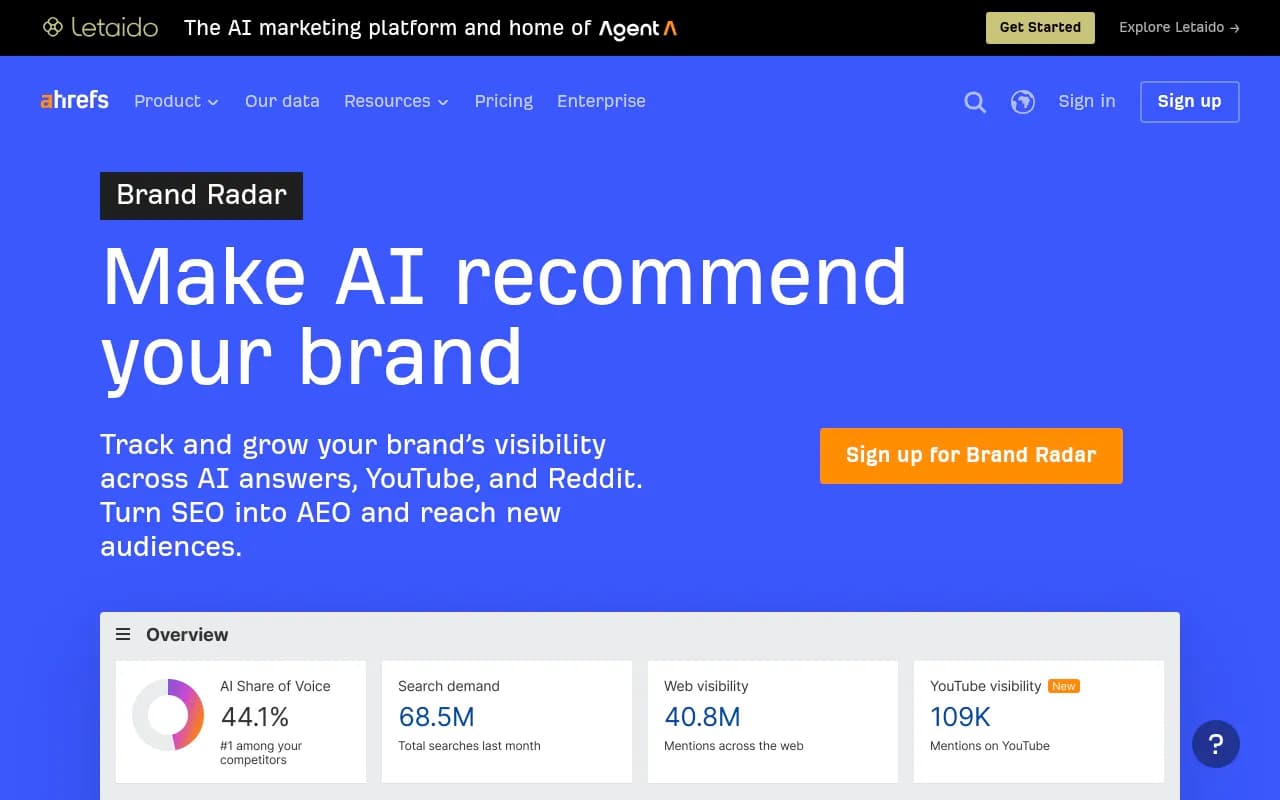
If you already pay for a suite, check what it has added. Semrush and Ahrefs Brand Radar bolt AI tracking onto existing SEO data, convenient but usually with fixed prompt sets and shallower AI-specific detail. Meltwater, Brand24 and Talkwalker came from listening and carry the misinformation angle naturally.
Quick comparison
| Tool type | Examples | Narrative depth | Best for |
|---|---|---|---|
| End-to-end AI visibility platform | Promptwatch | Claim-level themes, fact-checking, fixes | Teams who want to find and fix |
| Enterprise AEO agent | Profound | Fact-check and correction | Large budgets, sales-led buying |
| Mention and citation trackers | Otterly.AI, Peec AI | Light | Cheap coverage checks |
| Sentiment-forward trackers | AthenaHQ, Rankscale, Goodie | Medium | Mid-size teams |
| SEO suites with AI add-ons | Semrush, Ahrefs Brand Radar | Light to medium | Teams already in the suite |
| Listening platforms with AI modules | Meltwater, Brand24, Talkwalker | Medium | PR and comms teams |
Browse more options in the GEO software directory if you want to compare beyond this list.
Step 6: Set a cadence and ownership
A narrative audit is not a one-off. A rhythm that holds up:
- Weekly: glance at new claims and sentiment shifts if you use a tool.
- Monthly: re-run the manual prompt set, or review the tool's claim report, against your canon.
- Quarterly: refresh the canon, retire outdated narratives, and review the top cited sources.
- After any launch, rebrand, pricing change or incident: run it immediately.
Give one person ownership, and loop in communications, product marketing and support, because a narrative problem rarely lives in one team. Semrush reports that 81% of brands that integrated AI visibility tracking into an existing SEO workflow saw increased traffic or leads from AI platforms, versus 36% that managed the two separately. I can't vouch for the methodology, but it matches what I'd expect: narrative work sticks when it belongs to a process.
Common mistakes
- Treating one response as the truth. Run each prompt repeatedly and look for patterns.
- Only checking one model. Claims differ between assistants.
- Counting mentions and calling it done. Presence is not accuracy.
- Trying to "correct" the model rather than the source page.
- Skipping the canon, then arguing about what is accurate.
- Assuming your listening platform already covers AI answers.
A simple 60-minute plan
- Spend 15 minutes writing your brand canon.
- Spend 30 minutes running 10 prompts across four assistants and logging claims.
- Spend 10 minutes marking each claim accurate, inaccurate, outdated or unverifiable.
- Spend 5 minutes opening the cited sources for your worst two claims.
By the end you will know which two pages to fix first. That alone is more than most brands know today. When the list outgrows a spreadsheet, move it into a platform that tracks claims over time and shows you whether your fixes changed what AI says.