Key takeaways
- HubSpot has the strongest native marketing data layer, making it the easiest CRM to connect with AI search visibility workflows.
- Salesforce wins on raw customization and enterprise-grade integrations, but you'll need developer resources to wire it up properly.
- Pipedrive is the cleanest sales-only CRM but has almost no native marketing intelligence — you'll rely entirely on third-party tools.
- Zoho CRM offers the best value for teams that want a broad feature set without enterprise pricing, including decent API access for custom integrations.
- None of the four CRMs natively track AI search visibility. That requires a dedicated platform like Promptwatch, which you then connect via API, Zapier, or webhook.
There's a question most CRM comparisons don't ask: what happens when a prospect discovers your brand through ChatGPT or Perplexity instead of a Google search? Which CRM can actually receive that attribution data, connect it to a contact record, and help your team understand which AI-driven content is generating pipeline?
That's the question this guide answers. The standard CRM comparison covers pipeline stages, email sequences, and pricing tiers. This one goes further — into how each platform handles the new reality that a growing share of B2B discovery happens through AI search engines, and whether your CRM is set up to capture any of it.
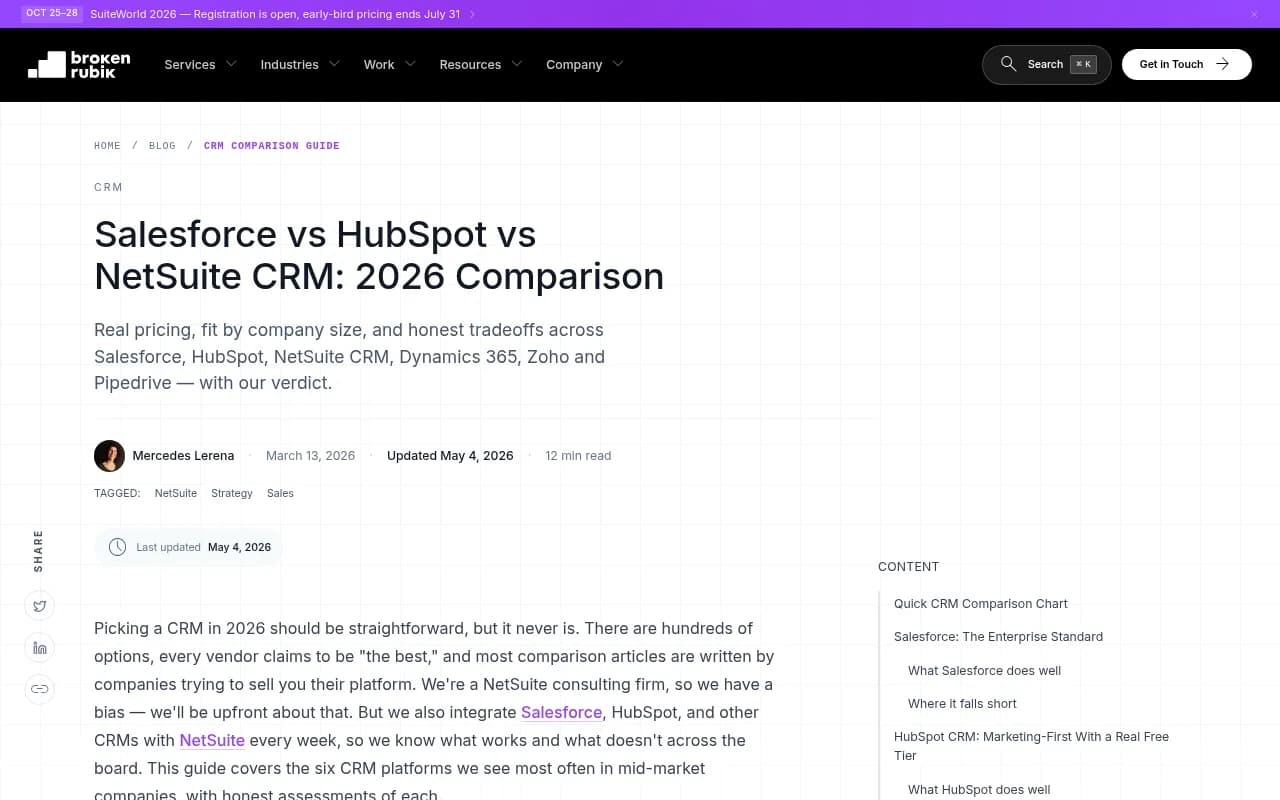
The four CRMs at a glance
Before getting into AI visibility integration, here's where each platform stands in 2026:
| CRM | Best for | Starting price | AI features | API quality | Free tier |
|---|---|---|---|---|---|
| HubSpot | Marketing-driven teams | $0 (free CRM) / $15/user/mo | Strong (Breeze AI) | Excellent | Yes |
| Salesforce | Complex enterprise sales | $75/user/mo | Very strong (Einstein) | Best-in-class | No |
| Pipedrive | Sales-focused SMBs | $14/user/mo | Basic | Good | No (14-day trial) |
| Zoho CRM | Budget-conscious teams | $14/user/mo | Solid (Zia AI) | Good | Yes (limited) |
Each has a clear lane. Salesforce is the most configurable. HubSpot is the most marketing-aware. Pipedrive is the simplest to use. Zoho is the best value. The real question is which lane aligns with how AI search visibility data needs to flow into your revenue stack.
Why AI search visibility data belongs in your CRM
In 2024 and 2025, most marketing teams treated AI visibility as a separate reporting concern — something you checked in a dashboard but never connected to actual pipeline. That's changing.
When a prospect says "I found you through ChatGPT" or your attribution data shows a spike in direct traffic correlating with an AI Overview mention, that signal has revenue value. If it never makes it into your CRM, you can't:
- Attribute closed deals to AI-driven content
- Identify which prompts or topics are generating qualified leads
- Feed that data back into content strategy
The gap between AI visibility platforms and CRMs is still wide in 2026, but it's closeable with the right setup. Here's how each CRM handles it.
HubSpot
Promptwatch connects to HubSpot more naturally than any other CRM on this list, and the reason is structural: HubSpot was built around content and inbound marketing from the start.

HubSpot's contact and deal records support custom properties, which means you can push AI visibility data — citation counts, prompt-level visibility scores, which AI models mention your brand — directly into the CRM as enrichment fields. From there, you can segment contacts by how they discovered you, build workflows that trigger based on AI-sourced attribution, and report on AI-driven pipeline in the same dashboards where you track everything else.
HubSpot's Breeze AI (launched in late 2024) adds a layer of native intelligence: it can summarize contact activity, suggest next steps, and generate content. But it doesn't track AI search visibility. That's a separate problem requiring a separate tool.
What HubSpot does well for this use case:
- Clean REST API with good documentation
- Native Zapier integration for no-code data piping
- Custom contact and deal properties for AI attribution fields
- Marketing Hub's traffic source reporting can be extended with custom UTM parameters from AI-referred clicks
- Content Hub integrates with SEO tools, making it easier to build a content workflow that feeds both traditional and AI search
The limitation: HubSpot's reporting is strong but not infinitely flexible. If you want complex multi-touch attribution that ties AI visibility to revenue, you'll hit the ceiling of what HubSpot's native reports can do and need a dedicated attribution tool alongside it.
For most marketing-led B2B teams, HubSpot is the right CRM anchor for an AI visibility stack.
Salesforce
Salesforce is the most powerful option here, and also the most demanding. If you have the resources to build it out, you can create a genuinely sophisticated integration between AI search visibility data and your CRM.
The Salesforce platform supports custom objects, meaning you can create a dedicated "AI Visibility" object that stores prompt-level data, citation scores by model, and content performance metrics — all linked to accounts and opportunities. Einstein AI can then surface patterns across that data, potentially flagging accounts where AI visibility is high but sales engagement is low.
That's a compelling use case. But it requires Salesforce developers or a serious admin investment to build. Out of the box, Salesforce doesn't know what Perplexity is.
What Salesforce does well:
- Best-in-class API and integration ecosystem (MuleSoft, native REST/SOAP APIs)
- Custom objects let you model AI visibility data however you want
- Einstein Analytics can incorporate external data sources
- AppExchange has a growing number of marketing intelligence integrations
- Salesforce Flow for automating data pipelines between external tools and CRM records
The limitation: cost and complexity. Salesforce starts at $75/user/month and escalates quickly when you add Einstein features, analytics licenses, and integration middleware. For a small team trying to connect AI visibility data to their CRM, this is probably overkill.
For enterprise teams with dedicated RevOps resources, Salesforce is the most capable option. For everyone else, the setup cost outweighs the benefit.
Pipedrive
Pipedrive is honest about what it is: a sales pipeline tool. It's not trying to be a marketing platform, and that clarity is actually refreshing. But it means the AI search visibility integration story is thin.
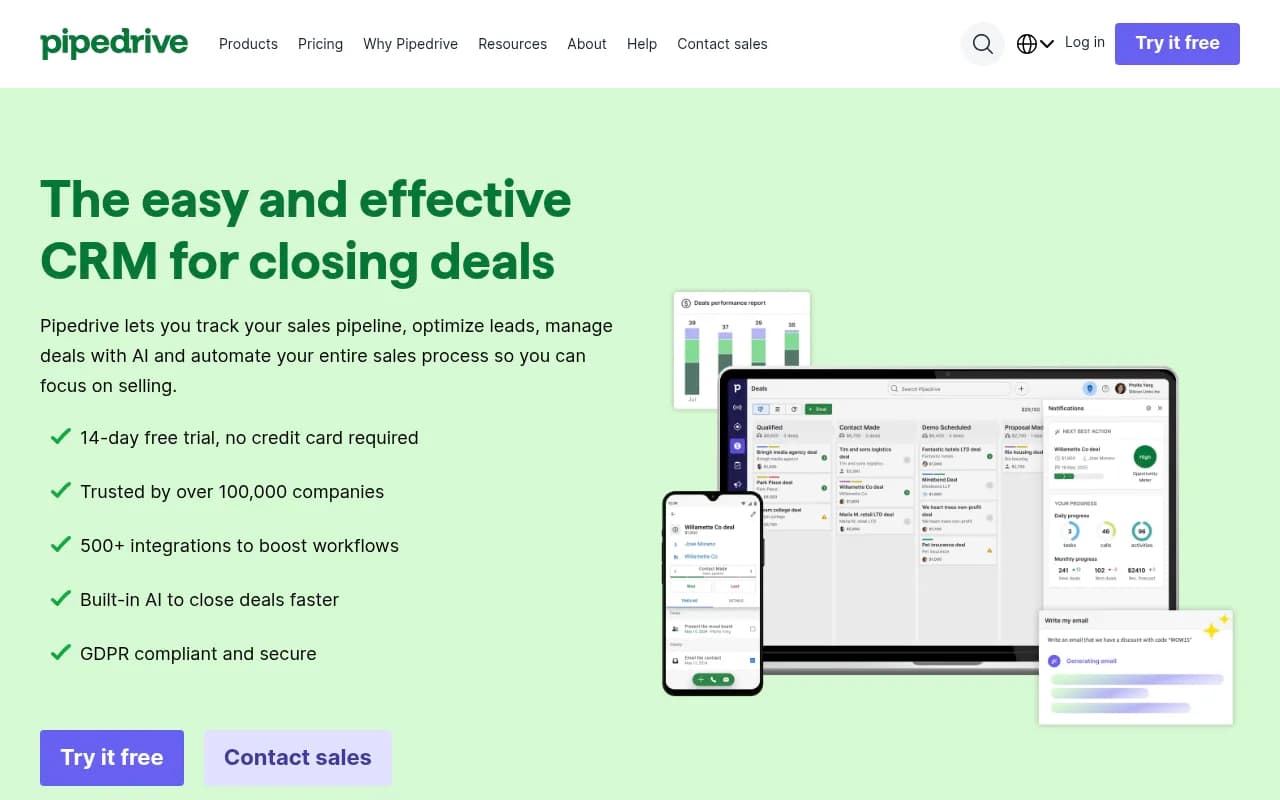
Pipedrive's API is solid and well-documented. You can push data into contact and deal records using custom fields. In theory, you could pipe AI visibility metrics from a platform like Promptwatch into Pipedrive via Zapier or a direct API connection. In practice, Pipedrive's reporting is too limited to do much with that data once it's there.
Pipedrive's AI features (introduced in 2024-2025) focus on sales coaching, deal scoring, and email assistance. There's no content intelligence layer, no traffic source analysis, and no native connection to anything upstream of the sales pipeline.
What Pipedrive does well:
- Simple, clean UI that sales reps actually use
- Good API for pushing enrichment data into contact records
- Zapier integration works reliably
- Affordable starting price ($14/user/month)
The limitation: Pipedrive is a sales tool, not a marketing intelligence platform. If you want AI visibility data to inform content strategy, influence pipeline reporting, or connect to revenue attribution, Pipedrive will require significant external tooling to make that happen. You'd essentially be building the intelligence layer yourself.
For teams that use Pipedrive for sales and a separate marketing stack for everything else, this is manageable. But it's more work than HubSpot or Salesforce.
Zoho CRM
Zoho sits in an interesting middle position. It's more feature-complete than Pipedrive, cheaper than HubSpot and Salesforce, and has a surprisingly capable API. Zia, Zoho's AI assistant, handles predictive lead scoring, anomaly detection, and some content suggestions — though it's not as polished as HubSpot's Breeze or Salesforce's Einstein.
The Zoho ecosystem is also worth noting. If you're already using Zoho Analytics, Zoho Marketing Plus, or other Zoho products, the data sharing between them is native. That makes it easier to build a reporting layer that incorporates external data sources, including AI visibility metrics.
What Zoho does well:
- Strong API with good documentation
- Custom fields and modules for external data
- Zoho Analytics can pull in data from third-party sources for unified reporting
- Affordable pricing ($14-52/user/month depending on tier)
- Zia AI adds some intelligence without requiring expensive add-ons
The limitation: Zoho's integrations with specialized marketing tools are less mature than HubSpot's. The Zapier library for Zoho is smaller, and some integrations require more manual configuration. For teams that want a plug-and-play connection between AI visibility data and their CRM, Zoho requires more setup than HubSpot.
That said, for budget-conscious teams willing to invest some setup time, Zoho delivers real value.
How to actually connect AI visibility data to your CRM
Regardless of which CRM you choose, the integration pattern is roughly the same:
-
Track AI search visibility in a dedicated platform. This means monitoring which prompts your brand appears in, which AI models cite you, and how citation rates change over time.
-
Identify the data you want in your CRM. Useful fields include: AI visibility score by model, top prompts driving brand mentions, content pages being cited, and traffic attributed to AI search.
-
Push that data via API or automation. Most CRMs support custom fields that can receive data from external tools via REST API, Zapier, or Make.
-
Build reports that connect AI visibility to pipeline. This is where CRM choice matters most — HubSpot and Salesforce have the reporting depth to make this meaningful.
For step one, Promptwatch tracks visibility across 10 AI models (ChatGPT, Perplexity, Claude, Gemini, Grok, DeepSeek, and others), provides page-level citation data, and includes traffic attribution that connects AI visibility to actual website sessions. That's the data layer you'd pipe into your CRM.
Which CRM wins for AI visibility integration?
Here's the honest answer by team type:
Marketing-led B2B teams: HubSpot. The native marketing data layer, clean API, and Zapier ecosystem make it the easiest CRM to connect with AI visibility workflows. You'll spend less time on integration plumbing and more time on actual analysis.
Enterprise sales orgs with RevOps resources: Salesforce. The customization ceiling is higher, Einstein can do more with the data once it's there, and the AppExchange ecosystem will eventually have native AI visibility integrations as the category matures.
Sales-focused SMBs: Pipedrive works fine as a sales tool, but you'll need to accept that AI visibility data lives in a separate system. Don't try to force a deep integration — use Pipedrive for what it's good at and keep your AI visibility reporting in its own dashboard.
Budget-conscious teams wanting breadth: Zoho CRM. More setup than HubSpot but significantly cheaper, and capable enough to handle the integration if you're willing to invest the time.
A note on attribution
One thing none of these CRMs solve natively is the attribution problem specific to AI search. When someone discovers your brand through a ChatGPT response and then visits your site directly, that session shows up as "direct" traffic in Google Analytics. It doesn't get attributed to AI search.
Solving this requires either a dedicated AI visibility platform that tracks crawler activity and citation patterns (and can infer the connection), or custom UTM parameters on any links that AI models might surface. The second approach only works for some AI engines and some content types.
This is an evolving area. The CRM you choose matters less than having a clear strategy for capturing AI-sourced attribution in the first place. Without that upstream data, there's nothing meaningful to push into your CRM.
Final comparison
| Dimension | HubSpot | Salesforce | Pipedrive | Zoho CRM |
|---|---|---|---|---|
| API quality for custom integrations | Excellent | Best-in-class | Good | Good |
| Native marketing intelligence | Strong | Moderate | Minimal | Moderate |
| AI features | Breeze AI (solid) | Einstein (advanced) | Basic | Zia (decent) |
| Ease of connecting external data | High | High (with resources) | Medium | Medium |
| Reporting depth | Strong | Very strong | Limited | Moderate |
| Price | $0-$1,200+/mo | $75-$300+/user/mo | $14-$99/user/mo | $14-$52/user/mo |
| Best for AI visibility integration | Marketing teams | Enterprise RevOps | Sales-only teams | Budget-conscious |
The CRM market in 2026 is mature. The AI search visibility market is not. The platforms that win the next few years will be the ones that close the gap between "we appear in AI answers" and "that appearance generated this much pipeline." Right now, that requires stitching together a CRM with a dedicated AI visibility platform. The stitching is easier with HubSpot, more powerful with Salesforce, and more affordable with Zoho.
Pick the CRM that fits your team's size and workflow, then build the AI visibility layer on top of it.