Key takeaways
- Jasper, Surfer SEO, and Frase are all built around traditional Google search — they help you write and optimize content, but none of them tell you whether that content is being cited in AI search engines like ChatGPT, Perplexity, or Gemini.
- Promptwatch fills a different slot entirely: it tracks your AI search visibility, identifies the gaps competitors are winning, generates content designed to be cited by AI models, and shows you which pages are actually getting picked up.
- For most content teams in 2026, the answer isn't one tool — it's a stack. The question is which tools belong in it and what role each one plays.
- If AI search visibility is a priority (and for most B2B and e-commerce brands, it should be), you need something beyond Jasper/Surfer/Frase in your stack.
The content tool landscape has split into two eras. There's the pre-2024 stack — Jasper for drafts, Surfer for optimization scores, Frase for research briefs — and then there's the question that none of those tools were built to answer: is your content actually showing up when someone asks ChatGPT for a recommendation?
This guide compares all four tools honestly. Jasper, Surfer, and Frase are genuinely useful. But they were designed for a world where Google was the only game in town. That world still exists, but it's no longer the whole game.
What each tool is actually for
Before comparing features, it helps to be clear about what problem each tool solves.
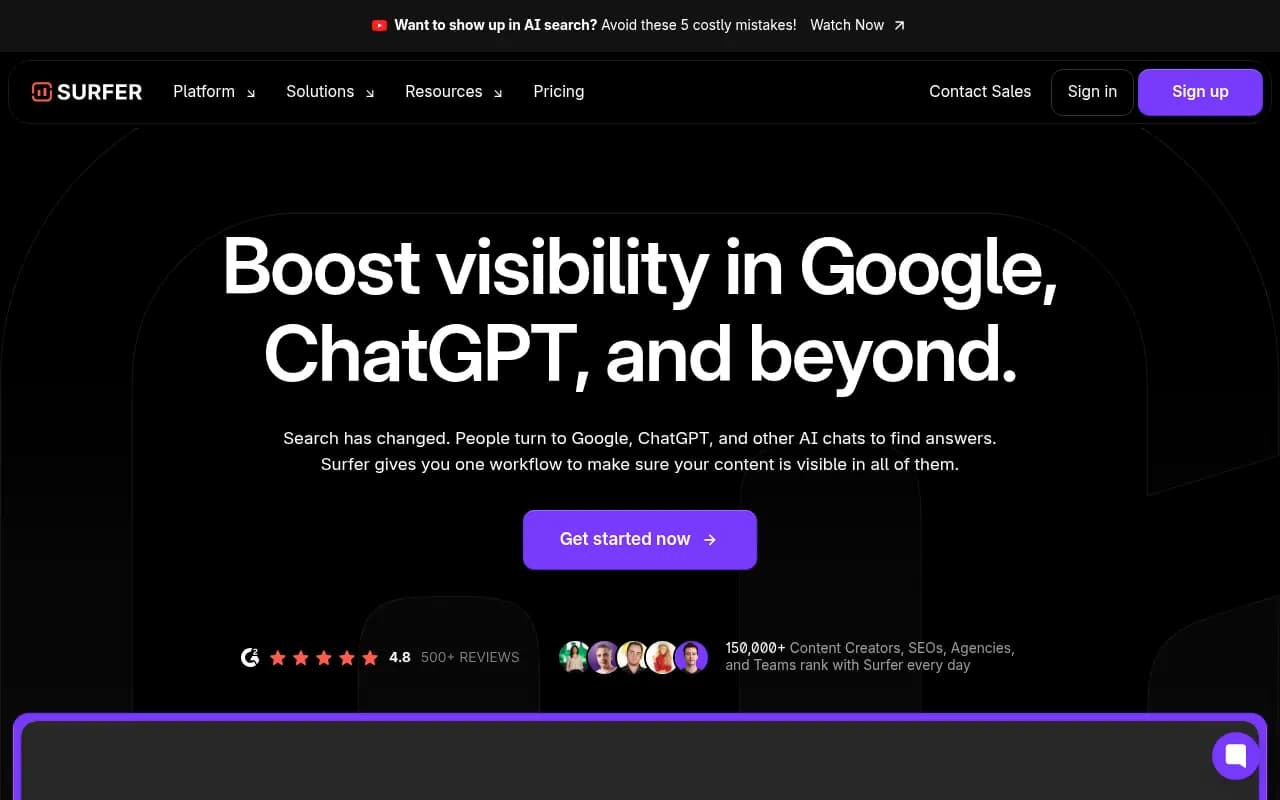
Surfer SEO is a content optimization tool. You paste in a draft, it analyzes the top-ranking pages for your target keyword, and gives you a score based on NLP terms, word count, headings, and backlink benchmarks. The Content Editor is genuinely useful for writers who want real-time feedback. It was built for Google rankings and does that job well.
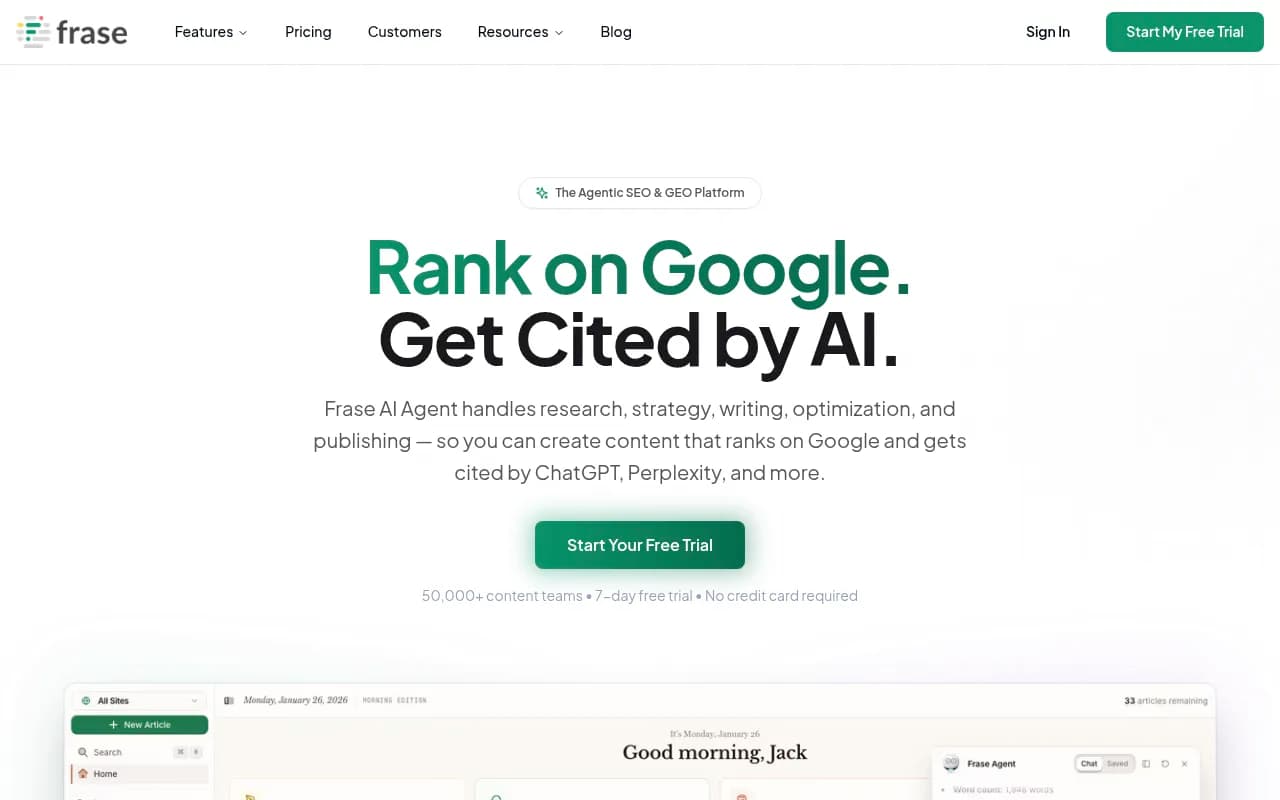
Frase is a research and brief-building tool. It pulls the top SERP results for a query, extracts the key topics and questions, and helps you build an outline. There's an AI writing mode, but Frase's real strength is the research layer — it saves hours of manual SERP analysis.
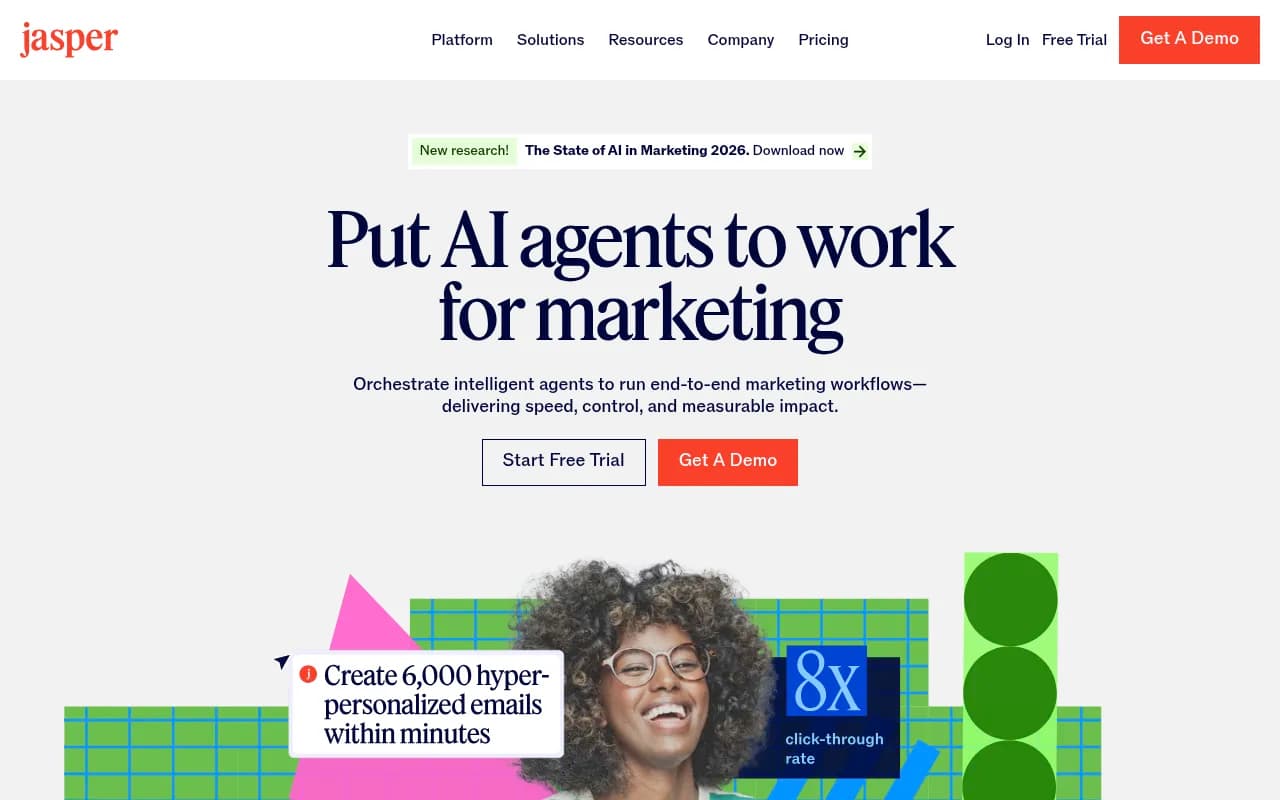
Jasper is an AI writing platform. It's strong on brand voice, long-form drafts, and marketing copy across formats — ads, emails, social posts, blog posts. The "Voice Profiles" feature is one of the better implementations of brand consistency in AI writing tools. It requires a separate optimization layer (like Surfer) to make the output search-competitive.
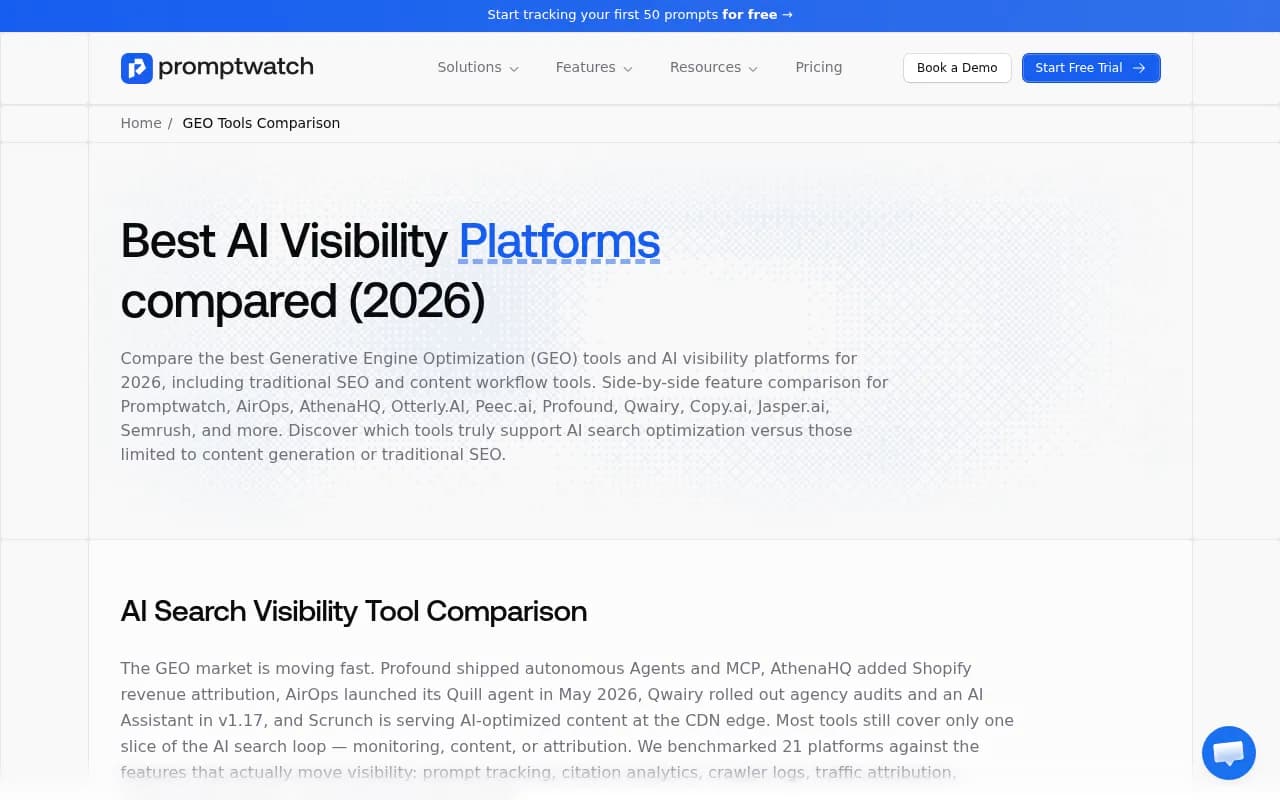
Promptwatch is an AI search visibility and GEO platform. It tracks how your brand appears in AI search engines (ChatGPT, Perplexity, Gemini, Claude, and more), identifies which prompts competitors are winning that you're not, generates content designed to close those gaps, and monitors which of your pages are actually being cited. It's not a writing tool or an SEO optimizer in the traditional sense — it's the layer that connects your content to AI search outcomes.

Feature-by-feature comparison
| Feature | Jasper | Surfer SEO | Frase | Promptwatch |
|---|---|---|---|---|
| AI writing / drafts | Excellent | Basic | Moderate | Yes (via Content Agents) |
| On-page SEO scoring | No (needs Surfer) | Core feature | Yes | No |
| SERP research & briefs | No | Moderate | Core feature | Yes (AI-grounded) |
| AI search visibility tracking | No | No | No | Core feature |
| Citation monitoring (ChatGPT, Perplexity, etc.) | No | No | No | Yes |
| Answer gap analysis | No | No | No | Yes |
| AI crawler logs | No | No | No | Yes |
| Prompt volume & difficulty scoring | No | No | No | Yes |
| Reddit & YouTube insights | No | No | No | Yes |
| ChatGPT Shopping tracking | No | No | No | Yes |
| Traffic attribution from AI search | No | No | No | Yes |
| Brand voice / style control | Yes | No | No | Yes (via brand guidance) |
| Multi-language support | Yes | Yes | Partial | Yes |
| Pricing (starting) | ~$49/mo | ~$89/mo | ~$45/mo | $99/mo |
The table makes the split obvious. Jasper, Surfer, and Frase compete in the same lane — content creation and traditional SEO optimization. Promptwatch is in a different lane entirely.
Where Jasper, Surfer, and Frase still earn their place
It would be easy to dismiss these tools as "legacy" now that AI search is a thing. That's not quite right.
Surfer's content scoring is still genuinely useful for Google optimization. If you're writing content that needs to rank in traditional search — and most content still does — having a real-time NLP score against live SERP data is valuable. The SERP Analyzer is one of the better implementations of competitive content analysis available.
Frase saves real time on research. Pulling the top 20 results for a query, extracting the questions they answer, and building a structured brief in minutes is a legitimate productivity win. For teams producing high volumes of content, that adds up.
Jasper is the strongest of the three for pure writing quality. The brand voice consistency is better than most alternatives, and the multi-format support (ads, email, social, long-form) makes it a reasonable hub for marketing copy. It's not a research tool or an optimization tool, but it's a solid drafting tool.
The limitation all three share is the same: they were built to help you rank on Google. They have no visibility into whether your content is being cited in AI search engines, no way to tell you which prompts your competitors are winning, and no mechanism for tracking AI crawler behavior on your site.
The gap that none of them fill
Here's the problem content teams are running into in 2026: buyers are increasingly getting their answers from AI before they ever hit a search results page. Someone researching project management software asks ChatGPT for recommendations. Someone looking for a B2B data tool asks Perplexity. Someone comparing CRM options reads Gemini's AI Overview.
If your content isn't being cited in those answers, you're invisible to a growing share of your potential customers — and Jasper, Surfer, and Frase can't tell you that's happening, let alone help you fix it.
This is what Promptwatch was built for. The core workflow is:
- Track which prompts are relevant to your category and see which AI engines are citing competitors but not you
- Use Answer Gap Analysis to find the specific content your site is missing — the topics and questions AI models want to answer but can't find on your pages
- Use Content Agents to generate articles, comparisons, and briefs grounded in real prompt data and citation patterns
- Monitor which pages get crawled and cited, and track how visibility changes over time
That's a fundamentally different workflow from "write a draft in Jasper, optimize it in Surfer." It's not replacing those tools — it's answering a question they don't ask.
How these tools fit together in a real content stack
Most teams don't need to choose one tool. The more useful question is: what role does each tool play, and do you have all the roles covered?
A realistic 2026 content stack for a team that cares about both Google and AI search might look like this:
Research and brief building: Frase or a similar SERP research tool. Pull the top results, extract the key questions, build the outline.
Writing and drafts: Jasper for brand-consistent copy, or any capable AI writer. The output still needs editing, but the speed gain is real.
Traditional SEO optimization: Surfer SEO for on-page scoring against live SERP data. Still relevant for Google rankings.
AI search visibility and GEO: Promptwatch for tracking citations across ChatGPT, Perplexity, Gemini, and other AI engines, identifying gaps, generating AI-optimized content, and monitoring crawler behavior.
The gap most teams have right now is the last one. Jasper + Surfer + Frase is a well-understood stack. Adding AI visibility tracking is the piece most teams haven't figured out yet — and it's the piece that's becoming more important every quarter as AI search traffic grows.
Pricing reality check
| Tool | Entry price | What you get |
|---|---|---|
| Frase | ~$45/mo | 30 docs/mo, AI writing, SERP research |
| Jasper | ~$49/mo | 1 seat, unlimited words, brand voice |
| Surfer SEO | ~$89/mo | 30 articles/mo, content editor, SERP analyzer |
| Promptwatch Essential | $99/mo | 1 site, 50 prompts, 5 articles, AI visibility tracking |
| Promptwatch Professional | $249/mo | 2 sites, 150 prompts, 15 articles, crawler logs, city-level tracking |
Jasper and Frase are cheaper entry points, but they're also solving a narrower problem. Surfer at $89/mo is reasonable for teams with active Google SEO programs. Promptwatch at $99/mo is the entry point for AI search visibility — a category that didn't meaningfully exist two years ago.
The honest framing: if you're only worried about Google rankings, Surfer + Frase + Jasper is a solid stack. If you're also worried about AI search visibility (which, in 2026, most teams should be), you need Promptwatch or something like it in addition to those tools.
Who should use what
Use Jasper if: You're producing high volumes of marketing copy across multiple formats and need consistent brand voice. Pair it with Surfer for SEO.
Use Surfer SEO if: You have a content team actively writing for Google and you want real-time optimization feedback. It's still one of the better on-page tools available.
Use Frase if: Your bottleneck is research and brief creation. It's faster than manual SERP analysis and the outline builder is genuinely useful.
Use Promptwatch if: You want to know whether your content is actually showing up in ChatGPT, Perplexity, Gemini, or other AI engines — and you want a system for closing the gaps where competitors are being cited and you're not.
Use all four if: You're a content team that takes both Google and AI search seriously. Each tool covers a different part of the workflow, and there's minimal overlap between them.
A note on the direction things are moving
Surfer, Jasper, and Frase are all adding AI features. Surfer has an AI outline generator. Jasper has SEO mode integrations. Frase has improved its AI writing. But none of them have shipped anything close to AI search visibility tracking, citation monitoring, or crawler log analysis — because those require fundamentally different data infrastructure.
The GEO market is moving fast. Platforms built specifically for AI search visibility — Promptwatch, AthenaHQ, Profound, and others — are shipping features that traditional content tools aren't positioned to build. The question isn't whether AI search matters; it's whether your current stack gives you any visibility into it.
For most teams reading this, the honest answer is: it doesn't. Jasper, Surfer, and Frase are good tools for the job they were designed to do. They just weren't designed for this job.
Bottom line
Jasper, Surfer SEO, and Frase are complementary tools that cover content creation, optimization, and research for traditional search. They're worth using if those are your priorities.
Promptwatch covers the part of the stack none of them touch: whether your content is actually being cited in AI search engines, which gaps you need to fill, and how to track the results. For teams that want to rank in AI search — not just Google — that's the missing piece.
The content stack that wins in 2026 probably includes all four. The teams that are behind are the ones still running a 2023 stack and wondering why their AI search visibility is flat.