Key takeaways
- Most AI writing platforms are optimized for speed and volume, not for producing content that AI search engines will cite -- these are different goals that require different approaches.
- Writer stands out for enterprise policy enforcement and brand consistency; Jasper leads on template breadth and instruction-following for long-form content; Writesonic is the most accessible for beginners.
- Copy.ai has repositioned itself as a marketing workflow platform rather than a pure writing tool, which changes how you should evaluate it.
- Narrato is the most complete content operations platform in this group, covering planning, creation, and workflow management in one place.
- Getting cited in LLMs depends less on which tool you use to write content and more on the structural and topical signals in the content itself -- but some platforms make it easier to hit those signals than others.
- If you want to track whether your content is actually being cited by ChatGPT, Perplexity, or Google AI Overviews, you need a separate visibility layer like Promptwatch.
There's a question most AI writing tool comparisons refuse to answer honestly: does the content these platforms produce actually get picked up by AI search engines?
In 2026, that question matters more than it did two years ago. A growing share of search traffic now flows through AI-generated answers. ChatGPT, Perplexity, Google AI Mode, and Claude are all synthesizing responses from web content -- and they're selective about what they cite. Publishing more content faster isn't enough if none of it ends up in those answers.
So let's look at Jasper, Copy.ai, Writesonic, Writer, and Narrato through that lens. Not just "which one writes better copy," but "which one helps you produce content that has a real shot at being cited."
What makes content get cited in LLMs
Before comparing tools, it's worth being specific about what LLMs actually look for when they cite sources. The research on this is still evolving, but a few patterns are consistent:
- Topical authority: pages that cover a subject comprehensively and link to related content on the same domain tend to get cited more often
- Factual specificity: vague, generic content gets ignored; content with concrete data, named entities, and specific claims gets cited
- Structural clarity: headers, lists, and clear question-answer structures make content easier for AI models to parse and excerpt
- Source credibility signals: backlinks, domain authority, and third-party mentions still matter for whether AI models trust a page
- Freshness: AI models increasingly weight recent content, especially for fast-moving topics
None of these are things an AI writing tool controls directly. But some platforms make it much easier to hit these signals than others -- through research integration, SEO optimization features, and content structure guidance.
The five platforms, honestly assessed
Jasper
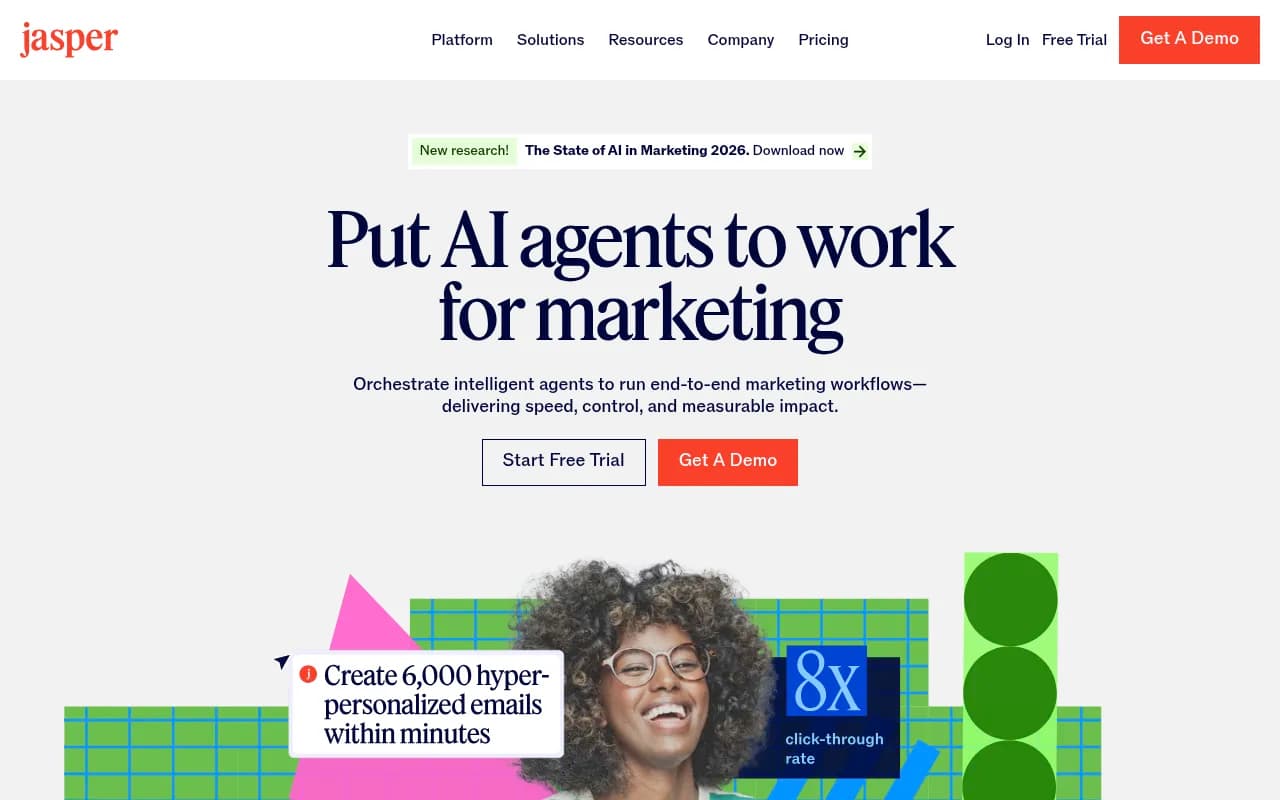
Jasper is the most mature platform in this group. It's been around the longest, has the broadest template library, and has invested heavily in brand voice customization. The Brand Voice feature trains the model on your tone, terminology, and style -- which matters for consistency across a large content operation.
Where Jasper genuinely leads: following complex instructions and handling longer projects. If you give it a detailed brief with specific angles, word counts, and structural requirements, it delivers more reliably than most competitors. That's useful for producing the kind of thorough, well-structured content that LLMs tend to cite.
The honest downside: at $69/month for the Creator plan, it's not cheap for what you get, and the output quality has been described by some users as inconsistent without careful prompting. The platform has also shifted toward an "AI marketing platform" positioning with agents and workflows, which adds capability but also complexity.
For LLM citation potential: Jasper's strength in long-form, structured content is a genuine advantage. A well-briefed Jasper article with proper headers, specific claims, and topical depth has a reasonable shot at being cited. But Jasper doesn't help you identify which topics to target for AI visibility -- you still need to bring that strategy yourself.
Copy.ai

Copy.ai has made an interesting pivot. It started as a short-form copywriting tool -- ad copy, email subject lines, social posts -- and it's still very good at that. But the platform has repositioned itself as an "AI Marketing OS" with automated workflows that can handle multi-step content processes.
The workflow angle is genuinely useful for teams that need to produce content at scale with consistent inputs. You can build sequences that pull in data, generate content, and route it for review without manual handoffs at each step.
Where Copy.ai falls short for LLM citation: short, playful content (which is where Copy.ai genuinely shines) is rarely what AI models cite. They tend to cite longer, more authoritative pieces that answer specific questions in depth. Copy.ai can produce that kind of content, but it's not where the platform's strengths lie.
The free plan is generous, which makes it accessible for experimentation. But if your goal is producing content that gets cited in AI answers, you'll need to push Copy.ai beyond its natural sweet spot.
Writesonic

Writesonic is the most beginner-friendly option here. The interface is clear, the templates are well-organized, and the pricing is more accessible than Jasper. It supports a wide range of content types and has added SEO-focused features including integration with real-time web data for article generation.
The Botsonic chatbot builder is a separate product that shares the Writesonic brand, which can cause some confusion when evaluating the platform.
For LLM citation potential: Writesonic's article generation with real-time web data is its strongest feature for this use case. Content grounded in current information and structured around specific questions is more likely to surface in AI answers than evergreen fluff. The platform's SEO mode, which pulls in keyword data and competitor analysis, also helps produce content with the topical depth that LLMs favor.
The tradeoff is that Writesonic's output can feel formulaic without careful prompting. The tool guides you toward a structure, which is helpful for beginners but can produce content that reads like it came from a template -- because it did.
Writer
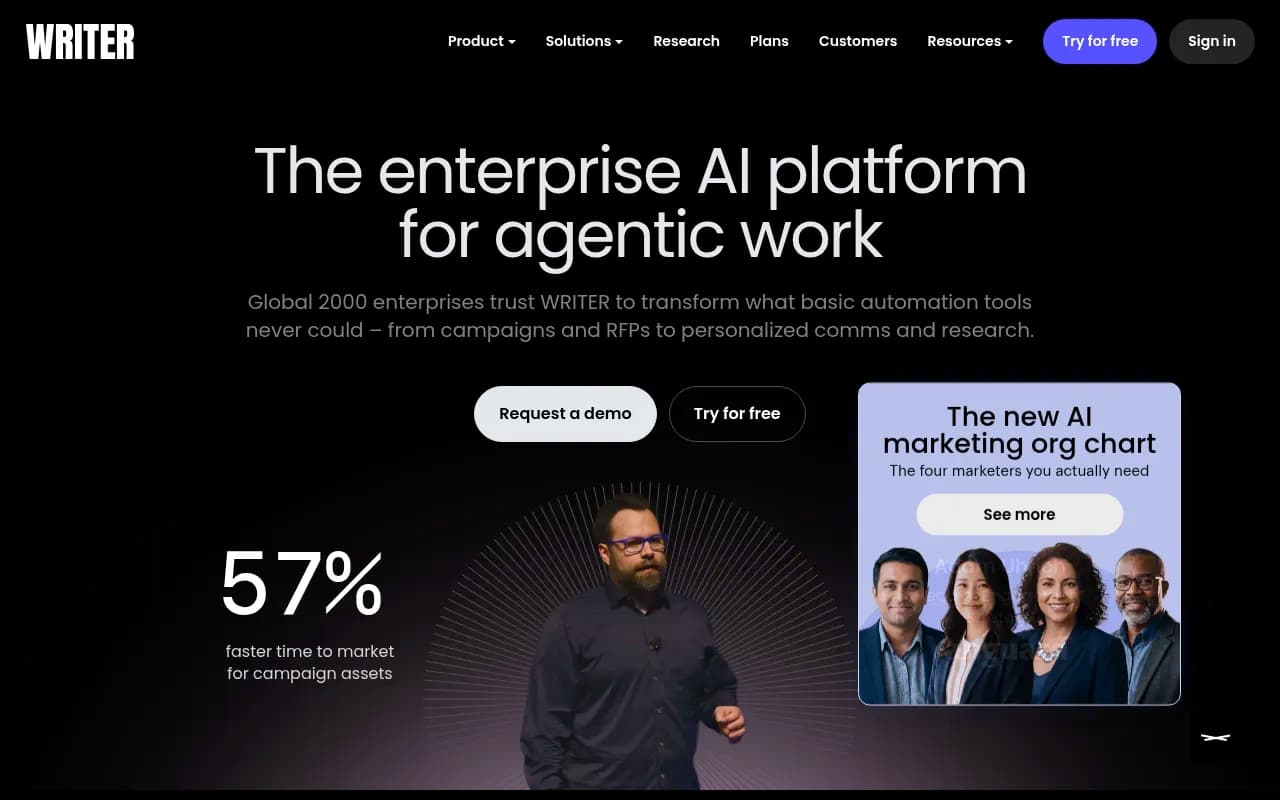
Writer is the most enterprise-focused platform in this comparison. Its core differentiator is policy enforcement: you can define brand guidelines, compliance rules, and style requirements that the AI actively enforces rather than just suggesting. For regulated industries or large organizations with strict brand standards, this is a meaningful advantage.
The platform also has strong security and privacy features, which matter for enterprise procurement decisions.
Where Writer stands out for LLM citation: consistency and brand specificity. Content that consistently reflects a clear, authoritative voice -- with specific terminology and well-defined positions -- tends to perform better in AI citations than generic content that could have been written by anyone. Writer's brand enforcement features make it easier to maintain that consistency at scale.
The downside is that Writer is priced for enterprise budgets and may be overkill for smaller teams. The platform is less focused on SEO optimization features than Jasper or Writesonic, so you'll need to bring more of your own content strategy.
Narrato
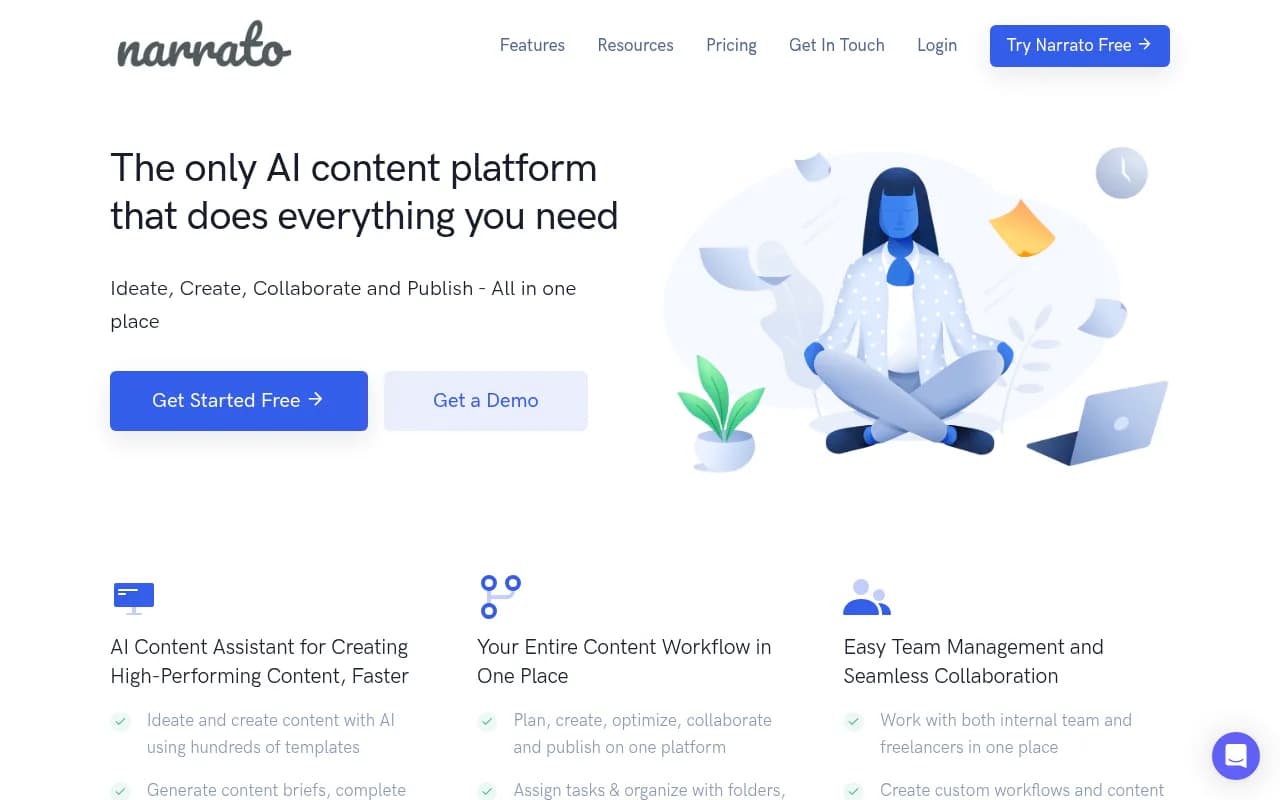
Narrato is the least well-known platform in this group, but it's arguably the most complete for content operations teams. It combines AI writing with content planning, workflow management, and collaboration features in a single platform. You can manage briefs, assignments, reviews, and approvals without switching to a separate project management tool.
The AI content generation is solid, and the platform includes SEO content briefs with keyword suggestions and competitor analysis. The content calendar and workflow features are genuinely useful for teams managing high content volumes.
For LLM citation potential: Narrato's content brief system is its strongest asset here. Briefs that specify target questions, required topics, and competitor gaps produce more thorough content -- and thoroughness correlates with citation likelihood. The platform essentially forces a more structured approach to content creation, which tends to produce better outputs for AI visibility.
The tradeoff is that Narrato's AI writing quality, while competent, doesn't quite match Jasper's instruction-following or Writer's consistency. It's a platform built around workflow first, with AI writing as one component.
Feature comparison
| Platform | Best for | Long-form quality | SEO features | Brand voice | Workflow/ops | Starting price |
|---|---|---|---|---|---|---|
| Jasper | Advanced users, long-form | Excellent | Moderate | Strong | Basic | ~$69/mo |
| Copy.ai | Short copy, workflow automation | Good | Limited | Moderate | Strong | Free tier available |
| Writesonic | Beginners, SEO content | Good | Strong | Moderate | Moderate | ~$20/mo |
| Writer | Enterprise, compliance | Very good | Limited | Excellent | Moderate | Enterprise pricing |
| Narrato | Content ops teams | Good | Strong | Moderate | Excellent | ~$36/mo |
The gap these tools don't fill
Here's what none of these platforms tell you: whether the content you're producing is actually getting cited by AI models, and if not, why not.
You can use Jasper to write a thorough, well-structured article on a competitive topic and have no idea whether ChatGPT is citing it, ignoring it, or citing a competitor's version instead. The writing tools don't have visibility into that layer.
That's a separate problem that requires a separate tool. Platforms like Promptwatch track exactly which of your pages are being cited by which AI models, how often, and what competitors are being cited instead. That data is what lets you close the loop between "we published content" and "it's actually working."

The practical workflow for teams serious about LLM visibility looks like this: use one of the writing platforms above to produce content, then use a visibility tracker to see what's actually getting cited. When you find gaps -- topics where competitors are visible but you aren't -- you go back to your writing platform with specific briefs to fill those gaps. Repeat.
Without the visibility layer, you're optimizing blind.
Which platform should you actually use
The honest answer depends on what your actual bottleneck is.
If your team is producing content and struggling with quality and consistency at scale, Jasper or Writer are the right choices. Jasper if you need breadth and template variety; Writer if you need policy enforcement and brand consistency.
If you're a smaller team or solo operator who needs to move fast and doesn't want a steep learning curve, Writesonic is the most practical starting point. The SEO features are solid and the pricing is reasonable.
If your real problem is workflow chaos -- too many tools, unclear ownership, approval bottlenecks -- Narrato addresses that more directly than any other platform here. The AI writing is good enough; the operations layer is what sets it apart.
If you need short-form copy at volume with automated workflows, Copy.ai's repositioning as a marketing OS makes it genuinely useful. Just don't expect it to produce the kind of long-form, authoritative content that AI models tend to cite.
For LLM citation specifically, the ranking would be: Jasper (best instruction-following for thorough content), Writesonic (best SEO integration), Narrato (best brief system), Writer (best consistency), Copy.ai (weakest for this specific use case).
But again -- none of them tell you whether it's working. That's the gap worth closing.
A note on the "editing tax"
One thing the pricing pages don't mention: AI-generated content typically requires substantial editing. Research from content operations teams suggests 30-50% of the time you'd spend writing from scratch, depending on complexity and quality standards. You'll fact-check claims, adjust tone, add links, optimize structure, and rewrite sections that don't land.
This is true across all five platforms. The difference is in how much raw material you get to work with and how close it is to publishable. Jasper tends to produce the most usable first drafts for long-form content. Writesonic's SEO-focused output often needs less structural editing. Writer's brand-enforced output needs less tone correction.
Factor that editing time into your total cost calculation before committing to any platform.
Bottom line
In 2026, the question isn't just "which AI writing tool is best" -- it's "which tool helps me produce content that actually performs in AI search." Those are related but different questions.
Jasper leads on raw writing quality for long-form content. Writer leads on enterprise consistency. Writesonic leads on accessibility and SEO integration. Narrato leads on content operations. Copy.ai leads on short-form workflow automation.
None of them tell you whether your content is getting cited. For that, you need a visibility platform running alongside whichever writing tool you choose -- otherwise you're publishing into a black box and hoping for the best.