Key takeaways
- Junia AI, Outranking, and Surfer SEO are primarily content creation and optimization tools built around Google rankings -- they don't track whether your content gets cited in AI search engines like ChatGPT or Perplexity.
- Promptwatch is the only platform in this comparison that closes the loop: it helps you find content gaps, generate content engineered for AI citation, and then track whether that content actually appears in AI responses.
- If your goal is traditional Google SEO, Surfer SEO or Outranking are solid choices. If you care about AI search visibility, you need a different category of tool.
- The gap between "writing content" and "knowing if AI models cite it" is where most teams are currently flying blind.
- This comparison focuses specifically on which tools can answer the question: "Did the content I published actually get picked up by AI search engines?"
There's a question most content teams don't ask often enough: after you publish that article, does it actually show up when someone asks ChatGPT for a recommendation in your space?
Traditional SEO tools have always had a feedback loop. You write, you publish, you check rankings in Google Search Console. It's imperfect, but it exists. The problem in 2026 is that a growing chunk of search behavior has moved into AI-generated answers -- and most content tools were built before that shift happened. They help you write. They don't tell you whether the writing worked in the new environment.
This comparison looks at four tools that often get mentioned together: Junia AI, Outranking, Surfer SEO, and Promptwatch. They're not all the same category of product, which is actually the most important thing to understand before you pick one.
What each tool actually does
Before comparing features, it's worth being honest about what category each tool belongs to.
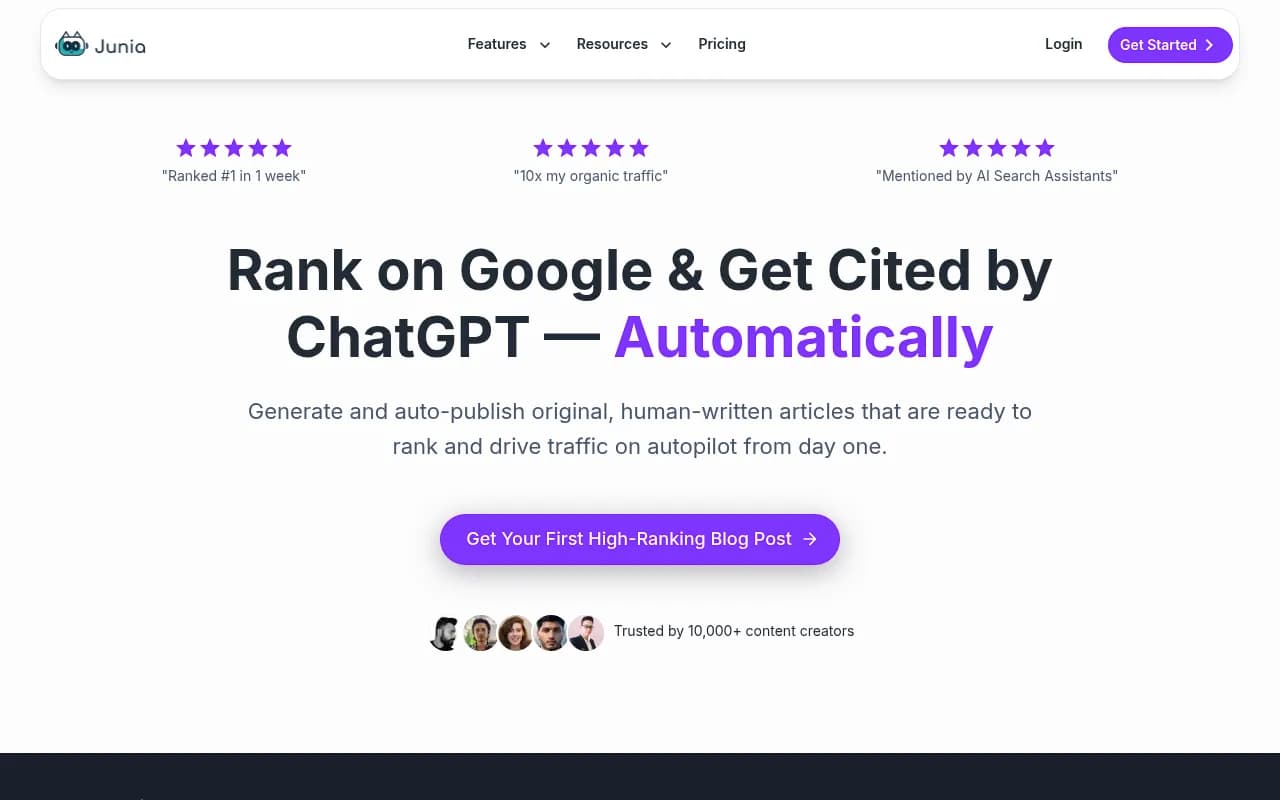
Junia AI is an AI content writing platform with SEO optimization baked in. It generates long-form articles, handles internal linking, and optimizes content for Google rankings. It's good at producing content at scale.
Outranking is an AI-assisted SEO content platform focused on research, briefs, and optimization. It pulls SERP data to inform content structure and helps writers produce pieces that compete in Google search.

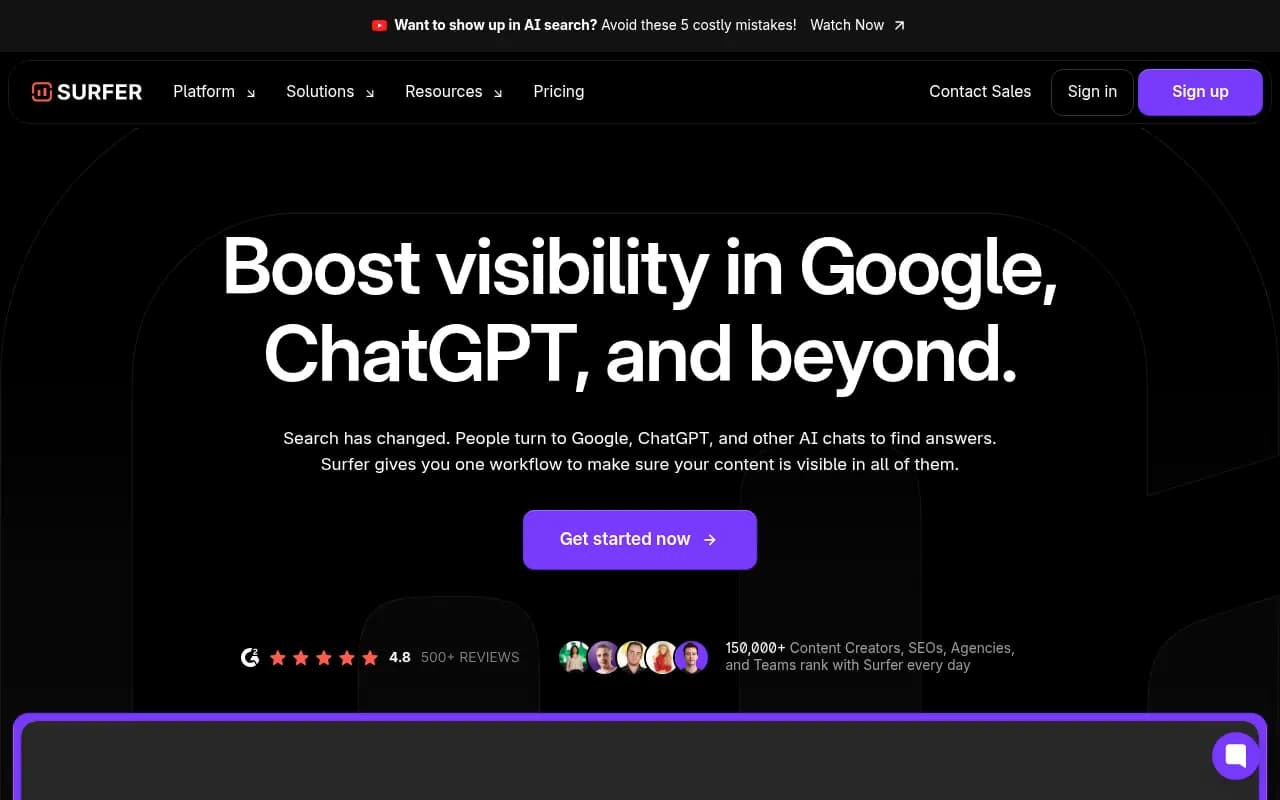
Surfer SEO is the most established of the three content optimization tools. It's built around its Content Score -- a real-time signal that tells you how well your content is optimized relative to top-ranking Google results. Surfer is widely used by SEO agencies and in-house teams.
Promptwatch is a different category entirely. It's an AI search visibility platform -- not primarily a writing tool. Its job is to track how your brand and content appear inside AI-generated responses from ChatGPT, Claude, Perplexity, Gemini, and others, then help you fix gaps.

That last distinction matters a lot. Three of these tools help you create content. One of them tells you whether that content is working in AI search.
The core question: does the content actually get cited?
Here's the problem with using only Junia AI, Outranking, or Surfer SEO in 2026: they optimize for Google's ranking algorithm, not for AI citation patterns.
These are different things. Google ranks pages based on signals like backlinks, authority, and keyword relevance. AI models like ChatGPT and Perplexity cite sources based on a different set of factors -- how well a page answers a specific question, whether it's been indexed by AI crawlers, whether it covers the right topics with the right depth, and whether it appears in the training data or real-time retrieval pool.
A piece of content can score 95 on Surfer's Content Score and still never appear in a ChatGPT response. Conversely, a moderately optimized page that directly answers a question AI users are asking can get cited repeatedly.
The tools that help you write for Google don't tell you which of those two outcomes you're getting.
Feature comparison
| Feature | Junia AI | Outranking | Surfer SEO | Promptwatch |
|---|---|---|---|---|
| AI content generation | Yes | Yes | Yes (Surfer AI) | Yes (built-in AI writer) |
| Google SEO optimization | Yes | Yes | Yes (core feature) | Partial |
| AI search visibility tracking | No | No | No | Yes (10 AI models) |
| Citation analysis (ChatGPT, Perplexity, etc.) | No | No | No | Yes |
| Content gap analysis for AI search | No | No | No | Yes |
| AI crawler log monitoring | No | No | No | Yes |
| Competitor AI visibility heatmaps | No | No | No | Yes |
| Reddit/YouTube citation tracking | No | No | No | Yes |
| Prompt volume and difficulty scoring | No | No | No | Yes |
| Traffic attribution from AI search | No | No | No | Yes |
| ChatGPT Shopping tracking | No | No | No | Yes |
| Starting price | ~$49/mo | ~$79/mo | ~$89/mo | $99/mo |
The table makes the gap obvious. Junia AI, Outranking, and Surfer SEO are content production tools. Promptwatch is a visibility and optimization platform that also generates content -- but the content it generates is specifically engineered to get cited by AI models, grounded in real citation data from 880M+ citations analyzed.
Junia AI: strong writer, no AI visibility feedback
Junia AI does a good job of generating long-form content quickly. It handles SEO basics -- keyword integration, heading structure, meta descriptions -- and has features for internal linking and content clustering. For teams that need to produce a lot of Google-optimized content without a large writing staff, it's a reasonable choice.
What it doesn't do is tell you anything about AI search performance. There's no way to know, from inside Junia AI, whether the articles it generates are appearing in ChatGPT responses, whether Perplexity is citing your pages, or whether competitors are getting more AI visibility than you on the same topics.
That's not a knock on Junia AI specifically -- it's just not what the tool is built for.
Outranking: research-heavy content workflow, same blind spot
Outranking leans harder into the research and brief-building side of content creation. It pulls competitor data, suggests content structures, and helps teams produce pieces that are informed by what's already ranking. The workflow is more structured than Junia AI, which some teams prefer.
The same limitation applies: Outranking is optimizing for Google, and it has no mechanism for tracking whether your published content is being cited by AI models. The brief it generates might be excellent for traditional SEO and still miss the angles that AI models are looking for when answering questions in your space.
Surfer SEO: the best Google optimizer in this group
Surfer SEO is probably the most mature product in this comparison for traditional SEO purposes. Its Content Score is genuinely useful -- it's a real-time signal that correlates with Google rankings, and agencies have built entire content workflows around it. The keyword research, SERP analysis, and content editor are all solid.
But Surfer SEO was built for Google, and it shows. The tool has no AI search monitoring, no citation tracking, and no way to measure whether your content is appearing in AI-generated answers. In 2026, that's a meaningful gap for any brand that cares about how it appears when customers ask AI for recommendations.
One external source put it plainly: "Surfer SEO tells you how to optimize content for Google rankings. Promptwatch tells you whether that content is actually getting cited by AI models." Those are two different jobs, and right now, most teams need both.
Promptwatch: the only tool here that closes the loop
Promptwatch approaches the problem differently. It starts with the question "where are you invisible in AI search?" and works backward from there.
The Answer Gap Analysis shows you which prompts competitors are appearing for that you're not -- the specific questions AI models are answering where your brand is absent. That's the starting point for content creation, not keyword volume or SERP position.
From there, the built-in AI writing agent generates content grounded in real citation data. It's not producing generic articles -- it's producing content specifically designed to get cited by ChatGPT, Claude, Perplexity, and other AI models, based on analysis of what those models actually cite.
Then it tracks results. Page-level tracking shows which of your pages are being cited, how often, and by which AI models. Traffic attribution (via a code snippet, Google Search Console integration, or server log analysis) connects AI visibility to actual revenue.
That full cycle -- find gaps, create content, track results -- is what makes it an optimization platform rather than just a monitoring dashboard.
A few other capabilities worth knowing about:
- AI Crawler Logs show you in real time when ChatGPT, Claude, and Perplexity are crawling your site, which pages they're reading, and what errors they're hitting. Most content tools have no visibility into this at all.
- Prompt Intelligence gives you volume estimates and difficulty scores for each prompt, so you can prioritize the ones worth going after.
- Reddit and YouTube tracking surfaces the discussions that directly influence AI recommendations -- a channel that Junia AI, Outranking, and Surfer SEO don't touch.
Pricing starts at $99/month for the Essential plan (1 site, 50 prompts, 5 articles), with Professional at $249/month and Business at $579/month.
Which tool should you actually use?
This depends entirely on what you're trying to accomplish.
If you're running a traditional SEO program and your primary goal is Google rankings, Surfer SEO is the strongest option in this comparison. It has the most mature content optimization workflow and the best track record for that specific job.
If you want AI-assisted content creation with decent SEO research built in, Junia AI or Outranking are both reasonable. Outranking is better for teams that want structured briefs; Junia AI is better for volume.
But if you care about AI search visibility -- if you want to know whether your content is appearing when customers ask ChatGPT for recommendations in your space -- none of the first three tools help you with that. You need Promptwatch, or something like it.
The honest answer for most marketing teams in 2026 is that you probably need both categories: a content creation tool for Google SEO, and an AI visibility platform to track and optimize your presence in AI search. These aren't competing tools so much as tools for different parts of the same problem.

The feedback loop problem
Here's what makes this comparison interesting beyond just feature lists.
Junia AI, Outranking, and Surfer SEO all have a feedback loop for Google. You write content, you check rankings, you adjust. The loop is slow (Google takes time to index and rank), but it exists.
For AI search, most teams have no feedback loop at all. They publish content and have no idea whether it's being cited by AI models. They can't tell which pages are working, which topics they're missing, or why a competitor keeps appearing in ChatGPT responses while they don't.
That's the gap Promptwatch fills. And it's a gap that matters more as AI search becomes a primary channel for product discovery.
The tools that help you write content for AI search are useful. The tool that tells you whether that content is actually working is what most teams are currently missing.
Bottom line
Surfer SEO wins for Google content optimization. Junia AI and Outranking are solid AI writing tools with SEO features. But none of them answer the question in the title of this guide: does the content you published actually rank in AI search?
For that, Promptwatch is the only platform in this comparison that's built for the job. It's not just a tracker -- it finds the gaps, helps you create content to fill them, and then shows you whether it worked. That's the full loop, and it's what most content teams are missing right now.