Key takeaways
- Surfer SEO and Outranking are strong content creation and optimization tools, but they're built for Google's blue links — neither tracks whether your content gets cited by AI models like ChatGPT or Perplexity.
- Junia AI adds some AI search awareness but still lacks deep citation tracking and content gap analysis tied to real LLM prompt data.
- Promptwatch is the only platform in this comparison that closes the full loop: find gaps in your AI visibility, generate content engineered to get cited, then track whether it actually works across 10 AI models.
- If your goal is ranking in traditional Google search, Surfer SEO remains the best pure content optimizer. If your goal is appearing in AI-generated answers, you need a different tool entirely.
- The two goals aren't mutually exclusive — many teams are starting to run both in parallel.
There's a gap in how most content teams think about "ranking."
They write an article. They optimize it with a content scoring tool. They publish it. They check Google Search Console a few weeks later. Maybe it climbs. Maybe it doesn't.
What almost nobody checks: did ChatGPT start citing it? Did Perplexity pull it into an answer? Is Claude recommending it when someone asks about your category?
That's the gap this guide is about. Four platforms — Junia AI, Promptwatch, Outranking, and Surfer SEO — all sit somewhere on the spectrum between "writes content" and "tracks whether that content ranks in AI." But they sit in very different places on that spectrum.
Let's be honest about where each one actually stands.
What we're actually comparing
The question isn't just "which tool writes better content." That's table stakes in 2026. The real question is: after you publish, does the platform help you understand whether AI models are picking it up?
This matters because AI search is now a meaningful traffic channel. Gartner predicted 50% of traditional search traffic would be replaced by AI by 2028, and the shift is already visible in analytics dashboards. Brands that aren't tracking AI citations are flying blind on a channel that's growing fast.
So the comparison here runs along two axes:
- How good is the content creation and optimization?
- Does the platform track AI visibility — and can it help you improve it?
Surfer SEO: the gold standard for Google, silent on AI
Surfer SEO is genuinely excellent at what it does. The Content Editor scores your article against top-ranking pages, tells you which terms to include, how long to write, how to structure headings. For traditional SEO, it's one of the most refined tools available.
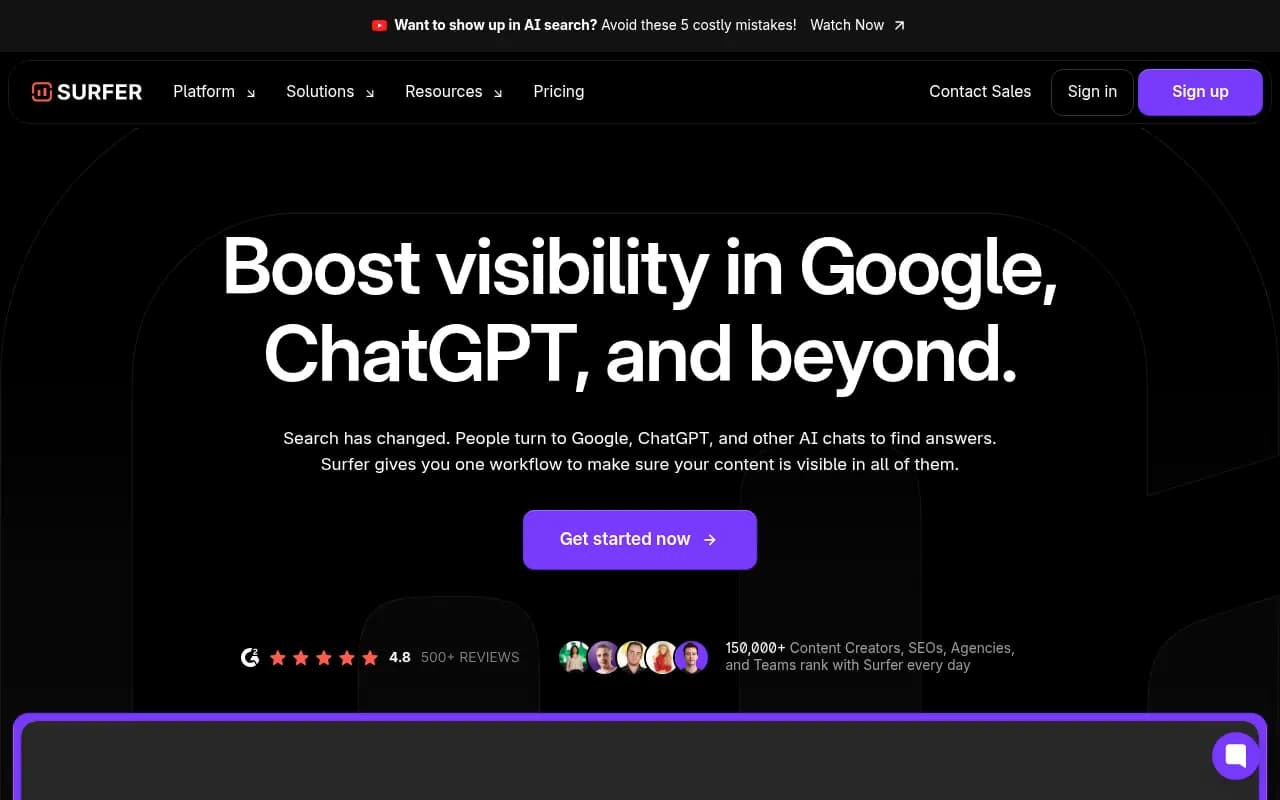
But here's the honest limitation: Surfer was built for Google's ranking algorithm. Its optimization signals come from analyzing what already ranks in blue-link search results. That's useful — but it tells you nothing about what gets cited in a ChatGPT response or a Perplexity answer.
There's no prompt tracking. No citation analysis. No way to know if the article you just optimized is being picked up by any AI model. You write, you publish, and then... silence on the AI side.
For teams that are purely focused on Google organic traffic, Surfer is still a top-tier choice. But if you're asking "is our content showing up in AI search?" — Surfer can't answer that.
Outranking: solid AI writing, same blind spot
Outranking takes a more automated approach than Surfer. It handles content briefs, first drafts, and optimization in a more integrated workflow. The platform is particularly good for teams that need to produce a high volume of SEO content without a large writing team.

Like Surfer, though, Outranking's optimization model is built around traditional search signals. It helps you write content that should rank in Google. It doesn't track whether that content gets cited by AI engines.
The workflow is smoother than Surfer for end-to-end content production, but the AI visibility gap is the same. You're optimizing for an algorithm that Outranking understands well — Google's — and getting no signal on the algorithms that power ChatGPT, Gemini, or Perplexity.
Junia AI: closer to the AI search world, but not all the way there
Junia AI is worth examining separately because it's positioned more explicitly around AI search than the other two. It generates long-form content with SEO optimization built in, and it's made some moves toward understanding how AI models consume content.
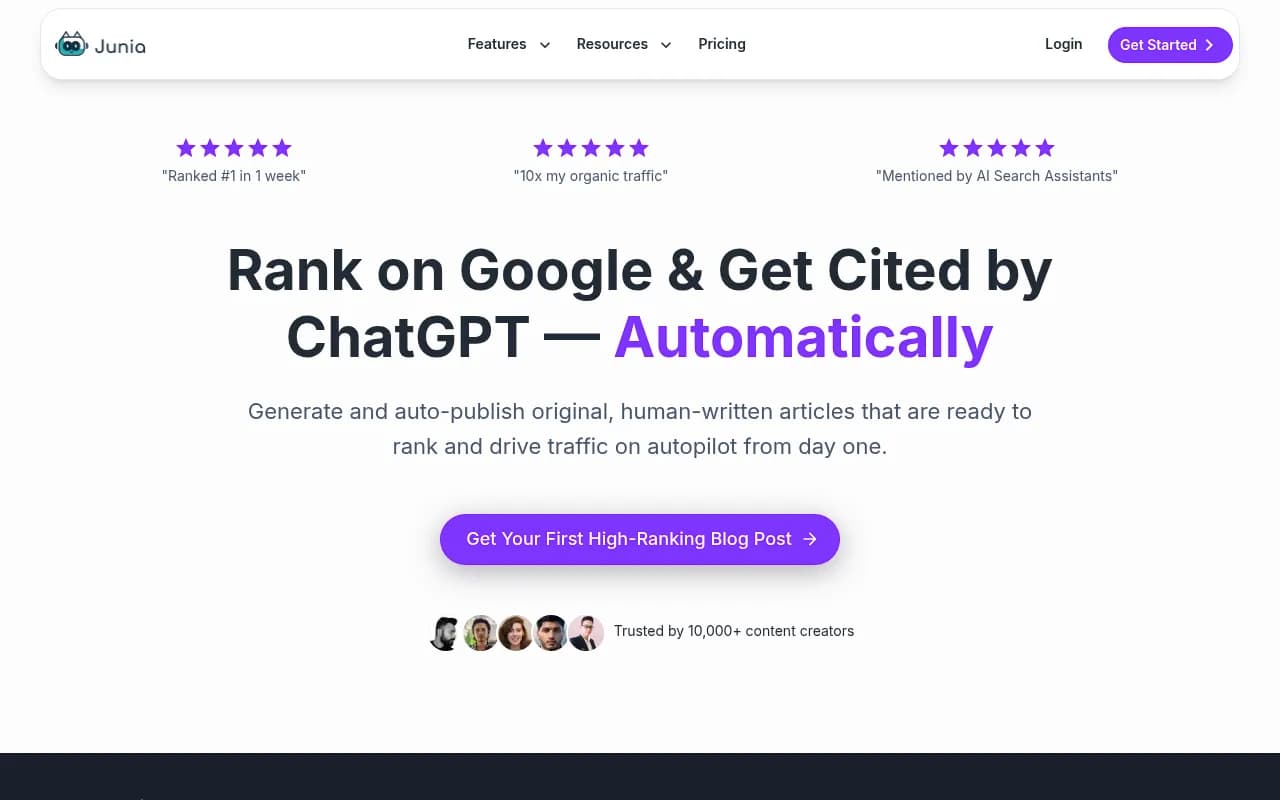
The content quality is good. The interface is clean. For teams that want AI-assisted writing with some awareness of the AI search landscape, it's a reasonable option.
But "awareness" is doing a lot of work in that sentence. Junia AI doesn't give you prompt-level tracking across ChatGPT, Perplexity, Claude, and Gemini. It doesn't show you which prompts your competitors are appearing for that you're missing. It doesn't analyze 880M+ real citations to tell you what content AI models actually want to cite. The gap between "AI-aware content creation" and "closing the loop on AI visibility" is significant, and Junia sits on the creation side of that gap.
Promptwatch: the only platform that closes the loop
This is where the comparison gets interesting.
Promptwatch approaches the problem from the opposite direction. It starts with AI visibility — tracking how your brand appears across 10 AI models (ChatGPT, Perplexity, Claude, Gemini, Grok, DeepSeek, Copilot, Mistral, Meta AI, and Google AI Overviews) — and then works backward to help you fix the gaps.

The core workflow is three steps:
First, Answer Gap Analysis shows you exactly which prompts your competitors are appearing for that you're not. Not vague category-level insights — specific prompts, with visibility scores, prompt volumes, and difficulty ratings. You can see the precise questions AI models are answering where your brand is absent.
Second, the built-in AI writing agent generates content designed to fill those gaps. This isn't generic SEO content. It's grounded in real citation data from over 880 million citations analyzed, so the articles are engineered around what AI models actually cite, not just what Google ranks.
Third, page-level tracking shows whether the new content is working. You can see which pages are getting cited, how often, and by which models. Traffic attribution (via a code snippet, Google Search Console integration, or server log analysis) connects AI visibility to actual revenue.
That's the loop that Surfer, Outranking, and Junia don't close. They help you create. Promptwatch helps you create, track, and improve — specifically for AI search.
A few other capabilities worth noting: Promptwatch logs AI crawler activity in real time (which pages ChatGPT, Claude, and Perplexity are reading, how often, what errors they hit), surfaces Reddit and YouTube discussions that influence AI recommendations, and tracks when your brand appears in ChatGPT's shopping carousels. Most competitors in this space don't touch any of that.
Head-to-head comparison
| Feature | Surfer SEO | Outranking | Junia AI | Promptwatch |
|---|---|---|---|---|
| AI-assisted content writing | Yes | Yes | Yes | Yes |
| Traditional SEO optimization | Strong | Strong | Moderate | Not the focus |
| AI search visibility tracking | No | No | Limited | Yes (10 models) |
| Prompt-level gap analysis | No | No | No | Yes |
| Citation data from real LLM responses | No | No | No | Yes (880M+) |
| Content generated for AI citation | No | No | Partial | Yes |
| AI crawler logs | No | No | No | Yes |
| Reddit/YouTube influence tracking | No | No | No | Yes |
| Traffic attribution from AI search | No | No | No | Yes |
| ChatGPT Shopping tracking | No | No | No | Yes |
| Starting price | ~$89/mo | ~$79/mo | ~$49/mo | $99/mo |
The table makes the split clear. Surfer and Outranking are content optimization tools that happen to use AI in their workflows. Promptwatch is an AI search visibility platform that happens to include content generation. Junia sits somewhere in the middle but doesn't fully commit to either side.
Which tool is right for which situation
Use Surfer SEO if your primary goal is ranking in Google's organic results and you want the most refined content scoring tool available. It's the best in class for that specific job.
Use Outranking if you need high-volume SEO content production with an integrated brief-to-draft workflow and Google ranking is your main metric.
Use Junia AI if you want AI-assisted content creation with some SEO guidance and you're not yet ready to invest in dedicated AI visibility tracking.
Use Promptwatch if you care about appearing in AI-generated answers — in ChatGPT, Perplexity, Claude, Gemini, or any of the other major AI models. It's the only platform here that tells you whether your content is actually getting cited, and the only one that helps you fix it when it isn't.
The honest answer for most marketing teams in 2026 is that you probably need both a traditional SEO tool and an AI visibility platform. They're measuring different things. A brand can rank #1 on Google for a keyword and be completely absent from ChatGPT's answer to the same question — or vice versa.
The "write and pray" problem
Here's the thing that bothers me about the current state of most content platforms: they stop at publication.
You write the article. You optimize it. You publish it. And then you hope.
Hope that Google picks it up. Hope that AI models cite it. Hope that someone somewhere asks a question that your content answers.
Surfer and Outranking reduce the guesswork on the Google side. But on the AI side, they leave you praying. Junia gets closer to acknowledging the AI search world but doesn't give you the data to actually measure it.
Promptwatch is the only platform in this comparison that treats AI search as a measurable, improvable channel rather than a black box. The Answer Gap Analysis alone — showing you exactly which prompts competitors are winning that you're not — is the kind of specific, actionable data that most teams don't even know they're missing until they see it.

A note on pricing and fit
Surfer SEO starts around $89/month. Outranking around $79/month. Junia AI has plans starting around $49/month. Promptwatch starts at $99/month for the Essential plan (1 site, 50 prompts, 5 articles per month), with Professional at $249/month adding crawler logs, state/city tracking, and 15 articles.
For teams that are just starting to think about AI search visibility, the Essential plan is a reasonable entry point. For agencies managing multiple clients, the Business plan at $579/month covers 5 sites and 350 prompts.
The more relevant question than price is what you're actually measuring. If you're not tracking AI citations at all, you have no idea whether your content investment is paying off in the channel that's growing fastest. That's a more expensive problem than any monthly subscription.
The bottom line
Surfer SEO and Outranking are good tools. They do what they say they do, and they do it well. If Google organic is your only channel, either one is worth considering.
But if you're asking whether your content is actually getting cited by AI models — and if not, why not, and what to do about it — neither of them can help you. Junia AI gets closer but doesn't close the loop.
Promptwatch is the only platform in this comparison that treats AI search as a first-class, measurable channel and gives you the tools to actually improve your position in it. That's a different product category, not just a different feature set.
In 2026, those are two separate jobs. Make sure you have the right tool for each one.