Key takeaways
- Google says structured data isn't required for generative AI search and that no special schema.org markup is needed. Keep it for rich results and clarity.
- Evidence that schema helps ChatGPT is thin. In Otterly's experiment, 6 of 7 AI platforms, ChatGPT included, couldn't fetch or interpret JSON-LD when asked directly. Only Gemini did.
- A 10-week Evergrow study (Feb 27 to Apr 4, 2026) found LocalBusiness schema didn't move SERP or Google Maps rank, with some positive signals from certain LLMs, ChatGPT among them. It's one business, so treat it as a hint.
- Schema labels facts. It won't help if crawlers are blocked or your visible page doesn't state the facts.
- Ship accurate LocalBusiness JSON-LD, match it to visible content and your listings, then measure whether AI answers actually change.
The honest answer first
Plenty of vendor posts claim LocalBusiness schema makes you more visible in local AI search. SEOptimer and Edigital say so. None of them cite OpenAI, and I found no OpenAI documentation describing how ChatGPT uses schema at all. So treat those claims as unproven.
What is solid is narrower. Schema labels facts on a page: business name, phone number, service area, hours. That helps machines read explicit details and makes pages eligible for supported Google features. Whether ChatGPT leans on it when naming a plumber is a different question, and nobody outside OpenAI can answer it with certainty.
My take: add schema, because it's cheap and useful elsewhere. Just don't expect it to be the lever that gets you into ChatGPT's shortlist.
What the evidence actually says
Google's position
Google Search Central's AI optimization guide says: "Structured data isn't required for generative AI search, and there's no special schema.org markup you need to add." It still recommends structured data for rich results. I only saw that quote relayed by Digidop, not on Google's page itself, so check the source before quoting it to a client.
Digidop also says Microsoft states that schema helps its systems understand content. That's a secondary claim I couldn't verify.
The Otterly experiment
Otterly implemented five schema types on live pages, asked seven AI platforms directly to retrieve the structured data, and tracked brand coverage across 319 prompts over three months. Six of seven couldn't fetch or correctly interpret the markup. ChatGPT said it could not detect schema in the accessible source. Only Gemini returned the right JSON-LD.
Their explanation is plausible: schema was built for algorithms that couldn't handle unstructured text, and AI search is built to read exactly that. It's a self-reported test, so weigh it accordingly. It also tests whether a chatbot can quote your JSON-LD, which isn't quite the same as whether the markup influences retrieval behind the scenes.
The Evergrow study
Evergrow Marketing added standard LocalBusiness schema to a business for 10 weeks (Feb 27 to Apr 4, 2026). Result: no effect on SERP rank, no effect on Google Maps rank, but some positive influence from certain LLMs, including ChatGPT.
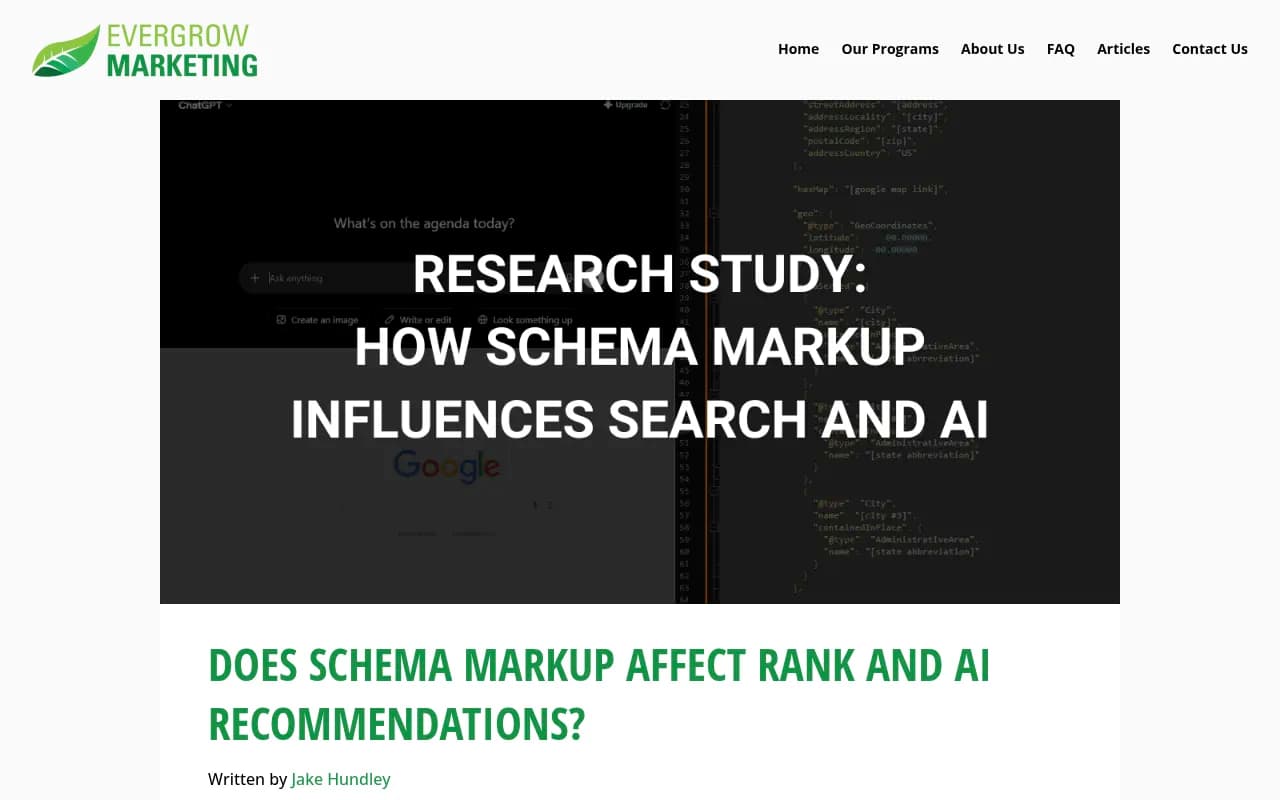
One business, ten weeks. Interesting, not conclusive.
Putting it together
| Source | Claim | How much to trust it |
|---|---|---|
| Google Search Central (via Digidop) | No special schema needed for generative AI search | High on Google's own systems, secondhand quote |
| Otterly experiment | 6 of 7 platforms couldn't read schema when asked | Self-reported, but specific |
| Evergrow study | No rank effect, some LLM lift incl. ChatGPT | Single business, short window |
| SEOptimer, Edigital | LocalBusiness schema improves AI local visibility | No first-party backing |
What ChatGPT actually seems to cite
If schema isn't the story, what is? Promptwatch has no report on schema, but its citation data points at the visible page. In Promptwatch Data's content type report (Sep 28 to Oct 4, 2026), product pages were 22.4% of classified ChatGPT citations and landing pages 16.8%. That's 39% going to pages describing what a company sells. For branded prompts, product pages hit 23.3% and landing pages 22.8%, with FAQ pages rising to 4.8% and reviews to 5.6%.
For a local business, translate that: your service pages, location pages, and an FAQ about your business are the content ChatGPT quotes. Schema can restate those facts, but the facts have to be on the page first.
There's also a plain access issue. In Promptwatch's AI crawler data (June 8 to Sep 6, 2026), OpenAI accounted for 79.8% of verified AI crawler requests in the week of Aug 31 to Sep 6. If your robots.txt, CDN or WAF blocks those bots, a page can't be fetched at answer time, whatever markup it carries.
Which local schema is worth adding
I didn't verify which individual LocalBusiness properties matter to AI systems, so I'll stay with what Google documents and what makes sense for entity clarity. Google's LocalBusiness documentation covers business hours, departments and reviews.
A sensible baseline for a small service business:
- LocalBusiness (or a more specific subtype such as Plumber or Dentist) with name, URL, logo, telephone
- PostalAddress and geo coordinates
- openingHoursSpecification
- areaServed for service-area businesses
- sameAs links to your Google Business Profile, social profiles and major listings
- Organization or WebSite markup on the homepage so the entity is defined once
Azence argues schema does three jobs for AI: it disambiguates your entity from similarly named businesses, extracts exact facts like hours and services, and gives engines clean facts to quote. That's a reasonable description of intent. It isn't proof ChatGPT does it.
Example JSON-LD
{
  "@context": "https://schema.org",
  "@type": "Plumber",
  "name": "Example Plumbing Co.",
  "url": "https://www.example.com",
  "telephone": "+1-555-010-0199",
  "address": {
    "@type": "PostalAddress",
    "streetAddress": "100 Main St",
    "addressLocality": "Austin",
    "addressRegion": "TX",
    "postalCode": "78701",
    "addressCountry": "US"
  },
  "openingHoursSpecification": [{
    "@type": "OpeningHoursSpecification",
    "dayOfWeek": ["Monday","Tuesday","Wednesday","Thursday","Friday"],
    "opens": "08:00",
    "closes": "17:00"
  }],
  "areaServed": ["Austin", "Round Rock"],
  "sameAs": ["https://www.facebook.com/example"]
}
Use JSON-LD, Google's recommended format, in a single block in the page head.
Rules that keep you out of trouble
- Mark up only what's visible on the page. Nord Marketing's advice is to describe the visible page and business accurately.
- Don't mark up your own reviews expecting stars. Self-serving business reviews are ineligible for Google review rich results.
- Keep hours, phone and address identical across your site, your Google Business Profile and your listings. Conflicting facts hurt more than missing markup.
Azence's framing is useful: schema is essential infrastructure, not a magic bullet. The bigger win is connecting your business facts into one consistent graph, paired with content worth citing.
Tools for generating and checking markup
You don't need all of these. Pick by how your site is built.
If you're on WordPress, a SEO plugin handles most of it:
For deeper entity markup and knowledge graph work, WordLift is built around structured data:
To verify the markup is present and crawlable across many pages, a crawler helps:
For listings consistency, which matters as much as schema, local platforms like these keep your name, address and phone aligned:
| Job | Option | Notes |
|---|---|---|
| Generate schema on WordPress | Yoast SEO, Rank Math | Fine for baseline LocalBusiness and Organization |
| Entity and knowledge graph markup | WordLift | More structured data depth |
| Audit schema across a site | Screaming Frog | Extracts and validates JSON-LD at scale |
| Keep listings consistent | BrightLocal, Yext, Whitespark | NAP consistency across directories |
| Check Google performance | Google Search Console | Rich result reports and indexing |
Measuring whether any of it works
This is where most schema projects fall apart: nobody checks. Before and after you ship markup, run the same set of local prompts in ChatGPT, such as "best plumber in Austin" and "emergency plumber near me", and record whether you're named, in what position, and which sources get cited.
Doing that by hand gets old fast. Tools like Promptwatch can track your visibility across ChatGPT and other AI engines over time, and its crawler logs show whether AI bots are actually reaching your pages. That second part matters for this topic, because markup on a page that bots can't fetch does nothing.

If you want to compare options, the GEO software directory lists the main platforms.
Any test should isolate one change at a time. If you add schema, rewrite service pages and fix your listings in the same week, you won't know which one moved the needle.
A practical order of operations
- Confirm AI crawlers can reach your site. Check robots.txt, CDN and WAF rules.
- Put the core facts in visible text on service and location pages: name, address, hours, services, areas served, prices where you can.
- Add an FAQ page about your business in plain language. FAQ pages earned 4.8% of citations on branded prompts in Promptwatch's data.
- Clean up listings and your Google Business Profile so facts match everywhere.
- Add LocalBusiness JSON-LD that mirrors the visible page.
- Collect reviews on sites people trust in your category. Reviews rose to 5.6% of citations for branded prompts.
- Re-test your prompts after a few weeks and compare.
Schema is step five on purpose. It's the cheapest item and the least proven one.
So which markup helps ChatGPT?
No markup is confirmed to help ChatGPT specifically. LocalBusiness with a precise subtype, address, hours, areaServed and sameAs is the sensible set to ship, because it costs little, supports Google features, and states your facts unambiguously. Whether ChatGPT benefits is unproven, with one study showing a hint of lift and another showing models failing to read it on request.
So spend an afternoon on the schema, and the rest of your effort on visible pages, consistent listings, crawler access and reviews. Then measure the answers, not the markup.
If you'd rather have a team run that process and the testing for you, an agency such as 1001 SEO Media works on local SEO and AI search visibility.