Key takeaways
- Otterly.AI is a cheap monitoring tool ($29/mo entry) that gives you audits and briefs. It does not write and publish the pages for you.
- The alternatives worth considering split into three groups: monitoring platforms with a built-in writing and publishing loop, content engines that bolt on tracking, and SEO suites with AI add-ons.
- Check four things before switching: where drafts come from, which CMSs it publishes to, whether a human review step exists, and whether the tool measures the page after it ships.
- Pages need refreshing. Promptwatch Data shows product pages and how-tos in ChatGPT reach their citation half-life at roughly 74 to 77 days, so a tool that only drafts new posts is half a solution.
Why people leave Otterly.AI for content features
Otterly.AI is a fine tracker. It starts at $29 a month, covers four AI engines per workspace, and has unlimited team members. Most teams who leave aren't unhappy with the numbers. Their question changes from "where do we stand?" to "who writes the fix?"
Otterly.AI answers the first question well and the second with audits and briefs. Someone on your team still has to turn the brief into a page, get it through review, and paste it into WordPress or Webflow. That works at 5 prompts. At 150 it becomes a full-time job.
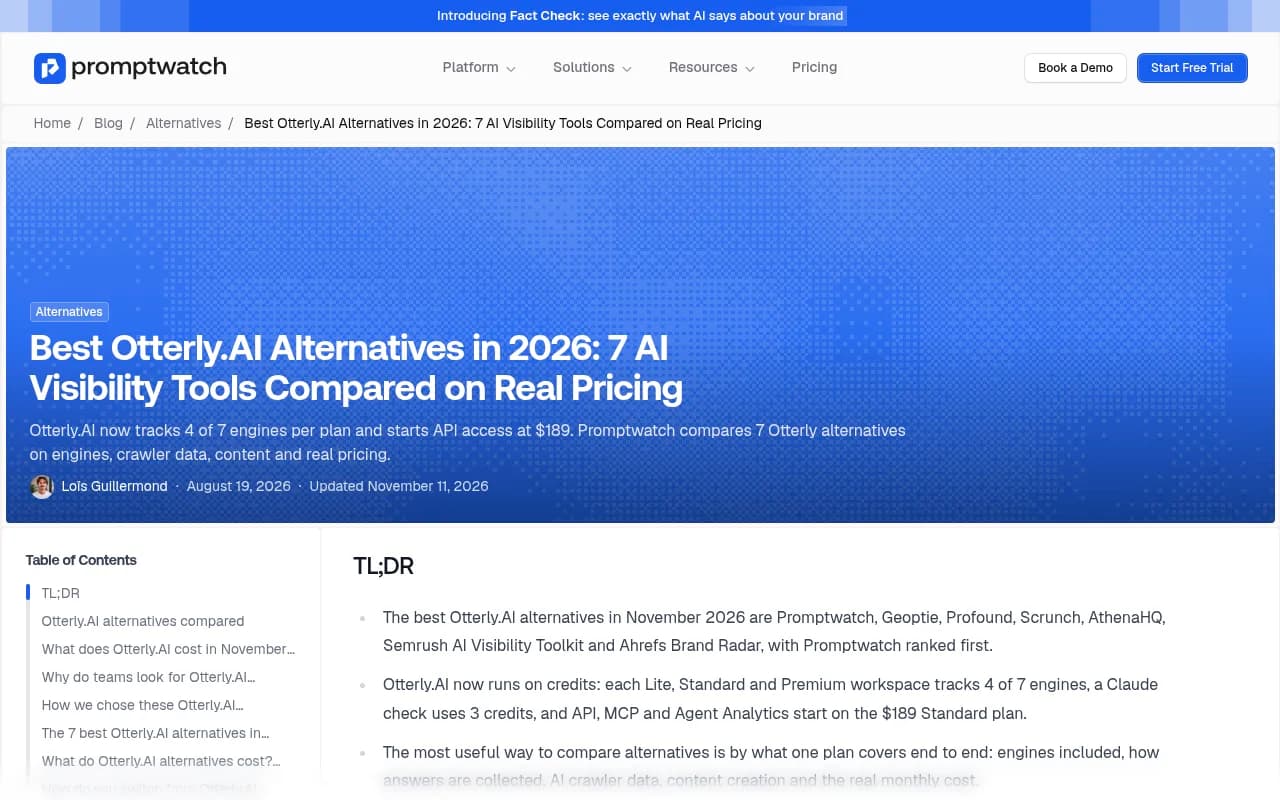
Two other practical points from the pricing pages I reviewed. Otterly runs on credits, and a Claude check uses 3 credits. API, MCP and Agent Analytics start on the $189 Standard plan. The team at 3RD estimates that adding Google AI Mode, Gemini and Claude pushes the Standard plan to around $416 a month. So the "cheap" option stops being cheap once you want full coverage. (Both are vendor claims, so check current pricing yourself.)
Otterly.AI

What "content generation and CMS publishing" should actually mean
Vendors use these words loosely. A tool that generates a 300-word blurb in a text box is not the same as one that plans a page from your tracked prompts, writes it with your brand facts, and ships it to your CMS as a draft. Here is the checklist I would use.
Drafting grounded in AI visibility data
The whole point of buying this from a GEO tool rather than a general writer is that the draft is aimed at a specific prompt where you are missing. Look for gap analysis that maps your pages against the prompts AI answers, and drafts that use the pages AI already cites as input.
A real publishing connection
Copy and paste doesn't count. You want native connections to WordPress, Webflow or Framer (or an API or MCP endpoint), with field mapping so title, description, body and image land in the right place. Draft versus live should be a choice, not an accident.
A review step
Fully hands-off publishing is tempting and sometimes fine for low-risk pages. Most teams want an inbox where an editor approves, edits or declines. Ask whether both modes exist.
Measurement after publish
This is the part most content tools skip. Did AI crawlers read the page? Was it cited? Did it send visitors? Without that, you are guessing.
Refresh support
Promptwatch's half-life research tracked every page ChatGPT cited on July 6, 2026, for 90 days. Product pages, reviews and how-tos sat at about 55% still cited after 60 days, and all three hit their half-life at 74 to 77 days. News was worse: half gone by day 36. See What Is the Half-Life of Content in ChatGPT? for the full breakdown. Landing pages and docs lasted longest (78% and 76% still cited at 30 days). The lesson is simple: pick a tool that updates old pages, not just one that writes new ones.
Which formats should the tool be able to produce?
In Promptwatch's content type report (Sep 28 to Oct 4, 2026), product pages were 22.4% of ChatGPT citations and landing pages 16.8%. Listicles were 13.6%, how-tos 8.7%, comparisons 5.9%. For commercial prompts, product pages hit 26.0% and landing pages 20.6%.
So a generator that only writes blog posts misses roughly 40% of what ChatGPT actually cites. Make sure the tool can handle comparison pages, listicles, how-tos, docs and FAQ pages, not just generic articles.
The alternatives compared
| Tool | Content generation | CMS publishing | Tracking depth | Best for |
|---|---|---|---|---|
| Promptwatch | Content Agent, on-demand articles, Content Refresh | WordPress, Webflow, Framer, REST API, MCP | All supported AI models, crawler logs, visitor analytics | Teams who want the full loop in one product |
| Geoptie | Unlimited generation and optimization on every plan, per its own page | Check current docs | Monitoring plus recommendations | Teams who hate credit meters |
| Profound | Agents that draft or optimize on higher tiers | Limited | Enterprise analytics, many engines | Large enterprises with analyst teams |
| Scrunch | 1 page optimization/mo on Core; advanced generation on Enterprise | Limited | Strong monitoring | Enterprises, $250/mo Core |
| AirOps | Workflow-based generation | Pushes to CMS via integrations | Tracks 10+ engines on Pro | Content ops teams |
| Writesonic | GEO tracking plus writing | Built-in | Moderate | Small teams wanting one writing tool |
| OGTool | Complete posts, Reddit replies | Publishes | ChatGPT and Google, daily | Lean teams focused on ChatGPT |
Treat vendor claims as claims. Several of the above come from the vendors' own comparison pages, which is always worth a pinch of salt. Test with your own prompts.
Tool by tool
Promptwatch
Promptwatch is the one I would put first for this specific use case, and yes, it is also the platform 1001 SEO Media uses for GEO work, so factor that in. The reason is the loop. It tracks prompts across the real interfaces of ChatGPT, Google AI Overviews, Gemini, Perplexity and others, finds the gaps, and then the Content Agent plans, writes and publishes pages against them. You can run it through a review inbox or hands-off, on a publishing calendar with a monthly budget.
Publishing goes to WordPress (official plugin), Webflow (OAuth or the Marketplace app) and Framer, as draft or live. After that, IP-verified crawler logs show whether GPTBot, ClaudeBot and others read the page, Page Tracker shows whether AI cites it, and visitor analytics show traffic. Underperformers come back as actions or refresh suggestions via Content Refresh.
The Content Agent is on Business ($579/mo) and above, which is a real step up from Otterly's $29. Essential is $95/mo and Professional $245/mo, with 5 AEO articles on Professional. Confirm everything at promptwatch.com/pricing. The 7-day free trial is the easiest way to see whether the output fits your voice, and the Content Agents page explains the workflow. Crisp scaled to 5 to 10 articles per day and saw 2x higher conversion from AI traffic (case study).
For a side-by-side with Otterly specifically, the Promptwatch vs Otterly page covers it.

Geoptie
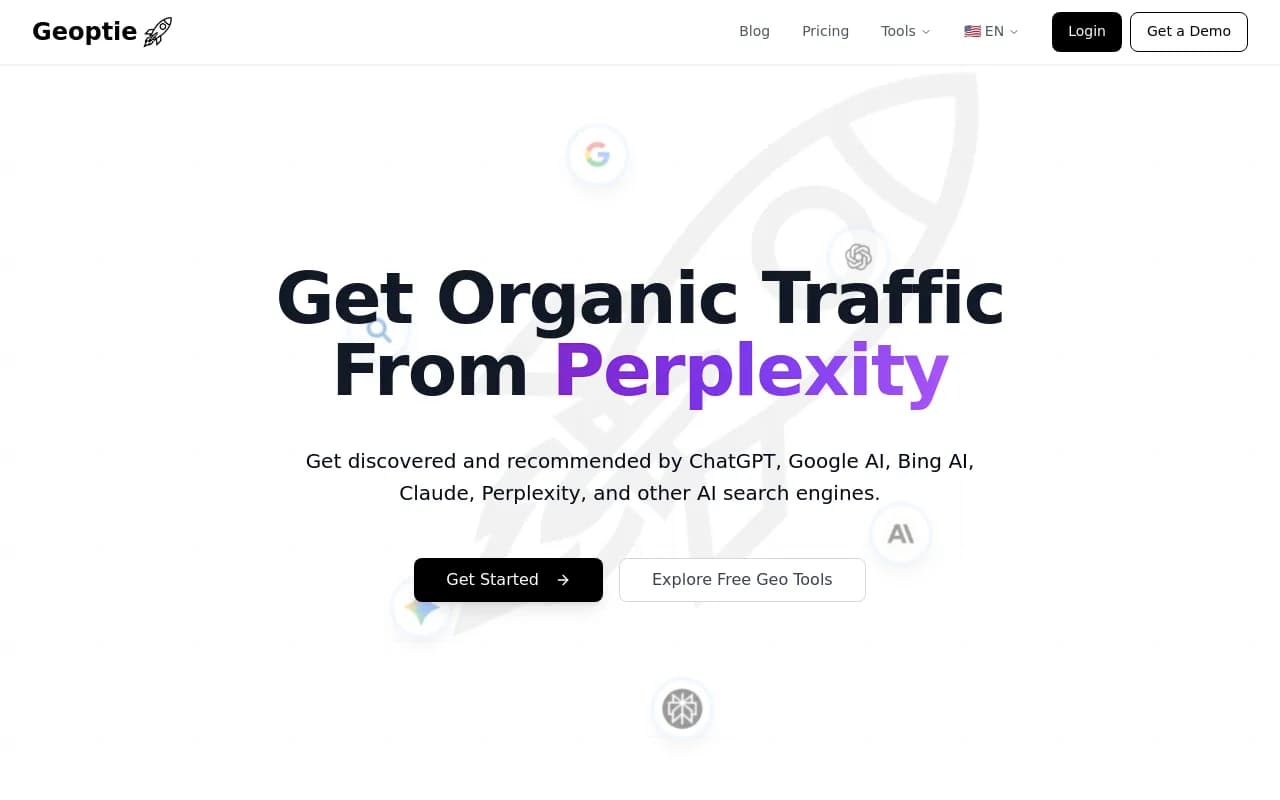
Geoptie's pitch is no credits: unlimited audits, recommendations, content generation and optimization on every plan, Starter included. If credit anxiety is your main complaint about Otterly, that is appealing. I would check how it handles CMS publishing and how deep its tracking goes before committing.
Profound and Scrunch
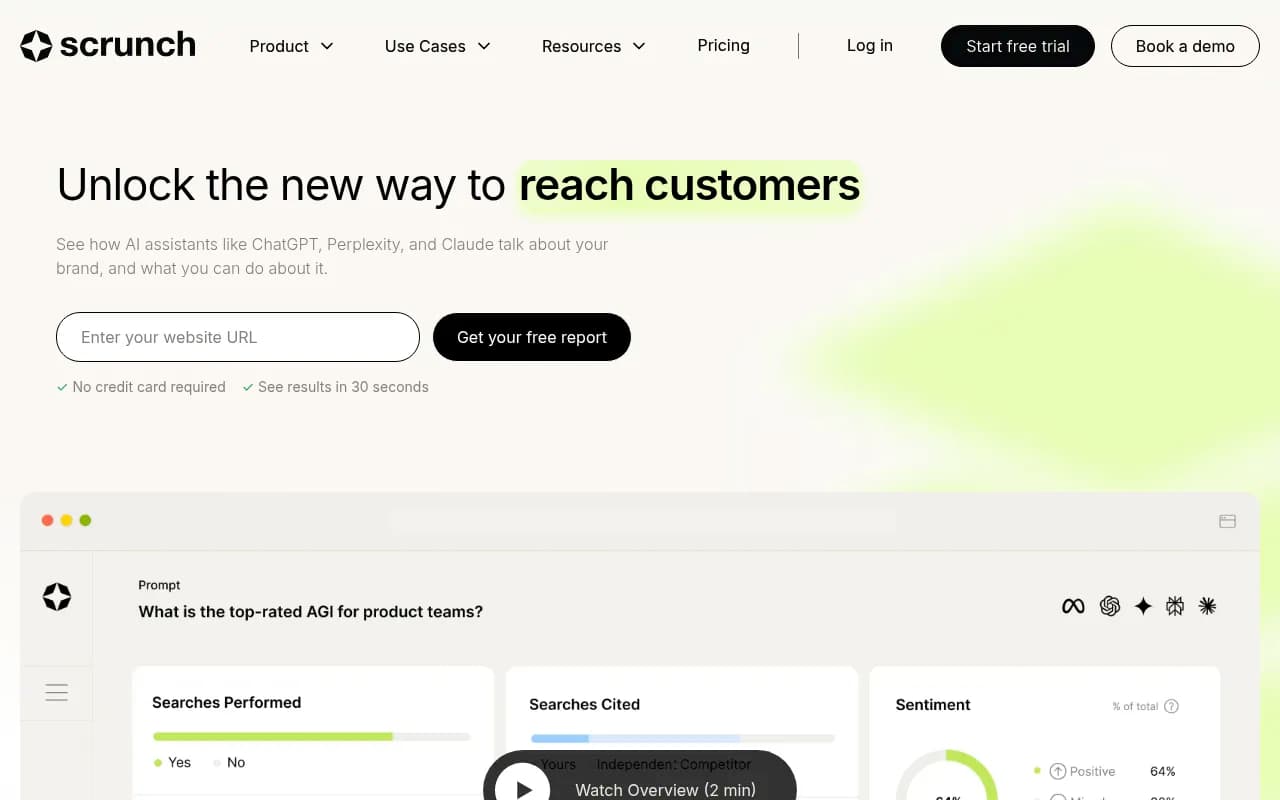
Both are strong measurement platforms. Scrunch's Core plan at $250/mo includes just one page optimization a month, with advanced content generation on Enterprise. Profound adds agents that draft or optimize content, but neither is built to operate the publish loop for you. Priced higher, and no match if content volume is your goal.
Profound

AirOps
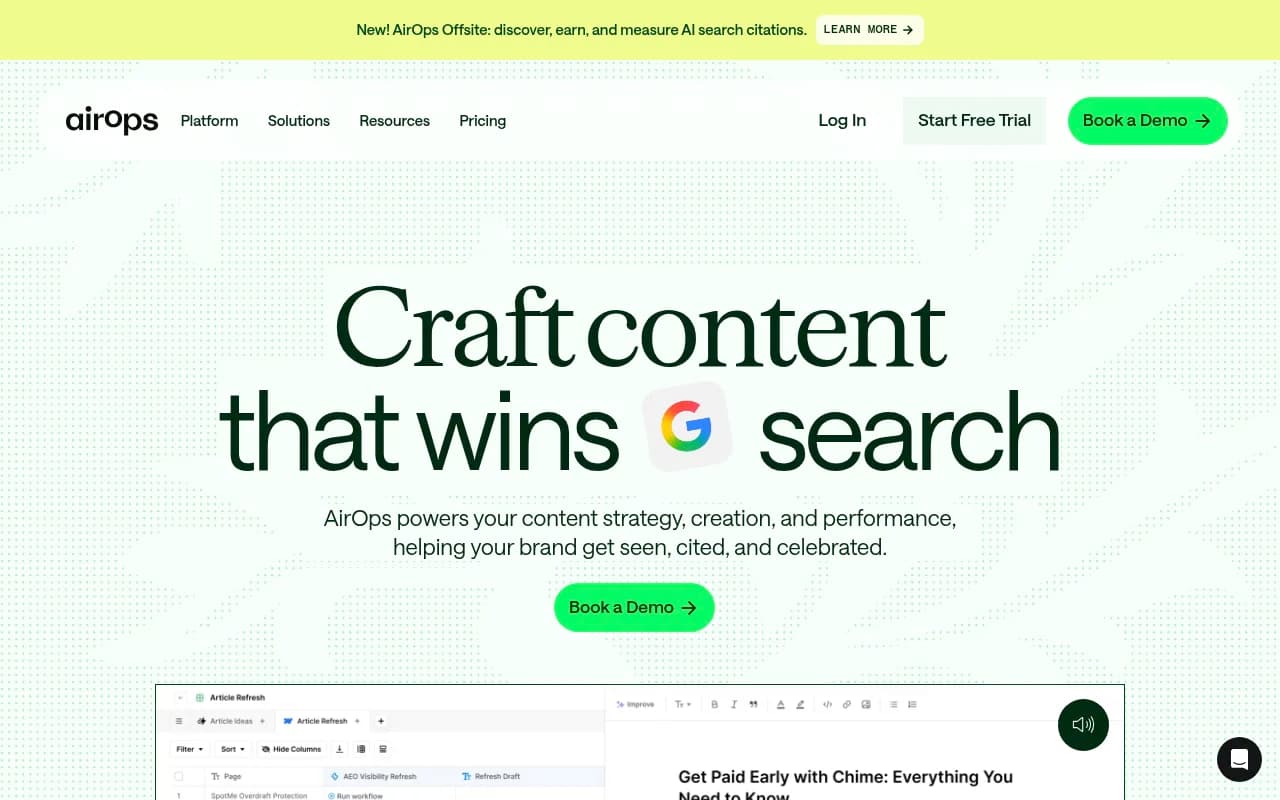
AirOps comes from the content side. Its workflows generate and push content to a CMS, and tracking has been added. The catch, per one comparison, is billing: tasks per month, so daily tracking across many engines eats the same budget as content runs. Good if you want custom workflows and have someone to build them.
Writesonic
Writesonic combines GEO tracking with an AI writer, SEO tools and workflow automation. A WorkDuo comparison favors it over Otterly if you want everything in one place. It is a more generalist tool than the specialist platforms above.

OGTool
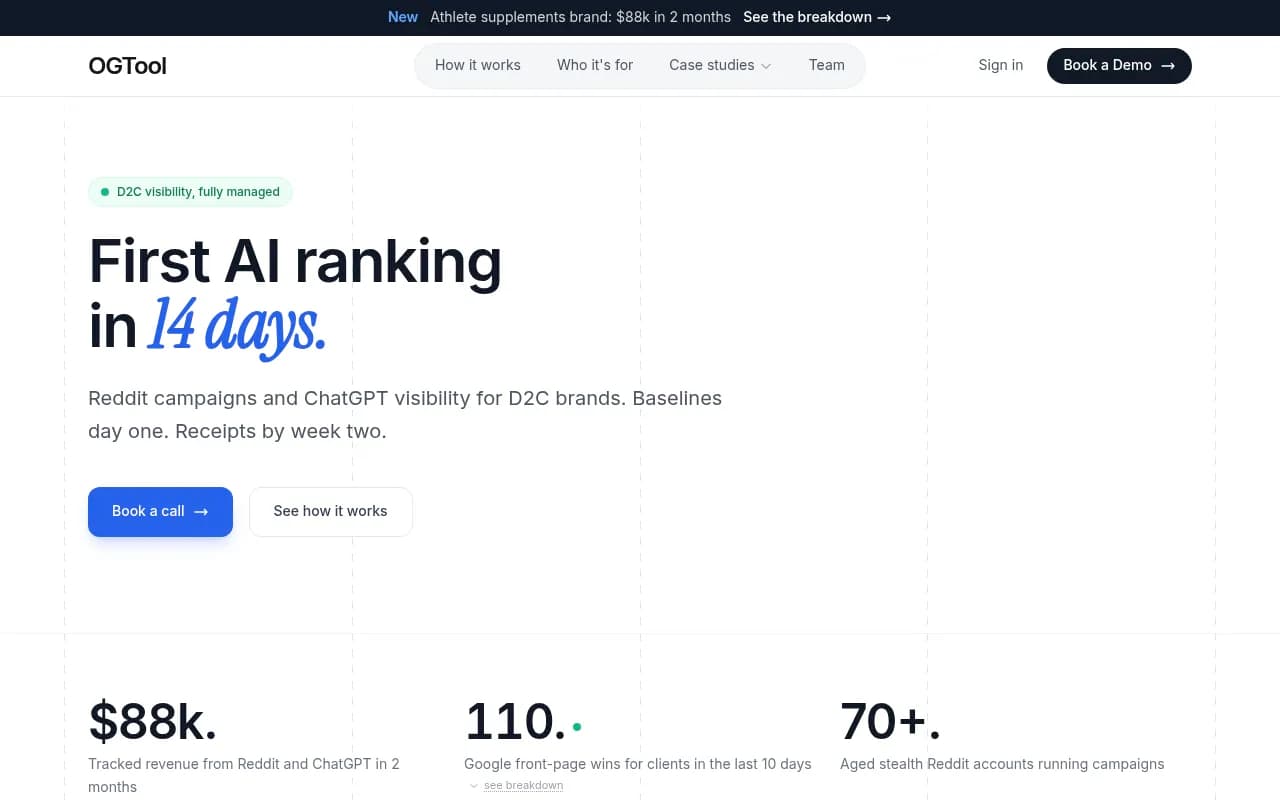
OGTool generates complete, publish-ready posts and also does Reddit replies and a competitor article workflow. Its tracking is narrower (ChatGPT and Google), and the comparison I read is on its own blog. Fine for a small team, but verify the output on your own prompts.
SEO suites
Semrush and HubSpot AEO also compete here. HubSpot's pitch is CRM attribution next to AI visibility, which matters if your reporting lives in HubSpot. The tradeoff with suites is usually fixed prompt sets and shallower AI-specific data.

Which one should you pick?
| If you need... | Look at |
|---|---|
| Track, write, publish and measure in one loop | Promptwatch |
| No credit meter, unlimited drafts | Geoptie |
| Custom content workflows | AirOps |
| Enterprise analytics, less content | Profound, Scrunch |
| A writer with GEO tracking attached | Writesonic |
| CRM attribution | HubSpot AEO |
If you want to browse beyond this list, the GEO software directory covers the wider field.
How to switch without losing your baseline
- Export your Otterly prompts, responses and citations before cancelling. Your baseline is worth keeping.
- Rebuild the prompt list in the new tool, grouped by topic and intent (commercial, informational, branded). Don't just copy; drop prompts that never mattered.
- Run both tools in parallel for two to four weeks. Numbers will differ because tools collect answers differently (real interface versus API), so compare trends, not absolutes.
- Connect your CMS to a staging site first. Publish three drafts, check field mapping, images and internal links.
- Start with review on. Move to hands-off only for page types where you trust the output.
- Set a refresh cadence. Given the 74 to 77 day half-life for product pages and how-tos, review those at around 60 days.
- Measure after publish: crawler visits, citations, visits. If AI bots never reach a page, the problem is access, not writing.
A few honest caveats
AI-written pages are only as good as the facts you feed them. Whatever tool you pick, load a brand book or knowledge base with real product facts, and have a human read anything that makes claims about pricing or features. Also, the price jump from a $29 tracker to a content platform is real. If you publish four articles a month, a tracker plus a writer may cost less. If you publish dozens, the loop pays for itself in editor hours.
Finally, if you'd rather hand the whole thing to people, 1001 SEO Media runs GEO and content programs for brands, and the agency tooling above is what they use day to day.