Key takeaways
- Yext and Uberall are built for local/multi-location listing management and are adding AI features, but neither was designed for tracking or improving how AI search engines like ChatGPT or Perplexity respond to brand queries.
- Otterly.AI is a solid GEO monitoring platform with strong citation analytics and multi-engine coverage, but stops short of content generation and optimization.
- Promptwatch is the only platform in this comparison that covers the full cycle: tracking AI visibility, diagnosing content gaps, generating content to close those gaps, and attributing the results to traffic and revenue.
- For franchise brands specifically, the right tool depends on what problem you're actually trying to solve: listing accuracy (Yext/Uberall), AI monitoring (Otterly.AI), or end-to-end AI search optimization (Promptwatch).
Franchise marketing has always been complicated. You're managing brand consistency across dozens, hundreds, sometimes thousands of locations -- each with its own address, hours, reviews, and local quirks. For years, that meant local SEO: Google Business Profiles, citation management, review responses.
Then AI search happened.
Now when someone asks ChatGPT "what's the best pizza chain near me" or Perplexity "which franchise gym has the best value," the answer doesn't come from a Google Maps listing. It comes from whatever the AI model has learned from the web -- articles, Reddit threads, review aggregators, brand websites, and third-party citations. Your Google Business Profile is largely invisible to that process.
That's the problem this comparison is trying to solve. Four platforms claim to help franchise brands with AI visibility. They're not the same thing, and the differences matter a lot.
What "AI visibility" actually means for franchise brands
Before comparing tools, it's worth being precise about the problem.
Traditional local SEO is about being found in map packs and local search results. AI visibility is about being cited, recommended, or mentioned in AI-generated answers. These are different mechanisms with different levers.
For a franchise brand, AI visibility has two layers:
The brand layer: Does ChatGPT recommend your brand when someone asks for a category recommendation? ("What's the best fast-casual Mexican chain?")
The location layer: Does the AI give accurate, helpful information about specific locations? Hours, services, whether a particular location has a drive-through, etc.
Most platforms in this comparison handle one of these layers reasonably well. Very few handle both. And almost none help you actually fix gaps once you find them.
The four platforms at a glance
Otterly.AI
Otterly.AI is a purpose-built GEO monitoring platform. It tracks brand mentions, citations, and visibility across ChatGPT, Perplexity, Google AI Overviews, Gemini, and Claude. The analytics are genuinely good -- engine-by-engine comparison, citation source analysis, competitor benchmarking, and a prompt history that lets you see how visibility changes over time.
Otterly.AI

One standout feature is the MCP server integration, which lets AI-native teams query their brand data without leaving their workflow. That's genuinely useful for technical teams who want to build custom dashboards or automate reporting.
Where Otterly.AI falls short for franchise brands: it's primarily a monitoring tool. It shows you where you're visible and where you're not, but it doesn't help you fix the gaps. There's no content generation, no content brief creation, and no traffic attribution connecting AI visibility to actual revenue. For a franchise marketing team that needs to act on data, not just observe it, that's a significant limitation.
Multi-location support is also not a core feature. Otterly.AI is designed around brand-level monitoring, not location-level granularity.
Promptwatch
Promptwatch is the broadest platform in this comparison. It covers monitoring, content gap analysis, content generation, crawler logs, and traffic attribution -- all in one place.

The core workflow is what separates it from the others. Answer Gap Analysis shows exactly which prompts competitors are appearing for that you're not. Content Agents then generate articles, comparisons, and listicles designed to close those gaps -- grounded in real prompt data, citation analysis, and competitor research. AI Crawler Logs show which pages AI crawlers are actually reading, how often they return, and when a page moves from crawled to cited. Traffic attribution connects visibility to revenue.
For franchise brands, Promptwatch's multi-language and multi-region monitoring is relevant -- you can track AI responses in different languages and configure custom personas that match how your actual customers prompt. Page-level tracking shows which specific pages are being cited and by which models, which matters when you're trying to understand whether your location pages or your brand-level content is driving AI recommendations.
Pricing starts at $99/month for the Essential plan (1 site, 50 prompts), $249/month for Professional (2 sites, 150 prompts, crawler logs), and $579/month for Business (5 sites, 350 prompts). Agency and enterprise pricing is available for larger franchise operations.
The honest limitation: Promptwatch is not a listing management tool. It won't sync your hours across Google, Yelp, and Apple Maps. If you need that, you still need a separate tool.
Yext
Yext is the established player in multi-location brand management. Its core product is a centralized content management system that pushes accurate business information -- name, address, phone, hours, services -- to hundreds of directories, maps, and search platforms simultaneously.
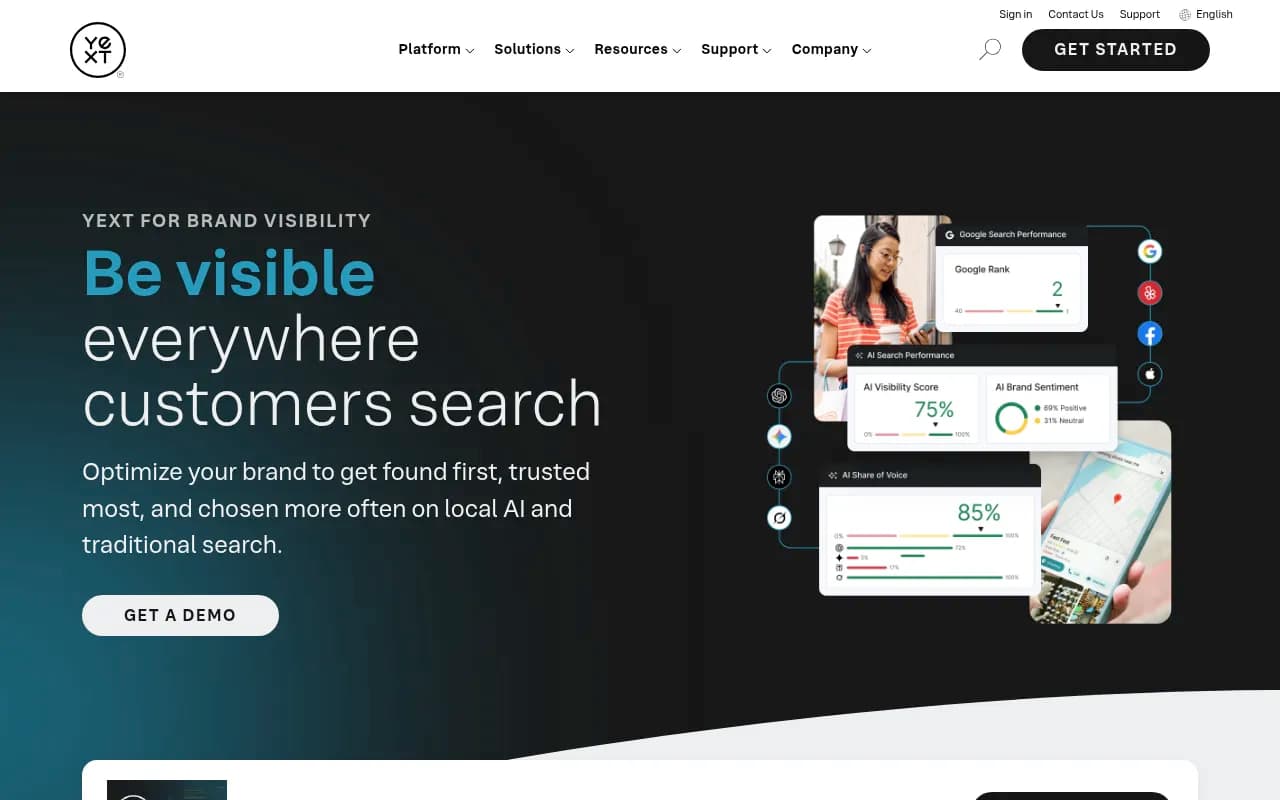
In 2024-2025, Yext added AI search features under the banner of "AI Search Visibility." The idea is that accurate, structured data in Yext's knowledge graph feeds into AI models that rely on structured data sources. There's some truth to this -- AI models do pull from structured data, and having consistent NAP (name, address, phone) data across the web matters.
But Yext's AI visibility features are fundamentally different from what Otterly.AI or Promptwatch offer. Yext doesn't track how your brand appears in ChatGPT responses. It doesn't show you which prompts competitors are winning. It doesn't generate content to improve AI citations. The AI angle is more about ensuring your data is clean and consistent so that when AI models do pull structured data, they get it right.
For franchise brands, Yext remains genuinely useful for the listing management problem. If your locations have inconsistent hours or wrong addresses showing up across directories, Yext fixes that. But it won't tell you why ChatGPT recommends a competitor when someone asks for the best option in your category.
Uberall
Uberall is Yext's closest competitor in the listing management space. It offers centralized management of business listings across 125+ directories, review management, local pages, and social posting -- all with a strong multi-location workflow.
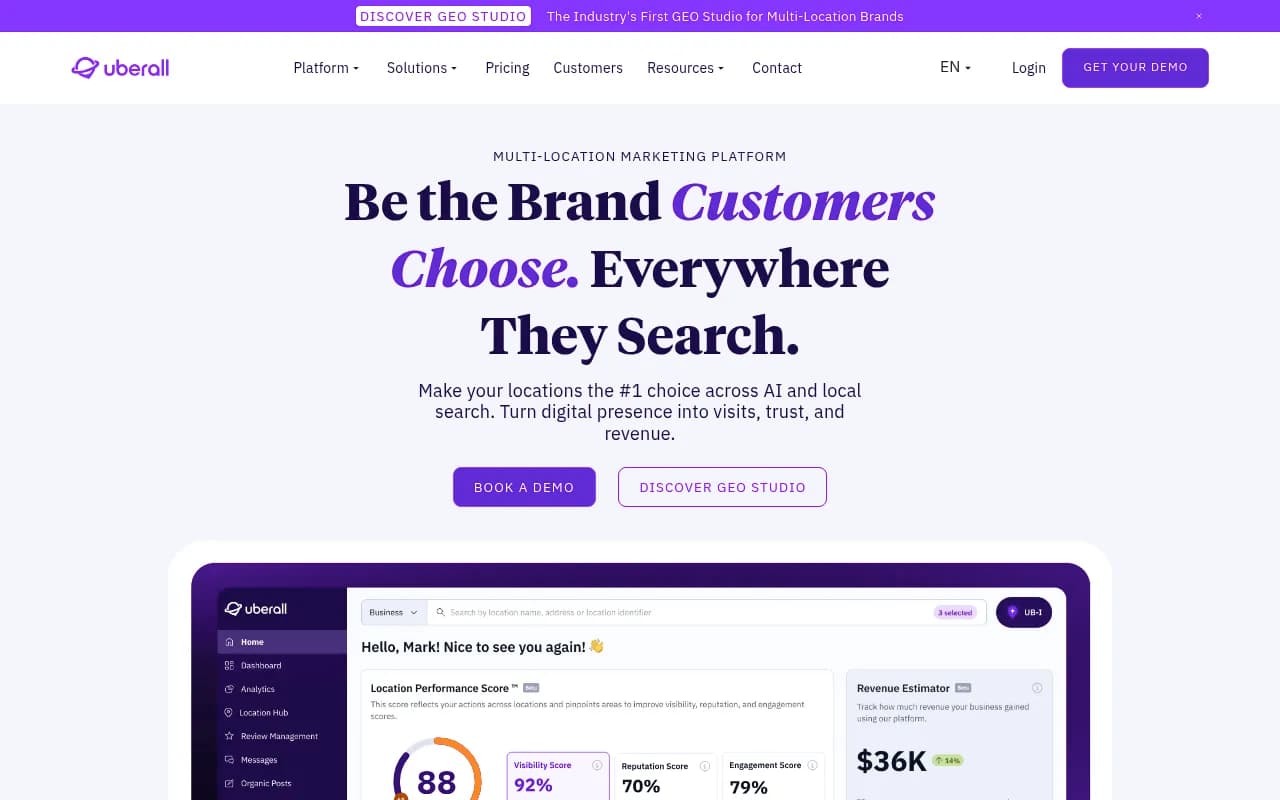
Like Yext, Uberall has added AI-adjacent features in recent years. Their "Near Me" brand experience platform includes some AI search visibility tracking, and they've positioned themselves around the idea that consistent local data improves AI discoverability.
The honest assessment: Uberall is excellent at what it was built for. Multi-location listing management, review aggregation, and local page creation are all solid. But it's not an AI visibility platform in the way Otterly.AI or Promptwatch are. It doesn't track prompt-level visibility, doesn't analyze which AI models are citing you, and doesn't help you create content that gets cited.
For franchise brands, Uberall and Yext solve similar problems. The choice between them usually comes down to pricing, integrations, and which directories matter most to your specific business.
Feature comparison
| Feature | Otterly.AI | Promptwatch | Yext | Uberall |
|---|---|---|---|---|
| AI prompt tracking | Yes | Yes | No | No |
| Multi-engine coverage | Yes (5+ engines) | Yes (10 engines) | Limited | Limited |
| Citation analysis | Yes | Yes | No | No |
| Competitor benchmarking | Yes | Yes | No | No |
| Content gap analysis | No | Yes | No | No |
| AI content generation | No | Yes | No | No |
| AI crawler logs | Beta | Yes (Professional+) | No | No |
| Traffic attribution | No | Yes | No | No |
| Listing management | No | No | Yes | Yes |
| Review management | No | No | Yes | Yes |
| Multi-location support | Limited | Yes (multi-site) | Yes (core feature) | Yes (core feature) |
| Reddit/YouTube insights | No | Yes | No | No |
| ChatGPT Shopping tracking | No | Yes | No | No |
| Local page creation | No | No | Yes | Yes |
| API access | Yes | Yes | Yes | Yes |
| Free trial | Yes | Yes | No | No |
| Starting price | ~$99/mo | $99/mo | Custom | Custom |
Which platform is right for which franchise use case?
If your main problem is listing accuracy
You need Yext or Uberall. If your franchise locations have inconsistent hours, wrong addresses, or outdated information showing up across Google, Apple Maps, Yelp, and dozens of other directories -- that's a listing management problem, not an AI visibility problem. Fix it with the right tool.
The choice between the two usually comes down to your existing tech stack and which directories are most important to your business. Yext has a larger publisher network; Uberall tends to be more competitive on pricing for mid-market franchise groups.
If your main problem is understanding AI visibility
You need Otterly.AI or Promptwatch. If you want to know how ChatGPT, Perplexity, and Google AI Overviews are responding to queries in your category -- which brands they recommend, which sources they cite, how your visibility compares to competitors -- these are the tools built for that.
Otterly.AI is the better choice if you want strong analytics and don't need content generation. The citation analysis is genuinely detailed, and the MCP integration is useful if your team works in AI-native workflows.
Otterly.AI
Promptwatch is the better choice if you want to act on the data, not just observe it. The Answer Gap Analysis shows you exactly which prompts you're missing, and the Content Agents help you create content designed to close those gaps. For a franchise brand trying to improve AI recommendations across multiple markets, that action loop matters.
If you need both listing management and AI visibility
This is the honest answer for most mature franchise brands: you probably need two tools. Yext or Uberall for listing management, and Promptwatch or Otterly.AI for AI visibility monitoring and optimization.
The good news is that these tools don't overlap much. Yext/Uberall handle the structured data layer; Promptwatch/Otterly.AI handle the content and citation layer. Running both in parallel isn't redundant -- it's comprehensive.
The content gap problem that most tools ignore
Here's something worth dwelling on for a moment.
When a franchise brand is invisible in AI search, the reason is almost never that the AI model doesn't know the brand exists. It's that the AI model doesn't have good content to cite when answering specific questions. "Which franchise has the best training program for new employees?" "What's the healthiest option at [fast casual chain]?" "Which gym franchise is best for beginners?"
If your website doesn't have content that directly answers these questions -- or if that content exists but isn't structured in a way AI models can easily parse -- you won't get cited. Full stop.
This is why the monitoring-only approach has limits. Knowing you're invisible is step one. Knowing which specific content gaps are causing that invisibility is step two. Creating content to fill those gaps is step three. Tracking whether the new content actually gets cited is step four.
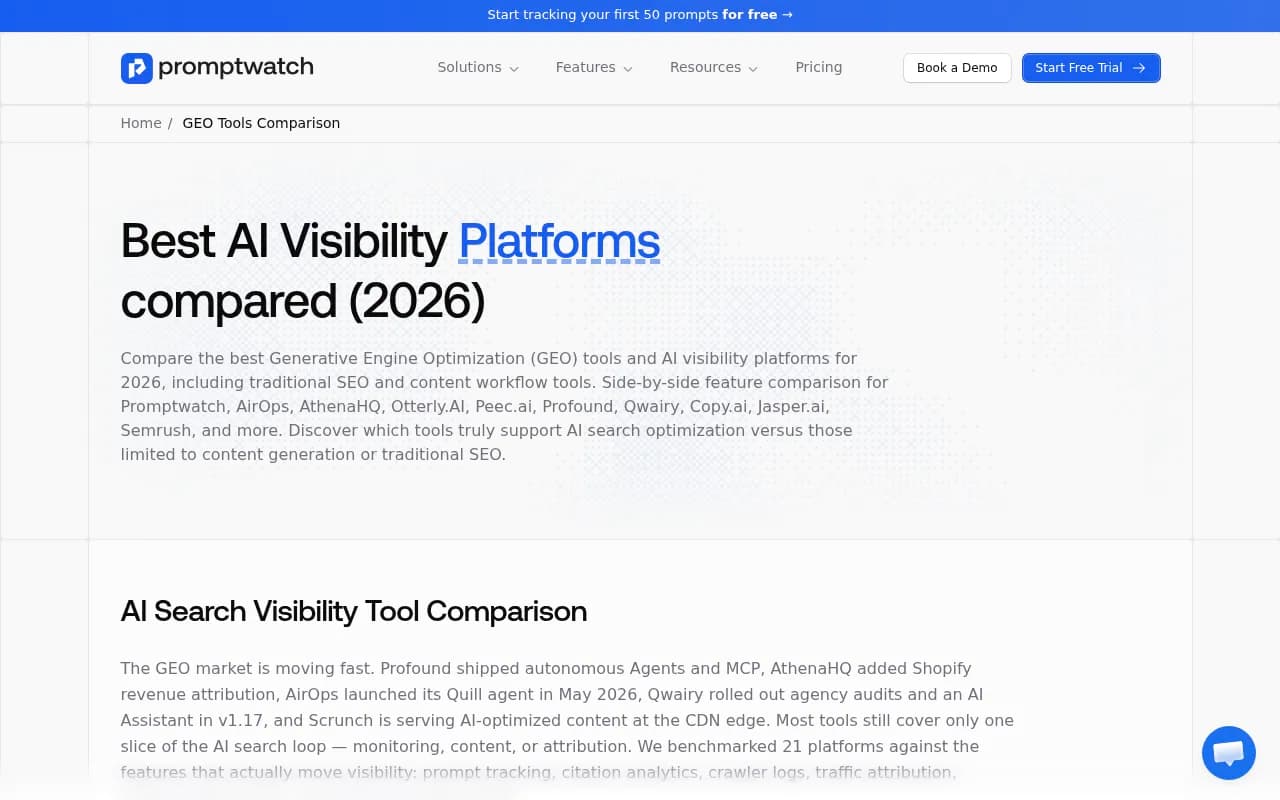
Otterly.AI handles steps one and two reasonably well. Yext and Uberall don't really address this problem at all. Promptwatch is the only platform in this comparison that supports all four steps.
A note on AI search data quality
One thing that often gets overlooked in these comparisons: not all AI visibility data is the same.
Some platforms query AI models through APIs and report on API responses. Others track how AI search engines actually behave in real user interfaces. The difference matters because user-facing answers, citations, and shopping recommendations can differ significantly from API outputs. ChatGPT's web search mode behaves differently than the base API. Perplexity's real-time web results don't always match what you'd get from a direct API call.
Promptwatch tracks real user-interface behavior across 10 AI models, which gives a more accurate picture of what actual users are seeing. This is worth asking about when evaluating any AI visibility platform -- "are you tracking API responses or real UI behavior?" is a question that will quickly separate the serious platforms from the lightweight ones.
Practical recommendations for franchise marketing teams
If you're running marketing for a franchise brand and trying to figure out where to start with AI visibility, here's a practical sequence:
First, audit your listing accuracy. Before worrying about AI citations, make sure your basic data is clean. Wrong hours or addresses will hurt you in both traditional local search and AI-assisted local queries. Yext or Uberall can handle this.
Second, establish a baseline for AI visibility. Run your key category prompts through ChatGPT, Perplexity, and Google AI Overviews manually. See where your brand appears, where competitors appear, and what sources are being cited. This takes about an hour and costs nothing -- but it'll show you whether you have a real problem.
Third, get a proper monitoring setup. Manual checks don't scale. A platform like Promptwatch or Otterly.AI will track this systematically across multiple prompts, multiple engines, and multiple competitors -- and alert you when visibility changes.
Fourth, identify and close content gaps. This is where most franchise brands are leaving the most opportunity on the table. The prompts that AI models answer without citing your brand are the prompts you should be creating content for. Promptwatch's Answer Gap Analysis automates this identification; the Content Agents help you act on it.
Fifth, track the results. AI visibility without attribution is just a vanity metric. Connect your AI visibility improvements to actual traffic and revenue so you can justify the investment and prioritize the right content.
Bottom line
Yext and Uberall are excellent tools for what they were built for: multi-location listing management. They're not AI visibility platforms, and evaluating them as such sets up a false comparison.
Otterly.AI is a legitimate GEO monitoring platform with strong analytics. If you want to understand your AI visibility without needing to act on it immediately, it's a solid choice.
Promptwatch is the only platform here that covers monitoring, gap analysis, content generation, and attribution in one place. For franchise brands that want to actually improve their AI visibility -- not just measure it -- that end-to-end capability is what makes the difference.
The franchise brands that figure out AI search optimization in 2026 will have a significant advantage over those still treating it as a future problem. The tools to do it properly exist now.